
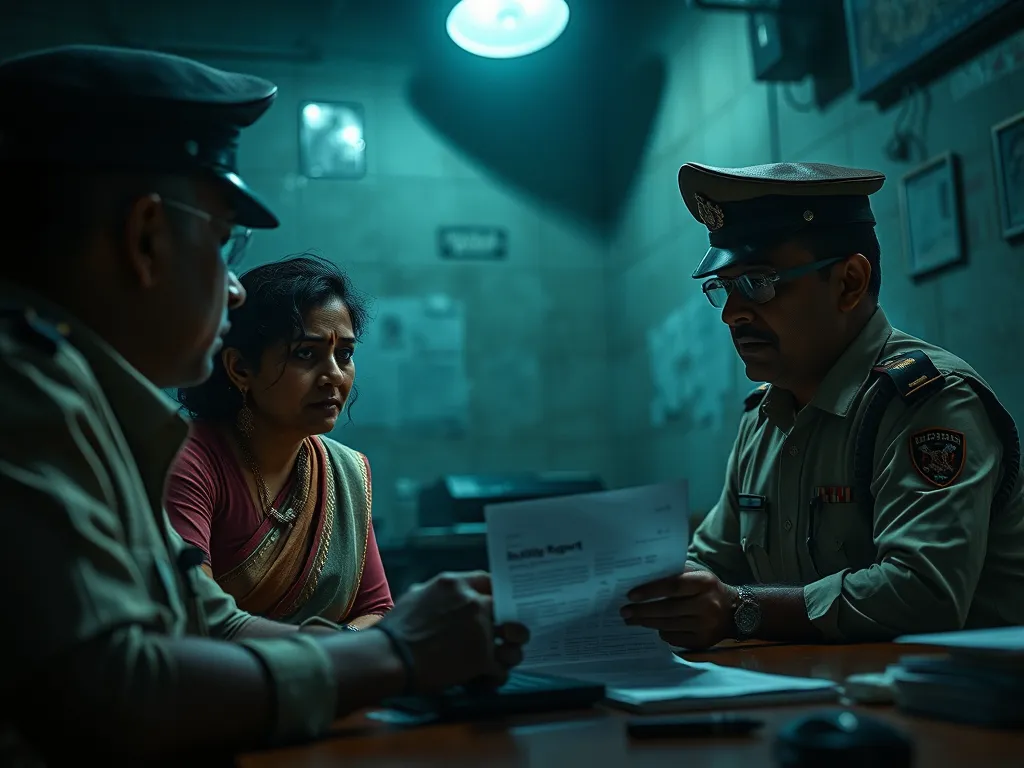
Corruption in Mirzapur Police & Grievance is a gripping narrative that not only highlights how systemic issues within law enforcement create a culture of impunity but also emphasizes the profound implications of these issues. In this story, the police not only overlook grievances but, furthermore, actively manipulate situations to conceal their corrupt activities. As a result, ordinary citizens seeking justice find themselves silenced by bureaucratic indifference and intimidation. Consequently, the intertwining of crime and authority shapes a community in which trust steadily erodes, leaving victims to fight their battles alone. This dark landscape, therefore, underscores the urgent need for reforms and accountability within the Mirzapur Police to restore faith in the justice system.
Here are the key takeaways from the analysis of Mahima Maurya’s grievances against the Mirzapur police:
1. Allegations of Evidence Tampering
The core of the complaint involves the deliberate suppression of medical evidence. The complainant alleges that local police pressured doctors at the CHC Vindhyachal to avoid conducting X-rays on a bone fracture to minimize the legal severity of the assault. Furthermore, the police have reportedly labeled legitimate government hospital reports from Prayagraj as “false.
2. Failure of Oversight Mechanisms (Corruption in Mirzapur Police & Grievance)
A significant “red flag” in this case is the alleged defiance of the Uttar Pradesh Human Rights Commission (UPHRC). Despite an explicit order from the Commission to investigate the matter, the Senior Superintendent of Police (SSP) of Mirzapur reportedly ignored the directive, suggesting a breakdown in the hierarchical accountability of the state’s law enforcement.
3. Demand for Legal Compensation
The grievance invokes a specific 2021 Allahabad High Court mandate regarding illegal detention.
- The Claim: Mahima Maurya is demanding ₹25,000 for the illegal detention of her husband, Pramod Kumar.
- The Law: Under Sections 107/116/151 of the CrPC, if detention is found to be illegal. The state must pay compensation and take disciplinary action against the officer involved. (Corruption in Mirzapur Police & Grievance)
4. Critique of Administrative “Rubber-Stamping”
The complainant highlights a lack of substantive review within the Chief Minister’s Secretariat and senior police offices. Furthermore, she argues that high-ranking officials are merely signing off on documents prepared by subordinates without thoroughly reading the actual contents of the grievance. Consequently, this leads to a cycle of “insensitive” governance.
5. Current Administrative Status (Corruption in Mirzapur Police & Grievance)
Shri Arvind Mohan (Joint Secretary) at the Chief Minister Secretariat in Lucknow is currently addressing the active grievances that is accessible to him to do so. These complaints will serve as a litmus test for whether the state’s grievance portal can effectively check local police corruption.
Corruption in Mirzapur Police & Grievance: The Case of Mahima Maurya vs. Mirzapur Police
The strength of a democracy often measures itself not by grand proclamations, but by the integrity of its smallest administrative units. When the local police apparatus—the very entity that protects the citizenry—faces accusations of becoming an instrument of oppression, the “Rule of Law” risks giving way to a “Rule of Anarchy.
The grievances filed by Mahima Maurya under registration numbers GOVUP/E/2025/0038182, GOVUP/E/2025/0031932, and GOVUP/E/2025/0031937 present a harrowing narrative of alleged corruption, custodial abuse, and institutional apathy; furthermore, this troubling account unfolds within the Mirzapur district of Uttar Pradesh.
The Core Conflict: Allegations of Systemic Corruption
At the heart of this dispute is a fundamental breakdown in the investigative process. Mahima Maurya alleges that the Mirzapur police have actively worked to suppress evidence of physical assault.
Suppression of Medical Evidence
The complainant highlights a discrepancy between the medical findings at the Community Health Centre (CHC) in Vindhyachal and the Tej Bahadur Sapru Hospital in Prayagraj. Despite documented fractures, Maurya alleges that:
- Local Interference: Police allegedly pressured government doctors to forgo X-ray examinations to minimize the recorded severity of injuries.
- Dismissal of Records: When medical reports from a superior government facility in Prayagraj were presented, local authorities summarily dismissed them as “false” rather than conducting a verification.
This represents more than just a procedural lapse; it is an allegation of Circumstantial Evidence of Corruption, where the actions of the police appear designed to “cover the matter under the carpet” to shield specific individuals or interests.
Defiance of Constitutional Oversight
Perhaps the most alarming aspect of these grievances is, indeed, the alleged disregard for higher statutory bodies. Notably, the Uttar Pradesh Human Rights Commission (UPHRC) has reportedly ordered the Senior Superintendent of Police (SSP) to conduct a thorough investigation into the matter.
According to the grievance, this order effectively ended up “in a dustbin.” When local police ignore the directives of a Human Rights Commission, they render the checks and balances intended to protect the vulnerable toothless. This creates a vacuum of accountability where the complainant has no recourse but must petition the Chief Minister directly.
Illegal Detention and the Right to Compensation
A specific and legally significant component of Maurya’s complaint involves the illegal detention of her husband, Pramod Kumar, under Section 151 of the Criminal Procedure Code (CrPC).
The 2021 Allahabad High Court Guidelines
Maurya cites a specific government mandate issued on September 9, 2021, following directives from the Allahabad High Court. These guidelines were established to curb the misuse of preventive detention powers. Key provisions include:
- Mandatory Compensation: A person found to be illegally detained under Sections 107, 116, or 151 is entitled to ₹25,000 in compensation.
- Accountability: Disciplinary action must be initiated against the arresting officer responsible for the illegal detention.
By demanding this compensation, the complainant is not merely seeking financial redress but is attempting to trigger a legal mechanism that forces the state to acknowledge a violation of personal liberty.
The “Rubber Stamp” Bureaucracy
In grievance GOVUP/E/2025/0031932, Maurya touches upon a systemic frustration shared by many citizens: the perceived lack of “perusal” by high-ranking officials.
She critiques a culture where senior officers, instead of thoroughly verifying the contents or directly addressing the specific points raised in the grievance, merely sign off on reports prepared by subordinates. Consequently, this “eyes and ears closed” approach to governance creates a significant barrier between the citizen’s reality and the state’s record. Therefore, the complainant’s question remains poignant: Can such insensitive public staff provide truly good governance?
Summary of Grievance Status
The following table outlines the current administrative standing of these complaints: (Corruption in Mirzapur Police & Grievance)
| Registration Number | Subject Matter | Key Official Involved |
| GOVUP/E/2025/0038182 | Police Corruption & Medical Neglect | Shri Arvind Mohan (Joint Secretary) |
| GOVUP/E/2025/0031932 | Administrative Apathy in CM Office | Chief Minister Secretariat |
| GOVUP/E/2025/0031937 | Demand for ₹25,000 Compensation | Mirzapur Police/SSP |
Conclusion: A Litmus Test for Uttar Pradesh’s Administration
The case of Mahima Maurya is not just an isolated incident of local misconduct; it is a test of the Integrated Grievance Redressal System (IGRS). For the “Rule of Law” to prevail in Mirzapur, the following steps are critically required: (Corruption in Mirzapur Police & Grievance)
- Independent Verification: An inquiry led by an officer outside the Mirzapur district to verify the medical reports from Tej Bahadur Sapru Hospital.
- Human Rights Compliance: Report immediately on why the UPHRC orders police have not implemented.
- Legal Redress: A transparent review of the detention of Pramod Kumar to determine if the ₹25,000 compensation mandate applies.
Justice delayed is justice denied, but justice ignored is an invitation to anarchy. The eyes of the public and the higher judiciary remain on how the Chief Minister’s Secretariat handles these grave allegations of custodial high-handedness.
To assist you in following up on the grievances for Mahima Maurya, here is the structured directory of the concerned public authorities, including their contact numbers, email addresses, and official web links.
1. Primary Oversight Authority: CM Secretariat (Corruption in Mirzapur Police & Grievance)
The grievances are currently forwarded to the Chief Minister’s Secretariat. This is the highest administrative office for grievance redressal in the state.
| Name & Designation | Contact Number | Email Address | Office Address |
| Shri Arvind Mohan (Joint Secretary) | 0522-2226350 / 2226354 | arvind.12574@gov.in | Room No. 321, 3rd Floor, Lok Bhawan, Lucknow |
| CM Office General | 0522-2239234 (Fax) | cmup@nic.in | Lok Bhawan, U.P. Secretariat, Lucknow |
| CM Helpline | 1076 | — | Toll-free 24/7 Helpline |
2. Concerned Executive Authority: Mirzapur Police (Corruption in Mirzapur Police & Grievance)
These are the officers directly responsible for the investigation and the conduct of the local police personnel mentioned in your grievance.
| Designation | Officer Name | Mobile / CUG | Email Address |
| DIG / SSP Mirzapur | Shri Somen Barma | 9454400299 | spmzr-up@nic.in |
| Addl. SP (City) | Shri Nitesh Singh | 9454401104 | asp-city.mi@up.gov.in |
| Addl. SP (Operation) | Shri Manish Mishra | 9454401105 | asp-op.mi@up.gov.in |
| CO City | Shri Vivek Jawla | 9454401590 | co-city.mi@up.gov.in |
3. Web Links & Portals (Corruption in Mirzapur Police & Grievance)
You can use these links to track the status of your applications or file additional reminders:
- Jansunwai (IGRS) Portal:jansunwai.up.nic.in
- Use this to track registration numbers GOVUP/E/2025/0038182, 0031932, and 0031937.
- UP Police Official Directory: uppolice.gov.in
- UP Human Rights Commission (UPHRC): uphrc.up.nic.in
4. Summary of Application Details (Corruption in Mirzapur Police & Grievance)
- Complainant: Mahima Maurya
- Primary Application IDs: *
GOVUP/E/2025/0038182(Police Corruption/Medical Neglect)GOVUP/E/2025/0031937(Claim for ₹25,000 Compensation)GOVUP/E/2025/0031932(Administrative Apathy)
Recommended Next Step (Corruption in Mirzapur Police & Grievance)
Since your matter involves a ** fracture** and illegal detention, you may want to send a formal email to arvind.12574@gov.in (Joint Secretary) with the subject line: “URGENT: Reminder for Grievance GOVUP/E/2025/0038182 regarding Police Corruption and Compensation.” Would you like me to draft a concise email template for you to send to the Joint Secretary?


Facing a similar challenge? Share the details in the box below, and our team of experts will do their best to help.