
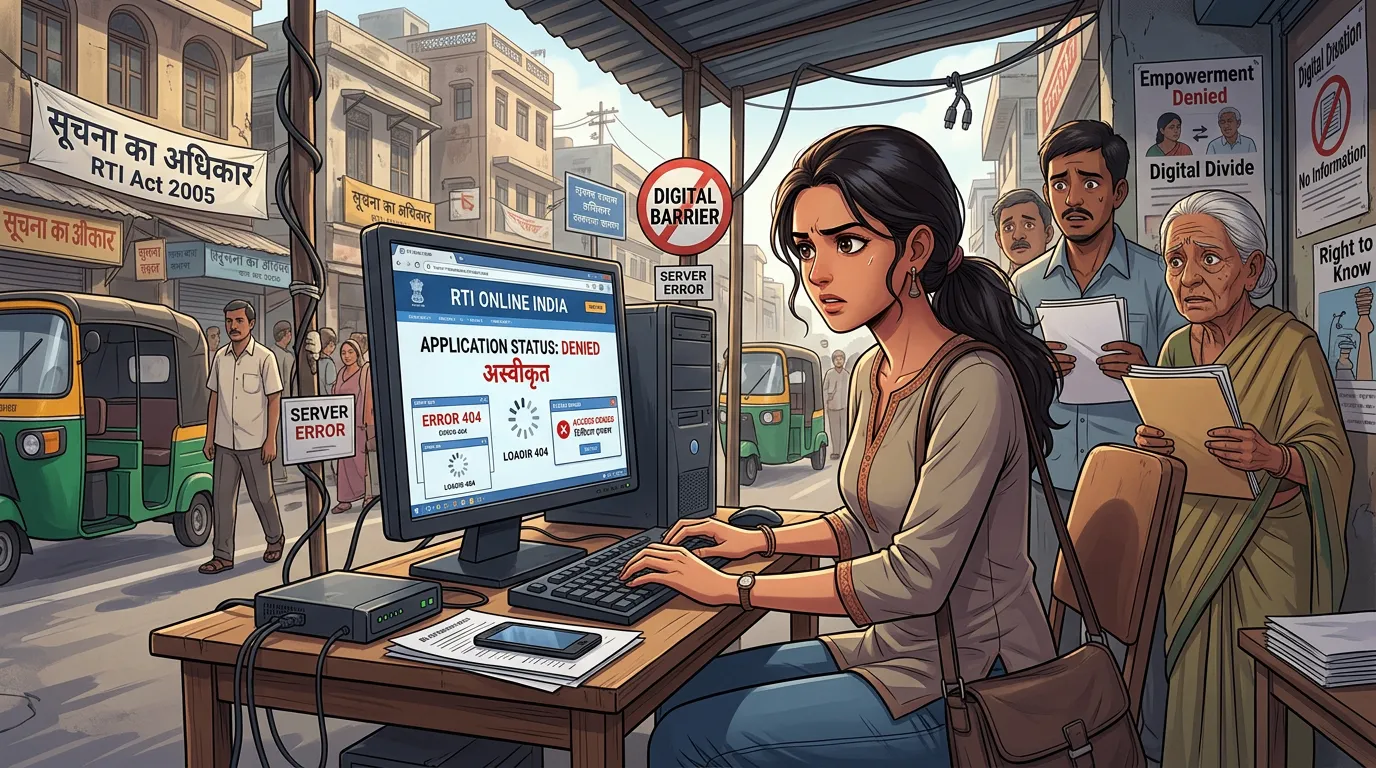
Explore the issues surrounding digital denial to the Right to Information and its impact on citizen empowerment in India. In an era where information is pivotal to democracy, the denial of digital access severely undermines the fundamental right to obtain information from public authorities. The barriers faced by citizens, including technological disparities, lack of digital literacy, and inadequate infrastructure, exacerbate the challenges of accessing critical information. This digital divide not only restricts accountability but also stifles citizen engagement in governance, leaving many vulnerable groups without the necessary tools to advocate for their rights. Consequently, addressing these issues is vital for fostering an informed citizenry that can actively participate in the democratic process and hold power to account, ultimately leading to stronger and more transparent governance in India.
Key Takeaways
- Digital denial to Right to Information hampers citizen empowerment in India by limiting access to crucial information.
- The UP RTI portal experiences severe technical issues, including failed OTP delivery and frequent server crashes.
- Government officials often dismiss technical failures, causing frustration and hindering accountability.
- These failures disproportionately affect marginalized citizens, preventing their engagement in democratic processes.
- Immediate technical audits and clearer grievance processes are essential to restore public trust and ensure accountability.
Digital Denial to Right to Information: How Technical Failures on the UP RTI Portal Sabotage Transparency
The Right to Information (RTI) Act of 2005 transformed Indian democracy. Consequently, Parliament enacted it to empower citizens and promote absolute transparency. Furthermore, it holds the government accountable for its actions and expenditures. To facilitate this, state governments across India launched online portals. These platforms promised a seamless, paperless e-governance experience. Additionally, they aimed to bring information power directly to the common man.
However, citizens in Uttar Pradesh face a deeply frustrating battle. Currently, they struggle to exercise this fundamental right. Specifically, applicants fight against poorly maintained digital infrastructure and bureaucratic apathy. A statutory government portal ceases to be a mere technical glitch when it fails consistently. Ultimately, it becomes an impenetrable digital wall. Therefore, this effectively acts as a complete digital denial to Right to Information.
This article provides an evidence-based look at the UP RTI Online Portal. Unfortunately, severe, recurring issues plague this system. We see an alarming history of key departments evading digital integration. Moreover, we witness a disturbing lack of accountability during official grievance handling.
A Portal Paralyzed: Roadblocks Causing Digital Denial to Right to Information
Filing an RTI application online in Uttar Pradesh requires immense patience. In fact, applicants need technological persistence and a great deal of luck. Two major technical roadblocks confront citizens attempting to use the portal. These flaws completely halt the statutory application process. Ultimately, they constitute a direct digital denial to Right to Information.
1. The OTP Blackhole: The portal mandates mobile-based authentication via a One-Time Password. Initially, this standard security measure aims to verify the applicant’s identity. However, the system frequently fails to deliver the OTP entirely. Users experience this even after multiple attempts spanning several hours. Consequently, this missing OTP arbitrarily locks citizens out of their accounts. This SMS gateway failure arbitrarily strips citizens of their legal recourse. For instance, they might miss the strict 30-day statutory appeal window. We cannot trust a portal to uphold transparency without reliable messaging.
2. Complete Server Unresponsiveness and ERR_TIMED_OUT: A user might miraculously manage to bypass the OTP authentication hurdle. Even then, the internal site architecture remains agonizingly sluggish. Recent documented attempts highlight this fatal networking flaw perfectly. Shockingly, opening the RTI application folder took a staggering 20 minutes.
Frequently, the portal crashes entirely before loading anything on the screen. Web browsers repeatedly return a fatal ERR_TIMED_OUT error. Specifically, this error code has a very clear technical meaning. The browser sent a request to the UP RTI servers. However, the server failed to respond within an acceptable timeframe. The server ultimately dropped the active connection. Undeniably, this indicates severe server capacity issues or poor database optimization. It might also point to outright infrastructure failure at the host.
Irrefutable Evidence: Diagnostics Proving Digital Denial to Right to Information
Government helpdesks often default to a standard script for connectivity issues. Typically, they blame the user’s local internet connection. However, meticulous technical data completely debunks this convenient excuse. This data proves that the digital denial originates from state servers.
First, I rigorously recorded evidence in GrievanceDocument.pdf. Next, I conducted comprehensive internet speed and network diagnostic tests. These tests ran between August 3 and August 16, 2026. Conclusively, this data proves a vital point regarding the failure. The fault rests squarely on the state infrastructure, not citizen hardware.
My JioFiber Postpaid connection yielded robust baseline metrics during these diagnostics. Here are the specific speed test results:
- August 03 (7:33 PM): 28.21 Mbps Download, 17 ms Latency.
- August 06 (1:39 PM): 30.02 Mbps Download, 52 ms Latency.
- August 08 (6:47 AM): 23.72 Mbps Download, 62 ms Latency.
- August 16 (8:48 PM): 16.76 Mbps Download, 74 ms Latency.
Furthermore, I showed extreme diligence by lodging a parallel telecom grievance. Specifically, I contacted Reliance Jio Infocomm Limited to investigate ISP fluctuations. Jio registered this grievance under DOTEL/E/2026/0052586 on August 17, 2026.
The diagnostic data remains absolute and unequivocal. Indeed, this connection streams high-definition video with negligible packet loss. It maintains latency as low as 17 milliseconds reliably. Therefore, it easily loads a basic HTML web form. A collapsed, neglected server infrastructure causes the ERR_TIMED_OUT browser errors. Consequently, the UP Government must take responsibility for 20-minute loading times.
A Historical Pattern of Evasion: UPHRC and NIC-UP
We cannot view current server crashes and OTP failures in isolation. Rather, they form part of a broader, deeply concerning historical pattern. Key technological and human rights bodies actively evade seamless integration. Instead, they avoid joining the state online transparency infrastructure entirely.
I extensively documented this evasion on yogi.systems in late 2024. Back then, transparency advocates faced immense challenges filing online RTIs. These RTIs concerned the Uttar Pradesh Human Rights Commission. Additionally, they targeted the National Informatics Centre, Uttar Pradesh itself. These organizations represent highly critical governance institutions. Yet, significant hurdles blocked their accessibility on the centralized portal.
The irony regarding this situation remains incredibly profound. After all, NIC-UP hosts and optimizes the state digital e-governance infrastructure. These digital custodians have their own documented history of transparency evasion. Consequently, citizens struggle to access them via digital transparency tools. This raises serious questions about their institutional commitment to the Act. For example, departments went missing from the portal in 2024. Then, servers collapsed completely in 2026. Ultimately, this transition suggests a systemic culture tolerating opacity. It heavily paves the way for current digital denial to Right to Information.
The “Server Down” Alibi: Bureaucratic Apathy Fuels Digital Denial to Right to Information
I documented these persistent, large-scale technical failures thoroughly. Subsequently, I escalated them through the Centralized Public Grievance Redress and Monitoring System (CPGRAMS). Sadly, the response from the authorities remains deeply concerning.
Recently, I filed a detailed grievance numbered GOVUP/E/2026/0105488. Officials arbitrarily closed this official complaint on September 7, 2026. Prior to this, I explicitly explained the issue over a phone call. I stated that the portal takes 20 minutes to open folders. Despite this, the closure remark offered a shockingly dismissive excuse:
“सर्वर डाउन होने के कारण कभी कभी पोर्टल पर आवेदन करने एवं OTP प्राप्त करने में तकनीकी समस्या आ सकती है जो कि सिर्फ कुछ समय के लिए होती है… तकनीकी समस्या आने पर कुछ समय बाद पोर्टल पर पुनः आवेदन करने के लिए कहा गया”
Advising a citizen to simply “try again later” is wholly unacceptable. Clearly, government bodies managing critical infrastructure must do significantly better. The RTI portal represents a statutory facility, not a beta-testing playground. Moreover, this e-governance system repeatedly times out under load. It fails to deliver authentication tokens across multiple days and sessions. Therefore, we absolutely cannot call this a “short time” issue. This catastrophic failure requires a rigorous, independent technical audit. Instead, generic administrative brush-offs artificially inflate grievance resolution statistics.
The Transparency Paradox: Ghost Officers Driving Digital Denial to Right to Information
The sheer lack of transparency forms the most alarming ordeal aspect. Ironically, a portal dedicated to transparency mishandles its own official complaints. Officials appear to deliberately design grievance closures to obfuscate true responsibility. Effectively, they use it to shield themselves from public scrutiny.
Evading Accountability: The irresponsible closure comment originally appeared anonymously on the portal. Shockingly, it entirely lacked the designation of the deciding staff member. This practice shields incompetent officials behind the web interface anonymity. However, I applied persistent pressure to uncover the hidden truth. Finally, I determined that Shri Bhaskar Chandra Kandpal authorized the closure.
The Broken Chain of Custody: Officials route CPGRAMS grievances to the Chief Minister Office. Then, they must forward these to the state Jan Sunwai portal. However, the closure report completely omitted the mandatory Jan Sunwai number.
This deliberate omission remains highly critical for state accountability. Basically, the lack of a Jan Sunwai reference leaves citizens blind. It makes tracking internal file movement completely impossible. As a result, citizens cannot escalate the issue further internally. They cannot determine which specific sub-department arbitrarily closed the active complaint. Consequently, this deliberate tracking break leaves citizens running in frustrating circles. Ultimately, they end up fighting a phantom, unaccountable bureaucracy.
The Broader Impact: Disenfranchising the Public
Consider my unique situation as a technologically literate citizen. Usually, I use high-speed JioFiber and advanced network diagnostic tools. I have the extreme persistence to file parallel telecom grievances. Also, I document historical institutional lapses on transparency platforms. Yet, I cannot successfully navigate the UP RTI portal interface. Given this, what realistic hope does a marginalized citizen have?
Consider a farmer relying on a spotty mobile data connection. Suppose this farmer seeks information about a misappropriated local fund. They might hit an ERR_TIMED_OUT wall or fail OTP verification. Consequently, the applicant will assume their mobile phone is broken entirely. Many might erroneously believe the system is too complex for them. Indeed, this digital denial to Right to Information acts ruthlessly. It silently disenfranchises the very people the Act aims to empower.
The Way Forward: Demanding Real Technical Solutions
The UP RTI portal suffers from severe, continued instability. Furthermore, bodies like NIC-UP show reluctance to embrace digital transparency. This dangerous combination represents a massive, systemic governance failure. Effectively, it enforces a de facto digital denial to Right to Information. Therefore, the government must stop using convenient “server down” excuses. Instead, officials must take immediate, specialized, and highly technical corrective action.
The government must take these steps to restore public trust:
- Direct Technical Intervention: The CMO must stop routing grievances to administrative bureaucrats. Instead, the government must escalate issues to the State Informatics Officer. They act as the actual technical custodians of the entire portal.
- Comprehensive Infrastructure Audit: NIC-UP must publish a full technical audit immediately. Crucially, this audit must cover server load balancing and database optimization. This will identify and rectify the prolonged loading times and failures.
- Mandatory Transparency in Grievances: Officials must stop closing technical complaints with generic remarks. Moreover, departments must clearly identify responsible, deciding officers by name. They must mandatorily provide Jan Sunwai tracking numbers in closure reports. Ultimately, this specific action maintains a clear, unbreakable accountability chain.
Citizens should not engage in grueling battles against broken websites. Truly, demanding basic transparency from government should not be this difficult. The state must urgently fix the UP RTI portal and servers. Only then can it fulfill the legal transparency promise.rom their government should not be this difficult. The state must fix the UP RTI portal and upgrade its servers. Only then can it fulfill the legal promise of the Right to Information Act.


Facing a similar challenge? Share the details in the box below, and our team of experts will do their best to help.