
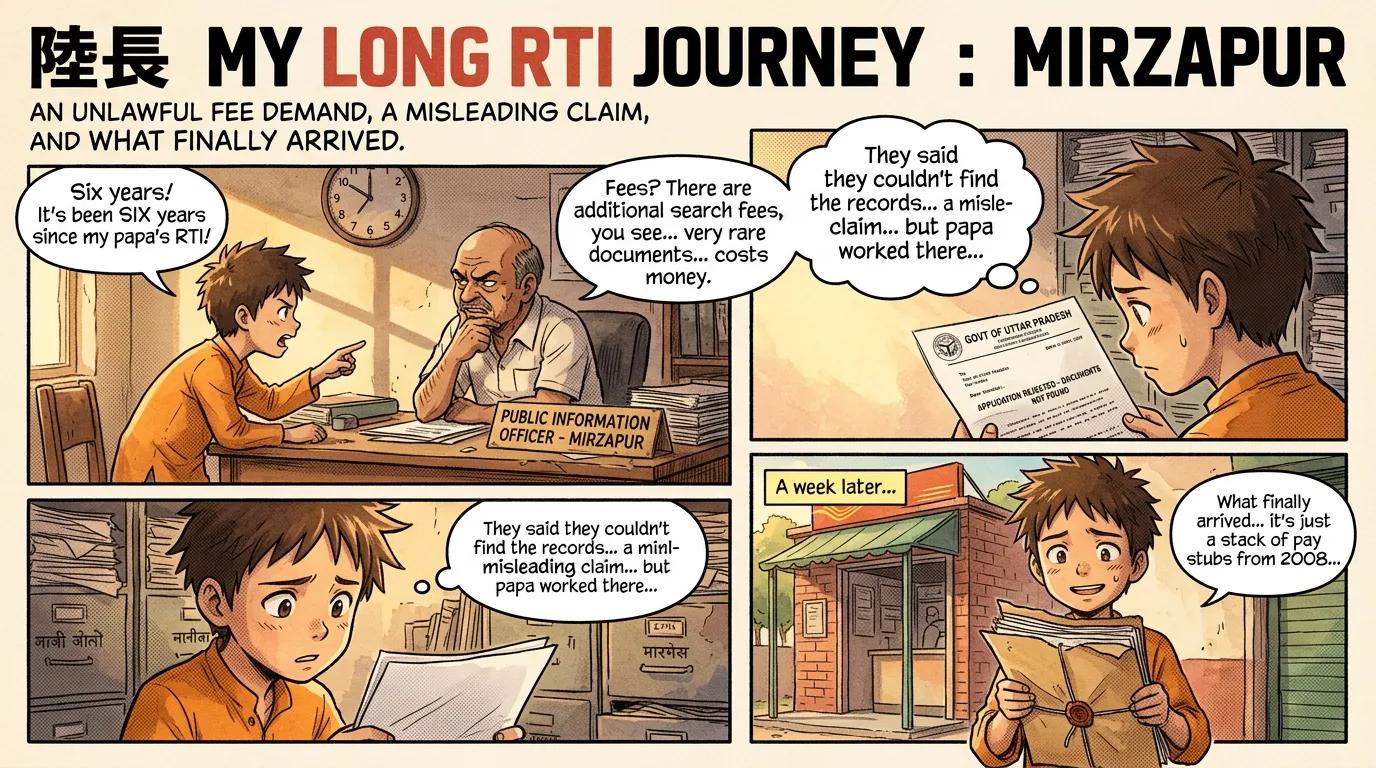
A first-hand account of a six-year RTI application delay in Mirzapur — an unlawful fee demand, a misleading claim, and what finally arrived after endless frustrations and bureaucratic hurdles. Throughout this lengthy ordeal, the applicant faced numerous challenges, including constant denials of information, which only fueled their determination to seek transparency. The fee demanded was not only exorbitant but also entirely unjustified, reflecting a shocking lack of adherence to legal protocols. Misleading claims about the status of the RTI application further exacerbated the situation, leaving the applicant in a state of confusion and disillusionment. Ultimately, after years of persistence and navigating through red tape, the long-awaited information finally arrived, shedding light on the systemic issues within the local administration and highlighting the importance of accountability in governance.
Key Takeaways
- The author experienced an RTI application delay lasting over six years for information on local development works.
- Despite following the RTI Act, the request faced misdirection and unresponsiveness from officials.
- Only a fraction of the requested information was eventually received, lacking sufficient detail to verify expenditure.
- The article highlights systemic accountability gaps in RTI governance and the challenges faced by ordinary applicants.
- Readers are encouraged to file RTI applications properly and keep detailed records to navigate potential delays.
YOGI · HUMAN RIGHTS DEFENDERCASE FILE · A-20241100325
RTI Act, 2005 · Field Report
I asked Mirzapur’s municipal office a simple question about how it spent public money on my neighbourhood. However, what followed was a six-year RTI application delay. Along the way, I encountered an unlawful fee demand and subsequently had to file a formal appeal. Even then, I received back only a quarter of what I’d asked for.
6+
years from request to reply
1/5
questions actually answered
₹1.34cr
in works the reply covered
The Right to Information Act, 2005 grants every Indian citizen a straightforward power; specifically, one can ask any government office a question in writing and pay a nominal fee. By law, the office is obligated to respond within thirty days. Consequently, it stands as one of the few instruments ordinary individuals possess to observe how the government allocates public funds. This leads to the narrative of my own experience with RTI application delays. Here, I will share what transpired when I endeavored to utilize that power, along with the duration it ultimately took.
What I actually asked for
In November 2019, I filed an RTI application with Mirzapur’s local authorities. Specifically, I asked for records pertaining to development works in my own neighbourhood, Sangamohal Ward. These include the drains, roads, toilets, and small repairs that ward funds are meant to pay for. Additionally, I requested five specific things.
I wanted the cost estimates drawn up before each scheme began. Furthermore, I wanted the work booklets that recorded what the contractors actually built. Additionally, I wanted the invoices that the Municipality paid. Moreover, I wanted a scheme-by-scheme account of the funds it granted. Finally, I wanted the names of the officials who inspected the work and cleared the payments.
None of this is unusual. It is the basic paper trail any local government should be able to produce on request. It is proof that a drain marked for money actually got built. What followed was a six-year RTI application delay before I saw any of it.
Where my RTI application delay began
My application reached the wrong desk; however, Section 6(3) of the RTI Act sets a clear rule. Specifically, an office that receives a request it can’t answer has five days to forward it to the appropriate one. Thus, that is the whole rule — five days.
What actually happened
I filed my application on 25 November 2019. However, officials did not pass it on to the Municipality — the office that actually held the records — until 12 August 2024. Consequently, five days had turned into nearly five years. Notably, this single gap accounts for most of my RTI application delay. Interestingly, I’ve seen the same pattern in other Mirzapur cases, including one where a transferred request was later closed as “disposed”.
The hearing, and an apology
Because the Municipality still wasn’t answering, the matter went to a second appeal before the Uttar Pradesh Information Commission — case S09/A/2174/2024. At one hearing in early 2025, frustration at the years of delay came through in my tone. I was pressing the point about the District Magistrate’s office at the time.
The presiding officer wasn’t satisfied with the apology I offered on the spot. She told me to submit one in writing instead.
I did. On 5 February 2025, I sent a formal, unconditional written apology to the Commission, as directed. I include this not to skip past it; rather, an honest account necessitates it. Furthermore, pushing for a public record can cost you something too. In fact, even the real problem here — years of silence on a plain request — was never in doubt.
Then they made an RTI fee demand
Eight months later, on 13 October 2025, the Public Information Officer’s own office wrote to say the information still wasn’t ready. It made an RTI fee demand, asking me to pay before it would even prepare the reply. Letter No. 166/2025-26.
The law on this point
Section 7(6) of the RTI Act is clear. Once a public authority misses its 30-day deadline, the rule is simple. It must hand over the information free of charge — no fee, no exceptions.
By October 2025, this request was nearly six years overdue. Consequently, a fee demand at that stage isn’t merely a paperwork slip; rather, it represents yet another obstacle obstructing a request that the law has already mandated the office to address free of charge. Furthermore, I’ve documented a similar breakdown of the 30-day response deadline elsewhere in Uttar Pradesh.
Three days later, at the hearing on 16 October 2025, the Public Information Officer told the Commission the information had already gone out by registered post. That claim contradicted the officer’s own letter from three days earlier. That letter had admitted the reply wasn’t ready yet.
What finally arrived, after the RTI application delay
I raised all of this formally with the Commission. I filed a written objection on 24 December 2025, then another on 23 February 2026. Both asked the Commission to make the PIO hand over the documents at once, free of cost. Both also asked it to punish the delay and the misleading statement under Section 20(1) of the Act.
On 20–23 February 2026, something did arrive. The Municipality’s Public Works office sent a two-page list of 16 works in Sangamohal Ward, each with a rupee figure attached. It forwarded that list to me by speed post. Here is how it measures against what I originally asked for, five years earlier.
| What I asked for | What I received |
|---|---|
| Cost estimates for each scheme | Not provided |
| Work booklets | Not provided |
| Invoices | Not provided |
| Fund granted, scheme by scheme | Partial — a bare list of 16 works and amounts, no supporting detail |
| Staff responsible for inspection & payment | Not provided |
The list itself covers real money: sixteen works totalling ₹1,34,20,843. The single largest item is drain-covering near a jewellery store, at ₹30,83,979. Smaller items range from a two-seater public toilet in Katra Kotwali (₹3,27,474) to restoring an old well for water recharge in Chhoti Mirzapur (₹9,01,549).
What the list leaves out matters more. It gives no way to check whether the money was actually spent as claimed. There are no estimates to compare against, no invoices, and no record of who signed off on the work.
Case Disposed · 23.02.2026
The Municipality wrote to the Commission asking it to close the case. The Commission did, recording it simply as “final order passed and case disposed of.” Four of my five original questions remain unanswered on the face of the record. The case is closed. The paper trail is not.
Why this RTI application delay matters
This isn’t a story about one municipality or one file. It is what “transparency” looks like in practice when nobody is watching closely. The law here has real teeth: a five-day transfer rule, a free-information penalty for delay, a punishment clause for misconduct. Even so, ordinary friction wore it down. Six years produced a two-page summary instead of a paper trail.
The RTI Act still worked, in the end. A second appeal forced something into the open, in the narrow sense that matters. But “eventually, partially, after an appeal and an apology” is not what a thirty-day law is supposed to mean. This isn’t an isolated glitch, either. It fits a wider pattern of systemic accountability gaps in RTI governance across Uttar Pradesh. Ask what a Right to Information Act delay like this really costs an ordinary applicant. Count the time, the second hearings, the written apology. The honest answer is more than it should be. This request was ordinary: spending records for road and drain works in one ward. If it happened to that, it can happen to yours too.
If you want to try this yourself
- Any citizen can file an RTI application with any government office. Address it in writing to that office’s Public Information Officer. Keep the request short and specific, and include the prescribed fee (many offices waive this for applicants below the poverty line).
- The office has 30 days to reply. If it doesn’t hold the information, it must forward your request to the right office within 5 days (Section 6(3)). Note the date you filed, so you can hold it to that.
- No response, a refusal, or a fee demand after the deadline: each gives you grounds for a first appeal to that department’s senior officer. If the first appeal doesn’t fix it, file a second appeal with your State Information Commission.
- Keep every letter, reference number, and date. It is tedious, and it is exactly what eventually moved this case.
Case Reference
- Original RTI application — Reg. No. DOUDV/R/2019/60044, filed 25/11/2019
- Transfer to District Magistrate’s Office, Mirzapur — Reg. No. DMOMR/R/2024/80016, 12/08/2024
- Second Appeal, UP State Information Commission — No. S09/A/2174/2024 (Reg. A-20241100325), Court Room S-9, Lucknow
- Fee-demand letter — Nagar Palika Parishad, Mirzapur, No. 166/2025-26, 13/10/2025
- Written objections to the Commission — 24/12/2025 and 23/02/2026
- Public Works Dept. reply — No. 273/Sa.Ni.Vi./2025-26, 20/02/2026; forwarded under No. 437/J.Su.A./2025-26, 21/02/2026
- Case status: disposed, 23/02/2026
◆


Facing a similar challenge? Share the details in the box below, and our team of experts will do their best to help.