
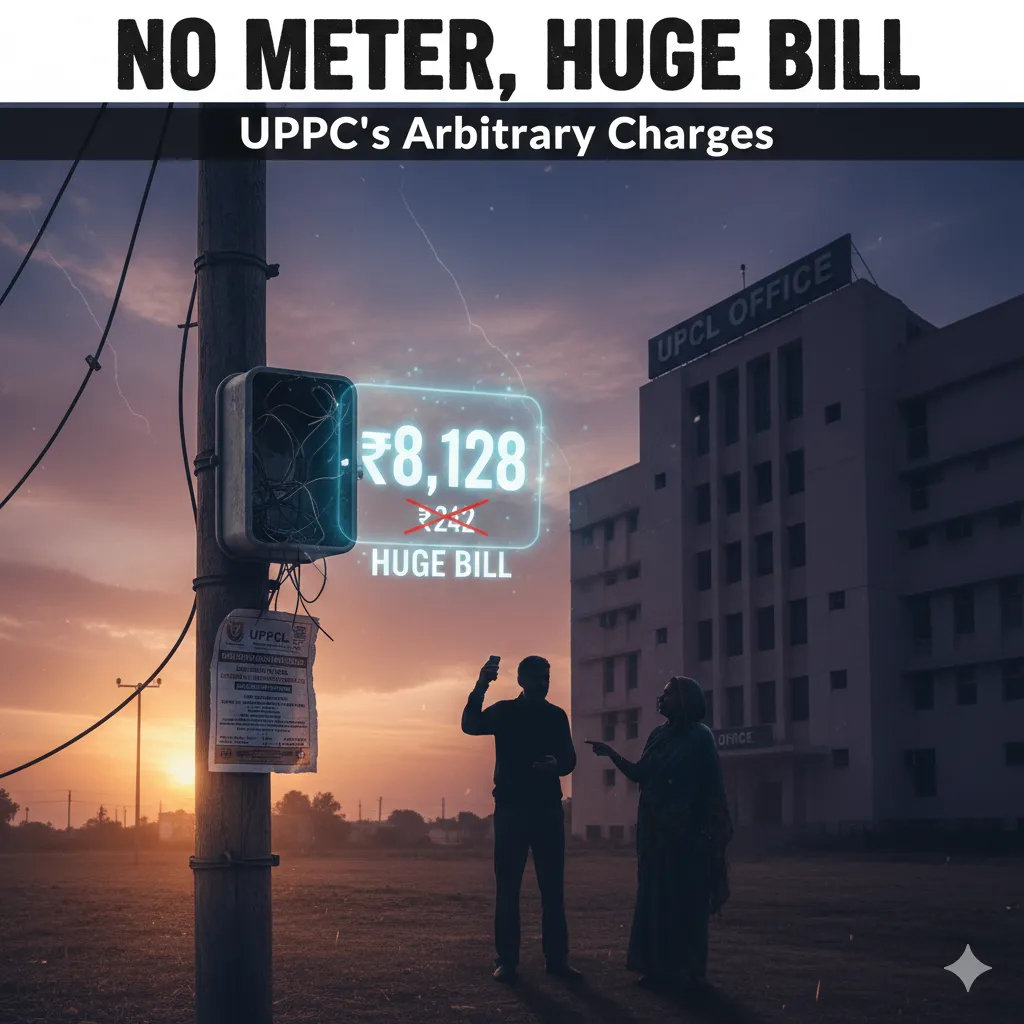
The blog post highlights a systemic failure within the electricity department, where administrative negligence is masked by procedural delays. No installation of metres even after repeated requests by the consumers..
Below are the key takeaways: (No installation of metres)
Summary of Key Issues: Electricity Billing Irregularities and Administrative Failure
This analysis highlights severe administrative and billing failures by the electricity department concerning a domestic consumer. No installation of metres. Unjustified Billing and Official Contradiction
- Gross Billing Spike: The consumer’s bill inexplicably jumped from ₹242 to ₹8,128—a surge of over 3300%—despite no change in consumption patterns.
- Absence of Meter Confirmed: Official departmental reports confirm that no electricity meter is installed at the premises. This admission legally and technically invalidates the high consumption-based bill.
- No installation of metres
Illegal “Demand”: Despite confirming the lack of a meter, the department continues to treat the ₹8,128 as a valid “Demand Category” charge, which directly violates the UP Electricity Supply Code 2005 requiring bills to be based on actual meter readings.
Administrative Obstruction and Grievance Failure (No installation of metres)
- Unlawful Preconditions: The Subdivisional Officer (SDO) committed a “Deficiency in Service” by refusing to correct the erroneous bill unless the consumer agreed to a separate administrative task: the installation of a smart meter.
- Redressal System Failure: The IGRS (Jansunwai) grievance system proved ineffective. Complaints were repeatedly “closed” with only “paper-only” promises of future corrections, leaving the consumer under the immediate threat of disconnection for the illegal debt.
- Escalation for Accountability: To bypass this cycle of administrative apathy, the complainant filed a formal RTI (Registration No. PUVNL/R/2026/60068). This strategic legal shift aims to force the department to provide the official justification for billing a consumer without a recording device.
- Administrative Delay: The process of simply requesting a meter installation was delayed by nearly a month, highlighting institutional apathy.
No installation of metres: A Case Study in Departmental Accountability and Consumer Rights
In the landscape of public utility services in Uttar Pradesh, the transition toward modernized infrastructure often leaves the common citizen caught in a web of administrative apathy and systemic errors. No installation of metres. For example, the recent case of Ms. Kalawati Devi (Account No. 8596072000) serves as a stark illustration. Specifically, a lack of transparency and a refusal to acknowledge departmental failures led to severe financial harassment for her.
The Core Issue: Anatomy of an Arbitrary Bill (No installation of metres)
The grievance began with a staggering disparity in electricity billing. For example, a household maintained a consistent and modest consumption pattern. This was evidenced by a payment of ₹242.00 as recently as September 2025. However, the sudden bill for ₹8,128.00 in October 2025 represents an increase of over 3300%.
Clearly, this is more than just a clerical oversight; instead, it is a prima facie case of “Arbitrary Billing.” In fact, such a spike is mathematically improbable for a domestic consumer. This is true unless there is a massive leak, a faulty meter, No installation of metres, or, ultimately, a total absence of functional metering equipment.
The Departmental Admission: Billing Without a Meter
The most critical turning point in this case came from the department’s own official disposal reports. Specifically, in response to IGRS Complaint No. 60000250241115, the Executive Engineer of the Electricity Distribution Division II, Mirzapur, admitted in writing that no meter is currently installed at the premises. No installation of metres
Consequently, this admission creates a legal and ethical paradox:
- The Legal Paradox: Furthermore, under the UP Electricity Supply Code 2005, billing must be based on actual consumption recorded by a meter. Generating a bill of ₹8,128 without a meter, therefore, directly violates these statutory norms.
The Ethical Paradox: Despite admitting they have no way to measure consumption, the department has categorized the grievance under the “Demand Category.” Thus, they effectively uphold the erroneous bill as a valid debt while the consumer waits for a resolution that may take months.
Dereliction of Duty and Unlawful Preconditions (No installation of metres)
When the consumer sought redressal, however, the response from the Subdivisional Officer (SDO) of Chhanabe was not one of assistance, but of coercion. Specifically, the SDO reportedly refused to correct the bill No installation of metres unless the consumer agreed to the installation of a new smart meter.
This action clearly constitutes a “Deficiency in Service” under the Consumer Protection Act 2019. Therefore, administrative tasks, such as upgrading to smart meters, must remain separate from the correction of billing errors. Consequently, linking a citizen’s right to a fair bill to an unrelated administrative process is an abuse of authority.
The Cycle of Ineffective Grievance Redressal (No installation of metres)
The IGRS (Jansunwai) portal aims to provide swift justice. However, in this case, the authorities used the system to “close” complaints without delivering actual relief.
- First Closure (November 2025): The department promised to resolve the issue one month after the department installs the metre.
- Second Closure (December 2025): They again closed the grievance. Specifically, the remark stated that the matter falls under the “Demand Category.” This essentially told the consumer that the incorrect bill stands until the department decides otherwise.
This “paper-only” resolution strategy effectively ignores the prayer for relief. For example, the relief requested included the suspension of the disputed bill. This was critical to prevent the threat of disconnection.
Strategic Shift: From Grievance to Legal Inquiry (RTI)
Recognising that standard grievance channels were stalling, we made a strategic shift on January 18, 2026. The responsible officers delayed the process by not installing metres. Thus, we filed a formal Right to Information (RTI) application (Registration No. PUVNL/R/2026/60068).
The RTI application focuses on exposing the structural flaws in the department’s logic. Specifically, it asks:
- What is the legal basis for maintaining a “Demand” on a connection with no meter?
- What are the fixed timelines for meter installation as per the Citizen Charter?
- What disciplinary actions do authorities take against officials who fail to follow the Electricity Supply Code?
The complainant directed this RTI to the same Executive Engineer who signed the disposal reports. Consequently, the officer must now provide the legal authority for his actions. He faces the penalty provisions of the RTI Act if he fails to respond.
Conclusion: The Path Forward for Consumer Justice
Ms. Kalawati Devi’s case reminds us that the “Right to Service” is a pillar of democracy. When a public utility, like Purvanchal Vidyut Vitran Nigam Ltd (PUVNL), provides inaccurate billing, it erodes public trust. Hiding behind procedural delays exacerbates this erosion. No installation of metres.
Therefore, the consumer’s path to justice now relies on three pillars:
- Accountability: Hold the SDO and EE responsible for delaying meter installation and issuing a baseless bill.
- Transparency: Use the RTI Act to compel the disclosure of the “Standard Operating Procedures” the department ignored.
- Correction: Insist that the authorities immediately revise the bill. It should be set to an average consumption rate (₹242). This should remain until a functional meter provides 30 days of verified data.
This case’s resolution will set a precedent for thousands of other consumers in Uttar Pradesh facing similar arbitrary demands. In essence, it is a battle for the rule of law over administrative whim.
The UP Electricity Supply Code 2005 provides the legal framework. Consequently, issuing arbitrary electricity bills while failing to install meters cannot be legally or ethically justified.
The evidence in your case highlights a significant gap between the department’s public claims and the documented reality.
The Contradiction: Public Claims vs. Official Records
The department often claims consumers resist meter installation. However, the records in your case prove otherwise:
- Official Admission: “The Executive Engineer explicitly admitted in the disposal report for IGRS No. 60000250241115 that UPPCL never installed a meter at Ms. Kalawati Devi’s premises.
- Proactive Requests: Since 09/10/2025, your grievance filings legally record the consumer’s active request for a meter. The filings also seek the correction of a ₹8,128 bill issued without any recording device.
No installation of metres
Administrative Delay: The records reveal that the department delayed the process for a full month. They took a full month. The process started from your first complaint in October. They sent a letter in November to begin the meter testing.
Why These Bills Lack Legal Justification
Under the UP Electricity Supply Code 2005, the department’s actions violate several core principles.
- Mandatory Metering: The Code mandates that a connection must be billed only with a meter. For instance, generating a bill of ₹8,128 (a 3300% increase from the previous ₹242) without a meter reading is a “prima facie” error. No installation of metres.
Basis of Demand: The department categorized this as a “Demand Category” issue in its latest report. However, a financial demand is only legally enforceable if it is based on actual consumption. Alternatively, it must be based on a verified “average” calculation used during a temporary meter failure. It cannot be used as a permanent billing method.
- Unlawful Preconditions: The SDO’s refusal to correct the bill until a smart meter is installed is an abuse of power. The right to a correct bill is independent of the department’s administrative timeline for equipment upgrades.
The Role of the Recent RTI
Your newly filed RTI (PUVNL/R/2026/60068) is designed to expose this contradiction. By asking for the “legal provisions that allow the department to maintain a financial demand… when records confirm no meter was present,” you are forcing the PIO to admit there is no such legal justification. No installation of metres
Strategic Analysis of the Department’s Strategy
The department appears to be using a “Wait and Watch” tactic:
- They issue a high “provisional” bill to maintain their revenue targets.
- When challenged, they admit no meter exists but refuse to cancel the bill.
- They claim they will adjust the bill “one month after a meter is installed,” effectively forcing the consumer to carry an illegal debt in the meantime.
This “Demand Category” classification is likely a way to protect the officers from admitting a “billing error,” as errors require immediate correction and can lead to disciplinary inquiries.
Based on the official records and grievance reports provided, here are the contact details and application identifiers for the concerned public authorities involved in this matter: No installation of metres
1. Key Application Identifiers
- Grievance Registration Number (Current): GOVUP/E/2025/0130616
- Previous Grievance Registration Number: GOVUP/E/2025/0118298
- Related IGRS Complaint Numbers: 60000250241115 and 60000250267789
- RTI Registration Number: PUVNL/R/2026/60068
- Consumer Account Number: 8596072000
2. Concerned Public Authority Contacts
The following officials are directly responsible for the processing and disposal of your grievances:
| Authority Role | Name of Officer | Contact Number | Email Address |
| Joint Secretary (CM Secretariat) | Shri Arvind Mohan | 0522-2226350 | arvind.12574@gov.in |
| Executive Engineer (EE) & PIO | Manish Kumar Srivastava | 9450963598 | ee.2mirzapur@puvvnl.in |
| Nodal Officer (PUVNL RTI) | PUVNL Nodal Officer | 9410685556 | rti@puvvnl.in |
3. Physical Addresses
- Chief Minister Secretariat: Room No. 321, U.P. Secretariat, Lucknow, Uttar Pradesh.
- Electricity Distribution Division II: Fataha, Morchaghar, District Mirzapur, PIN Code: 231001, Uttar Pradesh. No installation of metres.
4. Important Web Links
- UP IGRS / Jansunwai Portal: jansunwai.up.nic.in (For tracking grievances and filing appeals).
- UP RTI Online Portal: rtionline.up.gov.in (For tracking RTI Registration No. PUVNL/R/2026/60068).
PUVNL Official Consumer Portal: puvvnl.upenergy.in (For viewing the current status of Account No. 8596072000).
- No installation of metres
Next Steps
Since you have filed the RTI, monitor the UP RTI Online Portal using your registration number. If PIO Manish Kumar Srivastava does not provide a satisfactory response by February 17, 2026, they will not install meters. You will need these contact details to file a First Appeal with the Superintending Engineer.
Would you like me to help you draft the First Appeal template in advance? This way, you will be ready if the RTI response is delayed.


Facing a similar challenge? Share the details in the box below, and our team of experts will do their best to help.