
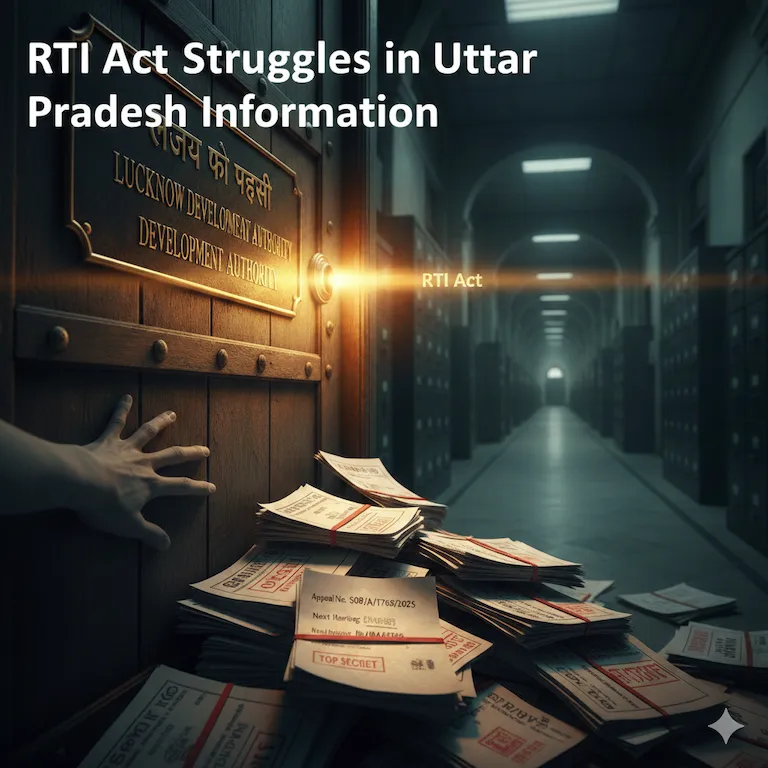
Key Takeaways from the Blog Post:(RTI Act Struggles in Uttar Pradesh)
- The Lucknow Development Authority (LDA) is actively undermining the Right to Information (RTI) Act of 2005. The case of Yogi M.P. Singh vs. Public Information Officer, LDA, is a clear example of RTI Act Struggles and bureaucratic delay. Evasion tactics are used to suppress information about alleged land irregularities in the Kanpur Road Scheme. This specifically concerns Plots SS-1914 to SS-1918.
- The “Pending Inquiry” Loophole is a Primary Tactic for Evasion. The LDA is using the existence of an “inquiry committee” as a shield. They are withholding basic, non-exempt administrative details. These include the names and designations of the committee members and its formation date. All of these are clearly public records.
- The Public Information Officer (PIO) is exhibiting a pattern of disregard for the Information Commission. PIO Hemchandra Tiwari has repeatedly failed to appear before the Uttar Pradesh Information Commission. He has not complied with the Commission’s explicit orders. This behavior demonstrates a “war of attrition” against the quasi-judicial authority.
- Evidence points to “Selective Transparency.” A communication from the LDA was sent to another individual, Dinesh Pratap Singh. The authority confirmed it is actively managing files for the same plots. This contradicts the claim that information must be withheld from the RTI applicant. This suggests the information is available but is being strategically suppressed to avoid accountability.
- The Bureaucratic Delay is a Violation of Rights and Protects Wrongdoers. The investigation has been delayed for more than two years. This is not just a procedural lapse. It is a violation of the “Right to Reason.” The ongoing silence effectively shields alleged wrongdoers and leaves genuine allottees in a state of legal limbo.
- The Upcoming Hearing is a Crucial Test for Accountability. The case is scheduled for a critical hearing on April 8, 2026, before the State Information Commissioner Shakuntala Gautam. The hearing is considered a crucial measure of the Commission’s ability. It needs to enforce the RTI Act against a powerful public authority. It aims to ensure accountability through penalty and mandated disclosure.
RTI Act Struggles: The Battle for Accountability in the Lucknow Development Authority
The legislature envisioned the Right to Information (RTI) Act of 2005. They saw it as the “sunlight” that would disinfect the corridors of bureaucracy. A persistent legal battle is currently unfolding in the Uttar Pradesh Information Commission. This highlights the growing friction between a citizen’s right to know and an administration’s tendency to withhold information. The case of Yogi M.P. Singh vs. Public Information Officer, Lucknow Development Authority (LDA) serves as a stark case study. It shows how procedural delays and administrative “committees” often mask systemic irregularities. The legislature conceived the Right to Information (RTI) Act of 2005. It was meant as the essential “sunlight” to expose and purify the operations of bureaucracy. However, a legal conflict is developing within the Uttar Pradesh Information Commission. This demonstrates the increasing tension between a citizen’s right to information. It also shows the administration’s inclination toward secrecy.
The case of Yogi M.P. Singh vs. Public Information Officer, Lucknow Development Authority (LDA) is a clear illustration. It reveals how routine procedural delays and the formation of administrative “committees” frequently serve to obscure underlying systemic problems.The legislature had a vision for the Right to Information (RTI) Act of 2005. They saw it as the “sunlight” that would disinfect the corridors of bureaucracy. However, a persistent legal battle is currently unfolding in the Uttar Pradesh Information Commission. This highlights the growing friction between a citizen’s right to know and an administration’s tendency to withhold information. The case of Yogi M.P. Singh vs. Public Information Officer, Lucknow Development Authority (LDA) serves as a stark case study. Specifically, it shows how procedural delays and administrative “committees” often mask systemic irregularities.
The Genesis: Allegations of Land Irregularities (RTI Act Struggles)
The core of this dispute lies in the Kanpur Road Scheme. It specifically concerns Plot Numbers SS-1914, 1915, 1916, 1917, and 1918. On April 28, 2025, Yogi M.P. Singh filed an RTI application (Reg. No. LKDPA/R/2025/60280). The application was not a mere request for general documents. It was a detailed investigation into alleged irregularities. These irregularities involve the execution of registries. They also pertain to the allocation of plots by the LDA.
The information seeker sought ten specific points of information, including:
- The names and designations of officers who set up a committee to look into these irregularities.
- The identities of the committee members and their current postings.
- The timeframe or deadline the authority provided to this committee to complete its investigation.
- The status of legal title suits involving multi-named individuals like Anuradha Singh.
The “Inquiry Committee” Loophole
A common tactic that public authorities use to delay releasing information is to claim a “pending inquiry.” In this case, the LDA admitted that a committee had been constituted to investigate the matter. The authority claimed that the non-appearance of parties with original documents stalled the inquiry. This highlights the struggles faced under the RTI Act in obtaining timely responses and ensuring accountability from public bodies.
While the LDA uses this “pending” status as a shield, the RTI Act is clear. Administrative details such as the names of the committee members and the date the committee formed are public records. These facts do not affect the investigation’s outcome. Therefore, they do not fall under the exemptions provided in Section 8 of the RTI Act.
Commission’s Intervention and PIO’s Evasion (RTI Act Struggles)
The matter reached the Uttar Pradesh Information Commission. It was assigned to the court of State Information Commissioner Shakuntala Gautam (Room S-09). The Commission’s records reveal a pattern of administrative evasion:
- September 24, 2025: The Commission noted the absence of both parties. It directed the PIO to provide clear, point-wise information.
- November 26, 2025: Despite explicit notices, the PIO remained absent. The Commission issued a stern order for the PIO to resolve the application before the next hearing.
- January 16, 2026: The Commission issued a formal notice for personal appearance. It noted that the PIO had failed to comply with previous orders.
This timeline demonstrates a “war of attrition.” The Public Information Officer (PIO), Hemchandra Tiwari, appears to be disregarding the quasi-judicial authority of the Commission.
Evidence of Selective Transparency
A recent communication from the LDA’s Special Executive Officer, Ravi Nandan Singh, is a critical turning point in this case. It is dated January 20, 2026. The letter was addressed to another individual, Dinesh Pratap Singh. However, it confirmed that the LDA is actively managing files for the same plots (SS-1914 to SS-1918). These are under different registration numbers (LKDPA/R/2022/60189).
This discovery exposes a significant contradiction. The LDA can communicate with one citizen regarding a committee’s progress. Therefore, there is no legal reason for the authority to withhold the same committee’s structural details. These details include names and designations, denied to another applicant. This selective transparency suggests that the information is available. The LDA is strategically suppressing it to avoid fixing accountability. The struggles faced under the RTI Act reveal the challenges individuals face when seeking information. These challenges often result in lengthy delays and arbitrary refusals. This ultimately undermines the act’s purpose of promoting transparency and accountability in public authorities.
The Human Cost of Bureaucratic Delay
The Appellant has pointed out a poignant fact. More than two years have passed since the committee should have investigated these irregularities. For five years, the LDA has reportedly sought “documents” from allottees without taking any concrete action.
This delay is not merely a procedural lapse. It is a violation of the “Right to Reason.” The Supreme Court of India has deemed this right an indispensable part of a sound administrative system. When a public authority remains silent for years, it effectively protects the wrongdoers. It leaves the genuine allottees in a state of legal limbo.
The Upcoming Hearing: April 8, 2026 (RTI Act Struggles)
The Appellant has now filed a formal Rejoinder (Diary No. D-090220260101) following the failure of the PIO to appear on February 5, 2026. The Commission set the case for a critical hearing on April 8, 2026 \[cite: 112—\].
The demands of the citizen are simple yet profound:
- Immediate Disclosure: Release the names and designations of the committee members.
- Accountability: Impose a penalty on the PIO under Section 20(1) of the RTI Act for a year-long delay.
- Verification: Allow for the physical inspection of records at the LDA office to prevent further manipulation of facts.
Conclusion: A Litmus Test for Accountability
The case of Appeal No. S09/A/1768/2025 is more than just a dispute over five plots of land. It challenges the Uttar Pradesh Information Commission’s capability to enforce its own orders. The orders are against a powerful development authority. If the system allows the PIO to continue ignoring mandates without penalty, the RTI Act becomes a toothless tiger. This situation reflects the struggles citizens face when seeking transparency and accountability from public authorities.
Transparency is not a favor the government grants; it is a right the people own. As the hearing on April 8 approaches, all eyes will be on Room S-09. People are eager to know. Will the “sunlight” of the RTI Act finally reach the files of the Lucknow Development Authority?
Based on the documents and notices provided, here are the application IDs, contact details, and web links for the concerned public authorities involved in your case:
Lucknow Development Authority (LDA) – Respondent Details
- Concerned PIO: Hemchandra Tiwari.
- Designation: Public Information Officer.
- Mobile Number: 9918005512.
- Email ID: hemtiwari071@gmail.com.
- Secondary Email (from recent communication): ldartionline@gmail.com.
- Office Address: Public Information Officer Office, Lucknow Development Authority, Janpad – Lucknow, Pin Code: 226012.
- Special Executive Officer (OSD): Ravi Nandan Singh.
- LDA Website: https://ldaonline.co.in/
Uttar Pradesh Information Commission (UPIC) – Authority Details (RTI Act Struggles)
- Presiding Commissioner: Shakuntala Gautam, State Information Commissioner.
- Hearing Room: S-09.
- Official Email for Submissions: hearingcourts9.upic@up.gov.in.
- Office Address: 7/7/A, RTI Bhawan, Vibhuti Khand, Gomti Nagar, Lucknow.
- Official Website: https://upsic.up.gov.in/.
- Online Hearing Link (Specific to your case): https://upsic.up.gov.in/cispu/onlinehearing/5aff76.
Application & Case Identifiers
- RTI Registration Number (Original): LKDPA/R/2025/60280.
- Second Appeal Number: S09/A/1768/2025.
- Commission Registration Number: A-20250702295.
- Notice Number: 202601S09N300520.
- Rejoinder Diary Number: D-090220260101 (Assigned on 09/02/2026).
- Related Third-Party RTI IDs (Dinesh Singh): LKDPA/R/2022/60189 and LKDPA/R/2023/60495.


Facing a similar challenge? Share the details in the box below, and our team of experts will do their best to help.