
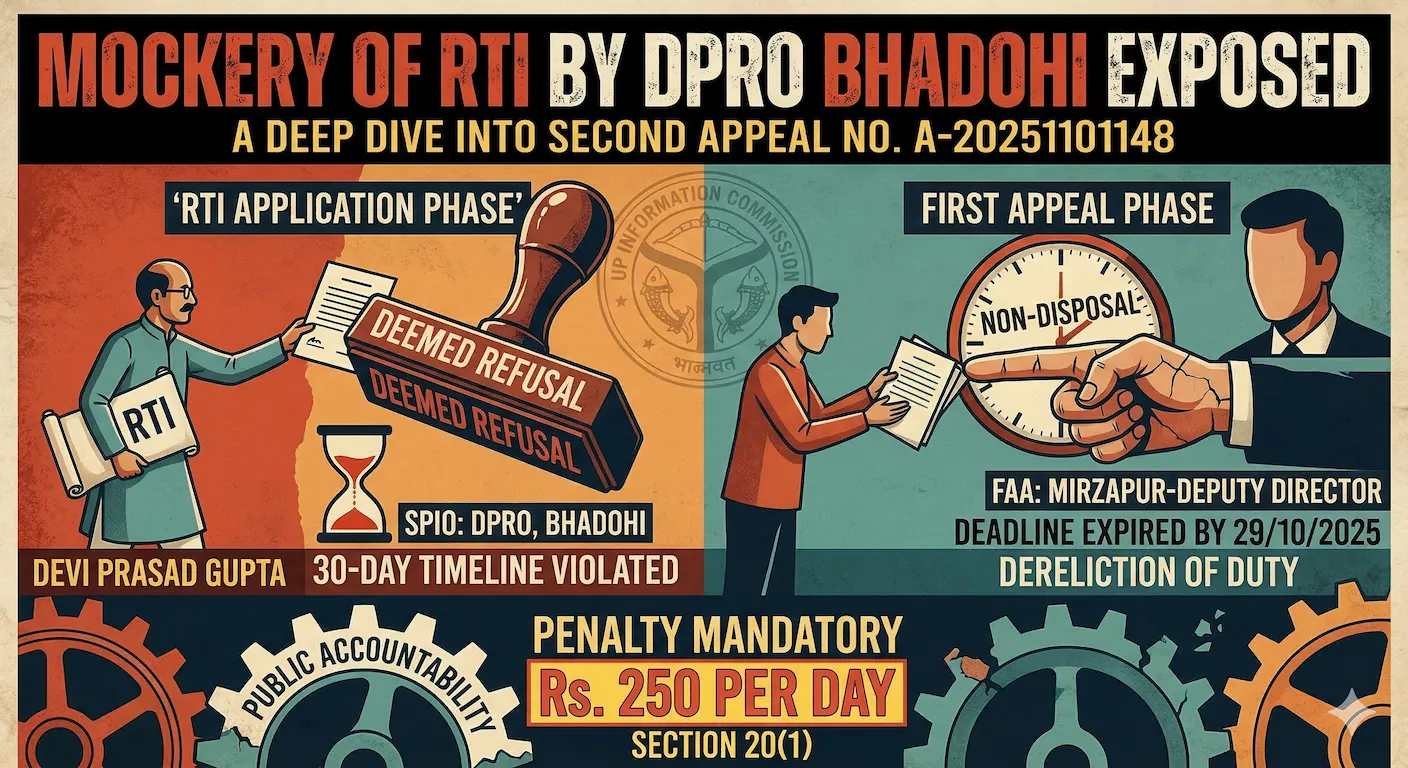
Key Takeaways (Mockery of RTI by DPRO Bhadohi)
- The Right to Information (RTI) Act, 2005, aims to ensure transparency but faces significant challenges due to bureaucratic delays.
- Case No. A-20251101148 exemplifies failures of the State Public Information Officer (SPIO) and the First Appellate Authority (FAA) regarding timely information provision.
- Both the SPIO and FAA violated statutory response timelines. This led to deemed refusal in the RTI appeal process. It also resulted in dereliction of duty.
- The RTI Act mandates penalties and potential disciplinary actions for non-compliance, reinforcing the need for accountability.
- The outcome of this case could set a precedent for enforcing the principles of the RTI Act against bureaucratic negligence.
📢 Mockery of RTI by DPRO Bhadohi: Deconstructing Deemed Refusal and Dereliction of Duty in RTI Appeals
A Critical Analysis of Second Appeal No. A-20251101148 before the UP Information Commission
🏛️ Introduction: The Erosion of Transparency (Mockery of RTI by DPRO Bhadohi)
The Right to Information (RTI) Act, 2005, is a cornerstone of Indian democracy. It is designed to foster transparency, accountability, and citizen participation in governance. However, the effective operation of this crucial legislation often faces challenges. Systemic resistance, particularly in the form of bureaucratic delays and non-compliance, is a major issue. One recent example is the mockery of RTI by DPRO Bhadohi, which highlights ongoing concerns about enforcement and respect for the Act.
A case that illustrates these challenges is Second Appeal No. A-20251101148. This case was filed by Devi Prasad Gupta before the Uttar Pradesh Information Commission (UPIC). It highlights the failure of the State Public Information Officer (SPIO). The First Appellate Authority (FAA) also failed to adhere to statutory timelines.
This appeal is directed against the Panchayati Raj Department, Bhadohi District. It is a textbook example of how the mechanism of “deemed refusal” operates. The penalty provisions of the Act are essential to uphold its spirit. The information sought pertains to vital public interest matters. It includes transparency of developmental activities, specifically wall painting for scheme publicity. It also concerns the expenditure of public funds in Village Panchayat Dhanwatiya.
🗓️ The Timeline of Non-Compliance: A Double Failure
The Appellant’s journey for information reveals a clear pattern of statutory violation across two critical stages: (Mockery of RTI by DPRO Bhadohi)
1. Failure at the PIO Level: The Deemed Refusal (Section 7(1))
- RTI Application Date (Section 6(1)): 30/07/2025 (Registration No. DIRPR/R/2025/61913) (Mockery of RTI by DPRO Bhadohi)
- PIO: DPRO, Bhadohi.
- Statutory Deadline (30 days): 29/08/2025.
- Violation: The PIO failed to provide any response by the deadline. The PIO neither furnished the information nor rejected the request with a valid reason.
- Legal Consequence: This non-response constitutes a “deemed refusal” under the proviso to Section 7(2) of the RTI Act. This is a critical legal fiction. It allows the applicant to proceed to the next appellate stage. Silence is treated as a denial.
2. Failure at the FAA Level: The Non-Disposal of First Appeal (Section 19(1)) (Mockery of RTI by DPRO Bhadohi)
- First Appeal Date (Section 19(1)): 14/09/2025 (46 days after the RTI filing).
- FAA: Mirzapur-Deputy Director.
- Statutory Deadline (30-45 days): The FAA must resolve the appeal within 30 days. It can take up to 45 days if there are exceptional reasons recorded in writing. The maximum period expired by 29/10/2025.
- Violation: The FAA provided no answer and issued no order by the time the Second Appeal was filed on 15/11/2025.
- Legal Consequence: The FAA’s inaction continued for 62 days between the first appeal and the second appeal. This behavior demonstrates a dereliction of duty. The spirit of Section 19(1) is violated, necessitating the involvement of the highest authority—the State Information Commission.
⚖️ Legal Pillars of the Second Appeal (Section 19(3))
The core strength of this Second Appeal rests on the compounded violations of the RTI Act. The grounds for appeal are robust and firmly supported by the statutory framework: (Mockery of RTI by DPRO Bhadohi)
1. The Right to Information as a Fundamental Right
The Supreme Court has repeatedly affirmed that the Right to Information is an inherent part of the fundamental right. This right to Freedom of Speech and Expression is guaranteed under Article 19(1)(a) of the Constitution of India. The delay and refusal by public authorities are not just administrative lapses but an infringement of the citizen’s fundamental right. (Mockery of RTI by DPRO Bhadohi)
2. Mandate for Free Information (Section 7(6)) (Mockery of RTI by DPRO Bhadohi)
This is one of the most powerful provisions invoked in cases of deemed refusal. Section 7(6) explicitly states:
Notwithstanding anything contained in sub-section (5), the information shall be provided. This occurs when the Central Public Information Officer or State Public Information Officer does not comply with sub-section (1). The recipient will receive it without any fee charged.
The SPIO did not respond within 30 days (Section 7(1)). The authority must provide the Appellant with all the requested information free of charge, thereby fulfilling their entitlement. This entitlement stands regardless of the Commission’s subsequent decision.
3. The Penalty Clause (Section 20) (Mockery of RTI by DPRO Bhadohi)
The failure to respond within the stipulated time, without reasonable cause, triggers the penal provisions of the Act. Section 20(1) mandates the Information Commission to impose a penalty of Rs. 250 per day until the information is furnished, subject to a maximum of Rs. 25,000, if the PIO has: (Mockery of RTI by DPRO Bhadohi)
- refused to receive an application,
- not furnished information within the time specified,
- malafidely denied the request, or
- obstructed the provision of information.
The SPIO’s complete silence in this case directly falls under “not furnished information within the time specified.” This makes the imposition of a penalty essential. It is necessary to deter future non-compliance.
4. Disciplinary Action (Section 20(2)) (Mockery of RTI by DPRO Bhadohi)
The Commission also has the power under Section 20(2). It can recommend disciplinary action against the PIO to the competent authority. This occurs when it finds that the PIO has persistently and flagrantly violated the Act. (Mockery of RTI by DPRO Bhadohi)
💡 Public Interest and the Nature of Information Sought (Mockery of RTI by DPRO Bhadohi)
The information requested is highly relevant to public accountability:
- Wall Painting Status: Seeking the status and location of wall paintings that document developmental activities. This directly measures whether the ground follows government circulars.
- Fund Expenditure: Requesting the total fund spent on these activities. This information is crucial for verifying the proper utilization of public money. It is also essential for investigating potential financial impropriety (“siphoning in government fund,” as alleged by the applicant).
- Verification Reports: Seeking copies of verification reports by block staff and the DPRO office. This helps ascertain the effectiveness of the supervisory mechanism intended to curb corruption.
The Information Commission, when adjudicating the appeal, will likely view the public interest in this specific information as high. This adds urgency to the need for a swift and penal order against the defaulting authorities.
⏭️ Conclusion and Direction (Mockery of RTI by DPRO Bhadohi)
Second Appeal No. A-20251101148 presents a clear-cut case of administrative negligence and a failure to uphold the core principles of the RTI Act. The PIO’s deemed refusal has forced the Appellant to expend time and resources. The FAA’s non-disposal also contributed to this. This information should have been provided within 30 days.
The Appellant’s relief sought is appropriate. It is legally sound. The relief includes immediate, free-of-cost information. It also involves the imposition of a penalty and disciplinary action against the SPIO under Section 20. The decision of the UPIC in this case will be a significant statement. It will demonstrate the Commission’s resolve to enforce accountability. It will ensure that bureaucratic inertia does not render the Right to Information Act redundant.
A related case against the Block Development Officer of the same district is analysed in BDO Bhadohi & RTI Provisions: A Case Study.
Enquiry officer may provide the information concerned with enquiry
Om Prakash Maurya registers F.I.R. against the branch manager in police station Bhadohi of Saharayn Universal Multipurpose Society Ltd.
Anand Kumar sought posting details of PIO and personnel of Chauri Bazar police station


Facing a similar challenge? Share the details in the box below, and our team of experts will do their best to help.