
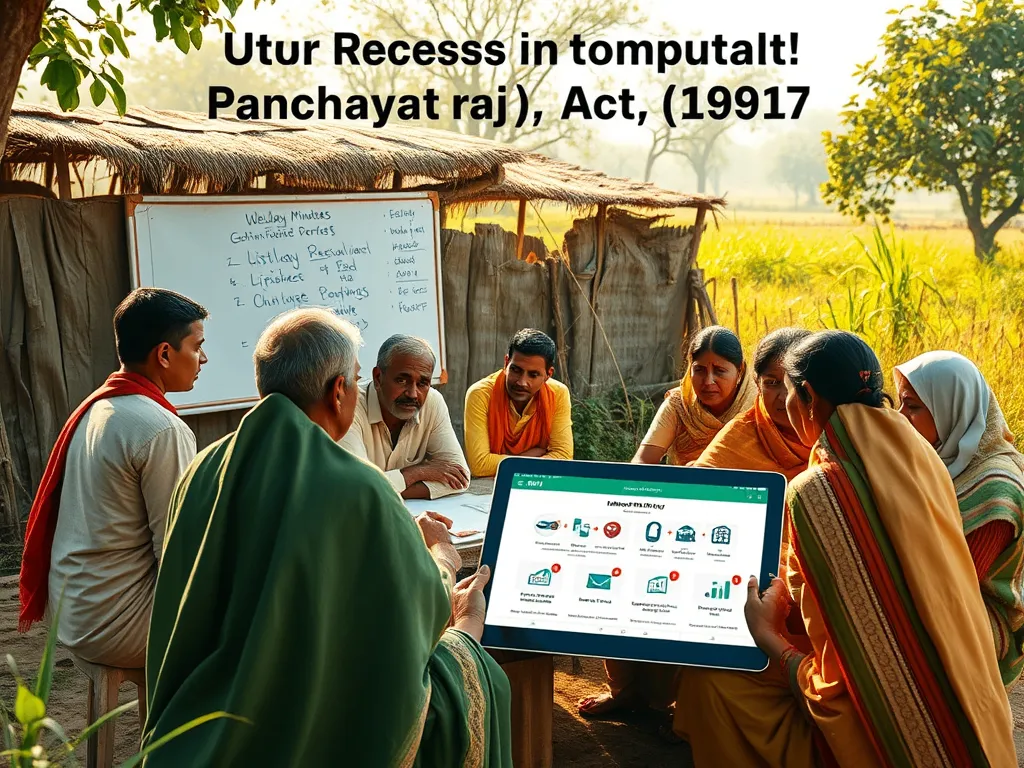
Understanding Uttar Pradesh Panchayat meetings starts with recognising why these local bodies sit at the heart of democratic participation. After all, Panchayats form a direct link between citizens and their representatives, so they foster open dialogue and accountability. Because Uttar Pradesh faces such diverse challenges, transparency in these meetings becomes crucial: it ensures that marginalized voices get heard and that decisions actually reflect community needs. Moreover, greater transparency can reduce corruption and build trust in local governance, which in turn empowers citizens to engage more actively in civic affairs. Ultimately, understanding Uttar Pradesh Panchayat meetings — and participating in them — lets residents shape policy and strengthen local governance, leading to a more informed, more involved citizenry.
Key Takeaways for Understanding Uttar Pradesh Panchayat Meetings: The RTI Inquiry into Gram Panchayat Manaua
1. Understanding Panchayat Meetings Through Democratic Verification
First, this inquiry goes beyond financial figures; instead, it digs into whether the Gram Panchayat is functioning legally. By demanding dates, times, and original signatures for four years of meetings, the RTI application seeks to prove whether collective decision-making actually took place, or whether a handful of officials made decisions unilaterally.
2. The “Digital vs. Physical” Audit
Next, the request exposes a critical accountability gap by comparing physical records against the Panchayat NIRNAY portal. If officials record meetings in manual registers but never upload them to the central government’s real-time monitoring system, that gap points to a lack of transparency — and possibly a deliberate bypass of mandatory digital oversight.
3. Accountability Through Penalty
Meanwhile, the District Panchayat Raj Officer (DPRO) has placed responsibility squarely on the Gram Panchayat Secretary. Specifically, the officer invoked Section 20 of the RTI Act, which allows penalties of ₹250 per day up to ₹25,000 — a necessary legal deterrent against the common practice of supplying misleading or incomplete information at the village level.
4. Empowerment of Ward Members
Similarly, by explicitly requesting the signatures of ward members, the RTI aims to empower local representatives. This requirement prevents a “Pradhan-Secretary” nexus from forging resolutions, and instead ensures that elected village members are actually present and consenting when officials decide how to spend village funds.
5. Panchayat Meetings as a Template for Rural Activism
Ultimately, this case offers a strategic roadmap for grassroots activists. It shows that combining the Uttar Pradesh Panchayat Raj Act, 1947 with the RTI Act 2005 provides the most effective way to move from “Paper Panchayats” toward truly transparent local self-governance — which is exactly why understanding Uttar Pradesh Panchayat meetings matters so much to activists today.
Accountability in Action: The RTI Battle for Transparency in Gram Panchayat Manaua
Understanding Uttar Pradesh Panchayat meetings also means understanding where real power lies: Indian democracy doesn’t rest solely in the halls of Parliament or the State Assemblies — rather, it lives in the Gram Sabhas of rural India. Under the Uttar Pradesh Panchayat Raj Act, 1947, Panchayats hold significant power over local resources, social justice, and economic development. However, that power only works as well as the transparency that governs it.
Recently, activist Shri Yogi M.P. Singh filed a Right to Information (RTI) request concerning Gram Panchayat Manaua (Development Block Kon, Mirzapur). This request pushes for accountability in local self-governance by seeking to uncover the procedural integrity of village meetings, as well as the adoption of digital monitoring tools like the Panchayat NIRNAY portal.
Understanding the Core of the Inquiry: Procedural Integrity (2021–2025)
Specifically, the RTI application demands records for four consecutive financial years: 2021-22, 2022-23, 2023-24, and 2024-25. Rather than simply requesting numbers, the applicant asks for the primary evidence of democratic functioning:
- Dates and Times of Meetings — to verify whether officials held meetings regularly, as the law mandates.
- Original Proposals (Resolutions) — specifically, this includes the verbatim text of what officials ultimately decided regarding village funds and projects.
- Signatures of Ward Members — a vital check against “paper meetings,” where, notably, officials often pass resolutions behind closed doors, without the presence or consent of elected ward representatives.
In many rural pockets, a “Pradhan-Secretary” nexus can sidestep the collective will of ward members entirely. Therefore, by demanding signed copies of proposals, the applicant forces a verification of whether the quorum was actually met and whether the decisions were genuinely collective.
The Digital Frontier for Understanding Panchayat Meetings: The NIRNAY Portal
Furthermore, one standout feature of this inquiry is its focus on the Panchayat NIRNAY (Naresh India Real-time Networks for Abhiyan and Yield) portal.
As the application notes, this portal forms one of three pillars of modern local self-governance. Its purpose is to shift Gram Panchayat management away from manual registers and toward a Real-Time Monitoring System. Specifically, the portal is designed to:
- Schedule and notify citizens of meetings in advance.
- Upload agendas to ensure public participation.
- Record proceedings digitally, preventing retroactive tampering with minutes.
The applicant has specifically requested the total number of meetings uploaded to this portal from Gram Panchayat Manaua — a genuinely strategic move. After all, if physical records show ten meetings while the central portal shows zero, that discrepancy reveals a failure to adopt the Government of India’s transparency mandates, suggesting a “digital gap” that often conceals administrative lapses.
The Administration’s Response: Pressure on the Ground
Consequently, on April 2, 2025, the District Panchayat Raj Officer (DPRO), Mirzapur, issued a response that reveals the internal mechanics of the RTI process. Specifically, the DPRO directed the Gram Panchayat Secretary of Manaua and the Assistant Development Officer (ADO) Panchayat to provide the requested information.
In addition, the letter carries a stern warning — often the only thing that moves the needle in rural bureaucracy — citing Section 20 of the RTI Act 2005:
“If the information is not provided… the Hon’ble State Information Commission will impose a penalty… at the rate of Rs. 250 per day…”
As a result, this legal pressure matters. Within the Panchayati Raj hierarchy, the Secretary (a government appointee) serves as custodian of records. Also, by copying the Block Development Officer (BDO) and the Divisional Deputy Director on the correspondence, the DPRO ensured that a “request disposed of” status on the portal doesn’t mark the end of the matter — instead, it starts the clock for the local secretary.
Why Understanding Panchayat Meetings Matters: The Fight Against “Paper Panchayats”
Indeed, the Manaua case represents a microcosm of a larger struggle across Uttar Pradesh. Many Gram Panchayats suffer from what activists call “Paper Panchayats,” where:
- Registers document meetings that never actually occur.
- Officials collect signatures from illiterate or semi-literate ward members on blank pages.
- Funds get allocated for “proposals” the community never actually discussed.
Therefore, by requesting specific signatures and portal upload counts, the applicant uses the UP Panchayat Raj Act and the RTI Act together as twin blades to cut through local corruption. In doing so, this approach empowers the “last man” in the village to know exactly how officials spend taxes and central grants.
Conclusion: Why Understanding Uttar Pradesh Panchayat Meetings Matters for Manaua’s Future
While the DPRO’s disposal of the RTI request marks a procedural victory, the real test still lies ahead: the quality of the documents the Gram Panchayat Secretary of Manaua ultimately provides. Will the signatures match? Will the NIRNAY portal reflect ground reality?
This case now serves as a template for rural activists everywhere, and it shows exactly why understanding Uttar Pradesh Panchayat meetings — not just the money trail — is the real key to accountability. It shifts the focus from “where did the money go?” to “how was the decision made?” — and when the decision-making process becomes transparent, misappropriating funds gets significantly harder.
What’s Next for Understanding Uttar Pradesh Panchayat Meetings in Your District?
So, if you’re tracking a similar issue in your district, your next step should be ensuring that “Information Provided” means more than a summary — insist on certified photocopies of the original registers.
Below, to help you follow up effectively on your request for Gram Panchayat Manaua, you’ll find the relevant contact points and digital links.
1. District Level Authorities (Mirzapur) (Understanding Uttar Pradesh Panchayat Meetings)
Primary responsibility for providing this information lies with local block and district officers.
- Public Information Officer (PIO):
- Name: Mr. Arvind Kumar Rai (District Panchayat Raj Officer – DPRO)
- Mobile: 9415375150 / 9415209838
- Office Phone: 05442-252883
- Email: dpromi-up@nic.in
- Assistant Development Officer (ADO) – Panchayat (Block Kon):
- This officer directly supervises the Gram Panchayat Secretary of Manaua.
- Office Address: Vikas Khand Karyalaya (BDO Office), Kon, District Mirzapur.
- Block Development Officer (BDO) – Block Kon:
- Serves as the administrative head of the block. Contact this office if the Secretary refuses to provide signed proposal copies.
2. State Level Authorities (Uttar Pradesh)
If the local office doesn’t provide the information within 30 days, escalate to these offices. (Understanding Uttar Pradesh Panchayat Meetings)
- Directorate of Panchayati Raj, Lucknow:
- Director (IAS): 0522-2322924
- Deputy Director (S.N. Singh): 9415375150 / 0522-2332871
- Email: up.panchayatiraj@gmail.com / panchraj@nic.in
- Website: panchayatiraj.up.nic.in
- State Information Commission (For Second Appeal):
- Address: RTI Bhawan, Vibhuti Khand, Gomti Nagar, Lucknow, UP.
- Website: upsic.gov.in
3. Key Web Links & Portals (Understanding Uttar Pradesh Panchayat Meetings)
Use these links to verify the “Digital Pillar” mentioned in the application:
- Panchayat NIRNAY Portal: gpdp.nic.in (for Gram Sabha meeting scheduling and recording)
- e-GramSwaraj Portal: (to check whether proposals passed in meetings match actual financial expenditure uploaded online)
- UP RTI Online Portal: rtionline.up.gov.in (to track application status or file a First Appeal if the response is unsatisfactory)
4. Summary Table for Quick Reference (Understanding Uttar Pradesh Panchayat Meetings)
| Authority | Name/Designation | Contact Number | Email ID |
|---|---|---|---|
| DPRO Mirzapur | Arvind Kumar Rai | 9415375150 | dpromi-up@nic.in |
| Panchayati Raj HQ | S.N. Singh (Dy. Director) | 0522-2332871 | up.panchayatiraj@gmail.com |
| Block Office | ADO (Panchayat) Kon | Contact via BDO Kon | – |
| RTI Helpline | UP State RTI Helpdesk | 0522-7118629 | onlinertihelpline-up@gov.in |
Would you like help drafting a formal “First Appeal” letter to the First Appellate Authority (FAA) in Mirzapur, in case the 30-day deadline (April 24, 2025) is missed?eadline (April 24, 2025) is missed?(April 24, 2025) is missed?, in case the 30-day deadline (April 24, 2025) is missed?


Facing a similar challenge? Share the details in the box below, and our team of experts will do their best to help.