
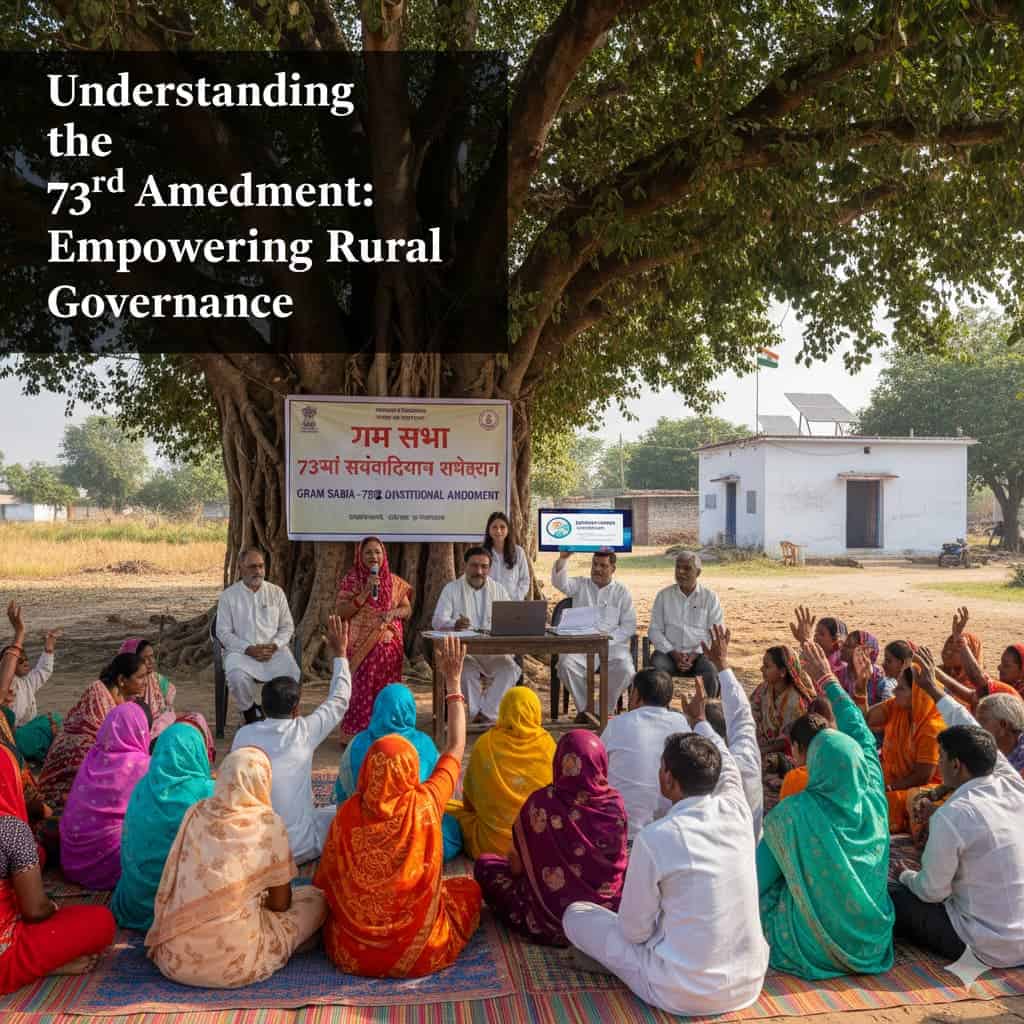
✊ The Cornerstone of Democracy: Why the Gram Sabha Must Meet
The foundation of Indian democracy often receives celebration at the national and state levels. However, the true crucible of self-governance resides in its villages. Empowering Rural Governance remains crucial for strengthening participation and accountability at the grassroots level. The Gram Sabha serves as the assembly of all registered voters in a Village Panchayat. It is designed to be the bedrock of this decentralized system. A recent Right to Information (RTI) application revealed an issue concerning the Dhanwatiya Village Panchayat in Bhadohi, Uttar Pradesh. People often neglect the spirit of this grassroots democracy, raising serious questions about accountability and participation in local governance.
🏛️ The Mandate: The 73rd Constitutional Amendment and Local Power
The 73rd Constitutional Amendment Act of 1992 stands as a landmark reform that constitutionally empowered the Panchayati Raj Institutions (PRIs). It was a revolutionary step. Power shifted from state capitals to the villages. This fulfilled the Gandhian dream of Gram Swaraj (village self-rule).
The Three-Tier System
Under Article 243B, the Act mandates a three-tier structure for rural local self-governance:
- Village Level: Gram Panchayat: A Sarpanch heads the grassroots unit. It manages local welfare, sanitation, and implements development schemes.
- Intermediate Level: Panchayat Samiti (Block Level): Coordinates the functions of several Gram Panchayats and manages broader planning.
- District Level: Zila Parishad: Oversees development across the entire district, allocating resources and supervising the lower tiers.
The Foundation of Participation: The Gram Sabha
Crucially, the Amendment established the Gram Sabha as the foundational element of participatory democracy. More than just a meeting, it acts as the legislative body of the village and takes on the following tasks:
- Approving the annual budget of the Gram Panchayat.
- Reviewing the annual accounts and administration report.
- Selecting beneficiaries for various welfare schemes.
- Ensuring transparency and social audit of the Gram Panchayat’s functions.
The Gram Sabha provides the ultimate check against local corruption and safeguards against malfeasance. This necessity keeps the elected Gram Panchayat accountable to the people who elected them. When these meetings do not gather, they make the entire structure of local self-governance a hollow shell.
🔍 Exposing Failure: The RTI Application as a Tool for Accountability
The failure to convene Gram Sabha meetings is an issue of immense public interest. The RTI application (Registration Number: DIRPR/R/2025/61924) filed by Devi Prasad Gupta concerns the Dhanwatiya Village Panchayat. This case serves as a powerful example of how ordinary citizens can use legal tools. These tools help them demand accountability.
The Right to Information (RTI) Act, 2005 empowers every citizen to scrutinize the working of public authorities. It promotes the very transparency and accountability that the Panchayat Act champions.
The Specific Information Demanded
The application directly addresses the issue of procedural compliance. It demands comprehensive records for four consecutive financial years (2021-22, 2022-23, 2023-24, and 2024-25). Specifically, the applicant requested:
- Total number of meetings convened with date and time.
- Copies of proposals passed as they were.
- Signatures of the ward members to verify attendance and consent.
- Data uploaded on the Panchayat NIRNAY portal, a central government monitoring system for Gram Sabha meetings.
The village administration faces a direct challenge from the applicant, who demands the “total number of meetings” held over four years, likely testing the initial assertion that “not a single meeting is, convened.” If the records are completely absent, it would confirm a profound breach of the Panchayat Act, while incomplete records would suggest manipulation of the procedures by someone.
🛑 The Peril of Paralysis: When the Gram Sabha is Silent
When authorities deliberately keep the Gram Sabha dormant, they severely cripple decentralized governance:
- Lack of Social Audit: Without regular meetings, the elected Sarpanch and ward members operate without the mandated public oversight. This creates a fertile ground for financial mismanagement, fund misappropriation, and corruption, as villagers are incapable of scrutinizing expenditures.
- Exclusion of the Marginalized: The Gram Sabha serves as the primary forum where marginalized communities, women, and low-income people voice their needs and ensure their inclusion as beneficiaries in development schemes. When the Gram Sabha remains silent, it mutely silences their voices. In such cases, local elites often divert benefits to those they favor.
- Stagnant Development: Projects remain stalled or poorly executed because the Gram Panchayat bypasses public consultation on local priorities like water supply, sanitation, and infrastructure.
Status of RTI & 73rd Amendment:
The RTI application is presently pending with the District Panchayat Raj Officer (DPRO) in Bhadohi. It demands an answer to a fundamental question: Are the constitutional mandates for local governance being followed? Or is the framework being undermined by inaction? The response will give specific data for Dhanwatiya. Additionally, it will show the state of grassroots democracy across many parts of rural India.
The Gram Sabha—the people themselves—must actively, informatively, and empoweringly realize the spirit of the 73rd Amendment. The citizen’s humble plea through the RTI Act serves as a powerful reminder. Voters ultimately shoulder the responsibility for self-governance. They must tirelessly demand that the meetings convene and ensure their voices are heard.
That is a critical point. According to the Uttar Pradesh Panchayat Raj Act, 1947, it governs Panchayati Raj Institutions in the state. The Gram Sabha is legally mandated to hold a least of two general meetings every year.
🗓️ Mandatory Meeting Frequency in Uttar Pradesh
Section 11(1) of the U.P. Panchayat Raj Act, 1947, specifies the requirement for Gram Sabha meetings:
- Minimum Frequency: Every Gram Sabha must hold two general meetings in a year.
- Designated Meetings: These two meetings are traditionally tied to the harvest seasons:
- Kharif Meeting: Held soon after the harvesting of the Kharif crop.
- Rabi Meeting: Held soon after the harvesting of the Rabi crop.
- Purpose: These meetings are crucial for discussing the Gram Panchayat’s annual statement of accounts. They also handle the development programs undertaken. Additionally, they cover the identification of beneficiaries for welfare schemes.
- Quorum: The quorum required for any Gram Sabha meeting is one-fifth (1/5th) of the total number of members.
🚨 Implications for the RTI Application
The applicant, Devi Prasad Gupta, is seeking records for four financial years. These years are 2021-22 to 2024-25. This request directly relates to this mandate.
- If the rules were followed, the Gram Panchayat should have held at least 8 mandatory general meetings. These meetings were required during this period.
- The request for the “total number of meetings convened” will show the level of compliance. Signed copies of “proposals passed” by ward members will provide confirmation. This will verify if the legal need of two meetings per year was met.
- A response confirming “not a single meeting” was held would be a clear violation of Section 11 of the U.P. Panchayat Raj Act, 1947, and undermine the core principle of local self-governance established by the 73rd Constitutional Amendment.
That’s an important angle for ensuring accountability. Legally mandated meetings sometimes do not occur. In these situations, calling an Extraordinary General Meeting (EGM) of the Gram Sabha is essential. This process serves as a crucial check. It also offers a balance for the citizens.
📢 Procedure for Calling an Extraordinary Gram Sabha Meeting in UP
Section 11(1) of the U.P. Panchayat Raj Act, 1947 outlines the provision for an Extraordinary General Meeting (EGM).
1. Who Can Requisition the Meeting?
The elected head or the public and supervisory authorities can call an EGM.
- The Pradhan: The Pradhan (Chairperson of the Gram Panchayat) will call an extraordinary meeting whenever they deem it necessary.
- The Members (Voters): Members submit a written requisition to the Pradhan, who calls an extraordinary meeting. This must be submitted by at least one-fifth (1/5th) of the total number of members of the Gram Sabha.
- The Prescribed Authority (Government Officials): The prescribed authority calls the meeting. This authority is responsible for external control and oversees supervision. The Block Development Officer or the Director of Panchayats holds this authority.
2. Time Limit for Convening the Meeting
When either one-fifth of the members or the prescribed authority submits a valid requisition, the Pradhan must act. The Pradhan is legally, bound to call the extraordinary meeting within 30 days from the date they submits the requisition.
3. Consequence of Pradhan’s Failure (Citizen’s Power)
This is the most critical provision for citizen empowerment:
- Action by Prescribed Authority: The Pradhan must call the meeting within a 30-day period. If the Pradhan fails to do so, the Prescribed Authority intervenes. This supervisory government officer arranges the meeting themselves within a further prescribed period. This ensures that the meeting is eventually, held regardless of the Pradhan’s inaction.
4. Notice and Quorum Requirements
- Notice Period: You must give notice for an extraordinary meeting at least four days in advance. This notice period ensures attendees have adequate time to prepare. You must specify the time, place, and agenda in the notice. Typically, you publish it by affixing it at the Panchayat office and other conspicuous public places.
- Quorum: Any meeting (ordinary or extraordinary) of the Gram Sabha requires a quorum of one-fifth (1/5th) of its total membership. If quorum is not met, the meeting is adjourned. It will reconvene at the same time on the same day of the following week. For this meeting, no quorum is necessary to transact the business listed in the original agenda.
In the context of the Dhanwatiya RTI case, villagers can take legal action. This is possible if the Gram Sabha records prove that the mandatory two meetings per year were not held. They can hand in a requisition to the Pradhan with the signature of at least 1/5th of the voters. This action forces an Extraordinary General Meeting. It triggers the accountability mechanism.
The 73rd Constitutional Amendment Act, 1992 is a landmark piece of legislation in India that granted constitutional status to the Panchayati Raj Institutions (PRIs). It officially came into force on April 24, 1993, which is now celebrated annually as National Panchayati Raj Day.
Below are the official web links and a summary of its key provisions:
🔗 Official Web Links
- Full Text of the Act (PDF): Legislative Department, Ministry of Law & Justice
- Ministry of Panchayati Raj (Official Site): panchayat.gov.in
- National Portal of India Summary: India.gov.in – Panchayati Raj
- Eleventh Schedule (29 Subjects): Detailed list of functional items
📝 Key Features of the 73rd Amendment
The amendment added Part IX (Articles 243 to 243-O) and the Eleventh Schedule to the Constitution.
| Feature | Description |
| Three-Tier System | Established Panchayats at the Village, Intermediate (Block), and District levels. |
| Gram Sabha | Recognized the Gram Sabha (assembly of all registered voters) as the foundation of the system. |
| Direct Elections | All seats in Panchayats at all levels are filled by direct elections every 5 years. |
| Reservations | Mandates reservation of seats for SCs and STs (in proportion to population) and not less than 1/3rd for women. |
| Finance Commission | Established a State Finance Commission to review the financial position and recommend tax distribution. |
| Election Commission | Created an independent State Election Commission to oversee the conduct of elections. |
💡 Why It Matters
Before this amendment, local bodies were subject to the whims of state governments—elections were often delayed for decades, and they lacked financial autonomy. By making these provisions justiciable (mandatory), the Act ensured that “grassroots democracy” became a permanent reality in India.
Would you like me to find the specific state-wise rules (Panchayat Acts) for a particular state?


Facing a similar challenge? Share the details in the box below, and our team of experts will do their best to help.