
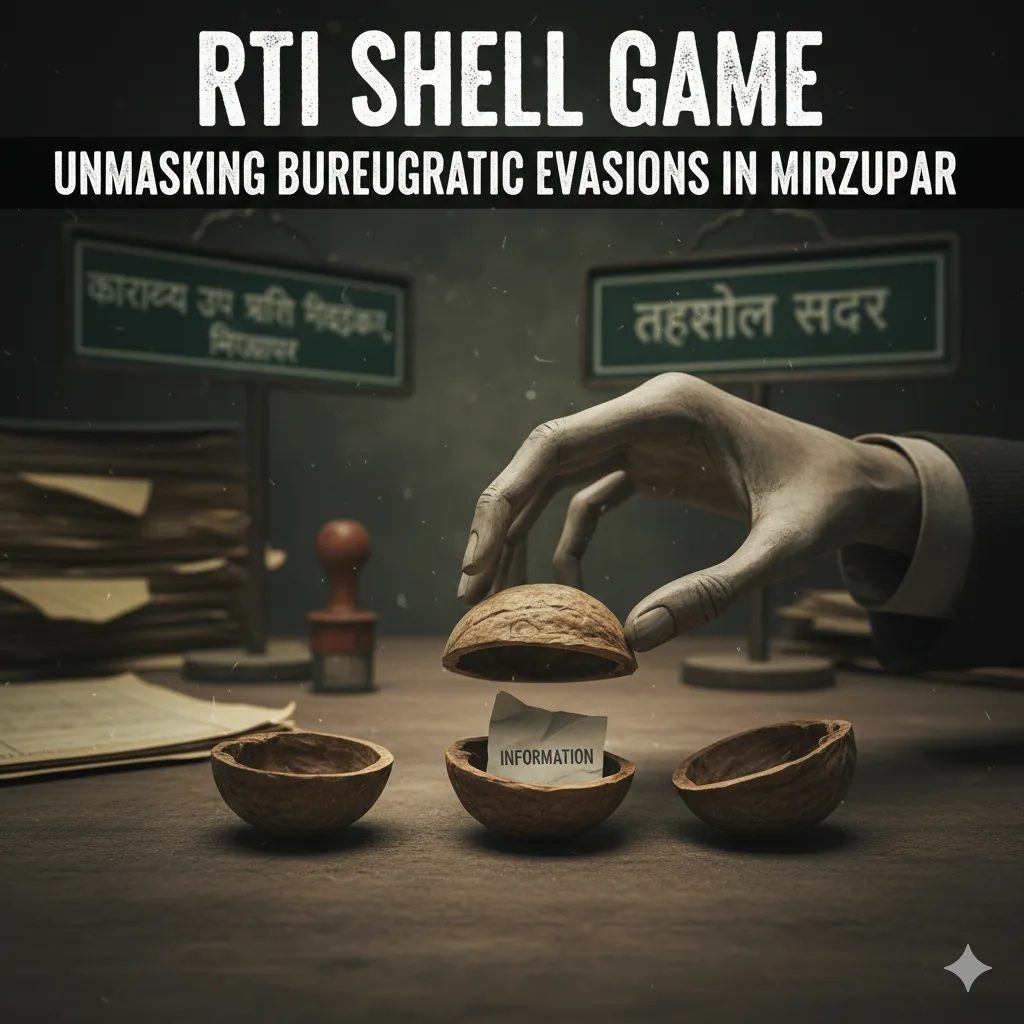
The RTI Shell Game: How Departments Evade Accountability in Mirzapur
Introduction: A Citizen’s Right vs. Bureaucratic Gaslighting
In democratic India, the Right to Information (RTI) Act, 2005, serves as the “sunlight” that disinfects corruption. However, in the district of Mirzapur, troubling patterns emerge. A real-life RTI Shell Game unfolds here. A simple inquiry into the rejection of a PM-Kisan Samman Nidhi application begins. It evolves into a masterclass in bureaucratic evasion. This showcases how public officials employ “jurisdictional shuffling” to avoid accountability.
The Core Conflict: The Wrong Department is Answering (RTI Shell Game)
The most glaring issue in the case of Yogi M.P. Singh vs. PIO Mirzapur is a serious procedural error. The original RTI was filed with the Revenue Department (Tehsil Sadar). They are the sole custodians of land verification records.
The authorities should hold the Tehsildar accountable for his actions. The Agriculture Department is now at the forefront of providing “arbitrary Reports.”
- The Problem: The Agriculture Department cannot provide internal Tehsil logs, staff joining dates, or verification details.
- The Tactic: By having an unrelated department respond, the actual PIO (Tehsildar Hemant Kumar) remains shielded from the Information Commission’s scrutiny and potential penalties.
The “Certified Copy” Trap: Contradicting Digital India (RTI Shell Game)
A central point of the dispute is the department’s claim. They assert that the PM-Kisan application was rejected because a “Certified Khatauni” was not uploaded.
- Legal Inconsistency: The department cites Government Order 83/2022/776. However, it fails to produce a clause that mandates a certified (paid/physical) copy for an online portal.
- Defying the Supreme Court: This demand directly contradicts the Supreme Court’s mandate in WP(C) 360/2021 (Kishan Chand Jain vs. Union of India), which pushes for paperless governance. Requiring a farmer to obtain a physical certified copy just to scan it for a digital portal is a hurdle. It is redundant and designed to obstruct, not facilitate.
A Timeline of Wilful Delay (RTI Shell Game)
Accountability is dead if it is not timely. The facts of this case reveal a staggering timeline of non-compliance:
- January 2025: Original RTI filed.
- July 2025: Information Commission orders immediate disposal.
- December 2025: A “Modified Report” appears only after a year of silence. It conveniently arrives just six days before the final hearing.
This is not “administrative processing”; it is malafide delay. Under Section 20 of the RTI Act, this warrants a maximum penalty of ₹25,000. The delay exceeds the 100-day mark by nearly three times.
The Fight for “Paperless” Justice
The appellant’s battle is not just about one farmer’s funds; it is about the Digital India vision. If a PIO can ignore an online RTI for 358 days, the system status stays frozen at “Request Received.” Then the digital infrastructure is being used as a wall rather than a window.
Conclusion: The Need for Stricter SIC Intervention
As the case moves to its next hearing in March 2026, the Uttar Pradesh Information Commission faces a choice. They can allow the “wrong department” to keep answering. Alternatively, they can fix accountability on the Tehsildar Sadar.
The demand remains clear:
- Identity Disclosure: Who specifically rejected the application?
- Rule of Law: Under what specific rule is a “certified” copy mandatory?
- Financial Penalty: The PIO must be fined to signal that the RTI Act cannot be treated as a suggestion.
Transparency is not a favor granted by the government; it is a debt owed to the citizen.
The transition of your RTI application from the Revenue Department to the Agriculture Department dilutes accountability. It is a classic administrative maneuver. While it may look like a routine transfer, the ground reality suggests a calculated effort to protect specific officials.
## The Ground Reality: Why the Transfer is a “Shield” (RTI Shell Game)
In the context of the PM-KISAN scheme, the Agriculture Department acts as the nodal agency for disbursement. They are responsible for paying the money. However, the Revenue Department (Tehsil) is the statutory authority for verification. They are in charge of approving the eligibility. (RTI Shell Game)
By transferring your RTI to the Deputy Director of Agriculture, the administration achieves three things:
- Hiding the “Identity” of the Rejecting Officer: Your first point requests the name of the staff who cancelled the application. It also asks for their designation. The Agriculture Department does not have the “Log-in ID” details or the internal service books of Tehsil employees. Therefore, they can safely say, “Information not available in our records.”
- Evading “Verification Steps”: The DDA cannot explain the “specific steps taken by Tehsil Sadar” (Point 3). They are not able to do this because they do not supervise the Tehsildar. This allows the Revenue staff to avoid explaining why they rejected a valid record.
- Bypassing the Penalty (Section 20): If the DDA provides a “reply,” even if it is incomplete, the Tehsildar can argue before the Commission. The argument would be that the matter was “transferred and dealt with.” This makes it harder for the Commission to pinpoint who exactly is responsible for the 11-month delay.
## Table: Information Gap Created by the Transfer
| Your Request Point | Custodian of Truth | Outcome of Transfer to Agriculture |
| 1. Staff who cancelled | Tehsildar Sadar | Agriculture Dept. gives a generic designation, not the specific staff ID. |
| 2. Legal Basis for “Certified” | Revenue Dept. / DM | Agriculture Dept. cites general PM-Kisan rules but ignores Revenue’s specific “certified” demand. |
| 3. Steps taken for Verification | Tehsildar Sadar | Agriculture Dept. cannot access Tehsil’s internal inquiry registers. |
| 4. Staff Joining Dates | DM Office / Tehsil | Agriculture Dept. has no access to Revenue Department service records. |
## Critical Legal Analysis: Why this Transfer is Invalid (RTI Shell Game)
Under Section 6(3) of the RTI Act, a transfer is valid only when the subject matter is closely tied to another public authority’s functions. The subject matter needs to be directly related to another public authority’s duties. Only then is a transfer considered valid. The subject matter must be closely related to another authority’s functions for the transfer to be valid. The connection must be significant for the transfer to be valid. (RTI Shell Game)
- The Flaw: Your questions are about internal staff conduct, specific verification steps, and joining dates within the Tehsil. These are 100% Revenue Department functions.
- The Result: Moving this to Agriculture is a misuse of the Act. It forces an unrelated department to answer for the “sins” of the Revenue Department.
## Strategic Advice for the March 2026 Hearing
Since the Commission has marked your case for “Further Hearing,” you must challenge the validity of the transfer itself.(RTI Shell Game)
Pro Tip: In your next submission, state: “The PIO (Tehsildar) has illegally used Section 6(3). They transferred a ‘Revenue Inquiry’ to an ‘Agriculture Office’ to suppress the names of the officials who processed the file. This is an obstruction of justice.”
You have hit the nail on the head. This is the “Shield of Office” tactic. The department is providing only the name of the Tehsildar (the administrative head). They are treating the office as a monolith to protect the specific individual. It could be the Lekhpal (Revenue Clerk) who actually made the adverse entry. Alternatively, it might be the Kanungo (Revenue Inspector) who failed to verify the record.
In the Indian administrative hierarchy, the subordinate signs the “Ground Truth” and the digital “Log-in” used to reject an application. The Tehsildar, however, signs the final order.
## Where the Accountability Lost (RTI Shell Game)
The “Digital Footprint” vs. “Physical Signature” gap obscures accountability. Here’s how the deception works:
- The Digital Rejector: The PM-Kisan portal assigns a specific User ID for every rejection. This ID corresponds to a specific desk, typically managed by a computer operator or a revenue clerk.
- The “Generic” Answer: By saying “Tehsildar Hemant Kumar processed it,” they convey a legal truth. However, it is a factual lie. The Tehsildar does not physically sit and type out thousands of verification; his subordinates do.
- Hiding the Joining Date: You asked for “Joining Dates.” You wanted to verify if the staff was even authorized at the time. You also wanted to check if they were present when the rejection happened. By giving only the Tehsildar’s joining date (12.08.2024), they are hiding whether the subordinate who actually handled your file was qualified or even posted there at the time.
## Challenging the “Misleading” Information (RTI Shell Game)
To fix accountability, you must demand the “Log-in Audit Trail.” You should argue to the Commission that the current information is a “Deceptive Generalization.”
Your Counter-Argument for the SIC:
Madam Commissioner, the PIO’s claim is an administrative technicality. It states that ‘Tehsildar Hemant Kumar processed the application‘. This claim is used to hide the Actual Decision Maker.
- I demand the User ID and Name of the subordinate staff who accessed the portal. They marked the application as ‘Rejected.’
- The Tehsildar’s name is being used as a shield to prevent the identification of the specific clerk/Lekhpal responsible for the ‘Authenticate Land Record’ remark.
- Accountability cannot be fixed on a ‘Head of Office’ alone when the RTI specifically asks for the staff performing the task.
## Ground Reality: The “Lekhpal” Factor (RTI Shell Game)
In Uttar Pradesh, the rejection “Authenticate land record” almost always originates from a report by the Lekhpal.
- If the Lekhpal claims the record is missing, the application is rejected.
- The department does not name the Lekhpal. This prevents you from filing a complaint against that specific individual for dereliction of duty or corruption.
## Summary of the Accountability Gap (RTI Shell Game)
| Information Provided | Actual Person Responsible | Why it is Misleading |
| Name: Hemant Kumar (Tehsildar) | Lekhpal / Computer Operator | The Tehsildar only supervises; he doesn’t do the data entry. |
| Joining Date: 12.08.2024 | Subordinate Staff | The subordinate might have been there longer, or might be unauthorized. |
| Guidelines: General DM orders | Specific Tehsil Work Allocation | Hides who was specifically assigned to handle Keshav Pratap Singh’s file. |
You need to shift the focus from “Administrative Responsibility” to “Digital and Operational Accountability.” This will force the department to stop hiding behind the Tehsildar’s name. It will reveal the actual individuals responsible.
This is a serious but understandable critique. When a case continues for over a year, it indicates a failure. The Commission permits a “proxy department” to respond for the original culprit. This failure is in the quasi-judicial oversight the Information Commission is supposed to provide.
We can analyze the timeline and the orders. This allows us to pinpoint exactly where the Incompetence of the Commissioner (or the Commission’s registry) manifests. (RTI Shell Game)
## 1. Failure to Enforce “Personal Appearance”(RTI Shell Game)
Under the RTI Act, a PIO must comply with orders. If they wilfully ignore an order, like the one dated July 3, 2025, the Commissioner has the power to act. The Commissioner can issue a bailable warrant. The Commissioner can also mandate a personal appearance.
- The Reality: The Commissioner has allowed the PIO to remain absent or send “Modified Reports” through a different department. This “soft” approach emboldens officials to keep delaying.
## 2. Tolerance of “Jurisdictional Fraud” (RTI Shell Game)
A competent Commissioner should have immediately flagged this issue. A Deputy Director of Agriculture is not legally qualified to answer questions about Tehsil Revenue Staff. They also cannot answer questions about the joining dates of clerks.
- The Failure: The Commissioner accepted the DDA’s letter into the record. They marked the case “For further hearing”. This was done instead of issuing a Show-Cause Notice for misleading the court. By doing this, the Commissioner is effectively rewarding the department’s “shuffling” tactics.
## 3. Violation of the “Summary Proceedings” Principle (RTI Shell Game) (RTI Shell Game)
RTI appeals are meant to be summary in nature.
- The Failure: The case was instituted in April 2025. It is now December 30, 2025, and the next date is March 2026. Taking a full year to decide a 5-point request is a failure of the Commission’s primary mandate of “speedy disposal.”
## 4. The Structural Incompetence: Hiding the “Deemed PIO”
The Commissioner has not yet invoked Section 5(5). (RTI Shell Game)
- The Ground Reality: The Commissioner knows the Tehsildar is a “monolith” answer. A competent judge would have asked, “Who is the clerk behind this User ID?” and made them a party to the case. By not doing this, the Commission is protecting the subordinate level of corruption.
## Comparison: Competent vs. Incompetent Handling (RTI Shell Game)
| Issue | Competent Commissioner Action | Current Situation (Court S-9) |
| Wrong Dept. Answer | Reject the report; fine the DM/PIO for misdirection. | Marked “For further hearing”; accepted the report. |
| Year-long Delay | Immediate ₹25,000 penalty on the first day of the second appeal. | No penalty mentioned yet after 8 months of SIC hearings. |
| Missing Identity | Order the production of the “Digital Audit Log.” | Waiting for the citizen to keep filing objections (KOF). |
## Strategic Leverage: Challenging the Commissioner’s Conduct
If you feel the Commissioner is being biased or incompetent, you have a specific legal path: (RTI Shell Game)
- Complaint to the Chief Information Commissioner (CIC): You can file a formal complaint against the “procedural lethargy” of Court S-9.
- Writ of Mandamus: You can approach the Allahabad High Court (Lucknow Bench) under Article 226. State that the Commission is failing to perform its statutory duty. They are not deciding the appeal in a time-bound manner.
Here is the Specific Interrogatory List. It is designed to pierce the veil of the “Head of Office.” The purpose is to identify the subordinates who actually performed or failed to perform the work.
## Interrogatories to Fix Subordinate Accountability
I request the Hon’ble Commission to direct the PIO (Tehsildar Sadar) to provide the following specific data points from the digital audit trail: (RTI Shell Game)
- The Digital Audit Trail (User ID): Provide the Unique User ID. Give the Name of the individual to whom that ID was assigned. Find the person who logged into the PM-Kisan portal. This should be done on the date when the application of Shri Keshav Pratap Singh was marked “Rejected.”
- The Field Inquiry Report (Lekhpal Identity): Provide a copy of the Field Verification Report (स्थलीय आख्या) submitted to the Tehsil. Who specifically verified the land records for the village in question on that date? Was it the Lekhpal or the Revenue Inspector (Kanungo)?
- Work Allocation Order: Provide a copy of the Office Order (कार्यालय आदेश). The Tehsildar/SDM should issue it. This document must officially authorise specific clerks or computer operators. They will handle the “Self-Registration Update” portal for the 2024-25 academic year.
## Why this fixes the Accountability Gap (RTI Shell Game)
By asking these three questions, you remove the Tehsildar’s ability to give a generic answer. Here is the ground reality of how this works: (RTI Shell Game)
- Audit Trail: The PM-Kisan portal tracks every action. If a subordinate clerk used their ID to reject your file, that is a recorded fact. Saying the Tehsildar did it is incorrect. The digital log shows a clerk’s ID. This is a false statement under the RTI Act.
- The Lekhpal’s Role: The Tehsildar rejects applications based on the Lekhpal’s report. If the Lekhpal lied or was negligent, naming him allows you to seek a departmental inquiry against that specific person.
- Unauthorized Access: Often, “outsourced” staff or unauthorized people handle these portals. If the person who rejected your file doesn’t match the “Work Allocation Order,” it is a criminal breach of data security. This also violates administrative protocol.
## Conclusion: The “Master-Servant” Trap
The department is currently using the “Master-Servant” defense—the Master (Tehsildar) takes the blame so the Servant (Subordinate) stays hidden. Under the RTI Act, Section 5(5) allows the Commission to treat the subordinate as a “Deemed PIO.” > Strategic Note: In your next hearing, tell the Commissioner: “The PIO is shielding the ‘Deemed PIO’ (the subordinate). I request the Commission to invoke Section 5(5) and identify the specific staff who accessed the portal.”
To streamline your follow-ups for the March 10, 2026 hearing, we have compiled the essential Application IDs. You will also find Official Emails, Mobile Numbers, and Web Links gathered from your documents and official records.
## 1. Primary Case & Application IDs (RTI Shell Game)
- RTI Second Appeal No:
S09/A/1087/2025 - SIC Registration No:
A-20250401292 - Original RTI Online No:
DMOMR/R/2025/60003 - IGRS (Grievance) Ref No:
60000250271058 - Aadhar (Subject of Inquiry):
822435097042(Keshav Pratap Singh)
## 2. Key Official Contact Directory
### State Information Commission (SIC) (RTI Shell Game)
| Official / Court | Email Address | Mobile / Phone |
| Court S-9 (Shakuntala Gautam) | hearingcourts9.upic@up.gov.in | — |
| UPIC Helpdesk/Webmaster | webmaster-upic@up.gov.in | 0522-2724930 |
| Administrative Officer (SIC) | jansu-section.upic@up.gov.in | 9151804317 |
District Administration (Mirzapur)
| Office | Email Address | Mobile / Phone |
| District Magistrate (DM) | dmmir@nic.in | 9454417567 |
| Tehsildar Sadar (PIO) | teh-sadar.mi@up.gov.in | 9454416823 |
| SDM Sadar (FAA) | sdm-sadar.mi@up.gov.in | — |
| DDA Mirzapur | ddamzp2012@gmail.com | 7379105911 (Referenced) |
### PM-Kisan National Helpdesk (RTI Shell Game)
- Email:
pmkisan-ict@gov.in - Helpline (Toll-Free):
155261or1800115526 - Landline:
011-24300606
## 3. Important Web Links for Action (RTI Shell Game)
- Online Hearing Link (Court S-9): https://upsic.up.gov.in/cispu/onlinehearing/56cd3d
- UP SIC Weekly Cause List: Check Status Here
- PM-Kisan Farmer Registry: upfr.agristack.gov.in (Required for Re-registration)
- UP IGRS (Jansunwai) Portal: jansunwai.up.nic.in (To file jurisdictional complaints)
- RTI Online (UP): rtionline.up.gov.in
## Final High-Value Strategy (RTI Shell Game)
You now have the Tehsildar’s direct CUG mobile number (9454416823). I recommend you send the “Notice to Produce” via WhatsApp as well as by email. In legal proceedings, modern Indian courts often accept a WhatsApp “Double Tick” (Read Receipt) as proof of service.


Facing a similar challenge? Share the details in the box below, and our team of experts will do their best to help.