
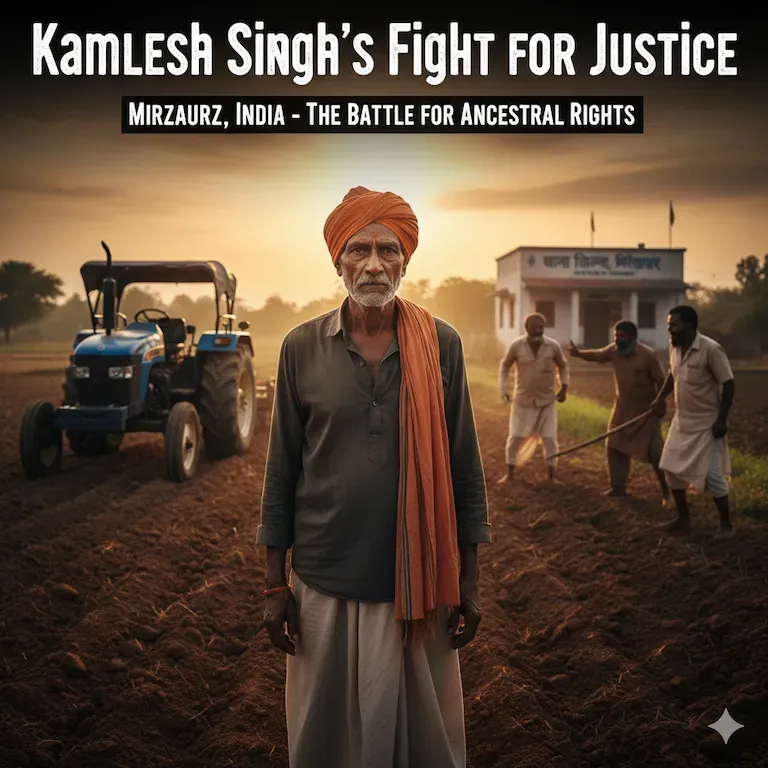
Kamlesh Singh’s Fight for Justice in Mirzapur is not just a personal quest; it symbolises the collective struggle of countless individuals victimised by systemic injustice. His relentless pursuit began after a tragic incident that took the life of his close friend, an event that ignited a fire within him to challenge the status quo. Unwavering in his resolve, Kamlesh has rallied the community, organised protests, and engaged local leaders to raise awareness about the rampant corruption and lawlessness in the region. His efforts have spurred hope among the marginalised, inspiring others to join the cause and seek accountability for their grievances.
Key takeaways from this blog post are as follows:
The blog post highlights a systemic failure where legal loopholes and administrative apathy allow a private land dispute to escalate into a human rights issue. Here are the key takeaways:
1. Police Inaction & False Assurances
The Jigna Police Station is criticised for its superficial handling of the case. Despite a site visit and verbal assurances from the accused, the harassment continued. The “Closed” status of the grievance is presented as a premature move that ignores the persistent threats faced by the complainant.
2. Manipulation of Ancestral Property
A central issue is the “new trend” of partitioning ancestral land through paid registries rather than traditional inheritance.
- This forces legal heirs to “buy” their shares.
- It creates a financial barrier that excludes poorer family members.
- It provides a window for “muscle men” to use corruption to grab land that was never formally registered.
3. The Legal “Pincers” (Police vs. Revenue)
The complainant is facing two challenges, highlighting the complexity of Indian land law:
- Criminal Front: Seeking an FIR for abuse and intimidation to ensure physical safety.
- Civil/Revenue Front: Utilising Section 116 of the U.P. Revenue Code, 2006, to seek a formal partition. The blog emphasises that without a clear division by the S.D.M. Sadar, the police often dismiss these cases as “civil matters.
4. Breakdown of Emergency Services
The mention of Dial 112 and the SPIO inquiry suggests that emergency response systems failed to provide real-time protection. This points to a gap between the government’s “safe society” rhetoric and the local reality of Mirzapur.
5. Demand for Accountability
The post identifies Shri Arvind Mohan (Joint Secretary) as the key figure for intervention. The ultimate takeaway is that “justice must be accessible”—meaning the administration must look beyond paperwork and address the physical intimidation occurring on the ground.
This situation highlights a distressing intersection of property disputes, family dynamics, and the struggle for administrative accountability. Below is a structured blog post detailing the nuances of your case and the broader systemic issues it represents.
Kamlesh Singh’s Fight for Justice in Mirzapur: When Law and Order Fail the Common Man
In the heart of Mirzapur, a quiet battle over soil and lineage has turned into a loud cry for justice. The case of Kamlesh Singh vs. The Local Administration is more than just a family feud; it is a diagnostic look at how the machinery of the state—from the local Jigna Police Station to the Revenue Courts—functions (or fails) when confronted with the “muscle power” of local offenders.
1. The Incident: Violence in the Fields
On the morning of June 8, 2024, someone shattered the sanctity of agricultural life. As Kamlesh Singh, his son, and a hired tractor driver attempted to plough their land, Raghuvar Dayal Singh and his associates allegedly accosted them. The encounter included not just a verbal disagreement but also a targeted act of intimidation that involved verbal abuse and physical obstruction of livelihood.
The authorities have provided a lacklustre immediate response, despite the attachment of photographic evidence to the official grievance (GOVUP/E/2024/0034568), raising serious questions about the safety of farmers on their land.
2. The Failure of Local Policing: The Role of Jigna Police Station
The crux of the complainant’s frustration lies with the Station House Officer (SHO) of Jigna. While the state government frequently touts a “criminal-free society,” the reality on the ground in Mirzapur paints a different picture.
- The Broken Assurance: The SHO reportedly visited the village and received a verbal assurance from the accused that no further hurdles would be created.
- The Reality: This assurance was allegedly a facade, proven false as soon as the authorities turned their backs.
- Administrative Apathy: The grievance was marked “Closed” on June 29, 2024, with a “report attached.” However, for the victim, the “investigation report” (Janch Akhya) serves as little comfort when the ground reality remains unchanged.
3. The Root Cause: Ancestral Property and “Registry Corruption”
This dispute isn’t just about a single day of abuse; it is rooted in a complex and arguably manipulative handling of ancestral property.
Kamlesh Singh points to a disturbing “trend” set by his late father: the partitioning of ancestral property through land registries rather than traditional inheritance. This method places an undue financial burden on heirs, requiring them to pay heavy stamp duties to “purchase” what is rightfully theirs by birth.
The applicant had no money to pay the heavy stamp duty required to purchase his own share of the land from his father. Now, his brothers are trying to grab that piece of land using muscle power and corruption.
This highlights a systemic loophole where legal instruments (registries) are used to circumvent the spirit of ancestral inheritance laws, often to the detriment of the less financially stable members of the family.
4. Seeking Redress: Section 116 of the U.P. Revenue Code 2006
Recognising that the police can only handle the criminal aspect (the abuse and threats), Kamlesh Singh has moved the S.D.M. Sadar’s office under Section 116 of the U.P. Revenue Code 2006.
What is Section 116?
This section is the legal gateway for the partition of a holding. It allows a co-tenure holder to sue for the division of their specific share in land.
- The Goal: To obtain a clear, legal boundary and title that prevents “muscle men” from claiming the entire plot.
- The Hurdle: Transparency in the S.D.M. office. Bureaucratic delays in revenue courts often allow aggressors to create “facts on the ground” through force while the legal case languishes.
5. The Breakdown of Accountability: Dial 112 and the S.P. Office
The complainant’s reach for justice extended to the Superintendent of Police (SP) Mirzapur, seeking information via the State Public Information Officer (SPIO) regarding the efficacy of Dial 112.
When a citizen calls for emergency police help and that help fails to curb illegal acts, the system suffers a “crisis of confidence.” By questioning the working of the emergency response team, the applicant is holding the mirror up to a system that claims to be “just a phone call away” but often feels miles away in times of actual crisis.
6. The Human Cost of “Muscle Power”
Behind the registration numbers and legal sections is a family living in a state of constant humiliation. The “daily routine” of the offenders—using physical strength to bypass the law—creates an environment of “anarchy.” When the police appear to side with the powerful, or at least remain neutral in the face of blatant illegality, it emboldens the aggressor and silences the victim.
7. A Call for Stringent Action (Kamlesh Singh’s Fight for Justice in Mirzapur)
The current status of the grievance is “Closed”, but the dissatisfaction is “High”. The complainant has identified Shri Arvind Mohan (Joint Secretary) at the Chief Minister’s Secretariat as the concerned officer.
The demands are clear and justified:
- Re-opening the Grievance: The “closed” status must be reconsidered, given that the harassment continues.
- FIR Registration: The Jigna Police must register a First Information Report (FIR) against the named offenders to initiate a criminal trial.
- Revenue Expediency: The S.D.M. Sadar must expedite the litigation under Section 116 to settle the partition legally and permanently.
Conclusion: Justice Must Be Accessible
The case of Kamlesh Singh is a litmus test for the Uttar Pradesh administration. When a citizen cannot plough his field without facing abuse, and when the police accept “false assurances” from known aggressors, they fail to fulfil the promise of a “Rule of Law.”
Justice should not be a luxury, reserved for those who can afford stamp duties or for those who hold “muscle power”. It must be accessible to the man behind the tractor. (Kamlesh Singh’s Fight for Justice in Mirzapur)
Here are the official contact details for the authorities, you mentioned to help you effectively pursue your case. Since the authorities marked your grievance as “Closed” despite unresolved issues, you need these contacts for your follow-up.
1. State Level Authorities (Lucknow) (Kamlesh Singh’s Fight for Justice in Mirzapur)
| Designation | Name | Contact Number | Email / Web Link |
| Joint Secretary (CM Office) | Shri Arvind Mohan | 0522-2226350 | arvind.12574@gov.in |
| CM Helpline | — | 1076 | jansunwai.up.nic.in |
| Chief Minister’s Office | — | 0522-2239234 (Fax) | cmup@nic.in |
- Location: Room No. 321, 3rd Floor, Lok Bhawan, U.P. Secretariat, Lucknow.
2. District Police Authorities (Mirzapur) (Kamlesh Singh’s Fight for Justice in Mirzapur)
| Designation | Name / Rank | CUG Mobile No. | Email Address |
| DIG / SSP Mirzapur | Shri Somen Barma | 9454400299 | spmzr-up@nic.in |
| Addl. SP (City) | Shri Nitesh Singh | 9454401104 | asp-city.mi@up.gov.in |
| CO Lalganj (Circle) | Shri Amar Bahadur | 9454401592 | co-lalganj.mi@up.gov.in |
| SHO Jigna | Inspector | 9454404006 | — |
3. Revenue & Administration (Mirzapur) (Kamlesh Singh’s Fight for Justice in Mirzapur)
| Designation | Authority | CUG Mobile No. | Office Phone |
| District Magistrate | DM Mirzapur | 9454417567 | 05442-257400 |
| S.D.M. Sadar | Sub-Divisional Mag. | 9454417672 | — |
| Div. Commissioner | Mirzapur Division | 9454417505 | 05442-252986 |
4. Summary of Application Details (Kamlesh Singh’s Fight for Justice in Mirzapur)
- Grievance Portal (IGRS): Jansunwai-Samadhan
- Case Tracking: You can track your status using Registration No. GOVUP/E/2024/0034568 on the portal.
- RTI (Right to Information): If you wish to seek the “Investigation Report” (Janch Akhya) mentioned in the remarks, you can file an online RTI at rtionline.up.gov.in.
Important Note on Communication (Kamlesh Singh’s Fight for Justice in Mirzapur)
When emailing Shri Arvind Mohan or the SP Mirzapur, please ensure you:
- Please mention your Grievance Registration Number in the subject line.
- Please express your “Not Satisfied” status regarding the previous closure, as the offenders continue to intimidate you and the police have not registered an FIR.
- Attach the photographs of the farming land as evidence. (Kamlesh Singh’s Fight for Justice in Mirzapur)
Would you like me to draft a concise email for you to send to the Joint Secretary (Shri Arvind Mohan) to formally contest the closure of your case?


Facing a similar challenge? Share the details in the box below, and our team of experts will do their best to help.