
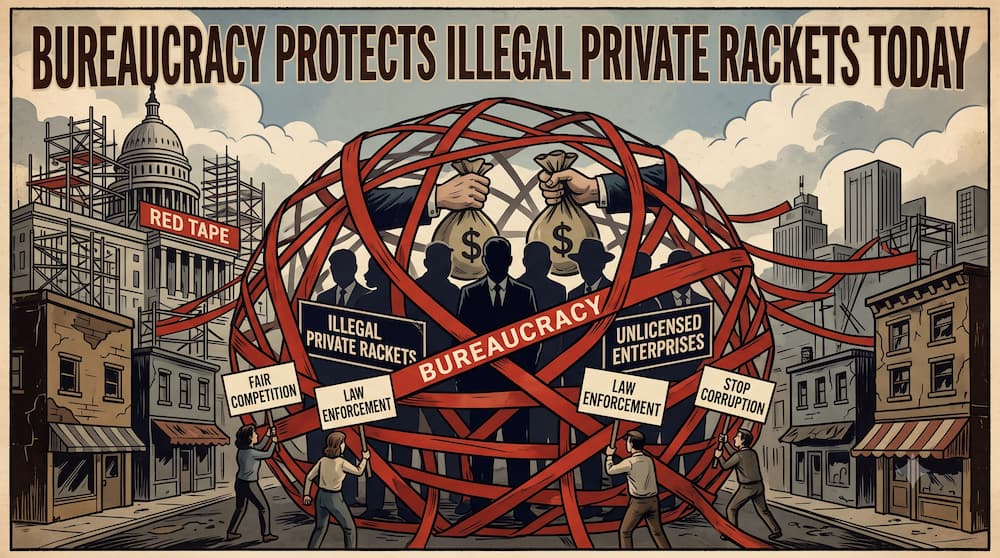
Bureaucracy Protects Illegal Private Rackets is a true story of private practice by a government doctor who, instead of dedicating his full attention to public health responsibilities, engaged in the lucrative realm of private practice. This situation raises critical questions about accountability within our healthcare systems. If the government took action against the government doctor for this unethical behavior, it stands to reason that it must also scrutinize the private nursing home associated with him. The duality of holding only one party responsible while overlooking the complicit institution creates a troubling loophole in our legal and moral frameworks. Both the doctor and the nursing home must face appropriate consequences to uphold the integrity of our healthcare system and ensure that public trust is not compromised by private interests that sidestep accountability.
Key Takeaways
- A government doctor exploited his position by running an illegal private practice, highlighting accountability failures in healthcare.
- Bureaucracy Protects Illegal Private Rackets as local health agencies delay investigations and shield complicit institutions.
- The case reveals severe patient exploitation and medical malpractice, including unnecessary treatments that endangered lives.
- Despite clear evidence of wrongdoing, the private hospital escaped penalties, showcasing systemic inaction within the bureaucracy.
- True accountability requires action against both corrupt doctors and the private facilities that enable their malpractice.
Shifting Files, Shielding Malpractice: How Bureaucracy Protects Illegal Private Rackets in Public Health
Standard healthcare remains a distant dream for many vulnerable citizens. This reality continues because public doctors run illegal commercial businesses through private clinics. Recently, a serious public health scandal came from Uttar Pradesh. As a result, this detailed analysis follows how official investigations, governor-supported orders, and organizational delays connect.
By looking at this specific case, we uncover how Bureaucracy Protects Illegal Private Rackets. Furthermore, we will examine how local health agencies delay openness, slow down investigations, and actively protect businesses from facing legal shutdowns.
The Genesis of the Scandal: Patient Exploitation and Profit-Diverting
The main problem started when a vulnerable, disabled citizen brought his seriously ill wife to the Maharaja Chet Singh District Hospital in Gyanpur, Bhadohi, for urgent care. However, the attending government doctor, Dr. Pradeep Kumar Yadav (Physician), misled the family instead of using state-funded public resources. He said that better, specialized care could only be found at a private place called Chhote Lal Bind Hospital. This facility is located across the district border in Baraut, Handia, Prayagraj.
Once shifted to the private facility, commercial motives took complete precedence over basic clinical safety:
- Medical Malpractice: The doctor administered heavy anti-malarial injections and medications. He did this despite a clear, pre-existing laboratory report showing the patient was negative for malaria.
- Severe Drug Reactions: This unwarranted, erroneous treatment triggered an acute, life-threatening drug reaction. As a direct result, the patient’s body turned black. Additionally, she suffered severe secondary medical emergencies, including sudden cardiac distress, acute liver dysfunction, and persistent vomiting.
- Financial Hardship: The poor family had to borrow large amounts of money to save the patient from serious neglect. As a result, they piled up over ₹1,50,000 in bills at expensive private hospitals.
Unmasking the “On-Call” Private Racket
Following formal public grievances, preliminary investigations uncovered a deeply institutionalised on-call private practice racket. Initially, inspection teams noticed a physical nameplate belonging to the government specialist prominently displayed on the walls of Chhote Lal Bind Hospital.
However, the private hospital management took swift evasive actions as soon as official spot inspections were organized. When investigators arrived for a surprise raid, the management had staff hurriedly remove the physical nameplate from the building.
Despite this cover-up, the paramedical staff—including the on-duty technicians and pharmacists—confessed the truth to the state investigators. They revealed that the system worked entirely on an “on-call” basis. Whenever private patients came to the facility, the management called the government-paid doctor directly via mobile phone to conduct paid consultations. Therefore, this smooth coordination during surprise checks provides a main example of how Bureaucracy Protects Illegal Private Rackets. It does so by allowing facilities time to erase physical evidence.
Validated by High-Level Inquiries and the Governor’s Order
While local administrative bodies tried to dismiss the initial complaints as unfounded, a subsequent high-level statutory inquiry permanently altered the legal trajectory of the case. Dr. Shobhana Dubey, the Additional Director of Medical, Health and Family Welfare (Vindhyachal Mandal, Mirzapur), took over the investigation.
Dr. Dubey’s meticulous inquiry completely proved and validated all the earlier investigative findings. Her final statutory report confirmed that the government doctor had actively used the private facility to run a commercial, illegal practice racket while drawing a state salary.
Faced with an irrefutable report from the Additional Director, the state machinery had to act. The Government of Uttar Pradesh, executing orders through the constitutional authority of the Governor, officially concluded the disciplinary proceedings against the specialist. Consequently, the state issued two severe adverse entries into Dr. Pradeep Kumar Yadav’s permanent service record. These penalties included a formal censure entry and the stoppage of his salary increment with cumulative effect.
The Protected Entity: Why Was Chhote Lal Bind Hospital Not Penalized?
The critical, unanswered systemic question remains: why has the private clinic not faced punitive closure if the state government and the Governor have officially established that a serious service crime occurred at Chhote Lal Bind Hospital?
Under the strict statutory provisions of the Clinical Establishments (Registration and Regulation) Act, any private clinical facility found abetting, hosting, or operating an illegal commercial nexus with a public government doctor faces immediate suspension or permanent cancellation of its licence to operate. Yet, the facility continues to run seamlessly. This stark gap proves that Bureaucracy Protects Illegal Private Rackets through calculated systemic inaction.
In this instance, the hospital administration used the quick removal of the physical nameplate and subsequent contradictory, notarised affidavits to construct a legal shield. Meanwhile, the local health authorities have chosen to treat the absence of the doctor at the exact second of the raid as an excuse. Thus, they completely ignore the confessions of the paramedical staff. In addition, they ignore the ultimate findings verified by the Governor’s office.
Institutional Procrastination: How the CMO Prayagraj Stalls Action
The weaponisation of administrative channels provides clear evidence of how Bureaucracy Protects Illegal Private Rackets. Rather than deploying local enforcement teams to shut down the violating facility, the CMO Prayagraj has engaged in systematic procrastination through two main tactics:
1. The Jurisdictional Loophole
Because the doctor belonged to the Bhadohi district cadre (Vindhyachal Division) and the private hospital sat across the border in Prayagraj district, the CMO Prayagraj used overlapping geographic lines to stall. Specifically, the Additional Director of Prayagraj chose to bundle the file and transfer it upwards to the Director General of Medical and Health Services in Lucknow. Shifting the dossier out of the district effectively pauses local accountability. As a result, this move ensures that Bureaucracy Protects Illegal Private Rackets. It does so under the cover of “higher-level reviews”.
2. The Suppression of RTI Disclosures
The most damning evidence of institutional procrastination is the absolute withholding of public information. In response to an online Right to Information (RTI) application (Registration No: DIRMH/R/2024/61103) demanding point-wise documentation on the legal provisions and action logs against the private clinic, the public authority maintained total silence. They refused to provide file notings. Moreover, they did not verify what action, if any, they took against the building. Ultimately, this silence led to a protracted battle before the State Information Commission.
Conclusion: The Path Forward for Systemic Accountability
This case exposes a dangerous reality: punishing a corrupt public official is completely meaningless if the private infrastructure feeding that corruption is left untouched. By penalising the doctor but ignoring the hospital, the local health administration merely prunes the branches of a toxic tree. At the same time, it keeps its roots perfectly healthy.
True accountability can only be achieved if the State Information Commission acknowledges how Bureaucracy Protects Illegal Private Rackets. It must also reject the deceptive dismissal applications filed by local health boards. The public has an absolute right to access the Action Taken Reports and see the Clinical Establishments Act enforced uniformly. Until private facilities face real financial and legal consequences for running on-call rackets with public doctors, the exploitation of poor patients will continue unabated behind closed clinic doors.
Based on the official documents, online RTI forms, and tracking portals provided, here are the application identifiers, contact credentials, and official web link details of the public authorities involved in this case:
🏛️ Case Registration & Application Identifiers (Bureaucracy Protects Illegal Private Rackets)
- State Information Commission Appeal Case Number:
S-02/A/1339/2024(also logged asS-02/A/1339/2025in dispatch letters) - UPIC Registration Number:
A-20241000147 - UPIC Welcome ID:
UPICR20240000149 - Online RTI Request Registration Number:
DIRMH/R/2024/61103 - Current Knowledge of Facts (KOF) Diary Number:
D-060720260137(Filed/Forwarded on 06/07/2026) - Prior KOF Diary Numbers:
D-130620250078andD-010920250061 - CMO Prayagraj Dispatch Letter Number:
मु०चि०अ०/जन०सू०अ०अधि०/2026-27/3443 - CMO Bhadohi Dispatch Letter Number:
मु०चि०अ०/डा० प्रदीप कुमार, चि०अ०/कार्यवाही/2023/512 - Core IGRS Reference Numbers (Bhadohi):
60000230177675,60000230177663,6000030177667,60000230177799,6000030177498, and60000240016948 - Complainant’s Original IGRS Number (Prayagraj):
8090306360
📧 Email Directories & Mobile Contacts (Bureaucracy Protects Illegal Private Rackets)
1. Public Authorities & Hearing Courts (Bureaucracy Protects Illegal Private Rackets)
- Uttar Pradesh Information Commission (Hearing Room S-2):
- Email:
hearingcourts2.upic@up.gov.in
- Email:
- Chief Medical Officer (CMO), Prayagraj:
- Email:
cmoald@gmail.com
- Email:
- Additional Director (Medical, Health & Family Welfare), Prayagraj Division:
- Email:
adallahabad@gmail.com
- Email:
- District Magistrate (DM), Prayagraj:
- Email:
dmall@nic.in
- Email:
2. Litigants & Citizen Details (Bureaucracy Protects Illegal Private Rackets)
- Appellant (Yogi M. P. Singh):
- Mobile Number:
+91-7379105911 - Email:
yogimpsingh@gmail.com
- Mobile Number:
- Original Complainant (Shri Jaychand Maurya):
- Mobile Number:
8090306360
- Mobile Number:
🌐 Official Web Portal Links for Citizen Actions (Bureaucracy Protects Illegal Private Rackets)
- File or Track State RTI Applications: Use the Uttar Pradesh RTI Online Gateway to submit point-wise queries directly to the Directorate of Medical and Health Services Personnel Section[cite: 3].
- Monitor Appeals and Hearing Room Status: Access the Uttar Pradesh Information Commission (UPIC) Registry Portal to track ongoing second appeals, monitor Knowledge of Facts (KOF) submissions, and check Room S-2 schedules[cite: 4].
- Lodge Grievances Against Medical Negligence: Submit or track complaints regarding illegal private practices and doctor misconduct through the Jansunwai – UP Integrated Grievance Redressal System (IGRS)[cite: 2].
- Review Central Health Guidelines and Cadre Orders: Visit the Directorate of Medical and Health Services, Uttar Pradesh to look up service conduct rules, clinical establishment regulations, and top-level administrative decisions[cite: 1, 2].


Facing a similar challenge? Share the details in the box below, and our team of experts will do their best to help.