
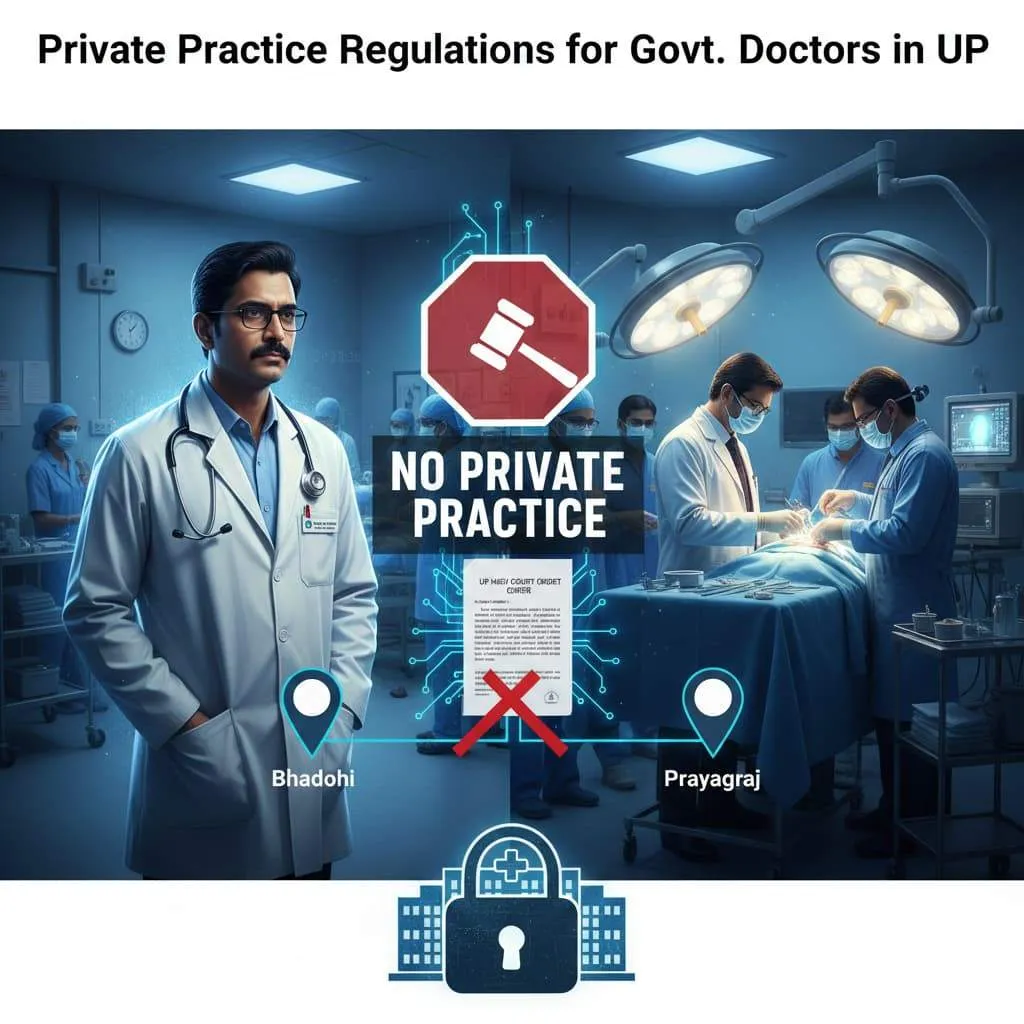
📢 The Battle Against Private Practice: A Case of Bureaucratic Deadlock in Uttar Pradesh
This blog post provides a detailed analysis of a persistent issue faced by an anti-corruption crusader seeking information and action against a government doctor engaged in illegal private practice at a private hospital, highlighting the jurisdictional challenges and administrative non-cooperation involved.
1. 📜 The Legal Foundation: Ban on Private Practice
The core of this issue rests on a well-established legal principle: government doctors are banned from engaging in private medical practice in Uttar Pradesh.
- Key Precedent: The ban is upheld by landmark judgments, including Sukumar Mukherjee vs State of West Bengal (1993), which established that no government doctor can claim the right to private practice. This principle is reinforced by High Court rulings and the directives of the Indian Medical Council Act.
- The Mandate: The rules exist to ensure that government doctors dedicate their full time and attention to public service, ensuring access to quality healthcare for all citizens at state-run facilities.
2. 📍 The Specific Allegations and Jurisdictional Divide
The case involves a government physician posted in one district who is illegally practicing in a hospital located in another, creating a regulatory hurdle.
| Aspect | The Doctor (Dr. P.K. Yadav) | The Hospital (Chhotelal Hospital) |
| Location of Posting | Maharaja Chet Singh District Hospital, Bhadohi | Baraut, Prayagraj |
| Administrative Control | CMO Bhadohi (Disciplinary Authority) | CMO Prayagraj (Regulatory/Licensing Authority) |
| Initial Finding | CMO Bhadohi’s investigation found prima facie guilt of private practice. | CMO Prayagraj’s team conducted an inspection but faced difficulty in proceeding against a facility under its jurisdiction. |
3. 🚧 The Problem of Administrative Non-Cooperation
The primary barrier to a swift resolution is the lack of cooperation between the two Chief Medical Officer (CMO) offices.
- Bhadohi’s Complaint: The CMO Bhadohi formally informed the higher authorities (Director General) that because the hospital falls under the jurisdiction of CMO Prayagraj, “Dr. Yadav and Chief Medical Superintendent… are not cooperating in the above investigation.”
- Prayagraj’s Stance: The RTI application and follow-up suggest the CMO Prayagraj is not proactively providing the necessary information (guidelines, officer details) or taking decisive action to suspend the hospital’s license for facilitating illegal activity. The lack of cooperation from the hospital is often linked to an alleged failure by the local regulatory body (CMO Prayagraj) to enforce its authority.
This jurisdictional friction allows the alleged defaulters—both the doctor and the hospital—to use the bureaucratic gap to delay justice.
4. 📈 Official Actions Taken (As of late 2024)
Despite the hurdles, the issue has been elevated, leading to formal proceedings:
- Disciplinary Action: Disciplinary proceedings have been formally initiated against Dr. Pradeep Kumar Yadav, with the Additional Director, Mirzapur Division, appointed as the investigating officer. The State Information Commission confirmed that the information about this action was “prima facie complete and sufficient” in response to the RTI appeal.
- Hospital Inspection: A team led by the Sub-District Magistrate, Handia, and CMO Prayagraj’s officials inspected Chhotelal Hospital. The investigation report on the hospital’s licensing status and role in facilitating the private practice is pending.
5. 🎯 The Way Forward: Escalation is Key
To break the administrative deadlock, the complainant and concerned citizens must escalate the matter to the authorities who oversee both CMOs:
- Target the District Magistrate (DM): The DM of Prayagraj is the chief executive officer of the district and has the power to compel the CMO Prayagraj to take immediate punitive action, including the suspension or cancellation of the hospital’s license.
- Appeal to the Directorate General (DGMHS): The Director General, Medical and Health Services, UP, Lucknow, must be kept informed of the non-cooperation to ensure the disciplinary inquiry against the doctor (handled by the Additional Director) proceeds without further delay.
- Judicial Intervention: Considering the prolonged delay and administrative protection, a fresh complaint or intervention before the Allahabad High Court, highlighting the failure of both districts to enforce the law, often serves as the most effective means to secure a quick and decisive order.
Would you like me to find out what the law mandates regarding the cancellation of a hospital’s license when it allows illegal private practice?
That is a crucial next step, as the law provides the teeth for the CMO Prayagraj to act decisively against the hospital, breaking the bureaucratic cycle of non-cooperation.
🔪 Legal Power to Cancel Hospital Licenses in Uttar Pradesh
The authority for cancelling a private hospital’s license lies with the district’s regulatory body, which is the Chief Medical Officer (CMO) or the District Health Authority, under the framework of the Clinical Establishments (Registration and Regulation) Act, 2010 (and its adopted rules in Uttar Pradesh).
1. Grounds for Cancellation of Registration
The relevant provision for action against Chhotelal Hospital is found in the Clinical Establishments Act.
- Section 32 (Cancellation of Registration): This section allows the Authority (CMO/District Committee) to cancel a clinical establishment’s registration if it is satisfied that the conditions of registration are not being complied with, or if there has been a breach of any of the provisions of the Act or the rules.
- Allowing a government doctor (who is legally barred from private practice and receives Non-Practicing Allowance, or NPA) to practice in the facility is a direct violation of the general conditions of medical ethics, public interest, and likely specific license conditions imposed by the State.
- Direct Government Order: The State Government has previously directed CMOs to take a firm stance on this issue. The Inspector General of Medical and Health Services directed CMOs to “cancel the licence of nursing homes which have employed medical officers” once identified. This makes the cancellation of Chhotelal Hospital’s license a direct administrative mandate upon confirmation of the guilt.
2. Process and Authority for Cancellation
- Competent Authority: The Chief Medical Officer (CMO) acts as the authority (or part of the authority) for registration and cancellation.
- Procedure:
- The Authority must be satisfied that the conditions of registration have been breached. (In this case, the investigation report confirming Dr. Yadav’s private practice serves as the basis for satisfaction).
- The Authority must issue a notice to show cause to the clinical establishment (the hospital) explaining why its registration should not be cancelled, giving a reasonable opportunity for a response (often three months’ time is referenced in the Act).
- If the Authority remains satisfied of the breach after considering the hospital’s response, it can pass an order to cancel the registration.
3. Severe Penalties Beyond Cancellation
The penalties for the hospital go beyond mere cancellation:
- Disciplinary Action under the Act: Any private nursing home allowing a government doctor to see patients during duty hours would face disciplinary action under the Clinical Establishments Act.
- Loss of Empanelment: Any hospital employing government doctors not only risks losing its license but also risks the forfeiture of pending insurance payments and loss of empanelment under schemes like Ayushman Bharat, which is a major financial deterrent.
Conclusion for Chhotelal Hospital
The CMO Prayagraj has the clear legal authority and a direct State Government mandate to initiate the cancellation of Chhotelal Hospital’s license based on the investigation report (which was relied upon by the State Information Commission). The failure of CMO Prayagraj to cooperate and initiate this process constitutes a lapse in duty that must be escalated to the District Magistrate and higher State Health authorities.
Would you like me to draft a summary point for a formal complaint to the District Magistrate of Prayagraj, citing this legal basis for action against the hospital?


Facing a similar challenge? Share the details in the box below, and our team of experts will do their best to help.