
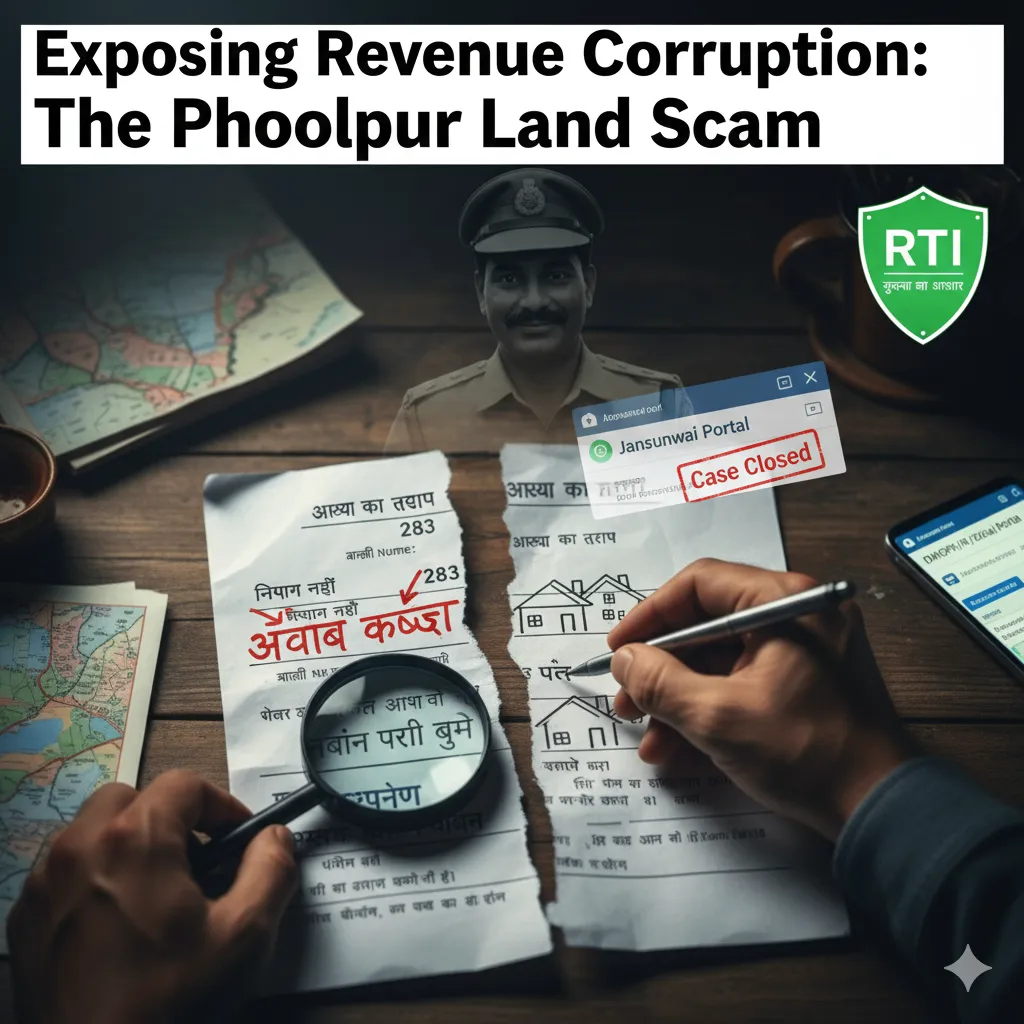
Exposing Revenue Corruption: How False Reports Protect Land Encroachers in Phoolpur
The integrity of our land records is the backbone of rural justice. Indeed, the entire system of governance collapses when the very officials tasked with protecting government land begin to submit forged reports. Furthermore, they create misleading reports to shield illegal encroachers. In this context, this blog post examines a specific case of alleged corruption in Tehsil Phoolpur, District Prayagraj and highlights the importance of exposing revenue corruption. Moreover, it provides citizens with a roadmap for fighting back under the Right to Information (RTI) Act.
The Core Issue: Protecting Government Property
Government land, often recorded as Naveen Parti (wasteland), is public property. Therefore, under Section 122B of the U.P. Zamindari Abolition and Land Reforms Act, 1950, the Tehsildar has a legal duty. Specifically, this duty requires him to initiate proceedings against anyone who encroaches upon such land.
A disturbing trend has emerged. Subordinate revenue staff, such as Lekhpals, are reportedly filing “clean chit” reports on the Jansunwai (IGRS) portal. These reports often claim that, surprisingly, the land remains vacant even after they have built permanent residential structures. This is not just a mistake; indeed, it is a calculated act of official misconduct. Consequently, the aim is to favour private parties over the state. (Exposing Revenue Corruption)
Anatomy of a Misleading Report (Exposing Revenue Corruption): The Phoolpur Land Scam
In a recent case involving Araji Number 283 in Village Saraijeet Rai Urf Pure Bhawa, there was a complainant. His name was Shri Tej Bahadur Singh. He raised a serious alarm regarding illegal constructions. Despite specific names and details provided, the official response from the Lekhpal stated: (Exposing Revenue Corruption)
“At present, no construction work of any kind is being carried out… the land is mostly vacant.”
This statement is a classic example of bureaucratic wordplay. By focusing on “current construction,” the official ignores the existing illegal houses. This allows us to close the case on the portal even though we have not resolved the encroachment. When officials prioritise semantics over ground reality, the result is the permanent loss of government assets.
The Role of RTI in Exposing Corruption
When the grievance system fails, the Right to Information Act, 2005 becomes the most potent weapon for the citizen. Moreover, recently, RTI activist Yogi M.P. Singh has stepped in to demand transparency. Consequently, the strategy is simple: force the department to provide documentary evidence that contradicts their own false claims. (Exposing Revenue Corruption)
To expose corruption in such matters, an RTI must specifically demand:
- The Nazri Naksha (Site Map): A visual representation of the land showing structures.
- Measurement Records: Exact dimensions of built-up areas.
- Staff Details: The names and joining dates of the officials are recorded. Consequently, this helps establish a timeline of their postings and potentially detect collusion.
Securing these documents, therefore, allows a complainant to prove that no one properly inspected the site. Furthermore, it illustrates that someone deliberately forged the report.
Accountability and the Jansunwai Portal (Exposing Revenue Corruption): The Phoolpur Land Scam
The Jansunwai (IGRS) portal was launched by the Uttar Pradesh government to ensure “Good Governance.” However, the effectiveness of the portal depends on the honesty of the reporting officer.
If a Lekhpal or Tehsildar submits a false report, it is, therefore, a criminal breach of trust. Under the law, such officials can consequently face disciplinary action and even FIRs for forging public documents. Moreover, the arbitrary closure of cases sometimes cites a “missed phone call” as grounds for dismissing a serious land dispute. Ultimately, this practice undermines the Chief Minister’s vision of a corruption-free state.
The Legal Framework: Section 122B
For those unfamiliar with the law, Section 122B serves as the primary tool. It enables the Land Management Committee to recover possession of land.
- Notice (Form 49-Ka): The Tehsildar must issue a notice to the encroacher.
- IConduct a formal inquiry. The official must confirm the encroachment, issue an eviction order, and recover damages.
When a Lekhpal reports that “no construction is happening,” he effectively prevents the issuance of the initial notice. This action stops the legal machinery before it can even start.
A Call for Independent Verification
The current system allows the same office accused of negligence to “investigate” itself. In the Phoolpur case, the report was “approved” by the very Tehsildar whose staff is under suspicion.
True justice requires: (Exposing Revenue Corruption)
- Independent Inspections: Field visits should be conducted by senior officials from different Tehsils or the District Headquarters (ADM level).
- Geotagged Photos: All inspection reports must include geotagged, time-stamped photographs to prevent “table-top” reporting.
- Action Against Forgery: If an RTI reveals that a report was false, the state must take decisive action. They should make an example of the reporting officer.
Conclusion: The Path Forward (Exposing Revenue Corruption)
The battle for Araji Number 283 is not just about one piece of land. It questions whether the law applies to everyone or only to those without “influence.” The RTI filed by Yogi M.P. Singh (Registration: DMOPR/R/2026/60018) is a crucial step in this fight.
Citizens must remember that they are not powerless. Furthermore, we can achieve this by documenting every step and using the RTI Act. In addition, we must also refuse to accept vague answers. As a result, this way, we can force the revenue department to act with integrity. Government land belongs to the people. Consequently, it is our collective duty to ensure it is not sold off. Therefore, we must prevent it from being protected by a wall of corrupt paperwork.
Next Steps for Activists
If you are facing a similar issue:
- Record the Encroachment: Take your own photos and videos of the site.
- Challenge the Report: Do not just mark “Dissatisfied”—file a specific appeal pointing out the lies in the report.
- Use RTI: Demand the names of the officers and the maps as shown in the Phoolpur case.
I have organised the blog post into a clean, professional format. You can copy the text below for your blog or use it as a script for a social media campaign.
The Phoolpur Land Scam: How Bureaucratic Forgery Protects Illegal Encroachers (Exposing Revenue Corruption)
The Crisis of Accountability in Revenue Governance
In the heart of Uttar Pradesh, a silent battle is being fought over the integrity of public land records. The state government promotes “Zero Tolerance” toward corruption. However, the ground reality in Tehsil Phoolpur, District Prayagraj, is quite different. The situation tells a different story. The narrative shows how subordinate revenue officials, expected to be the custodians of our land, use “table-top” reports. They allegedly employ these reports to shield illegal encroachers on government property.
The Case of Araji Number 283: A Study in Official Misconduct (Exposing Revenue Corruption)
The matter centers on a specific plot of land, Araji Number 283, located in Village Saraijeet Rai Urf Pure Bhawa. This land officially carries the status of Naveen Parti (Government Wasteland). Local resident Tej Bahadur Singh has filed complaints, claiming that influential individuals illegally erected permanent residential structures on this site.
According to Section 122B of the U.P. Zamindari Abolition and Land Reforms Act, any encroachment on government land requires a prompt legal response. This includes demolition and recovery of costs. However, the local Lekhpal and Tehsildar’s office did not uphold the law. They submitted a report. This report effectively stalled the justice system.
The Anatomy of a “False Report”
The official report was submitted to the Jansunwai (IGRS) portal. It claimed that “at present, no construction work is being carried out.” It also stated that the land is “mostly vacant.”
This is where the corruption hides: in the tenses of the verbs. By stating that no construction is underway, the officials ignored the permanent houses already built. This deliberate omission is a classic tactic that gives encroachers a “clean chit” while appearing to address the complainant’s concerns. Closing a serious land-grab case on such flimsy, misleading grounds is more than just negligence. It is a breach of public trust. (Exposing Revenue Corruption)
The Counter-Strike: Using RTI to Unmask the Truth
When the grievance portal failed to provide justice, Yogi M. P. Singh, a dedicated advocate for transparency, stepped in. He realised that the “clean chit” report was likely a fabrication. Therefore, he filed a comprehensive Right to Information (RTI) application (Registration Number: DMOPR/R/2026/60018).
The RTI strategy targets corrupt officials, leaving them with nowhere to hide. It demands:
- Certified Site Maps (Nazri Naksha): To visually prove the existence of structures.
- Field Measurement Records: To document the exact dimensions of illegally built-up areas.
- Deployment Timelines: We need to identify exactly which officers were in power when the encroachment occurred. Additionally, we must determine when they signed the false reports.
Why This Matters to Every Citizen
This is not just about one village in Phoolpur. When a Lekhpal or Tehsildar falsifies a report, they privatise public assets. They do this for personal gain or under the influence of local strongmen.
- Economic Loss: The government permanently loses land intended for schools, parks, or community centers.
Systemic Decay: A report can be forged for a small plot. This possibility casts doubt on the entire district’s revenue database, making the whole system suspect.- Erosion of Faith: Citizens lose faith in the digital governance portals (IGRS). This happens when they perceive the system as rigged in favor of lawbreakers.
The Legal Road Ahead: Section 122B and Beyond
The fight for Araji Number 283 is now a legal battle. The goal is to compel the District Magistrate of Prayagraj to ignore the previous biased reports. The aim is also to order an independent, senior-level inquiry. If the RTI reveals that the Lekhpal’s report was factually incorrect, the involved staff can face:
- Disciplinary Proceedings for dereliction of duty.
- Criminal Charges for forging public documents.
- Mandatory Eviction of the encroachers under Section 122B.
Conclusion: Transparency is the Only Cure (Exposing Revenue Corruption)
The case of Phoolpur is a reminder. Indeed, the “Right to Information” is the most powerful tool in a democracy. Furthermore, by demanding maps, names, and joining dates, we strip away the veil of anonymity that corrupt officials hide behind.
The public’s eyes are now on the Tehsildar of Phoolpur. Will the department provide the truth, or will they continue to hide behind vague terminology? The answer will determine whether the rule of law or the rule of the “land mafia” prevails in Prayagraj.
To help you with your follow-up, here are the official contact details. Specifically, they will ensure your RTI reaches the correct desk. Moreover, these contacts are for the public authorities in District Prayagraj involved in your matter.
1. Key Public Authorities (Revenue & Administration) (Exposing Revenue Corruption)
| Designation | Office | Mobile (CUG) | Email ID |
| District Magistrate | Collectorate, Prayagraj | 9454417517 | dmall@nic.in |
| ADM (Finance/Revenue) | Collectorate, Prayagraj | 9454417588 | admfr.ah-up@gov.in |
| SDM Phoolpur | Tehsil Phoolpur | 9454417816 | sdmphul.ah-up@gov.in |
| Tehsildar Phoolpur | Tehsil Phoolpur | 9454417824 | (Nodal RTI Office) |
2. RTI Nodal Officers & Appellate Authorities (Exposing Revenue Corruption)
If you do not receive a response for your RTI (Registration No: DMOPR/R/2026/60018) within 30 days. Please reach out to the officers listed below for your First Appeal.
- Nodal Officer (DM Office): Vinita Singh
- Phone: 8840843880
- Email:
admfr.ah-up@gov.in
- First Appellate Authority (Division): Divisional Commissioner, Prayagraj
- Phone: 0532-2640250
- Email:
commall@nic.in
3. Important Web Links
- Official District Website: prayagraj.nic.in (For checking official “Who’s Who” and updates).
- UP RTI Online Portal: rtionline.up.gov.in (To track your current request).
- Jansunwai (IGRS) Portal: jansunwai.up.nic.in (To check the status of your original grievance).
- Bhulekh UP: upbhulekh.gov.in (To verify the latest Khatauni/land records for Araji 283).
4. Summary of Your Application ID (Exposing Revenue Corruption)
RTI Registration Number: DMOPR/R/2026/60018
Date of Filing: 05/01/2026
Status: RTI Request Received
Concerned PIO: Jan Soochana Adhikari (Tehsildar), Phoolpur
. Alternatively, you can contact the Tehsildar (9454417824) after a week. Make sure to mention your RTI registration number. This often speeds up the process as it shows the applicant is actively tracking the case.


Facing a similar challenge? Share the details in the box below, and our team of experts will do their best to help.