
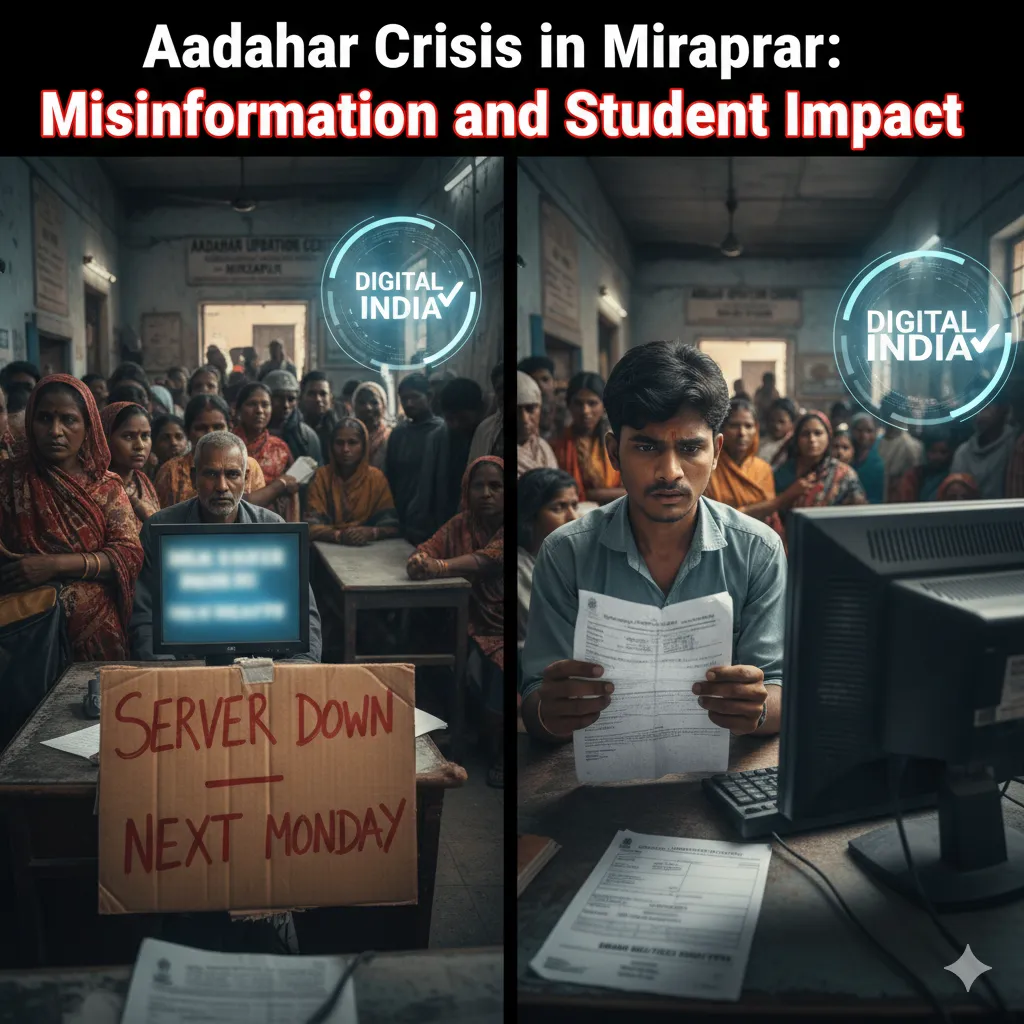
Key Takeaways (Aadhaar Crisis in Mirzapur)
- The Aadhaar Crisis in Mirzapur highlights significant administrative failures, obstructing citizens’ access to essential services.
- Despite policies from the UIDAI, local centers create arbitrary restrictions, limiting Aadhaar services and leaving citizens in distress.
- Students face dire consequences due to delayed Aadhaar updates, impacting their ability to apply for scholarships.
- Investigations reveal a systemic ‘blame-game’ among departments, with citizens caught in the middle, lacking accountability.
- Immediate reforms are necessary, including daily service at facilitation centres and specific support for students during crucial application periods. (Aadhaar Crisis in Mirzapur)
The Aadhaar Crisis in Mirzapur: When Digital India Meets Administrative Apathy
In the era of “Digital India,” the Aadhaar card has shifted from being a simple identity document. It has indeed become a mandatory gateway for survival. The 12-digit number is crucial for accessing bank accounts. It is essential for pension schemes. It also unlocks student scholarships. The number is, in fact, the key to every citizen’s rights. However, the Aadhaar Crisis in Mirzapur means that in the district of Mirzapur, Uttar Pradesh, this gateway faces systematic obstruction. Specifically, mismanagement, arbitrary restrictions, and a blatant lack of administrative accountability contribute to this blockade.
The Core Conflict: Policy vs. Practice
The Unique Identification Authority of India (UIDAI) mandates that Aadhaar enrollment and update centers operate during standard working hours. Therefore, this is to serve the public. However, the ground reality in Mirzapur reveals a different story. In fact, public facilitation centers have created their own “local laws.” This is particularly evident at the Bank of Baroda Main Branch and at the Mirzapur City Post Office (Beltar/Badlikatra).
The Aadhaar Crisis in Mirzapur exemplifies the challenges of a “token system” that is neither transparent nor fair. Consequently, officials have been observed capping services to a handful of individuals. At times, they serve as few as 25 people per day.
As a result, this leaves hundreds of others in the late-morning sun with no hope of assistance.
The Plight of the Student Community (Aadhaar Crisis in Mirzapur)
The timing of this administrative failure is particularly devastating. Consequently, January marks a critical period for students across Uttar Pradesh. In fact, thousands of students, including Beerbhadra Singh, are currently attempting to submit scholarship applications. Moreover, these scholarships are often the only means for students from economically weaker sections to continue their education.
A mandatory requirement for these applications is an updated Aadhaar card linked to a functional mobile number. However, the staff at Mirzapur’s facilitation centers deny or delay these updates through “server down” excuses. Moreover, they also implement arbitrary Monday-only service rules. Consequently, they are not just being inefficient—they are actively jeopardizing the academic future of the youth.
Detailed Evidence of Operational Failure
Our investigation into the grievance filed under UIDAI/E/2025/0024799 has highlighted two primary locations of concern:
1. Bank of Baroda, Mirzapur Main Branch (Aadhaar Crisis in Mirzapur)
At this branch, officials have restricted the essential service of Aadhaar updating to Mondays only. Consequently, this “once-a-week” policy lacks any basis in UIDAI regulations. Furthermore, when the scheduled Monday arrives, staff frequently turn away citizens with the claim that the “server is down.” As a result, this creates a bottleneck that forces citizens to return week after week, ultimately wasting their time and daily wages.
2. Mirzapur City Post Office (Beltar/Badli katra)
The situation at the Beltar/Badlikatra Post Office raises even more concern. Reports indicate that operators engage in misbehavior and harassment, frequently denying service without valid reasons. When citizens question the lack of transparency, they encounter hostility instead of help. This is similar to the Aadhaar Crisis in Mirzapur, where individuals face significant challenges linked to identity verification, exacerbating the issues of access and service delivery.
The “Information Gap” Excuse: A Shield for Accountability (Aadhaar Crisis in Mirzapur)
The most frustrating aspect of this struggle is the response from the authorities. When I lodged a formal grievance, the Postmaster General’s office in Allahabad (Prayagraj) closed the case with a startling remark. The Assistant Director, Shri J.M. Pandey, noted that I “did not specify which Post Office” was, involved in my complaint.
Administrative “red-tapism” is clearly evident in this example. For instance, the original complaint explicitly named the Beltar Badlikatra Post Office. However, by claiming the information was missing, the department successfully avoided conducting a physical inquiry into their staff’s conduct. Consequently, this tactic of closing cases on technicalities creates a systemic barrier to justice.
The Administrative Loophole: Who is Responsible?
Departments are engaging in a dangerous “blame-game.” The UIDAI supplies the software and technical framework, while the Department of Posts provides the physical premises and staff. The District Administration monitors the welfare of the citizens.
The Post Office blames the server when a center fails. The UIDAI blames the local operator. Meanwhile, the citizen is left standing in a queue. This lack of a single point of accountability enables corruption in Mirzapur’s Aadhaar centers. It also allows harassment to thrive there. (Aadhaar Crisis in Mirzapur)
Demands for Immediate Reform (Aadhaar Crisis in Mirzapur)
To resolve this crisis, the following steps are non-negotiable:
- Abolish Arbitrary Capping: Aadhaar centers must serve the public during all official working hours. They should not serve only the first 25 people.
- Daily Service at Banks: Therefore, banks must provide mandatory services like Aadhaar updates every working day. Moreover, the MoUs signed between UIDAI and lead banks outline this requirement.
- Physical Verification of Logs: The Appellate Authority must verify the machine logs of the Beltar Post Office. They need to determine how many hours the terminal actually operated. They must also check how many citizens the terminal turned away.
- Sensitivity Toward Students: Given the scholarship deadlines, establish a “Fast-Track” counter for students in Mirzapur.
Conclusion: A Call to Action
Aadhaar empowers citizens, not clerks behind desks who harass the public. Yogi M. P. Singh actively leads the struggle for the residents of Mirzapur. He emphasizes the importance of more than just a plastic card. He fights for the right to dignity. Moreover, He also advocates for access to government services without being subjected to the whims and fancies of local operators.
We call upon the Postmaster General of Allahabad and the Regional Office of UIDAI Lucknow. They should stop providing generic “links to functional centers.” Instead, they need to start fixing the centers that are broken. The students of Mirzapur cannot wait for another “next Monday.” (Aadhaar Crisis in Mirzapur)
The most alarming aspect of your case is not just the service failure in Mirzapur; rather, the administrative staff deliberately use “Cryptic Denial” to kill a grievance without investigating it. In fact, this pattern indicates that the administrative staff consistently employ “Cryptic Denial” to kill a grievance without investigating it.
This is a sophisticated form of bureaucratic stonewalling where, consequently, officials use the portal’s interface to silence valid complaints. Moreover, here is an analysis of how this cryptic denial was executed in your specific case.
1. The “Strategic Blindness” Tactic
The remark by J. M. Pandey (Assistant Director) is, indeed, a classic example of strategic blindness. He claimed, therefore, that your complaint did not specify the Post Office. However, the name “Mirzapur City Post Office Beltar Badlikatra” was, in fact, explicitly written in your description.
- How it works: By claiming “missing details,” the officer avoids the labor of an actual inquiry.
- The Goal: It improves the department’s “disposal rate” on paper. This shows the case is closed. However, it provides zero relief to the citizen.
2. The Language of Obfuscation
The use of the word “Essential Details” in the closure remark is a weaponized term. Moreover, the official labels your detailed 2000-character description as lacking “essential” info. Consequently, this shifts the blame from the operator’s corruption to the complainant’s incompetence. Furthermore, the official blames your description for lacking “essential” information. Thus, this shifts the blame from the operator’s corruption to the complainant’s incompetence.
The Reality: You provided the Location. You provided the Name of the Victim (Beerbhadra Singh). You mentioned the Nature of the Harassment (Token Capping). You stated the Consequence (Scholarship Loss). To call this “unclear” is a bad-faith interpretation of the law.
3. The Dead-End Loop (Administrative Gaslighting) (Aadhaar Crisis in Mirzapur)
The staff used the portal to create a circular trap:
- Step A: You complain about a specific location (Beltar Post Office).
- Step B: The officer ignores that line and closes the case because “location is missing.
- Step C: When you appeal, the system often assigns the appeal back to the same regional office. This creates a loop. The person you are complaining about is also the judge of your complaint.
4. Anatomy of the Systematic Failure
The breakdown occurs at the Redressal/Inquiry stage. Instead of a field visit to check why only 25 tokens are issued, the officer performs a “Desk Rejection.” This ensures that the operator at the Mirzapur center continues their “Monday-only” monopoly without fear of consequences.
How to Break the Cryptic Denial (Aadhaar Crisis in Mirzapur)
To defeat this “Cryptic Denial,” your Appeal and future communications must use Evidence-Based Confrontation:
- Challenge the Literacy of the Remark: In your next follow-up, state: “Moreover, the Assistant Director’s remark is a ‘Nullity in Law. Specifically, it contradicts the written record of the grievance. Consequently, closing a case by claiming a lack of details that are clearly present is an act of administrative misconduct.”
- Invoke the Citizen’s Charter: Most departments have a “Citizen’s Charter.” This charter, therefore, mandates a speaking order, which is a detailed explanation, for every closure. Thus, a one-sentence denial is, consequently, a violation of this charter.
- Demand a “Speaking Order”: Use this specific legal term. Demand that the officer explain why the mentioned address was considered insufficient.
To break the cycle of “Cryptic Denials,” take proactive steps. Additionally, move your appeal forward. Moreover, you need the direct communication lines for the high-ranking officials who oversee these departments.
Below are the Application IDs, Mobile/Contact Numbers, and Official Web Links you requested for your records and follow-up.
1. Key Application & Appeal IDs (Aadhaar Crisis in Mirzapur)
Keep these numbers ready for all future correspondence:
- Original Grievance No:
UIDAI/E/2025/0024799(The one closed with the cryptic remark). - Active Appeal No:
DPOST/E/A/26/0000090(Filed on 05/01/2026). - Previous Grievance No:
UIDAI/E/2025/0020547(Closed on 17/10/2025).
2. Escalation Contacts (UIDAI & Postal Dept)
Since the Assistant Director (J.M. Pandey) provided the cryptic remark. You should bypass him and reach out to the Directors and Deputy Directors who monitor him.
UIDAI Regional Office, Lucknow (Supervisory Authority)
| Name | Designation | Contact Number | Email Address |
| Akash Deep | Director | 0522-2304983 | dir-2.rolucknow@uidai.net.in |
| Col. Praveen K. Singh | Director | 0522-2304990 | dir1-rolko@uidai.net.in |
| Vipin Verma | Deputy Director | 0522-2304985 | dd3-rolko@uidai.net.in |
| General Helpline | Grievance Cell | 1947 | help@uidai.gov.in |
Department of Posts (Prayagraj/Allahabad Region) (Aadhaar Crisis in Mirzapur)
- Postmaster General Allahabad Office: 0532-2623471
- Email for PMG Allahabad:
pg.allahabad@indiapost.gov.in - Note: Use these to report that the “Cryptic Remark” given on Jan 4th was factually incorrect.
3. Important Web Links for Action
These links are for tracking status and verifying “Functional” centers:
- File/Track Appeal: CPGRAMS Portal (pgportal.gov.in)
- UIDAI Grievance Status: myAadhaar – Check Status
- Locate Aadhaar Centers: Bhuvan Aadhaar Portal (Use this to prove to them which centers are supposed to be open).
- UP Scholarship Status: [suspicious link removed] (To verify deadlines for student Beerbhadra Singh).
4. Summary of the “Cryptic Denial” Defense (Aadhaar Crisis in Mirzapur)
When you write to the emails above, use this specific argument:
“The remark on 04/01/2026 stating ‘Location not provided’ is a Cryptic Denial. The location ‘Mirzapur City Post Office Beltar Badlikatra’ was explicitly mentioned in the complaint. This closure is an attempt to suppress a report of operator misbehavior and should be investigated as administrative negligence.


Facing a similar challenge? Share the details in the box below, and our team of experts will do their best to help.