
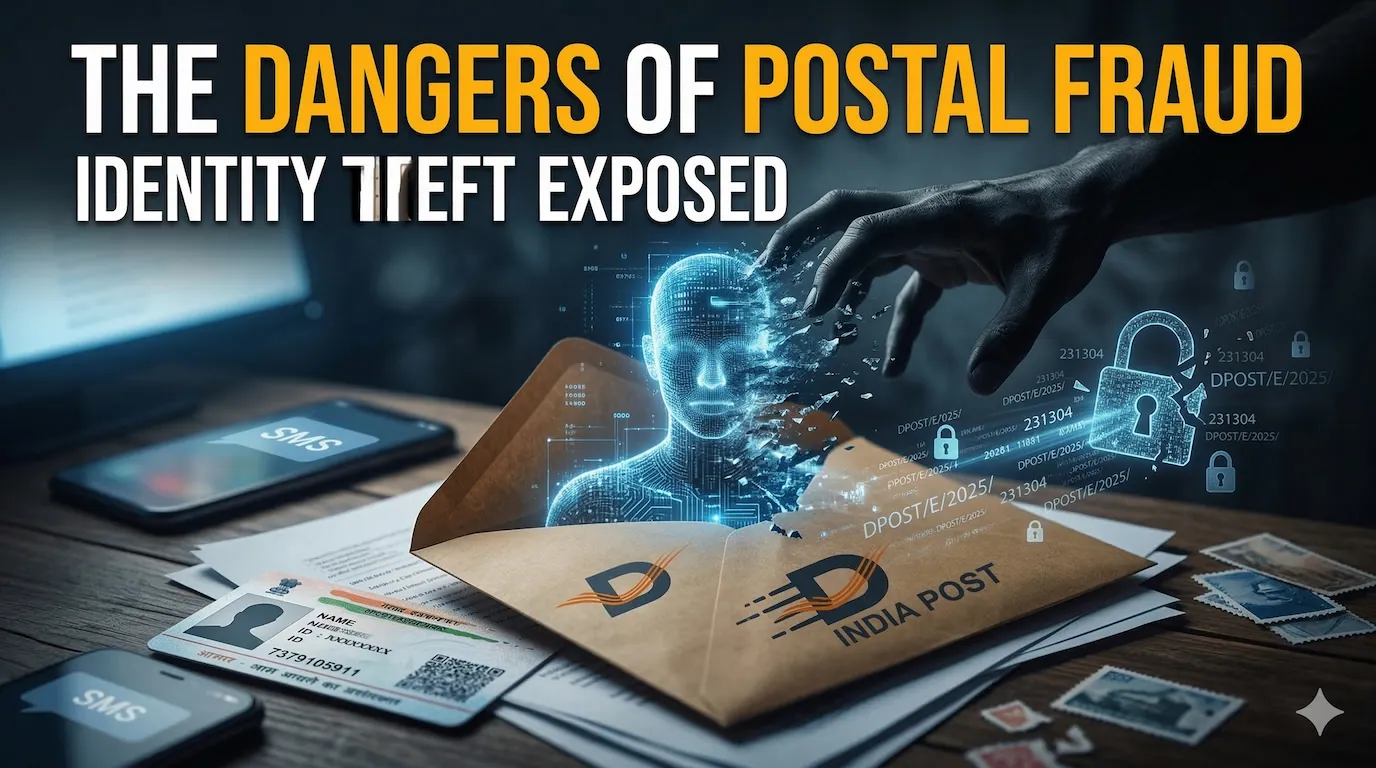
Key Takeaways (The Dangers of Postal Fraud)
- The case of DPOST/E/2025/0049143 reveals severe vulnerabilities in public service systems regarding unauthorised use of personal identity details.
- Mr Singh’s mobile number was misused for fraudulent bookings, placing him in a legal bind without proper verification protocols.
- The Department of Posts has been evasive in responding to the grievances, exacerbating identity theft risks and compromising accountability.
- Immediate reforms are essential, including mandatory sender verification to prevent future misuse of personal data.
- Mr Singh decided to file a police complaint. This highlights the need for legal action to ensure accountability from government departments regarding postal fraud.
🚨 The Dangers of Postal Fraud: A Deep Dive into Postal Fraud and Systemic Evasion
The case of DPOST/E/2025/0049143, filed by Yogi M. P. Singh, shows a critical vulnerability within our public service systems and illustrates the dangers of postal fraud. It highlights the unauthorised and fraudulent misuse of personal identity details. This issue is facilitated by a disturbing lack of verification protocols. This isn’t merely a customer service complaint. It’s a stark example of potential identity theft. It also involves cheating by personation. A government department’s systemic failure to act appropriately elevates the threat to an individual’s security.
This blog post will dissect the specifics of this grievance. It will illuminate the dangerous implications of such ‘evil practices.’ Additionally, it will outline the urgent policy and legal reforms required to safeguard citizens’ identities.
The Core Allegation: A Personal Number Used for Fraudulent Bookings
Mr Singh’s grievance concerns the unauthorised use of his private mobile number (7379105911) at Chunar Sub Post Office (SO) (231304). (The Dangers of Postal Fraud)
The critical issue is simple. An unknown individual deposited articles at the post office. They falsely provided Mr Singh’s private number as their own contact information. This act is not a mistake. It is a deliberate misuse of identity. It places Mr Singh in the legal and administrative chain of liability for articles he did not send.
The Department’s Evasive and Unacceptable Response (The Dangers of Postal Fraud)
The Department of Posts (DOP) has consistently been evasive in its official response. It only addresses the technicality of data entry. “The same mobile number provided by the sender at the time of booking is entered in the system.”
This remark, given by J. M. Pandey (Assistant Director of Postal Services), is a non-answer that completely sidesteps the question of verification and legality. The DOP admits they record the number provided by the sender without any check. This admission effectively confesses to a protocol that actively promotes identity fraud.
Why Evasion is Complicity (The Dangers of Postal Fraud)
The Department has refused to provide basic details. This includes the full name and physical address of both the Sender and the Receiver (DPRO). As a result, the victim (Mr Singh) is placed in an impossible legal position. Without these details, he cannot file a meaningful First Information Report (FIR) against the perpetrator.
The immediate closure of the grievance and the appeal, despite the clear legal threat, suggests one of two failures:
- Systemic Failure: The Chunar SO staff failed to follow any proper identification protocol, demonstrating gross negligence.
- Deliberate Evasion: The higher-ups are attempting to shield the identity of the miscreant. They are also trying to conceal the internal staff responsible for the lax procedures.
In either case, the DOP’s final action creates a hostile environment for the victim. Mr Singh rightly calls this action a “lack of accountability.”
🔪 The Dark Side: How Identity Misuse Facilitates Crime
The fraudulent use of an innocent person’s mobile number on official documentation is alarming. It is particularly concerning when linked to government-regulated services. These implications extend far beyond an administrative nuisance. (The Dangers of Postal Fraud)
1. Cheating by Personation and Legal Liability (The Dangers of Postal Fraud)
The person who booked the articles committed the crime of personation. They pretended to be someone they are not. Alternatively, they might have used a false identity linked to Mr Singh’s phone number. If the contents of those articles were illegal, then Mr Singh would face immediate liability. Examples of illegal content include contraband, threats, or defamation. The law would hold him accountable straight away. This is because his number is the only recorded contact detail for the sender. Additionally, the initial police investigation would focus on him for the same reason. This poses a direct and persistent threat to his personal security and reputation.
2. Weaponising Personal Data
In the modern digital landscape, a mobile number is an essential piece of KYC (Know Your Customer) data. Its unauthorised use signals a weakness in data acceptance protocols. If a post office accepts a number without verification, it sends a clear message to criminals that the system is easily exploitable for: (The Dangers of Postal Fraud)
- Money Laundering: Using anonymous or stolen identities for sending high-value items.
- Harassment/Threats: Sending articles containing threats while ensuring the trail leads back to an innocent party.
- Facilitating Scams: Establishing a physical touchpoint (the booking office) for a fraudulent scheme using a clean identity.
🛡️ Urgent Demands for Systemic Reform (The Dangers of Postal Fraud)
Mr. Singh’s appeal, now escalated to the Directorate level (DPOST/E/A/25/0005853), highlights the non-negotiable actions required to restore faith in the postal system’s integrity:
A. Immediate Disclosure and Police Cooperation (The Dangers of Postal Fraud)
The DOP must stop its obstruction. It should immediately provide the Full Name and Complete Physical Address of both the Sender and the Receiver (DPRO). This must be supplied to Mr Singh to file an FIR. It must also be proactively shared with law enforcement once the case is registered.
B. Initiate a High-Level Impartial Inquiry
A departmental inquiry must be launched immediately. It aims to investigate the specific lapses at Chunar SO (231304). It also seeks to examine the conduct of the supervising officers, such as J. M. Pandey, for their premature and evasive closures of a serious fraud complaint. (The Dangers of Postal Fraud)
C. Mandatory Policy Overhaul (The KYC/OTP Imperative) (The Dangers of Postal Fraud)
To prevent future identity misuse, the Department of Posts must implement mandatory sender verification protocols. This could include:
- OTP Verification: Sending a One-Time Password to the mobile number provided by the sender.
- KYC Linkage: Requiring a valid ID proof (Aadhaar, Voter ID). It must be digitally linked. Then, it should be verified against the mobile number used.
The reliance on self-declared, unverified mobile numbers is an outdated and dangerous practice that belongs to the past.
The Path Forward: Legal Action is Necessary (The Dangers of Postal Fraud)
A government department repeatedly fails to address a clear case of identity misuse. The citizen’s only remaining recourse is the legal system. Mr Singh’s decision to proceed with a Formal Police Complaint (FIR) is crucial. It compels cooperation and forces the disclosure of details that the Department of Posts is currently shielding.
The government’s responsibility is not merely to process articles, but to ensure the security and integrity of the process. The failure in this case is absolute, making systemic reform an imperative for all citizens who rely on postal services. (The Dangers of Postal Fraud)
2023 Corruption Perceptions Index reveals urgent need for tangible change in Asia Pacific


Facing a similar challenge? Share the details in the box below, and our team of experts will do their best to help.