
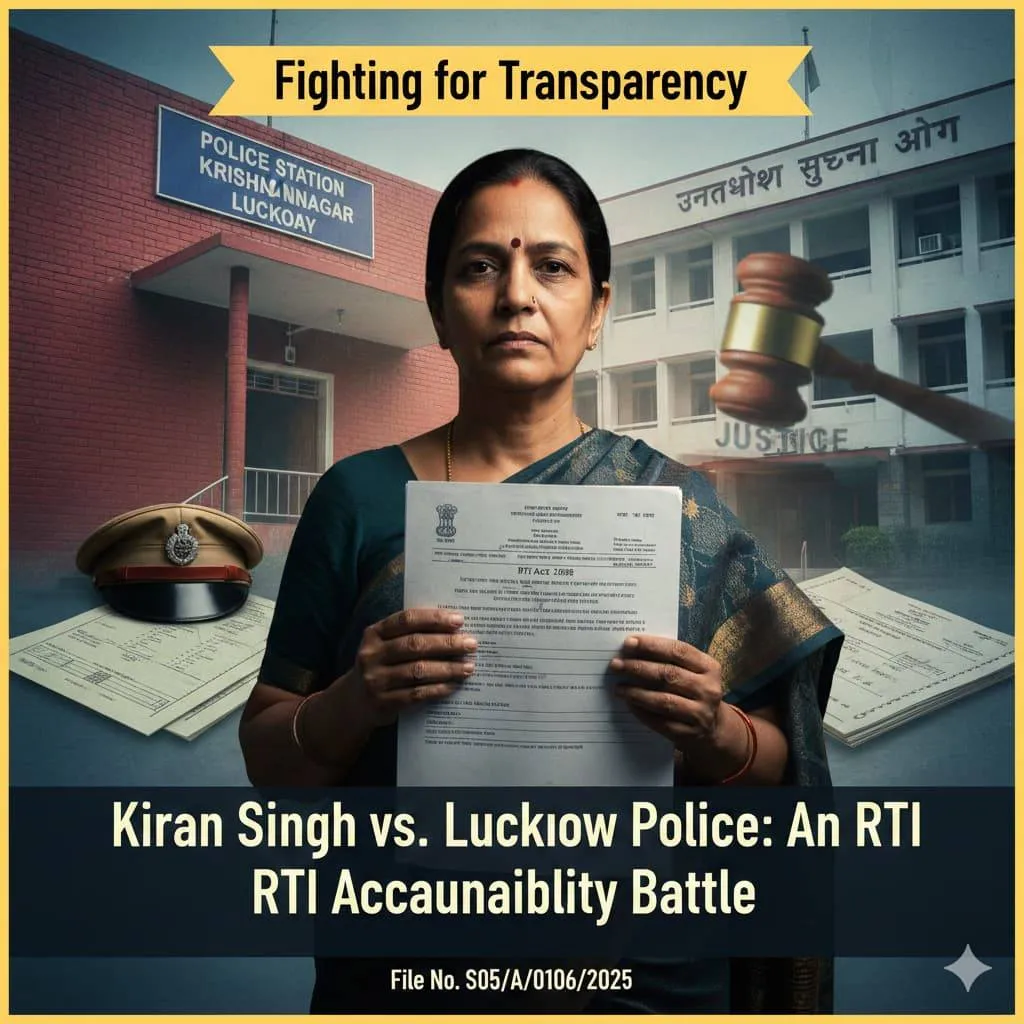
🚨 Kiran Singh vs. Lucknow Police: The Kiran Singh vs. Lucknow Police Case
The Right to Information (RTI) Act, 2005, is a powerful tool designed to ensure transparency and accountability in governance. However, the ongoing case of Kiran Singh vs. Lucknow Police in the office of the Commissioner of Police, Lucknow, is currently before the Uttar Pradesh Information Commission (UPIC). The case shows significant challenges. Citizens face difficulties when seeking information about departmental misconduct. They also encounter attempts at evasion by public authorities.
This case, registered under File Number S05/A/0106/2025, reveals a determined battle by an appellant, Kiran Singh. His goal is to uncover the police department’s rationale behind their reports and alleged actions related to a land dispute. He is facing repeated institutional roadblocks.
The Genesis of the Dispute: Revenue vs. Police Conduct (Kiran Singh vs. Lucknow Police)
The land dispute in the Krishnanagar area of Lucknow lies at the core of the matter. A report dated December 1, 2025, outlines the police station’s initial stance. It declares that the entire matter is purely “revenue-related”. Therefore, the police do not consider it a concern.
This is the standard defense mechanism. It is used by police departments to dismiss cases involving private land disputes. This mechanism effectively shunts the responsibility onto the Revenue Department (Tehsil). While the underlying issue is indeed about land ownership, Kiran Singh’s RTI application highlights a clever shift. It moves the focus from the land itself to the conduct and internal records of the police department.
The Crux of the RTI Queries and Police Evasion (Kiran Singh vs. Lucknow Police)
Kiran Singh’s RTI application contained three key questions. These questions directly challenge the police’s actions and reports. The Police Information Officer (PIO) has consistently failed to answer them adequately.
1. The ‘Common Road’ Conclusion (RTI Q. 1) (Kiran Singh vs. Lucknow Police)
The Question: On what basis did the police conclude this? Why did they determine that the private path claimed by the applicant is part of a ‘common road’? How did they reach this conclusion in their official investigation reports?
The Police Evasion: The PIO denied the information, stating it concerns the Revenue Department.
The Appellant’s Argument: Kiran Singh argues that police reports cannot be baseless. The police department issued reports mentioning the path as a ‘common road.’ This reasoning must be part of the investigation file. It is essential to include it in the file. This makes it subject to disclosure under the RTI Act. A failure to provide this reason implies that the police reports themselves are arbitrary or baseless.
2. Allegations of Misconduct and Detention (RTI Q. 2)
The Question: What is the legal provision that justifies police connivance in land grabbing? Why were the appellant and her family members subsequently detained or confined at the Krishnanagar Police Station?
The Police Evasion: The PIO outright denied the information, declaring the allegations to be baseless.
The Appellant’s Argument: By simply concluding that the allegations of misconduct are “baseless,” the police are judging their own conduct. Kiran Singh vs. Lucknow Police is seeking an inquiry into alleged irregularities and corruption. The police department is attempting to overlook these allegations. They are dismissing the entire complaint as a civil matter. The question is aimed at internal accountability. It concerns the alleged use of police authority to detain citizens in a civil dispute.
3. Posting Details of Personnel (RTI Q. 3)
The Question: Provision of posting details of Kamla Dayal and Manoj Kumar Solanki. They allegedly belong to the police. They may be influencing the investigation.
The Police Evasion: The PIO denied the information, claiming it concerns the Police Head Office.
The Appellant’s Argument: The PIO’s denial violates Section 6(3](https://yogi.systems/2025/10/28/office-of-district-judge-gorakhpur-and-rti-violations/ “Office of District Judge Gorakhpur and RTI Violations”) of the RTI Act, 2005. This mandatory provision requires the PIO to act. If the PIO believes that the requested information concerns another public authority, they must take action. They have to transfer the application to that authority. This must happen within five days. Instead of forwarding the request to the Head Office, the PIO denied the information. This decision created a deliberate hurdle for the appellant. This action has created a deliberate hurdle for the appellant. Additionally, the Kiran Singh vs. Lucknow Police case further highlights the need to comply with these regulations. It also shows the repercussions of negligence on the PIO’s part.
Undermining the Information Commission’s Authority
The most serious development in this case is the police department’s response following the UPIC Order dated September 11, 2025.
The UPIC found that the PIO had given “incomplete and misleading” information. It explicitly directed SHO Krishnanagar in Lucknow to deliver the desired information in the case of Kiran Singh vs. Lucknow Police. The commission also instructed the Tehsildar to provide the requested information and appear before it. Sub-Inspector Ashish Kumar submitted the subsequent report on December 1, 2025. This report restates the original, rejected police position, claiming that the matter is revenue-related.
Kiran Singh rightly terms this action a “mockery of the law.” It is also an attempt to “undermine the authority of the Hon’ble Uttar Pradesh Information Commission.” The police’s failure to adhere to the commission’s directive is concerning. Their continued evasion raises doubts about some departments’ willingness to comply. These issues are especially worrisome when transparency mandates confront uncomfortable questions about internal misconduct.
The Path Forward
Kiran Singh sent her strong Objection and Representation to the Commissioner of Police on December 2, 2025. She also addressed it to other senior officials. This document serves as a crucial escalation point. She has formally requested:
- The immediate withdrawal of the misleading December 1, 2025, report.
- An immediate, high-level internal inquiry into the allegations of misconduct and corruption involving the concerned personnel.
- The PIO must comply with the UPIC’s order. They need to provide complete, non-misleading information. Failure to do so will result in punitive action under Section 20 of the RTI Act.
This case is a stark reminder that the fight for transparency often requires citizens to take multiple actions. They must file RTI applications. They also need to persistently challenge the administrative and legal defenses that public authorities erect to avoid accountability. The next hearing before the UPIC will be pivotal. It will determine if the police commissionerate accepts responsibility for its personnel’s actions and adheres to the law. Alternatively, the cycle of evasion may continue.
This compilation includes web links, contact details, and application IDs. It also provides a chronological chart of events. These events are related to the RTI appeal filed by Kiran Singh against the Commissionerate Lucknow.
🔗 Key Links and Contact Details
| Authority | Website / Portal | Phone Number | General Email ID |
| UP Information Commission (UPIC) | https://upsic.up.gov.in/ | 0522-2724930 | webmaster-upic[at]up[dot]gov[dot]in |
| PIO, UPIC (Shri Mumtaz Ahmed) | (Same as above) | (Not provided) | jansu-section[dot]upic[at]up[dot]gov[dot]in |
| Commissionerate Lucknow (CP Office) | (Not explicitly provided) | 9454400137 (CP CUG) | cp-pol.lu@up.gov.in |
🆔 Application and File IDs (Kiran Singh vs. Lucknow Police)
The case is being tracked using multiple identification numbers across the system:
| ID Type | Number | Authority / Purpose |
| RTI Registration Number | A-20250200031 | Second Appeal Registration (Filed by Kiran Singh) |
| File Number | S05/A/0106/2025 | UPIC Case File Number (Allotted to Hearing Room S-5) |
| UPIC Diary Number | D-021220250096 | Diary entry for the Objection/Representation sent on Dec 2, 2025 |
| Welcome/Tracking Number | UPICR20250000775 | General Tracking Number |
🗓️ Chart of Dates and Events (Chronology)
The following chart outlines the key dates and events in the RTI appeal process. It includes the case of Kiran Singh vs. Lucknow Police. This demonstrates the escalation of the issue:
| Date | Event / Document | Status / Key Outcome |
| 01/02/2025 | Original RTI Application/Second Appeal Filed by Kiran Singh. | Application submitted. |
| 05/02/2025 | First Appellate Authority’s Decision (Overlooked by Appellant). | Supported the PIO’s misleading information. |
| 11/03/2025 | UPIC Hearing Date. | Status: For further hearing. Order passed noting PIO provided misleading information. |
| 26/05/2025 | PIO Representative’s Submission at Hearing. | Information provided was deemed misleading. |
| 27/05/2025 | Appellant’s Objection to Misleading Information. | Representation sent to UPIC (via email). |
| 11/09/2025 | UPIC Order Issued by Hon’ble State Information Commissioner. | Found information incomplete/misleading. Directed SHO Krishnanagar and Tehsildar to provide information and appear. |
| 01/12/2025 | Hearing Date and Sub-Inspector’s Report. | Sub-Inspector Ashish Kumar’s report submitted, re-stating matter is ‘revenue-related.’ Status: Hearing likely took place, report presented. |
| 02/12/2025 | Appellant’s Representation/Objection to S.I.’s Dec 1 Report. | Strong objection sent to CP, Lucknow (via email). |
Next Scheduled Hearing Date
The Order dated 11.09.2025 had directed appearance for the next hearing on 01.12.2025. Since the representation was sent on 02.12.2025, the outcome of the December 1, 2025 hearing is the immediate next key piece of information to seek.


Facing a similar challenge? Share the details in the box below, and our team of experts will do their best to help.