
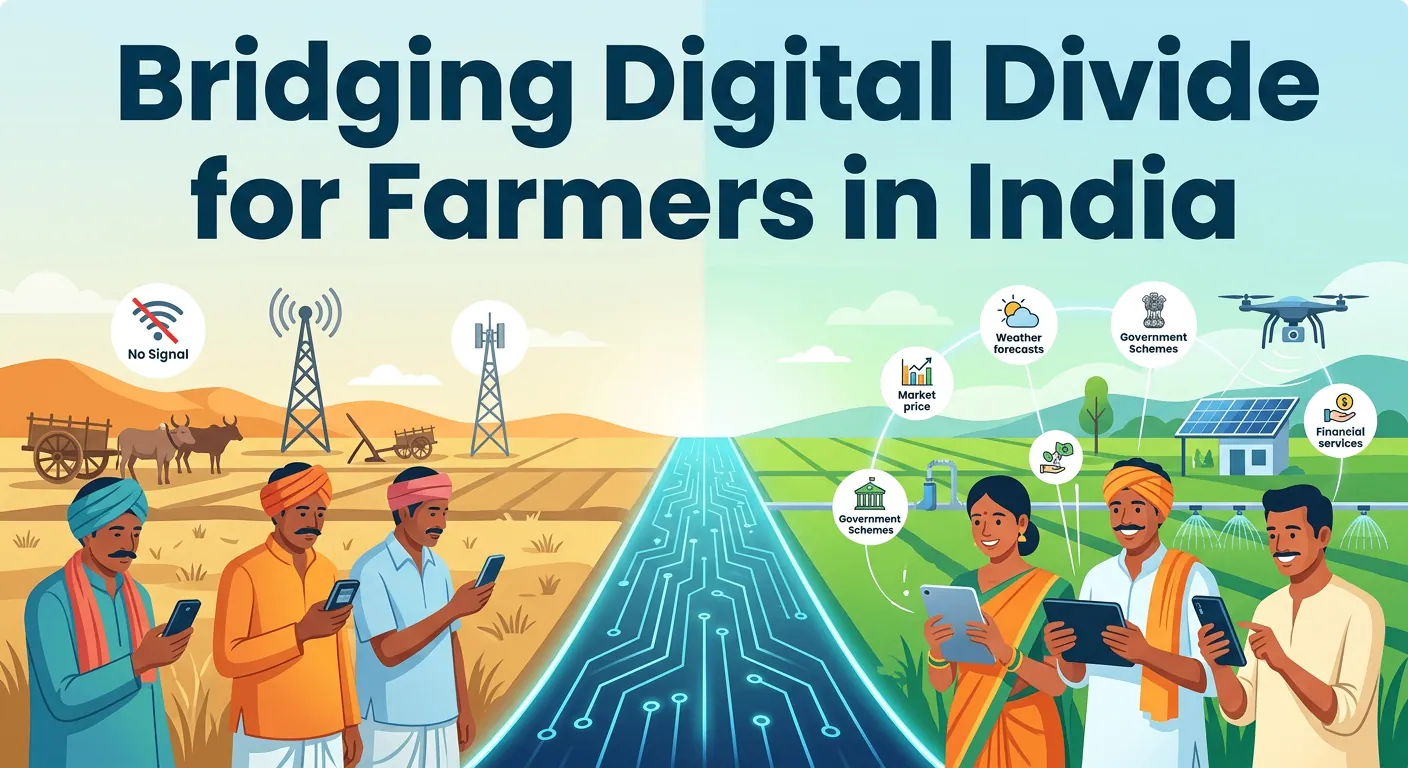
Key Takeaways (Bridging Digital Divide for Farmers)
- The PM-Kisan scheme aims to support farmers. However, it struggles with bureaucratic obstacles. These include confusing requirements for digital and physical documentation.
- Farmers face payment rejections due to minor discrepancies in names or documents. They receive little clarity on the reasons for these failures.
- Concerns about missing details, like fathers’ names, raise suspicions of fraud and hinder transparency in beneficiary identification.
- Local administrative control creates opportunities for corruption, undermining the purpose of digital applications.
- A genuine digital integration is essential to truly empower farmers and eliminate the frustrations caused by manual processes.
🌾 PM-Kisan’s Digital Dream vs. Ground Reality: Why Farmers Struggle (Bridging Digital Divide for Farmers)
The government launched the Pradhan Mantri Kisan Samman Nidhi (PM-Kisan) scheme.. Its noble aim is to provide direct income support to farmers. It leverages technology for transparency and efficiency. However, a significant gap often exists between this digital dream and the frustrating ground reality faced by applicants. Despite having online applications and Aadhaar-linked payments, many farmers find themselves caught in a bureaucratic tangle. They experience delays, rejections, and a bewildering demand for physical documents. (Bridging Digital Divide for Farmers)
1. The Digital Deadlock: Online Application vs. Hard Copy Demands
One of the most perplexing challenges for PM-Kisan applicants is the contradictory administrative stance on digital versus physical documentation. (Bridging Digital Divide for Farmers)
- Online Mandate: Farmers must initially apply online, using digital platforms and e-KYC (Know Your Customer) processes. This approach promotes a paperless and efficient system.
- The Irony of Hard Copies: Online submission is often successful. Yet, local agricultural departments frequently demand physical copies. These include essential documents like the Khatauni (land records), Aadhaar Card, and Bank Passbook.
- The Contradiction: This creates a frustrating paradox: if “everything is online,” why the persistent need for hard copies? This often means the digital verification system has flaws, or local authorities lack trust in its integrity, necessitating manual cross-checks.
2. The Opaque Walls of Name Mismatches and Data Discrepancies
Payment rejections are a common pain point, often attributed to seemingly minor “flimsy” grounds that nonetheless halt the entire process. (Bridging Digital Divide for Farmers)
- PFMS/Bank Rejection: The Public Financial Management System (PFMS) and banks are unforgiving when it comes to name mismatches. Even a slight discrepancy in spelling between the names can lead to payment failure. Differences in name order between the PM-Kisan portal and the Aadhaar card can also cause this issue. Such discrepancies between the Aadhaar card and the bank account can lead to payment failure.
- Lack of Clarity: Farmers are often not informed of the exact rejection reason (e.g., a specific PFMS error code). Instead, they receive a vague instruction to “submit documents,” leaving them clueless about the precise issue they need to correct.
- The “Passbook” Puzzle: The Aadhaar Payment Bridge System (APBS) routes payments to accounts linked with Aadhaar. This includes accounts in the India Post Payments Bank (IPPB). Still, the demand for a physical passbook persists. This is often to manually verify name spellings or account status, exposing a gap in digital data synchronisation.
3. Suspicion of Concealed Corruption: The Missing Father’s Name
A particularly alarming issue involves officials omitting crucial identifying details from publicly accessible beneficiary lists. (Bridging Digital Divide for Farmers)
- Incomplete Information: A beneficiary’s name may appear on the PM-Kisan list. However, if the father’s name is missing, it creates a “suspicion of concealment.”
- Obscuring Fraud: Without the father’s name, it becomes extremely difficult to distinguish between multiple individuals with the same common name. This situation potentially masks duplicate or fraudulent entries. This undermines public oversight and social audits, which are vital for identifying ineligible beneficiaries.
- Lack of Accountability: Such omissions can indicate gross negligence in data management. They may also suggest a deliberate attempt to obscure the identity of beneficiaries. These actions create fertile ground for corruption within the department.
4. The “Gatekeeper” Mentality: Fueling Local-Level Corruption (Bridging Digital Divide for Farmers)
The persistent reliance on physical verification and manual approvals, even after online submission, empowers local administrative staff disproportionately.
- Localised Control: The final approval or error correction depends on a physical check by a local officer. In this case, they become the “gatekeeper.” They set the pace, interpret the rules, and decide who gets approved or delayed.
- Opportunity for Extortion: This localized control creates an environment ripe for corruption. Farmers, desperate for their rightful benefits, may feel pressured to offer “expediting fees.” They might resort to bribes to overcome deliberate delays or arbitrary rejections.
- Meaningless Digitalisation: When manual steps constantly override the digital process at the local level. The purpose of an “online” application becomes questionable. The digital process loses its meaning.
Conclusion: A Call for Genuine Digital Integration and Transparency (Bridging Digital Divide for Farmers)
While the PM-Kisan scheme aims for direct and transparent benefit transfer, the on-ground experience for many farmers remains challenging. They face bureaucratic hurdles. Addressing these challenges requires more than just digitalisation. It demands genuine digital integration. This integration ensures that users fully trust online data and that error resolution remains transparent. Minimise manual intervention and strictly govern it with clear, publicly accessible rules. Only then can the scheme truly fulfil its promise to empower India’s farmers. It should not inadvertently create avenues for frustration and corruption.
🌐 PM-Kisan Official Website and Email Contacts (Bridging Digital Divide for Farmers)
| Category | Detail |
| Official Website Link | [suspicious link removed] |
| Online Grievance Portal | https://pmkisan.gov.in/Grievance.aspx (Use this for direct complaints) |
| General Helpdesk Email | pmkisan-ict@gov.in |
| Fund/Payment Transfer Email | pmkisan-funds@gov.in |
| Aadhaar/OTP Related Email | aead@nic.in |
📞 PM-Kisan Helpline and Toll-Free Numbers (Bridging Digital Divide for Farmers)
You can also use these numbers for immediate verbal inquiries:
- PM-Kisan Helpline No.: 155261
- PM Kisan Toll-Free Number: 1800-115-526
- Landline Numbers: 011-24300606, 011-23381092
Moreover, you already have the most critical contact information for your specific RTI application. You included it in the registration details you provided.
Here is the PIO and Nodal Officer contact information directly relevant to your application (DRAGR/R/2025/60325):
📞 PIO and Nodal Officer Contact Details (Bridging Digital Divide for Farmers)
| Role | Name/Designation | Mobile Number | Email ID (Corrected Format) |
| PIO | DDA MIRZAPUR / DEPUTY DIRECTOR AGRICULTURE | 7839882478 | ddamzp2012@gmail.com |
| Nodal Officer | ADDITIONAL DIRECTOR AGRICULTURE | 8081560096 | dirag@up.nic.in |
ℹ️ Important Note on Email Format (Bridging Digital Divide for Farmers)
Please ensure you use the standard email format (e.g., ddamzp2012@gmail.com) when sending emails or using your mobile phone. The format [at] and [dot] is only used in government publications. This is done to protect against spam, but the actual email requires the @ and . symbols.
The Nodal Officer is the Appellate Authority for your application. If the PIO (Deputy Director of Agriculture) does not provide a satisfactory response, you will have 30 days. During this period, you need to address your First Appeal. Direct this appeal to the Nodal Officer (Additional Director of Agriculture).
Do you need help searching for the address of the Appellate Authority’s office? You may need it to include on a First Appeal letter if you need to file one.


Facing a similar challenge? Share the details in the box below, and our team of experts will do their best to help.