
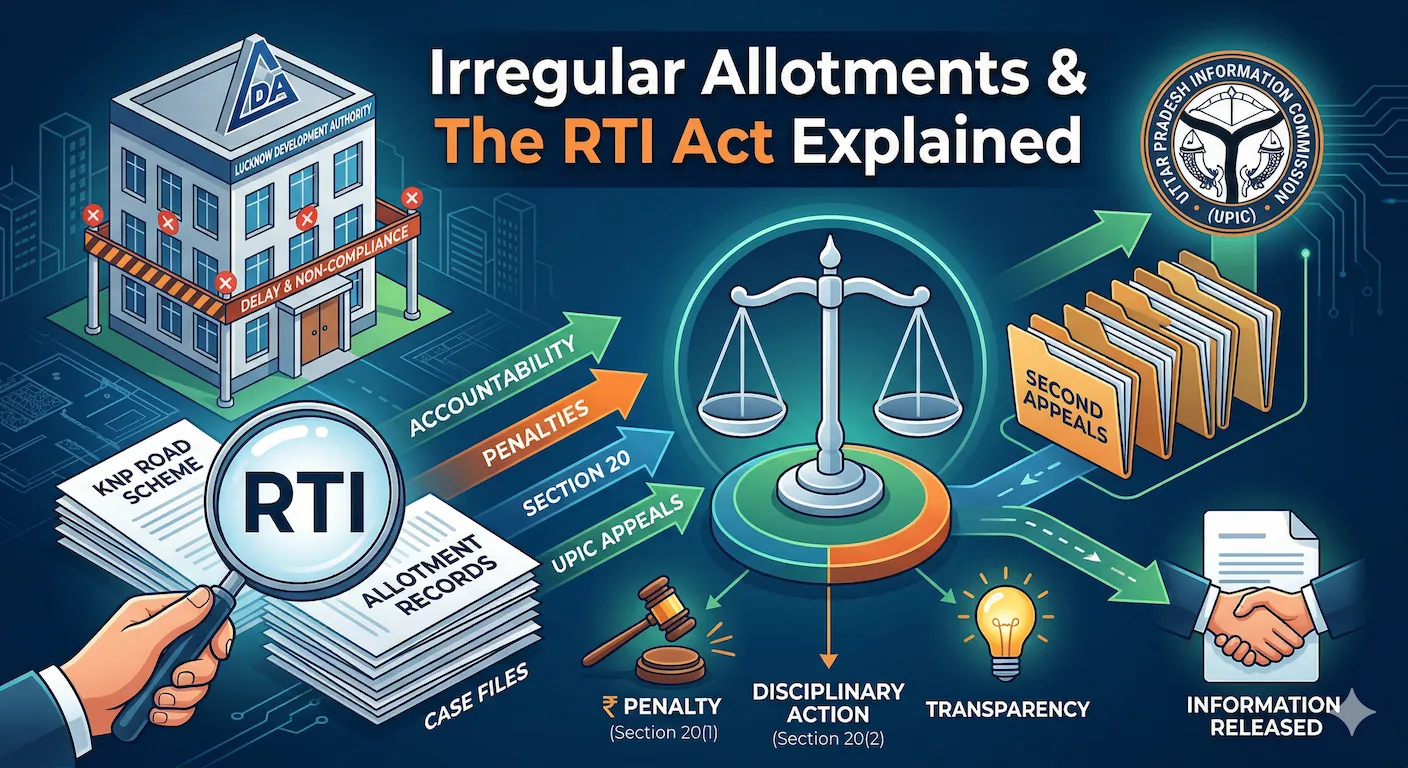
🚨 Irregular Allotments & Accountability Gap: LDA’s Failure to Comply on RTI in Kanpur Road Scheme Case
Introduction: The Power of Information vs. Institutional Inertia This discussion includes an exploration of Irregular Allotments and how they interact with established systems.
The Right to Information (RTI) Act, 2005, is a cornerstone of Indian democracy. However, public authorities determined to withhold records constantly test its strength. A stark case of this resistance is happening at the Lucknow Development Authority (LDA). The case concerns allegations of irregular plot allotments under the Kanpur Road Scheme.
Five separate Second Appeals are pending before the Uttar Pradesh Information Commission (UPIC) on this single issue. Despite this, the LDA has continued to stonewall the process. This blatant disregard for the Commission’s orders turns the investigative process into a cycle of futility. It demands immediate, punitive action under the law.
The Core Conflict: Evasion Despite Evidence (Irregular Allotments)
The central issue revolves around the allotment/registration of plots SS-1914, 1915, 1916, 1917, and 1918. The LDA, through its Estate Officer, Hemchandra Tiwari, and PIO, Atul Krishna, has acknowledged the matter is under committee investigation (as per their letter No. 601 dated 8/5/2025).
The official excuse for the delay is highly problematic:
❌ LDA’s Claim: The investigation is stalled. The complainant and allottees are “not appearing in the office with the desired original records/evidences.”
✅ The Reality: Crucial documents were sent to the LDA via three separate Registered Posts. An involved party, Dinesh Pratap Singh, sent them.
The LDA’s officials give an incorrect and misleading account to evade responsibility. They claim non-submission while documents were delivered via a traceable government service. This action is not a mere procedural delay. It suggests a deliberate attempt to obstruct the investigation into the alleged irregularities.
Escalation: The Critical Role of the UP Information Commission
Five appeals are pending, including the reference S10/A/1318/2024. The LDA is ignoring multiple notices that have been diligently submitted over time. The matter is no longer merely about obtaining the information required for clarity. Now it’s about enforcing accountability for the actions, or lack thereof, taken by the concerned parties. (Irregular Allotments)
1. Consolidation is Key (Irregular Allotments)
The first strategic move for the applicant is to petition the UPIC to consolidate (club) all five Second Appeals. Treating them as a single, large-scale obstruction case will compel the Commission to recognize the pattern of systemic non-compliance. The LDA repeatedly fails to comply with regulations on the same subject matter.
2. Invoking the Penal Section 20 of the RTI Act
When a PIO, without reasonable cause, refuses or knowingly gives misleading information, the law provides a clear pathway for punishment. The applicant must file a formal Compliance and Penalty Petition before the UPIC. They must specifically request the imposition of the maximum statutory penalties on the defaulting officials. (Irregular Allotments)
| Legal Provision | Required Action | Implication for LDA Officials |
| Section 20(1) (Penalty) | Request the maximum penalty of ₹25,000 for wilful delay/denial. | The penalty is levied personally on the PIO (and Deemed PIOs like the Estate Officer), not the public authority. |
| Section 20(2) (Disciplinary Action) | Request the Commission to recommend disciplinary action against the PIO/Estate Officer. | Can lead to adverse entries in the official’s service record, affecting promotions and service tenure. |
| Section 7(6) (Cost of Information) | Request that the information, once provided, be supplied free of cost, as the delay far exceeds the mandated time limits. | Ensures that the LDA is penalized for the delay by losing the right to charge copying fees. |
The evidence of five pending appeals directly refutes the LDA’s excuse. The proof of delivery for the documents establishes a strong case for malafide denial. It triggers the mandatory penalty clause under the Act. This situation not only underscores the negligence exhibited by the LDA in handling the appeals process. It also highlights the importance of adhering to legal protocols. These protocols protect the rights of individuals. Furthermore, the documented proof shows a clear disregard for due process. This disregard could have serious implications for future case handling. The LDA fails to acknowledge and address these pending appeals. This neglect sets a troubling precedent that undermines public trust in the enforcement of the law. It suggests a need for a more robust oversight mechanism to ensure compliance with the established legal framework.
Conclusion: Holding the Public Authority to Account (Irregular Allotments)
The Lucknow Development Authority’s continued defiance is particularly evident in a case involving multiple plot allotment appeals. This defiance highlights the significant challenges that RTI applicants face across the country. This situation highlights the bureaucratic hurdles individuals encounter when seeking transparency in governmental operations. It also raises important questions about accountability and governance. Applicants struggle to navigate the complex procedures. These procedures are often obstructive. As a result, the overall efficacy of the Right to Information Act is questioned. Moreover, authorities are reluctant to address these appeals. They fail to provide justifications for their decisions. This exacerbates the sense of frustration among citizens who seek to exercise their rights. Ultimately, this persistent defiance creates an environment where transparency and fairness seem elusive. This undermines public trust in the development processes meant to serve the community.
However, the strength of the RTI Act lies in the penal authority of the Information Commission. The applicant can consolidate the appeals. They can rigorously pursue the penalty and disciplinary action under Section 20. This will force the release of the long-awaited information. It will also send a clear message. Institutional inertia and wilful non-compliance will carry a personal cost for the responsible officers. The next hearing at the UPIC is the critical junction to move the matter from investigation stall to executive accountability.
Dinesh Pratap Singh submitted representation before vice chairman L.D.A. as they are procrastinating on serious issue of corruption
LDA did not provide plots to allottees, but preferred to auction, is corruption. Despite procrastination of L.D.A. in providing information, information sought from LDA
Key Takeaways (Irregular Allotments)
- The Lucknow Development Authority (LDA) faces allegations of irregular allotments in the Kanpur Road Scheme. These issues highlight a failure to comply with the Right to Information (RTI) Act.
- Five appeals are pending with the Uttar Pradesh Information Commission (UPIC). However, the LDA continues to obstruct the process. They are evading accountability.
- Applicants should consolidate all appeals to address systemic non-compliance. They should invoke Section 20 of the RTI Act for penalties against LDA officials.
- Evident bureaucratic hurdles question the efficacy of the RTI Act, frustrating citizens seeking transparency.
- The strength of the RTI Act lies in its penal provisions. These provisions can compel the LDA to release information. They ensure accountability for their actions.


Facing a similar challenge? Share the details in the box below, and our team of experts will do their best to help.