
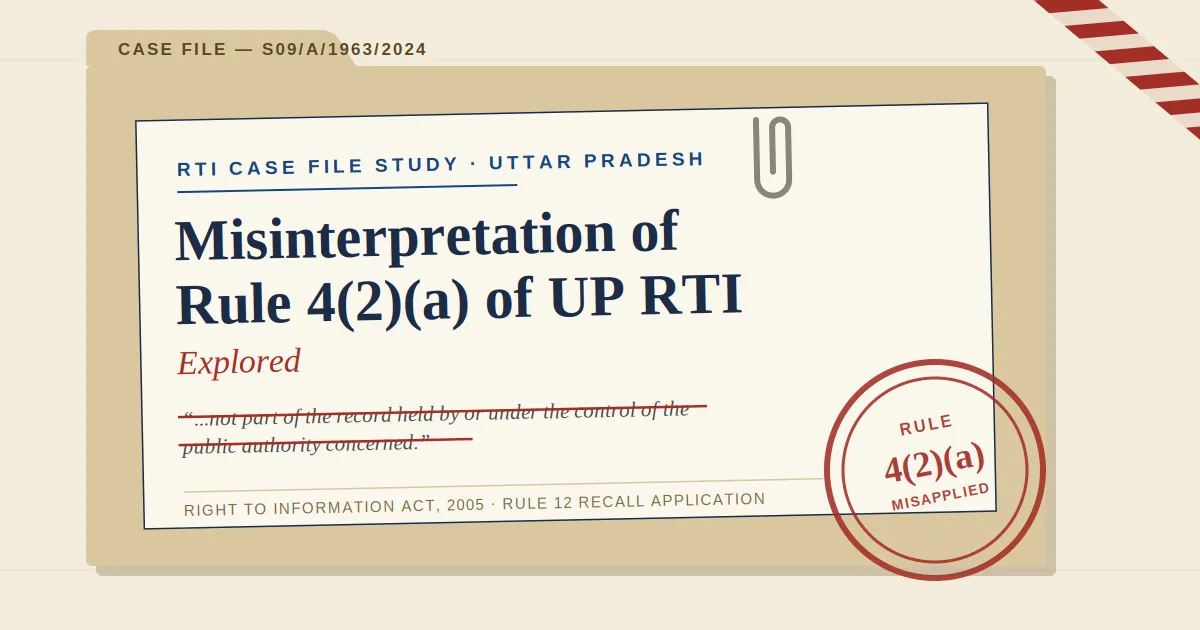
Misinterpretation of Rule 4(2)(a) of UP RTI: A Mirzapur Case Study in Denied Transparency
How a routine request for staff posting details turned into a 13-month test of accountability under the Right to Information Act, 2005 — and how the misinterpretation of Rule 4(2)(a) of UP RTI by a Tehsil-level office reveals a wider gap between law and practice in Uttar Pradesh. This case highlights the challenges faced by citizens when seeking transparency in government operations. The prolonged delay in responding raises questions about the commitment to uphold democratic principles and the effectiveness of the RTI framework. Furthermore, it underscores the necessity for better training and awareness among public officials regarding their responsibilities under the Act. As citizens strive to hold their government accountable, such instances of bureaucratic inefficiency can undermine trust and diminish the potential of the RTI as a tool for empowerment.
Key Takeaways
- A simple RTI request in Mirzapur highlighted issues surrounding the Misinterpretation of Rule 4(2)(a) of UP RTI, showing a significant gap between legal requirements and actual practices in government.
- The Tehsil office rejected the request by claiming the information was not part of their records, which contradicts the typical functioning of bureaucracies.
- A comparison with the Allahabad High Court demonstrates that similar public authorities maintain and disclose employee records, challenging the denial of information.
- The prolonged appeal process showcased institutional inertia, with the Uttar Pradesh Information Commission failing to hold the PIO accountable for non-compliance.
- This case underscores the need for improved transparency and accountability within RTI frameworks, as well as correct interpretations of relevant rules.
The Request That Started It All
On 8 August 2024, I filed an RTI application before the Public Information Officer, Office of the Tehsildar, Tehsil-Sadar, District Mirzapur. I used the state’s official portal, rtionline.up.gov.in. The Commission registered it as DMOMR/R/2024/60077. The request itself was simple. I asked for four things:
- Posting details of Class I and Class II employees — when they joined service in Mirzapur, and where they served before.
- Posting details of Class III employees, including transfer history.
- Posting details of Class IV employees, including transfer history.
- Confirmation of whether the State Government’s New Transfer Policy was actually being followed in the office, and if so, what steps had been taken.
My reasoning was straightforward. Long, static postings can breed complacency. They can also reduce accountability to the public. Rotational transfer policies exist to prevent exactly this. So I wanted to know: was the policy actually working on the ground in my own district? A near-identical question drove the DDO Mirzapur RTI application, which sought the same kind of posting and tenure records for City Block staff.
The Misinterpretation of Rule 4(2)(a) of UP RTI Begins
On 23 October 2024, the office rejected my request. The Public Information Officer at the time, Diksha Pandey, Tehsildar, cited Rule 4(2)(a) of the UP RTI Rules. Her remark read: “the information sought should be a part of the record held by or under the control of the public authority concerned.” In effect, she claimed the office held no records at all of its own staff’s postings and transfers.
This is the crux of the matter, so let’s pause here. Rule 4(2)(a) of the Uttar Pradesh Right to Information Rules, 2015 is meant to apply only in one situation. That situation is where information genuinely does not exist within a public authority’s records. It is not a catch-all excuse for inconvenient requests. Every government office, after all, must track who is posted where. It must also know since when, and where each employee came from. Salary disbursal depends on this data. So does leave sanctioning. So does seniority and promotion. Consequently, claiming this information is “not part of the record” is hard to square with how any bureaucracy actually operates. In short, this is the pattern this case now puts on record.
A Concrete Comparison That Exposes the Misinterpretation of Rule 4(2)(a) of UP RTI
To test this claim, I looked at how a comparable public authority in the same district handles identical information. The High Court of Judicature at Allahabad publishes the complete posting history of every District & Sessions Judge in the state. It does so on its own website. This includes the judge currently posted in Mirzapur, Sri Anupam Kumar (ID No. UP1902). His profile at allahabadhighcourt.in lists sixteen separate postings from 2011 to 2026. Each entry gives exact joining and relieving dates, districts, and remarks. It even records deputation periods and tribunal postings.
Here is why that matters. Section 4(1)(b) of the RTI Act, 2005 places a duty on every public authority. That duty is to voluntarily disclose particulars of its officers and its organisational structure. If a High Court can publish this level of detail about judicial officers, the logic is clear. A tehsil-level revenue office cannot credibly claim that equivalent staff data simply doesn’t exist. This comparison, therefore, offers the clearest evidence of what went wrong here. The rule was applied to deny records that a coordinate public authority, in the same district, maintains and publishes as routine practice.
The Appeal Process: A Timeline of Non-Response
Since the first request went nowhere, I pursued the statutory appeal route:
| Stage | Date | Forum |
|---|---|---|
| RTI Application | 08.08.2024 | PIO, Tehsildar Sadar, Mirzapur |
| Rejection | 23.10.2024 | PIO (Rule 4(2)(a)) |
| First Appeal | 18.09.2024 | First Appellate Authority — Section 19(1) |
| Second Appeal | 04.11.2024 | Uttar Pradesh Information Commission — Section 19(3) |
The Commission registered the Second Appeal before Hearing Room S-9. Its number is Appeal No. S09/A/1963/2024 (Registration No. A-20241100263). This is where the matter should have been settled on its merits. Instead, it turned into a study in institutional inertia. That inertia, however, was not on my end, as the record below shows.
What the Commission’s Own Record Shows
This next part matters most, because it isn’t my characterisation. It is what the Uttar Pradesh Information Commission’s own orders say.
On 21 March 2025, the Commission first directed the PIO to furnish the information by a fixed date. Then came the next hearing, on 30 April 2025. The Commission’s own order recorded that the PIO had neither appeared in person nor sent a representative, despite due notice. The PIO had also failed to comply with the earlier direction. Even so, the Commission granted one further opportunity. It fixed the next hearing for 6 June 2025.
The pattern simply repeated. The Commission’s final order, dated 2 September 2025, lists six separate notices sent to the PIO: 04.02.2025, 18.03.2025, 20.03.2025, 24.04.2025, 03.07.2025, and 28.08.2025. On every single occasion, the PIO neither appeared, nor filed a written statement, nor furnished the information.
And yet, the order dated 2 September 2025 disposed of the Second Appeal on different grounds entirely. It held that I, the appellant, appeared to have “no interest” in my own case. Its stated reason: I had not attended the same hearings.
Setting the Record Straight
That finding did not account for the full record. On 18 June 2025, I submitted a detailed written representation to Hearing Room S-9. This fell well within the period the Commission’s order describes as silence. In it, I reiterated all four points of information. I also flagged the PIO’s continued non-compliance with the Commission’s own order of 30 April 2025. This was not a stray email, either. The Commission’s Complaint and Appeal Tracking System (CATS) formally logged it as a Knowledge of Fact (KOF), Diary No. D-180620250008. The system marked it as forwarded to the concerned hearing officer.
I never received notice of the subsequent hearing dates, whether by email or SMS. Those dates led directly to the September closure. So the moment I discovered the disposal, on 24 January 2026, I acted immediately. I submitted a fresh complaint, logged as KOF Diary No. D-240120260001. I also filed a formal Order Recall Application under Rule 12 of the U.P. RTI Rules, 2015 (Registration No. P-20260102140, File No. S09/P/0062/2026). The application asks the Commission to restore the appeal and direct disclosure. It also asks for penalty proceedings under Section 20(1) of the RTI Act against the PIO, given the sustained non-compliance.
Why This Case Matters Beyond One RTI Request
Three issues here go well beyond my individual request.
First, there is a real asymmetry in accountability. Consider a citizen who misses hearing notices through no fault of his own. If there is no confirmed service of notice, he still risks having his case closed entirely. Now compare a Public Information Officer who misses six consecutive hearings over more than a year. That officer never once complies with a binding Commission direction, yet faces no automatic consequence. The file simply closes, and the underlying information stays undisclosed.
Second, “record not held” is a weak ground for rejecting basic establishment data. Employee posting and transfer records are not obscure or third-party information. Rather, they sit at the core of any office’s own administration. Treating them as unavailable sets a troubling precedent, especially without engaging with the RTI Act’s proactive disclosure provisions. If left unchallenged, this kind of misinterpretation of Rule 4(2)(a) of UP RTI could spread. It could become a template other officers reach for whenever a request is merely inconvenient, not genuinely unanswerable.
Third, the recall mechanism itself matters enormously. Rule 12 exists for situations where an order is passed without hearing a party, through no fault of their own. However, its value depends on two things. Citizens must actually know it exists. And Commissions must engage seriously with recall applications, rather than treating them as a formality.
Where the Matter Stands
The Commission fixed the recall hearing for 20 August 2026, before Hearing Room S-9. This followed its notice dated 19.08.2026 (Registration No. 202608S09P00054). Ahead of the hearing, I filed written submissions and a supplementary addendum, including the Allahabad High Court comparator described above.
For anyone tracking similar cases, the Commission’s hearing and case-status system sits at upsic.up.gov.in. You can track RTI applications and their status through the state portal at rtionline.up.gov.in. You can also reach the Public Information Officer for this matter at the office’s designated RTI email, teh-sadar.mi[at]up.gov.in.
FAQ: Understanding the Misinterpretation of Rule 4(2)(a) of UP RTI
What is Rule 4(2)(a) of the UP RTI Rules, 2015? It allows a Public Information Officer to decline a request in one narrow situation. That situation is when the information sought genuinely does not form part of the records held by, or under the control of, the public authority concerned.
Why does this case involve a misinterpretation of Rule 4(2)(a) of UP RTI? Because the office applied the rule to staff posting and transfer records. That data is something every public authority must maintain for its own administration. It is not information that was genuinely absent. Notably, the rejection never identified any other authority holding the data. It also never explained how an office administers its own staff without such records.
How does the Allahabad High Court comparison relate to the misinterpretation of Rule 4(2)(a) of UP RTI? It shows that a comparable public authority in the same district — the District & Sessions Judge’s establishment — voluntarily publishes exactly this category of information. That fact undercuts any claim that such records are inherently unavailable or beyond a public authority’s custody.
What remedy does this case seek for the misinterpretation of Rule 4(2)(a) of UP RTI? The pending Recall Application (No. S09/P/0062/2026) asks the UP Information Commission for three things. First, restore the Second Appeal. Second, direct disclosure of the original four points of information. Third, consider penalty proceedings under Section 20(1) of the RTI Act, 2005 against the Public Information Officer.
A Broader Takeaway
The Right to Information Act, 2005 rests on a simple premise: public authorities exist to serve, and answer to, the public. Viewed in isolation, one stalled request about staff postings in a single tehsil office might seem minor. But look closer, and the pattern becomes hard to ignore. The Commission’s own record shows six ignored notices. It shows two binding directions that were never followed. It also shows a citizen’s diligence, documented in the system’s own diary entries. Despite all this, the resulting order still found fault with the citizen. That, ultimately, is how procedural closure can quietly replace real accountability.
This is exactly what the recall application asks the Commission to correct — not just one file, but a larger question. Who should the Act’s consequences actually fall on when a public authority simply does not respond? And should the misinterpretation of Rule 4(2)(a) of UP RTI seen in this case be allowed to stand as a workable excuse for non-disclosure elsewhere in the state?
This account draws on the author’s own RTI application, appeal filings, and the Uttar Pradesh Information Commission’s own orders and case-tracking records. All of it remains part of the official record in Appeal No. S09/A/1963/2024 and Recall Application No. S09/P/0062/2026.
Related Reading: DPRO Bhadohi & RTI Information: Know Your Rights


Facing a similar challenge? Share the details in the box below, and our team of experts will do their best to help.