
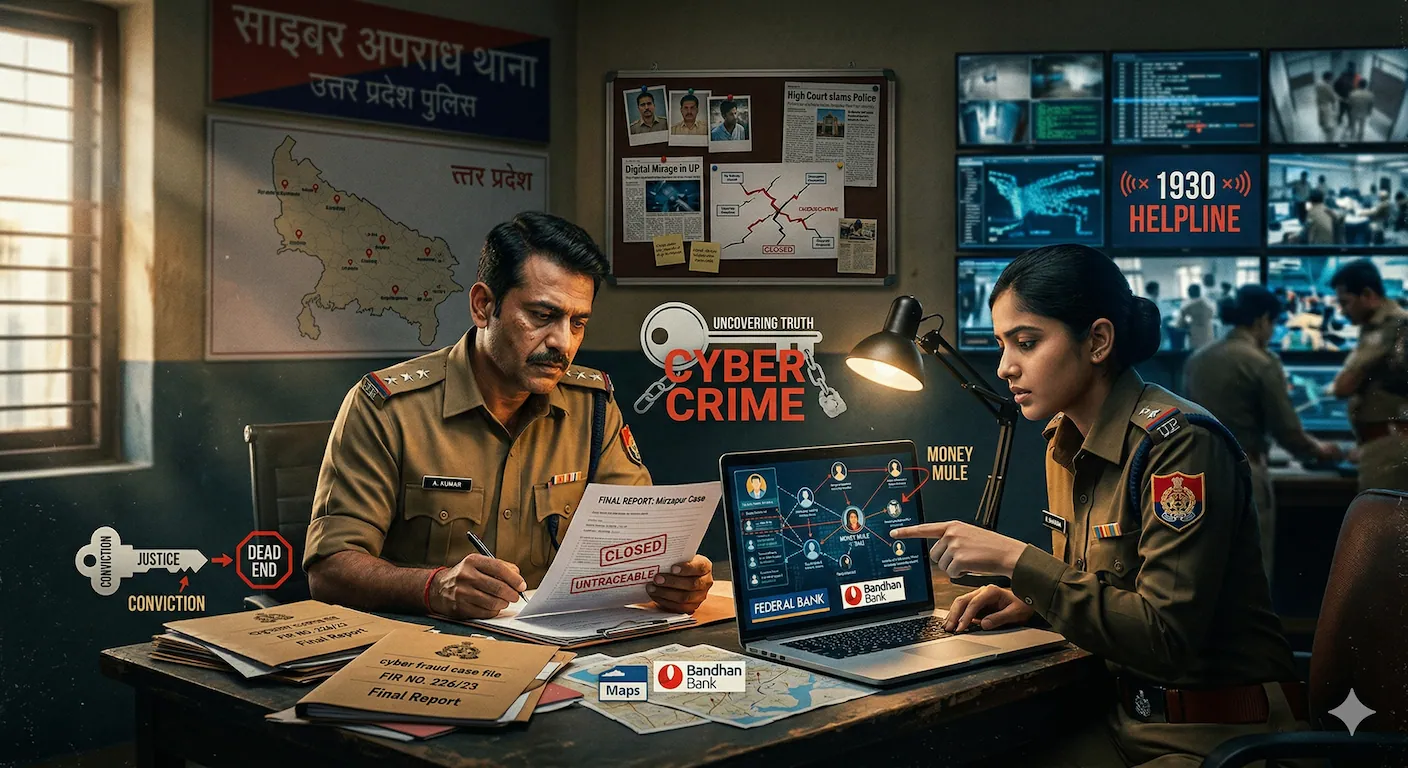
Key takeaways from this blog post are as follows
The blog post criticizes the disconnect between “digital progress” and “ground reality” in Uttar Pradesh. This is especially highlighted in Cyber Fraud Investigations in Uttar Pradesh. Here are the key takeaways:
1. Infrastructure vs. Implementation Gap
UP has made massive strides in “hardware”—expanding from 18 to 75 cyber police stations and training thousands of personnel. However, this has not translated into justice. The post argues that setting up a lab does not equal solving a crime. Investigators still close cases prematurely due to a lack of technical follow-through.
2. The “Final Report” (FR) Culture
A major hurdle is the police’s tendency to file a “Final Report” to close cases when investigations get difficult.
- The Mirzapur Case Example: The police stopped the investigation. This occurred even with specific bank account numbers and mobile links (Federal Bank, Bandhan Bank). The evidence was not enough to continue. They claimed that the physical addresses were “unverifiable.”
- Administrative Convenience: Closing cases as “untraceable” helps keep district records clean but leaves victims high and dry.
3. Systemic Institutional Failures (Cyber Fraud Investigations in Uttar Pradesh)
The post identifies three “Root Causes” of poor performance:
- Agency Culture: Senior officers often pass poor investigative habits down to junior officers.
- Supervisory Neglect: Higher-ups often sign off on substandard closure reports without demanding deeper forensic work.
- Defensive Mindset: Officers often view criticism as a personal attack rather than an opportunity for professional growth.
4. Judicial & Conviction Crisis (Cyber Fraud Investigations in Uttar Pradesh)
The Allahabad High Court’s intervention highlights that negligence is letting offenders escape. Despite high arrest numbers in cities like Lucknow and Ghaziabad, the conviction rate remains abysmal. This situation arises because the evidence collected is often procedurally weak. It is also frequently forensically flawed.
5. The “1930” Helpline Fragmentations
There is a lack of integration between the National Cyber Crime Helpline (1930) and local police stations. In the featured case, the investigator used the victim’s failure to provide a “helpline acknowledgement number” as an excuse. This caused investigative stagnation and showed that internal systems aren’t communicating.
The Bottom Line (Cyber Fraud Investigations in Uttar Pradesh)
The post concludes that UP needs to shift from focusing on quantity. This includes the number of labs and the number of trained staff. Instead, it should prioritise quality. This involves achieving successful convictions and verifying data trails for effective cyber policing. It will remain a “mirage.”
In 2025, the digital landscape of Uttar Pradesh presents a striking paradox. The state boasts 75 functional cyber police stations. It has also trained over 84,000 personnel. Yet, the ground reality for victims—like those in Mirzapur—remains one of procedural “dead ends” and technical stagnation.
The following analysis dissects the systemic failure in cyber fraud investigations, using the recent Mirzapur case (FIR No. 226/23) as a blueprint for a broader critique of law enforcement’s digital incompetence.
Cyber Fraud Investigations in Uttar Pradesh: Why UP’s Cyber Investigations are Collapsing
1. The “Final Report” Trap: A Culture of Administrative Closure
The letter from the Office of the SSP Mirzapur (June 2025) highlights a recurring pattern. This pattern is evident in UP’s cyber policing: the “Final Report” (FR). When investigators fail to identify a perpetrator, the case is closed under the guise of “non-availability of information.”
In FIR No. 226/2023, the police identified the bank accounts used to siphon funds (Federal Bank and Bandhan Bank). However, the investigation was halted. The reason was that the account holders’ addresses “could not be verified.” In a digital age, KYC (Know Your Customer) and digital footprints are mandatory. The inability to verify a physical address points to a lack of investigative persistence. It also indicates a failure to leverage inter-state police cooperation.
2. Forensic Lapses and Judicial Scrutiny
The Allahabad High Court’s recent “slamming” of the UP Police isn’t just rhetoric. It is a response to fundamental forensic negligence. (Cyber Fraud Investigations in Uttar Pradesh)
- Device Seizure: Investigations often proceed without seizing the primary tools of the crime—smartphones and laptops.
- Chain of Custody:When authorities seize devices, delays in forensic analysis often render digital evidence inadmissible. It becomes “volatile” (lost over time).
- Standard Operating Procedures (SOPs): The High Court noted that many officers treat cybercrime like traditional theft. They ignore the specialized protocols required for non-consensual image sharing. These crimes also need specific attention for sophisticated financial fraud.
3. The Skill-Infrastructure Gap (Cyber Fraud Investigations in Uttar Pradesh)
While the government cites thousands of “trained” officers, the distinction between certified training and operational expertise is vast.
- Technical Obsolescence: Criminals are shifting to encrypted communication and decentralised finance (DeFi).
- The 1930 Helpline Disconnect: In the Mirzapur case, the police claimed the “1930 Helpline acknowledgement number” was missing. The plaintiff did not provide it. This reflects a fragmented system. The initial emergency reporting (Helpline) and the formal investigation (Police Station) do not communicate automatically.
Root Causes: Beyond Individual Incompetence
Performance analysts have identified the “Final Report No. 24/24” sent to the court in the Mirzapur case as a symptom of deeper organisational issues. (Cyber Fraud Investigations in Uttar Pradesh)
- Normalization of Poor Practice: A unit’s culture might accept the “untraceable” excuse for cyber criminals. When this happens, new officers stop making an effort. They abandon the attempt to perform deep-dive digital forensics.
- Supervisory Neglect: Senior officials sign off on Final Reports. They do not question why a real person cannot trace their identity to KYC-verified bank accounts. By doing so, they validate subpar investigation.
- The “Burking” of Crime: By closing cases quickly, districts maintain “cleaner” records. However, this comes at the cost of the victim’s justice and the public’s trust.
A Strategic Path Forward for Advocacy
If you are building a case for reform or legal action, you must shift the focus from the “missing money.” It should shift to the “missing effort.”
Table: Accountability Metrics for Cyber Investigations
| Metric | Status in UP (2025) | Required Standard |
| KYC Traceability | Often dismissed as “unverifiable” | Mandating bank accountability for fake KYC. |
| Forensic Timeline | Months/Years for lab reports | Real-time digital imaging of suspect devices. |
| Conviction Rate | Near zero in major cities | Strengthening the “Chain of Evidence” for trial. |
| Victim Feedback | Defensive/Dismissive | Transparent, point-wise RTI compliance. |
Recommended Legal & Advocacy Steps: (Cyber Fraud Investigations in Uttar Pradesh)
- Challenge the Final Report: Under the Code of Criminal Procedure, the victim can file a Protest Petition in court. This is done under the new Bharatiya Nagarik Suraksha Sanhita. This filing is against the closure of the case. It demands further investigation.
- RTI for Forensic Logs: Use the Right to Information Act for inquiries about the “Forensic Readiness” of a specific district. Ask how many cases were sent for analysis. You should also inquire about the average turnaround time.
- Creative Advocacy: Highlight the “Meerut-West Bengal” link found in your case. This shows a “Money Mule” network that requires a centralized task force, not just a local sub-inspector.
The Mirzapur letter concludes that it is “not appropriate to continue the investigation.” For the citizens of Uttar Pradesh, however, accepting such a conclusion is no longer an option.
To assist you with your follow-up, RTI filings, or legal advocacy, here are the contact details. These contacts are for the public authorities in Mirzapur. This information will help with your follow-up, RTI filings, or legal advocacy. You can also contact the state-level cyber crime oversight.
1. Key Public Authorities (Mirzapur District)
These are the officers directly mentioned in your letter or responsible for the supervision of the Katra Police Station investigation. (Cyber Fraud Investigations in Uttar Pradesh)
| Designation | Name of Officer | Mobile (CUG) | Official Email ID |
| DIG / SSP Mirzapur | Shri Somen Barma | 9454400299 | spmzr-up@nic.in |
| Addl. SP (Operation) | Shri Manish Kumar Mishra* | 9454401105 | asp-op.mi@up.gov.in |
| CO City (Mirzapur) | Shri Vivek Jawla | 9454401590 | co-city.mi@up.gov.in |
| CO Operation | Ms. Shikha Bharti | 9454401594 | co-operation.mi@up.gov.in |
Note: The letter you received was signed by Om Prakash Singh (Additional SP Operation). Manish Kumar Mishra is listed in the current directory. However, you should address official correspondence to the designation (PIO/Additional SP Operation). Send official correspondence to the designation (PIO/Additional SP Operation). By doing so, it ensures the correspondence reaches the current incumbent.
2. Cyber Crime Authorities (State Level) (Cyber Fraud Investigations in Uttar Pradesh)
If you are escalating this as a “systemic failure” or seeking a forensic upgrade as suggested by the High Court, these authorities are relevant:
- SP Cyber Crime (Lucknow): * Mobile: 9454400581
- Email:
sp-cyber.lu@up.gov.in
- Email:
- DIG Cyber Crime:
- Office Phone: 0522-2390538
- Email:
dig-cyber.lu@up.gov.in
- ADG Technical Services (Forensics Oversight): * Email:
tshq@nic.in
3. Application & Web Link Details
For filing formal complaints, checking FIR status, or submitting an online RTI:
- UP Police Official Website: uppolice.gov.in
- Online RTI Portal (UP): rtionline.up.gov.in
- Jansunwai (UP Govt. Grievance Portal):jansunwai.up.nic.in
- Useful for challenging the “Final Report” at the government level.
- CCTNS Portal (View FIR/Status): cctnsup.gov.in
- Application IDs: Use your FIR Number (226/2023). Also, use the Registration Number mentioned in your letter (A-20240100077) for all future RTI/Appeal references.
Next Step Suggestion (Cyber Fraud Investigations in Uttar Pradesh)
The police claimed the bank accounts were “unverifiable.” This occurred despite having the names (Mohammed Aamir, Nayan Biswas). Your next move could be an RTI to the Nodal Officers of Federal Bank and Bandhan Bank.
Would you like me to draft an RTI specifically for the banks? We need to confirm if they provided the account holder details to the Mirzapur Police.


Facing a similar challenge? Share the details in the box below, and our team of experts will do their best to help.