
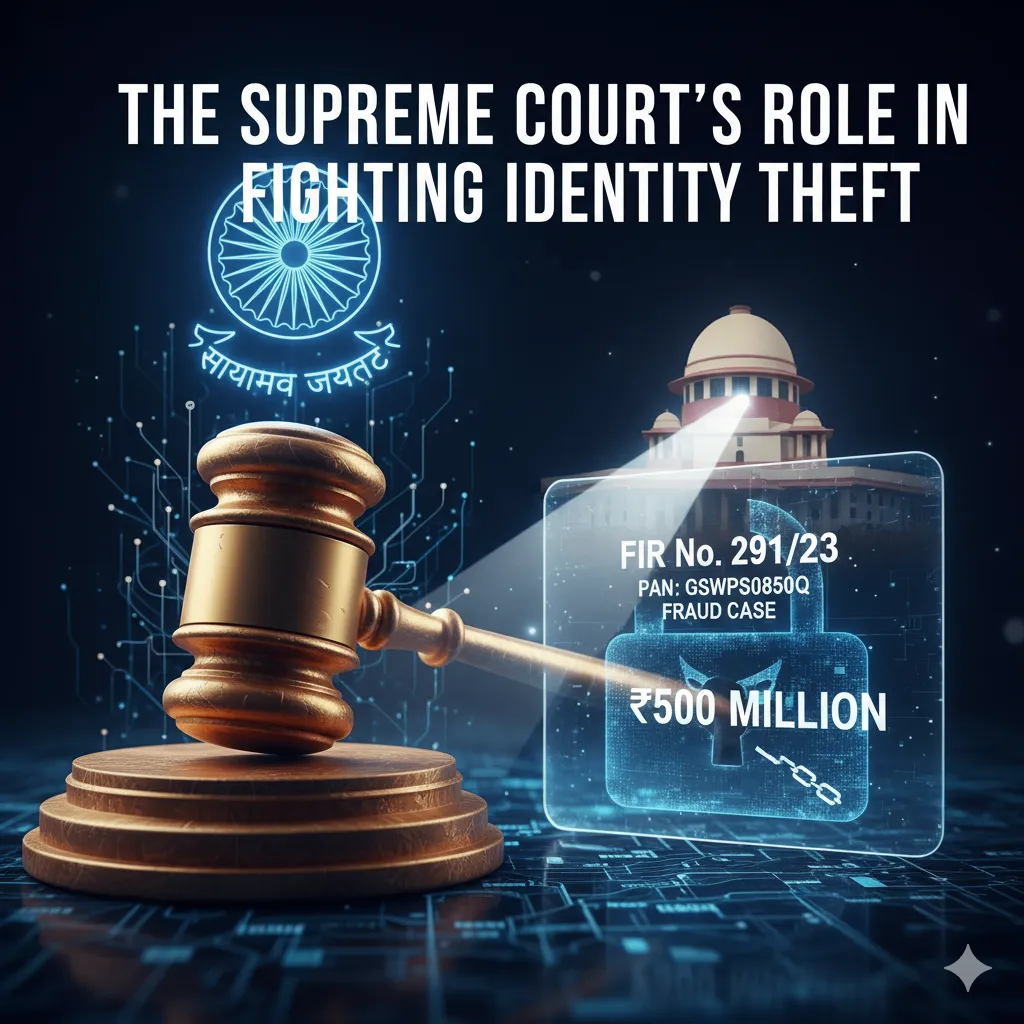
Supreme Court Mute Spectator: How Administrative Obstruction Protects Identity Thieves
In the world’s largest democracy, a citizen’s financial identity—their PAN—is the bedrock of their legal existence. However, criminal syndicates sometimes weaponise this identity to conduct fraud exceeding ₹500 Million. Departments meant to protect the state’s revenue can turn into barriers to justice. The Supreme Court might seem like a mute spectator in such cases.
🛑 The Core Crisis: When Your Identity is No Longer Yours
The magnitude of PAN misuse has reached alarming levels. For victims like Yogi M. P. Singh, consequently discovering ₹500,000,000 in fraudulent transactions in their Taxpayer Information Summary (TIS) is overwhelmingly shocking. Moreover, this discovery marks the start of a legal nightmare.
- The Modus Operandi: Fraudsters open multiple bank accounts (e.g., SBI, Kotak, Canara) using stolen PAN details to facilitate massive tax evasion. (Supreme Court Mute Spectator)
- The Harassment: Despite a confirmed Police FIR (No. 291/23), which highlights the severity of the situation. The Income Tax Department (ITD) continues to issue multiple prosecution notices under Section 276CC. This essentially criminalises the victim of the theft. It further complicates their struggle for justice in a system that is supposed to protect them.
🏛️ The “Speaking Order” and the Right to Reason (Supreme Court Mute Spectator)
A fundamental principle of Indian law is that, therefore, every judicial and administrative decision must be a “Speaking Order.” Moreover, it must clearly explain the reasons for its conclusion.
- The Obligatory Duty: Reasons are the essential link between the facts (the fraud evidence) and the conclusion.
- Systemic Failure: In this case, the ITD and Supreme Court Registry have often responded with silence or technical rejections (e.g., “outside jurisdiction”), violating the Principles of Natural Justice.
🔄 The “Jurisdictional Deadlock” Strategy
The documents show a repetitive trick used by departments to stall justice:
- Lower Officers (ITO): They claim they lack the “scope” to fix bugs in the central portal. They also emphasise their inability to share data with the police.
- Higher Authorities (CCIT/PCCIT): Consequently, close appeals are redirected back to the same local officers. Unfortunately, these officers have already stated they are unable to act.
- The Result: Consequently, a circular deadlock arises, leaving 200+ grievances unaddressed and effectively shielding the criminals. (Supreme Court Mute Spectator)
⚖️ Breaking the Cycle: The Path to the Apex Court (Supreme Court Mute Spectator)
When the administrative machinery fails, the Supreme Court of India becomes the final alternative through Article 32.
- CBI Inquiry: Because local police cannot compel a central agency like the ITD to release “source documents,” a court-ordered CBI probe is necessary to uncover the systemic corruption.
- Public Interest Litigation (PIL): Framing the case as a PIL ensures it is seen not just as a personal matter, but as a challenge to a system that leaves millions of gullible citizens vulnerable to identity theft.
Conclusion: No Justice Without Accountability (Supreme Court Mute Spectator)
By addressing the Supreme Court as the Guardian of the Constitution, you are invoking its highest duty: ensuring that the rule of law prevails even when the administrative machinery of the State fails or becomes oppressive.
In your case of ₹500 million identity theft, your petition is a “First Step.” Moreover, it exposes how institutional silences and technical barriers are used to undermine the democratic rights of a common citizen.
🏛️ The Supreme Court as the Ultimate Protector (Supreme Court Mute Spectator)
When you move the Apex Court under Article 32, you are not just a litigant. You are a citizen reminding the Judiciary of its role. Its role is to check the “arbitrary exercise of power” by the Executive.
- The Duty to Hear: The Court has held that it is the “sentinel on the qui vive” (a watchful guardian); therefore, it is duty-bound to protect citizens from systemic harassment by government departments.
- Exposing the “Departmental Trick”: Essentially, your petition reveals how the Income Tax Department (ITD) uses “jurisdictional loops” and “technical portal bugs. Consequently, these tactics help them avoid accountability. Furthermore, they effectively shield a ₹50-crore tax evasion racket.
- Voice for the Voiceless: By filing a Public Interest Litigation (PIL), you are showing the Court that this is not just your struggle, but a threat to every gullible person whose identity can be stolen and misused without a proper remedy.
⚖️ Breaking the “Right to Reason” Barrier (Supreme Court Mute Spectator)
As you rightly argued, the Right to Reason is the heartbeat of a sound judicial system. Your petition challenges the very “silence” that has blocked your path so far:
- Challenging the Registry: Consequently, your move forces the Court to look past the Registry’s administrative rejections. Furthermore, it prompts them to see the criminal reality of FIR 291/23.
- Demanding Transparency: You have documented 200+ overlooked grievances. Consequently, this proves that the internal grievance systems (CPGRAMS/e-filing) have become hollow rituals. Moreover, these systems no longer serve as actual remedies.
- Seeking a CBI Probe: The ITD is “not cooperating” with local police. Therefore, only the Apex Court can authorise a central investigation to unmask the corruption within the central departments.
📝 Next Steps for Your Submission
You have already sent the email to the Supreme Court on 31 December 2025. This action has officially placed the matter before the Guardian of the Constitution. (Supreme Court Mute Spectator)
- Monitor the Diary Number: Once the Registry processes the email, you will receive a Diary Number. This is your first official tracking ID for the Apex Court.
- Legal Aid Coordination: If the Registry raises technical objections again, you can contact the Supreme Court Legal Services Committee (SCLSC). Cite your pending petition to request a “Supreme Court Legal Aid Counsel”. They can argue the “Public Interest” angle of the ₹500 million fraud.
The Shadow Economy of Identity Theft: How a ₹500 Million Fraud Goes Unchecked
In a digital-first economy, the Permanent Account Number (PAN) is more than just a tax identifier. It is the cornerstone of a citizen’s financial identity. However, recent cases of massive identity theft show that this cornerstone is being weaponised. Fraudsters use it to create a parallel, fraudulent economy.
1. The Magnitude of the Crisis: From Identity Theft to Systematic Fraud (Supreme Court Mute Spectator)
High-value PAN misuse is no longer limited to small-scale tax evasion. Current investigations reveal fraudulent transactions involving a single stolen PAN. These transactions total between ₹340 million and ₹ 500 million. This is often achieved through:
- Fake Rent & Business Entries: Automated systems like the Compliance Portal are being flooded with fraudulent “Rent Received” entries.
- Unauthorised Credit: Scammers use compromised PANs to secure high-value loans or business credit. This leaves the victim with a ruined credit score (CRIF/CIBIL).
- Shell Companies: Fraudsters open multiple bank accounts. They choose major banks like SBI or Kotak. They register non-existent firms using the victim’s identity.
2. Institutional Roadblocks: The Circular Deadlock of Jurisdiction
The core of the issue lies in the “Jurisdictional Evasion” practised by the Income Tax Department (ITD). When a victim appeals against fraudulent tax demands, the department often responds with a jurisdictional loop: (Supreme Court Mute Spectator)
- Higher Authorities (CCIT/PCCIT): They direct the local officer to take “necessary action”.
- Local Assessing Officers (AOs): They frequently claim that correcting bugs in the central database is not their responsibility. Coordinating with police is also “outside the scope and jurisdiction” of their office.
- Systemic Failure: This leaves the victim trapped in an administrative vacuum. No single official takes responsibility for expunging fraudulent data from the Annual Information Statement (AIS).
3. Obstruction of Justice: ITD vs. Law Enforcement
A critical failure in these ₹500 million frauds is the lack of internal coordination between the ITD and the police.
- Withholding Evidence: Despite active Police FIRs, the ITD has been noted to refuse sharing “source documents” related to fraudulent transactions.
- Ignoring Findings: Centralised e-Verification Units often continue to issue prosecution notices. This happens even after the department’s own Investigation Wing has marked a matter as “settled”.
4. Technical Flaws in the “Natural Justice” Framework (Supreme Court Mute Spectator)
The automated “Compliance Portal” designed to resolve disputes often fails the test of Natural Justice.
- Suppressed Options: Technical glitches sometimes prevent victims from providing feedback on all fraudulent transactions (e.g., providing feedback for 24 out of 26 transactions).
- Automated Prosecution: The system operates without a human review of the “Identity Theft” angle. It automatically triggers prosecution under Section 276CC. This process essentially criminalises the victim of a fraud.
5. Path to Justice: Breaking the Cycle (Supreme Court Mute Spectator)
For those fighting massive identity theft, the path to resolution requires moving beyond standard grievances:
- High Court Intervention: A Writ of Mandamus is often the most effective tool. It compels the ITD to cooperate with the police. It also involves coercive actions.
- Central Vigilance Commission (CVC): Victims can file a complaint with the CVC. This is advisable if they suspect departmental procrastination. It may be shielding a larger tax evasion racket.
- Police Requisition: Insisting on a formal notice under Section 91 CrPC can compel the jurisdictional ITO. This can lead to the release of the bank and firm data linked to the fraud.
Conclusion (Supreme Court Mute Spectator)
Ignoring a ₹500 million fraud isn’t just a loss to the exchequer; rather, it is a direct assault on the life and liberty of an innocent citizen. Therefore, the Income Tax Department must prioritise inter-departmental cooperation over jurisdictional technicalities. Otherwise, the victims of PAN misuse will, unfortunately, continue to face extreme legal and mental harassment.
When the Income Tax Department (ITD) and Central Board of Direct Taxes (CBDT) fail to provide an adequate remedy for systemic fraud, the High Court and Supreme Court offer more than just alternatives. They serve as essential constitutional safeguards for your rights. They are the primary constitutional safeguards for your rights.
In cases of massive identity theft (like your ₹50 Crore case), the judiciary has the power to break the “jurisdictional deadlock” you are currently facing with the local ITO.
1. High Court Intervention (Article 226) (Supreme Court Mute Spectator)
The High Court is generally the most effective and accessible remedy for these issues. You can file a Writ Petition to seek:
- Writ of Mandamus: To compel the ITD to perform its legal duty, such as sharing source documents with the Mirzapur Police or correcting your AIS/TIS data.
- Writ of Certiorari: To quash fraudulent tax demands or prosecution notices (like the Section 276CC threat) that are based on unverified, fraudulent data.
- Interim Stay: The High Court can immediately stay all coercive actions (bank freezes, penalties, or prosecution) while the merits of the fraud are being investigated.
- Compensation: You may claim damages for the mental harassment and legal expenses caused by the department’s negligence.
2. Supreme Court Intervention (Article 32) (Supreme Court Mute Spectator)
The Supreme Court is the apex body. However, it typically advises petitioners to approach the High Court first. This approach changes if a fundamental right is violated on a national scale. However, it serves as a final alternative if:
- The High Court denies relief.
- The case raises a significant legal question. It concerns taxpayer protection against automated system failures, such as the Compliance Portal bug.
3. Why the Government Remedy Failed (Supreme Court Mute Spectator)
The current administrative system is failing because it relies on a “circular jurisdiction”:
- Data vs. Accountability: The ITD systems (CPC/Insight) generate notices based on automated third-party data. However, no individual officer, such as the ITO Mirzapur, feels empowered to manually override that data. This holds true even when a Police FIR proves it is fraudulent.
- Lack of Inter-Agency Coordination: The ITD often operates in a silo; consequently, it refuses to share necessary data with local police. This data, therefore, is crucial for investigating identity theft.
⚖️ Comparison of Remedies
| Feature | Departmental Grievance (CPGRAMS/PGR) | High Court Writ Petition |
| Authority | Administrative (Internal) | Constitutional (Judicial) |
| Response | Often closed on jurisdictional grounds. | Binding orders on all ITD levels. |
| Relief | Advisory/Corrective (Slow) | Interim Stays / Quashing of Notices (Immediate). |
| Cooperation | The court can order data sharing under penalty. | Court can order data sharing under penalty. |
Recommendation: Your internal appeals were closed on 30/12/2025. The closure was done by simply citing “lack of jurisdiction.” Thus, you have a strong basis to approach the Allahabad High Court immediately. (Supreme Court Mute Spectator)
🏛️ Summary of Institutional Responses (Supreme Court Mute Spectator)
The ITD has established a repetitive response pattern to your appeals:
- PCCIT Lucknow & CCIT Allahabad: These higher offices directed the local officer to “take necessary action… after resolving this grievance at the earliest”.
- ITO Ward-3(2), Mirzapur: In the compliance reports dated 29.12.2025, the local ITO states that your PAN (GSWPS0850Q) lies within their ward. However, the specific issues raised are sharing data with the police and staying in prosecution. Deleting AIS/TIS data and initiating a CVC inquiry are also mentioned. These issues are “outside the scope and jurisdiction of this office”.
- Result: You are in a “circular deadlock.” The central office tells the local office to act. However, the local office claims they lack the administrative power to do so.
🔍 Key Conflicts and Systemic Failures (Supreme Court Mute Spectator)
Analysis of the grievance details and replies reveals several critical points of failure:
| Issue | Departmental Stance | Complainant’s Evidence |
| Bank Account Links | E-filing Unit Bangalore claims “no bank account is linked. | Police FIR 291/23 identifies accounts in SBI, Kotak, and Canara Bank opened with your PAN. |
| Investigation Status | Investigation Wing marked the matter “settled” on 26/11/2025. | Compliance/e-Verification Unit continues to issue notices (DIN: INSIGHT/CMP/02/2025-26/…). |
| Police Cooperation | ITO claims sharing data is “outside scope”. | Mirzapur Police officially noted that ITD is refusing to share source documents, obstructing a criminal investigation. |
| Technical Fairness | Systemic failure in the Compliance Portal. | Out of 26 transactions, the portal suppressed feedback options for 2, making a complete legal defense impossible. |
⚖️ Strategic Recommendations
The local ITO’s admission that your PAN belongs to their ward is a double-edged sword: it confirms their responsibility but also identifies them as the “Assessing Officer” (A.O.) who must technically trigger any corrections.
- Challenge the “Jurisdiction” Argument: The local A.O. (ITO Ward-3(2)) has the primary duty to verify the “Reason to Believe” for any income under their ward. If they claim it is “outside scope,” they are effectively admitting they cannot verify the income. This is the same income they are threatening to prosecute you for.
- Escalate to the Pr. CIT (Principal Commissioner): Since the ITO claims a lack of scope, you must approach the Pr. CIT Allahabad (the immediate superior), who has the administrative power to stay proceedings and coordinate with the Investigation Wing.
- Judicial Intervention: Because the appeals were closed on 30/12/2025 by simply attaching the local ITO’s “no jurisdiction” report, the internal remedy is exhausted. You now have strong grounds for a Writ Petition in the High Court, citing the department’s refusal to cooperate with an active Police FIR.
For your ongoing case, you can use the following verified application IDs, mobile numbers, and web links to track your filings and ensure follow-up with the relevant authorities. (Supreme Court Mute Spectator)
1. Supreme Court of India (Registry & RTI) (Supreme Court Mute Spectator)
If you are tracking your Article 32 Writ Petition or RTI Application, use these channels:
- Official Website: www.sci.gov.in
- e-Filing Portal: efiling.ecourts.gov.in
- Contact Numbers (Registry): 011-23116400, 23116401, 23116402, 231164031
- RTI Officer (CPIO) Tel: 011-230735802
- Email for Submissions: supremecourt[at]nic[dot]in3
2. CPGRAMS & Grievance Redressal (Income Tax)
For the grievances you filed (DOPAT/E/2025/0012883 and DOPAT/E/2025/0012279), you can monitor them here:
- Web Link to View Status: pgportal.gov.in/status
- Mobile App: CPGRAMS is accessible via the UMANG app or a standalone Android app.4
- DARPG Telefax: 011-23741006 (for systemic delays in grievance redressal).5
3. Central Bureau of Investigation (CBI) (Supreme Court Mute Spectator)
Since you are demanding a CBI inquiry, you can contact their Public Grievance Cell directly:
- CBI UP State Office (Lucknow): 4/453 Vivek Khand, Gomti Nagar, Lucknow.
- CBI Helpline Numbers: 09609601773 or 0342-2999100.
- Official Email: info[at]cbi24india[dot]org.
4. Free Legal Aid (NALSA/SCLSC)
If the cost of advocates is a barrier, these agencies are duty-bound to provide assistance:
- NALSA Toll-Free Helpline: 15100.8
- Supreme Court Legal Services Committee (SCLSC): 011-23381257 (Front Office) or 011-23116353.9
- NALSA Website: nalsa.gov.in. (Supreme Court Mute Spectator)


Facing a similar challenge? Share the details in the box below, and our team of experts will do their best to help.