
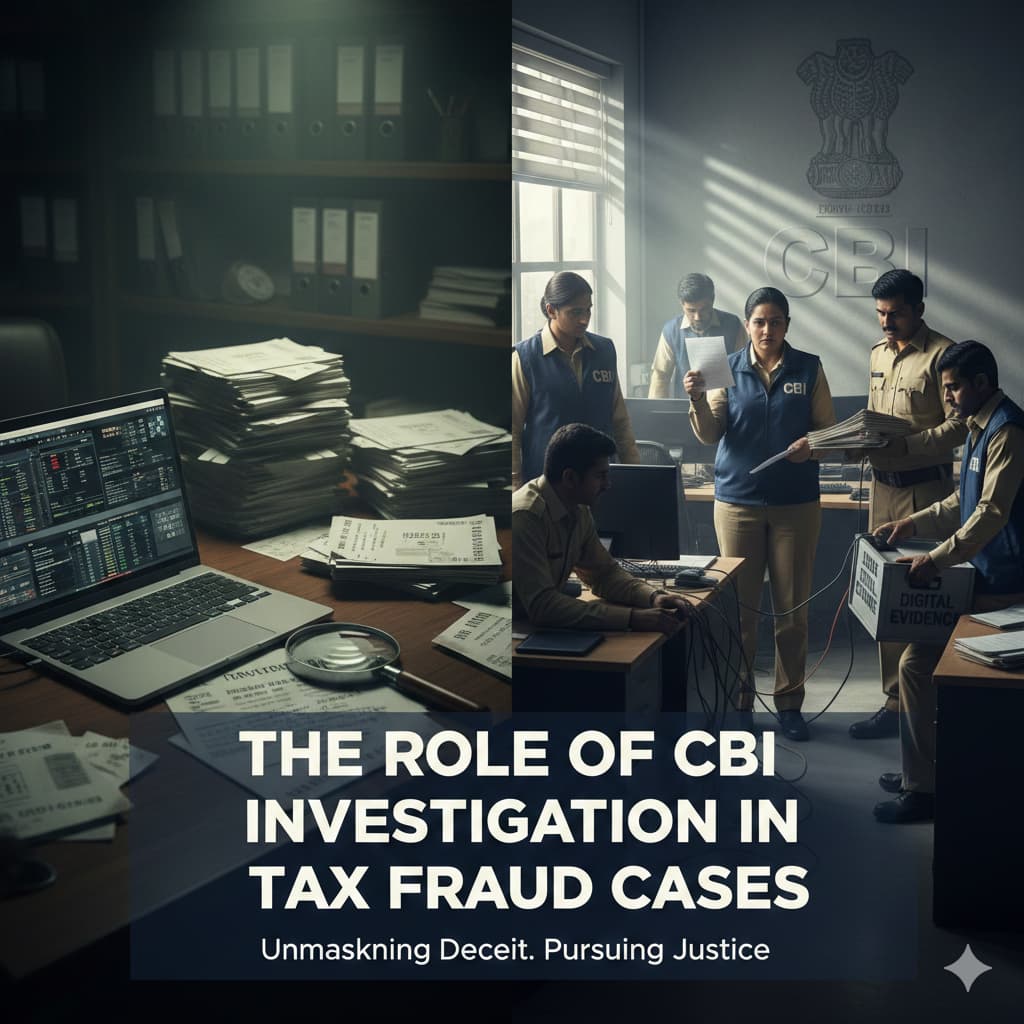
🚨 Role of CBI Investigation: A Failure of Inter-Agency Cooperation
The public grievance records detailed here focus on registration numbers DOPAT/E/2025/0006987 and PMOPG/E/2025/0044483. They reveal a serious and protracted case of alleged tax fraud involving the misuse of a Permanent Account Number (PAN). The purported transactions exceed ₹350 million. The core of the matter centers on the victim, Yogi M. P. Singh, whose brother, Mahesh Pratap Singh, reportedly misused his PAN. The Role of CBI Investigation becomes crucial in such complex cases. There are allegations of procrastination and non-cooperation from the Income Tax Department with the local police investigation.
🔎 Case Background and Allegations (Role of CBI Investigation)
On November 11, 2023, the police registered an FIR (No. 291/23) that brought the incident to light. They filed the case under Section 420 (Cheating) of the Indian Penal Code (IPC). The authorities also invoked Sections 66C and 66D of the Information Technology (IT) Act. An aggrieved individual lodged the case at the Kotwali Katra police station in Mirzapur, naming unknown persons as the accused. These individuals allegedly used the PAN GSWPS0850Q belonging to Mahesh Pratap Singh to open multiple accounts. They conducted transactions that amounted to a staggering ₹343,877,662. The role of the Central Bureau of Investigation (CBI) is crucial in further scrutinising the matter. The CBI possesses the authority to investigate complex financial crimes. They can also collaborate with other agencies to trace the illicit activities linked to this case.
The Two-Fold Complaint
The complainant, Yogi M. P. Singh, has raised two major, interconnected concerns:
- The Fraudulent Misuse: Alleged fraud by 200 companies or firms involved the financial crime itself. They misused the applicant’s PAN for tax evasion, resulting in massive, unauthorised transactions. This situation highlights a failure of the Income Tax Department and their systems.
- The Investigation Roadblock: The deliberate obstruction of the criminal investigation by the Income Tax Department. The local police, through the Investigating Officer (IO), made a specific request to the Income Tax Commissioner in Prayagraj. They asked for details of all accounts opened using the disputed PAN. They also requested the corresponding transaction records, including the names and addresses of account holders. This information was necessary to move the case forward.
- Role of CBI Investigation: The Central Bureau of Investigation (CBI) was called in to take over the case. This occurred after a significant delay from the Income Tax Department. Its role was crucial in unraveling the complexities of the financial irregularities. The CBI ensured that justice was served by conducting a thorough examination of the evidence and statements.
The police request, dated July 4, 2025, clearly indicates that the department’s cooperation is critical for a successful resolution. However, the grievance notes repeated requests have yielded “nil” outcome, with the department allegedly procrastinating “on the flimsy ground.”
🏛️ The Inter-Agency Conflict and Governance Failure
The public grievances highlight a critical breakdown in inter-agency cooperation. This issue is severely hampering the pursuit of justice in a major financial crime. The CBI investigation plays a crucial role in bridging this gap. It ensures that evidence is collected systematically. It also enforces accountability.
Obstruction of Justice ( Role of CBI Investigation)
The primary claim is that the Income Tax Department is “running away from providing account details.” This action effectively shields the corrupt elements. The complainant alleges that fraudulent transactions occurred in two types of accounts. These include those belonging to the taxpayer and those belonging to the Government of India. The lack of information from the tax authority is the central bottleneck. This prevents the police from tracking the flow of funds. It also hinders identifying the culprits behind the 200 firms.
Role of Vigilance and Oversight Bodies (Role of CBI Investigation)
The individuals initially directed their grievances to the Prime Minister’s Office (PMO) and the Ministry of Personnel and Training.
- Prime Minister’s Office (PMOPG/E/2025/0044483): The grievance emphasizes the lack of breakthrough after nearly a year and a half. This duration spans from November 2023 to May 2025. It suggests that “government departments itself [are] shielding the corrupt elements.”
- Central Vigilance Commission (CVC): In the follow-up grievance (DOPAT/E/2025/0006987), the complainant accuses the CVC. It is a key anti-corruption body. The accusation is of “escaping from the matter.” The complainant believes the CVC does this by forwarding the grievance to the Department of Income Tax. The complaint questions the integrity of the Income Tax Department. The complainant views this as a further lapse in oversight due to lack of cooperation.
📜 Legal Provisions for Obtaining Documents: BNSS (New Law)
The legal framework governing how police compel the production of documents has transitioned from the Code of Criminal Procedure (Cr.P.C.), 1973, to the Bharatiya Nagarik Suraksha Sanhita (BNSS), 2023.
The relevant provision empowers the police to demand documents from the Income Tax Department. Various sections of the tax legislation specifically outline this power. It grants law enforcement agencies the authority to access necessary financial records. This enables them to pursue investigations. The investigations include the role of CBI in cases of significant tax evasion or fraud. This legal framework allows the police to obtain critical documentation related to tax compliance. It also establishes protocols to protect taxpayer confidentiality, balancing the need for transparency and accountability in enforcement actions.
BNSS Section 94: Summons to produce document or other thing
This section, which replaced Cr.P.C. Section 91, allows an officer in charge of a police station to issue a written order. The officer can issue this order to any person believed to be in possession of a document. They require them to produce it for the purpose of investigation.
Key Points in BNSS Section 94: ( Role of CBI Investigation)
- It explicitly includes “electronic communication.” This includes communication devices likely to contain digital evidence,” making it directly applicable to a modern tax fraud investigation.
- The Investigating Officer issues a written order under this section. The head of the department holding the records, the Income Tax Commissioner, complies with the legal obligation.
Other Relevant Provisions
- BNSS Section 175 (Replaced Cr.P.C. Section 160): Allows police to summon witnesses. Under this section, police can summon relevant officials from the Income Tax Department) to appear for examination. Police gather all necessary information thoroughly. This supports the investigation process and upholds the rigorous standards of legal inquiry and accountability.
- BNSS Section 176 (Replaced Cr.P.C. Section 161): Allows police to examine orally any person acquainted with the facts of the case and record their statement.
The departmental procrastination directly violates the investigative powers granted to the police under the BNSS.
🎯 Current Status and Required Action
- Current Status: Under process.
- Officer Concerned: Shri Sushil Kumar Patel (Director), Administrative Vigilance Division-II.
- Action Needed: The Director must issue a firm and mandatory directive to the Income Tax Department. They must immediately comply with the police’s request under BNSS Section 94. The department should provide all bank and account details tied to the fraudulently misused PAN (GSWPS0850Q) to the investigating officer.


Facing a similar challenge? Share the details in the box below, and our team of experts will do their best to help.