
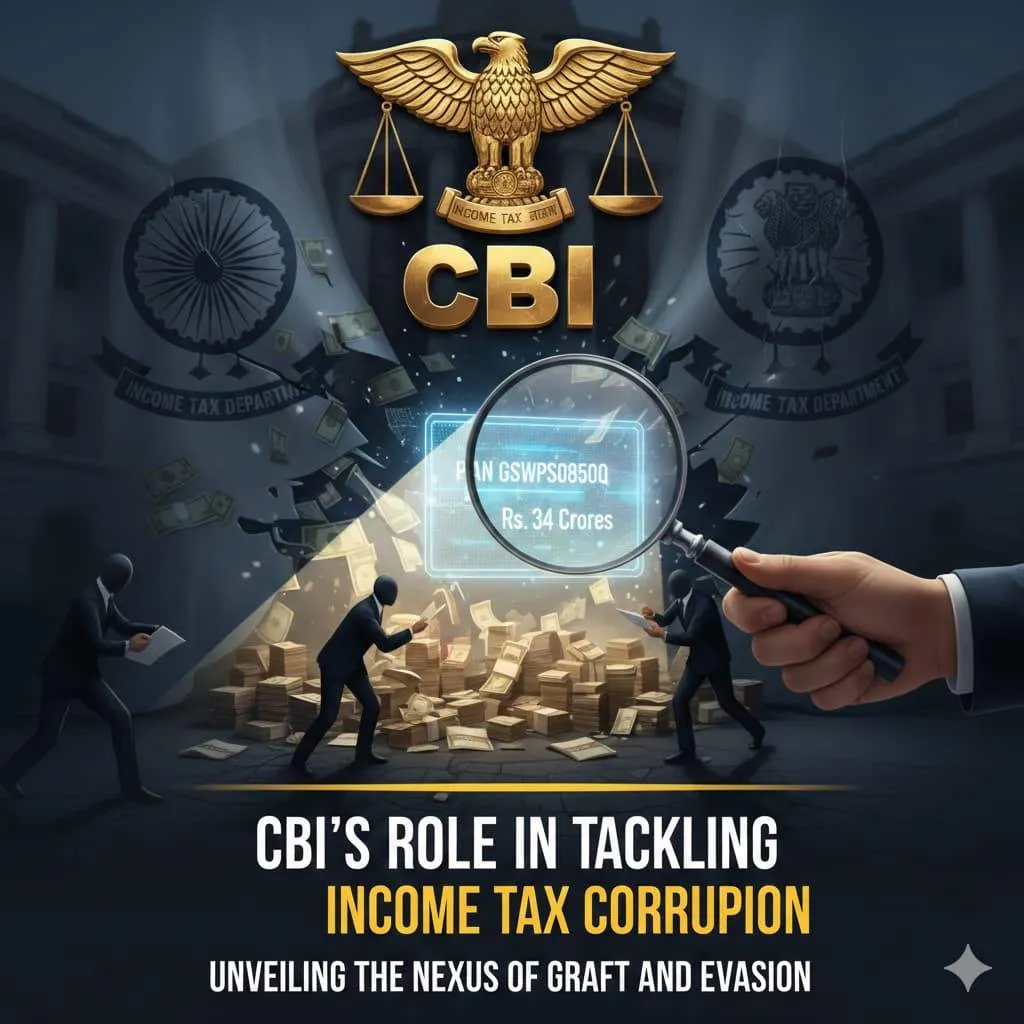
🚨 The Nexus of Corruption: Assessing the CBI’s Role in the Income Tax Department’s Integrity Crisis
The fight against corruption within the Indian Income Tax Department (ITD) is a complex and high-stakes battle. As an arm of the central government, the ITD’s integrity is paramount to the nation’s financial health. The presence of alleged large-scale corruption and tax evasion naturally places the spotlight on the Central Bureau of Investigation (CBI), India’s premier investigative agency.1 The user’s grievance, detailing an unsettling case involving the misuse of a Permanent Account Number (PAN) and departmental non-cooperation, raises critical questions about the CBI’s effectiveness and its strategic role in upholding the rule of law.
The CBI’s Mandate: Investigating Central Government Corruption
The premise that the control of corruption within the Income Tax Department falls under the CBI’s ambit is correct. The CBI derives its power from the Delhi Special Police Establishment Act, 1946, and functions primarily as a specialised agency to investigate complex cases of corruption involving central government employees and its various departments, including the ITD.2
Role of the CBI in Curbing Income Tax Department Corruption
The CBI’s role is not merely reactive; it is a critical component of the anti-corruption framework. Its responsibilities in addressing growing corruption in the ITD include:
- Proactive Intelligence Gathering: Developing sources and intelligence to identify corrupt officials, especially those occupying senior-rank positions who may facilitate large-scale tax evasion and complex financial crimes.
- Registration and Investigation of Cases: Registering cases under the Prevention of Corruption Act, 1988, and other relevant statutes. These investigations often involve complex forensic accounting, examining bank transactions, tracing benami properties, and scrutinising Disproportionate Assets (DA) of officers.
- Prosecution: Filing charge sheets against corrupt officials in the Special Judge courts, ensuring rigorous prosecution, and acting as a deterrent.
- Trap Cases: Conducting “trap cases” where officials are caught red-handed accepting bribes, serving as an immediate check on petty corruption.3
The user’s assertion that the persistence of large-scale corruption “reflects the failure” of the CBI is a common public perception when systemic issues persist. The CBI faces immense challenges, including the sheer volume of cases, the complexity of financial crimes, and occasional issues of political interference or resource constraints that can slow down investigations.4
Mute Spectator or Strategic Investigator?
The question of whether the CBI will “remain a mute spectator on the large-scale tax evasion by taking the senior rank officers of income tax in good faith” touches upon the critical issue of institutional trust and accountability.
The CBI is legally and morally bound to investigate any credible allegation of corruption, regardless of the rank of the officer. The principle of “good faith” cannot override the prima facie evidence of corruption or an official complaint. The user’s grievance—detailing a vast transactional amount ($\text{Rs. }34,38,77,662$) connected to a PAN ($text{GSWPS0850Q}$), coupled with evasive responses from ITD staff (claiming no linked bank account or that details are “not available in the system”)—would constitute a serious matter for investigation.
If the CBI were to receive an official referral or a court order regarding this grievance, they would be expected to initiate a Preliminary Enquiry (PE) or a Regular Case (RC). A PE would be launched to verify the facts, particularly:
- Verification of PAN Misuse: Determining who executed the transactions worth over $text{Rs. }34$ crore and how they were linked to the applicant’s PAN despite the ITD/NSDL denials of a linked ‘Beneficial Owner (BO)’ account or bank details.
- Scrutiny of ITD Responses: Investigating the veracity of the statements made by officers like Neeta Sharma and Pravin Kumar Shrivastav regarding the unavailability of bank details, which is highly unusual for transactions of this magnitude.
- Establishment of Conspiracy: Looking for a larger conspiracy between the tax evaders and any corrupt ITD officials who may be facilitating the evasion and providing cover-up.
In cases involving large-scale tax evasion, the CBI may also collaborate with the Enforcement Directorate (ED) to investigate potential money laundering activities.
The Case of PAN GSWPS0850Q: Non-Cooperation and Malignment
The user’s specific grievance concerning the PAN $text{GSWPS0850Q}$ highlights a breakdown in transparency and administrative accountability, which often fuels allegations of corruption.
The Evasion of Bank Details
The core issue is the alleged refusal by ITD staff to provide bank details for transactions concerning the PAN, while simultaneously citing its transactions to the complainant, Yogi M P Singh. This apparent contradiction—stating that a PAN is linked to $\text{Rs. }34$ crore in transactions while simultaneously claiming no bank details are available in the system—is a significant administrative anomaly that warrants external scrutiny.
- In normal investigative procedure, when the ITD or a police agency requests bank details under Section 91 of the CrPC or relevant IT Act provisions (like $text{u/s }69$ and $text{69B}$ mentioned in the grievance), banks are legally obliged to furnish the records, especially for a PAN which is the primary identifier for tax purposes.
- The ITD’s system (Business Application) is designed to consolidate financial information. The claim that bank details for transactions amounting to hundreds of millions are not available is highly questionable and suggests either gross incompetence, intentional deletion of records, or an active cover-up to protect the financial entities involved in the evasion.
The Allegation of Malignment
The charge that ITD staff are “maligning the image” of Yogi M P Singh suggests an attempt to shift focus and discredit the person exposing the potential tax evasion. This tactic is often observed when officials try to suppress a legitimate complaint that exposes systemic vulnerabilities.
Given that the grievance (PMOPG/E/2025/0037087) is under process with the Ministry of Home Affairs, the logical next step for the complainant, if the MHA process proves unsatisfactory, would be to pursue a direct complaint to the Director of the CBI or petition the relevant High Court or the Supreme Court for a court-monitored CBI investigation. The severity of the alleged tax evasion and the systemic non-cooperation by the ITD provide strong grounds for a detailed, external investigation to break the official impasse.
According to transparency international-What is corruption?
We define corruption as the abuse of entrusted power for private gain.
To end corruption we must first understand it. That’s why we look at what causes corruption and what works against it.
To end corruption, we advocate for power to be held accountable. Everywhere.
We have one vision, a world free of corruption
Our global movement works in over 100 countries to end the injustice of corruption by promoting transparency, accountability and integrity.


Facing a similar challenge? Share the details in the box below, and our team of experts will do their best to help.