
PAN Card Fraud Crisis: Understanding Its Impact
The surge in PAN card fraud has become a significant concern in recent years. Consequently, it has led to severe financial losses for individuals and the government alike. Moreover, cybercriminals exploit loopholes in the system to create fake identities. This practice facilitates money laundering and tax evasion. Such fraudulent activity not only undermines the integrity of financial institutions but also poses a threat to national security. Unfortunately, victims often face lengthy battles to restore their financial health. The emotional toll can be devastating. Therefore, raising awareness and implementing stricter security measures are essential to combat this crisis effectively. This proactive approach will ensure the safety of personal data and financial transactions.
Key Takeaways
- The PAN Card Fraud Crisis has escalated, causing significant financial losses and threatening national security.
- Cybercriminals misuse PAN details for identity theft, leading to money laundering and tax evasion.
- A case study illustrates the use of a stolen PAN for fraudulent transactions, resulting in a complex legal situation for the victim.
- The article suggests measures for individuals and authorities to combat PAN fraud, including FIR lodgment and tightening authentication processes.
- Urgent action is necessary to protect citizens from digital identity compromise and improve the investigation of financial crimes.
🚨 PAN Card Fraud Crisis: A Deep Dive into Identity Theft and Tax Evasion 🚨
The misuse of an individual’s Permanent Account Number (PAN) for fraudulent financial activities, particularly those related to income tax and Tax Deducted at Source (TDS), is an increasingly alarming concern in India.
Moreover, this complex web of identity theft and financial fraud has far-reaching consequences.
Not only does it impact the individual victim, but it also adversely affects the national exchequer.
In fact, a recent case highlighted through public grievance platforms vividly illustrates the severity and sophisticated nature of this crime.
Moreover, it demonstrates how organised entities are leveraging stolen identities to potentially launder money and evade tax liabilities.
🔎 The Case: A Snapshot of Identity and Tax Fraud
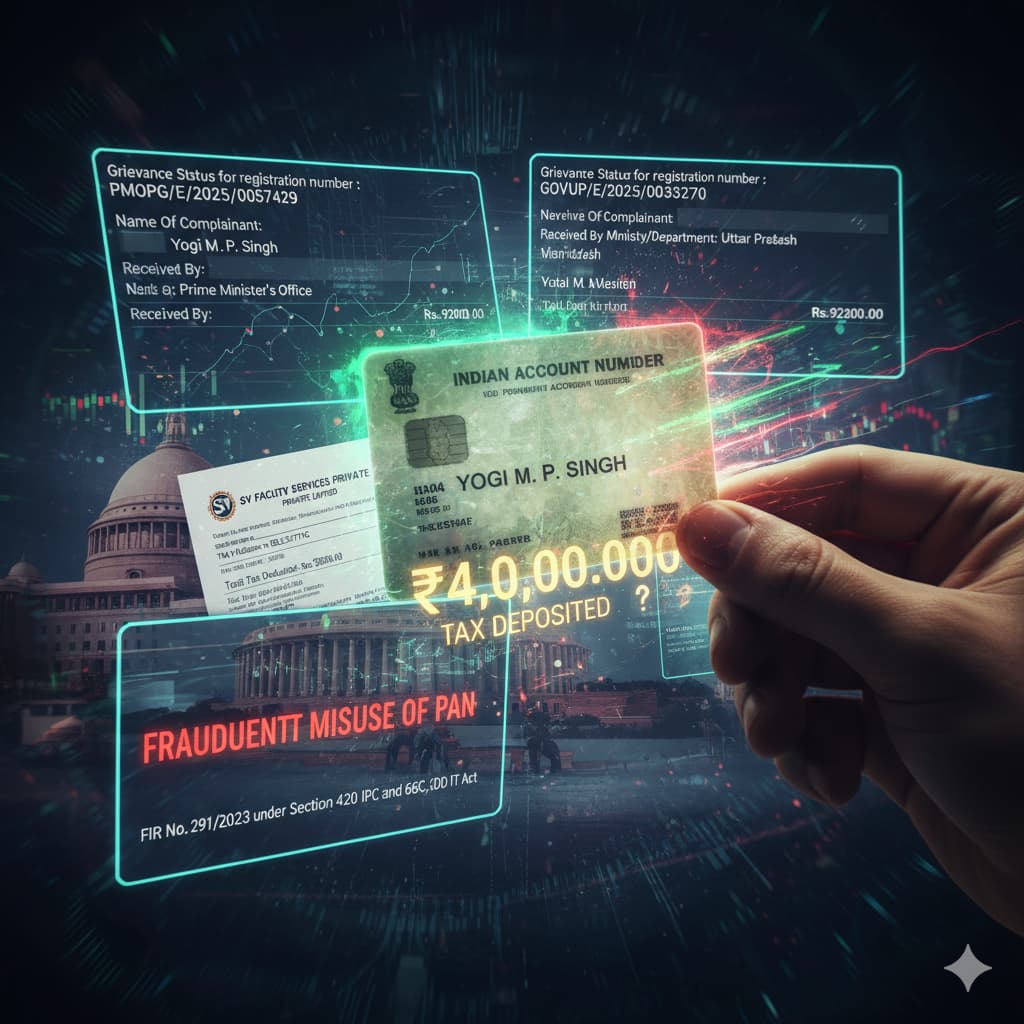
The grievance documents submitted by Yogi M. P. Singh highlight a classic case of PAN misuse. Specifically, the core facts reveal that unknown fraudulent elements allegedly used the complainant’s PAN to facilitate not only significant financial transactions but also associated TDS deductions.
Key Details from the Grievance:
- The Allegation: Fraudulent misuse of the applicant’s PAN, leading to unauthorised financial entries and a substantial, unexplained tax trail.
- Police Action: On November 11, 2023, the police officially registered an FIR (No. 291/2023) at Kotwali Katra, Mirzapur, specifically under Section 420 (Cheating) of the IPC as well as Sections 66C and 66D of the Information Technology (IT) Act. This decisive action demonstrates that the police recognize the gravity of both the financial crime and the digital identity theft involved.
- The Financial Trail: The complainant points to a staggering Rs. 40,000,000 (4 Crores) deposited into the public exchequer in taxes. The Department of Taxes monitors this amount through NSDL. The complainant questions how such a colossal amount could transfer from different sources “without any bank account” directly linked to the taxes.
- Digital Footprints: The grievance outlines that on September 1, 2017, someone activated this using the complainant’s PAN, but they used an incorrect registered address in Raipur, Chhattisgarh. Additionally, they included a specific mobile number (7024188072) and email address (dngoldraipur18@gmail.com) that do not belong to the PAN holder. These details serve as crucial evidence of digital identity theft.
The Deductor Entity: SV FACILITY SERVICES PRIVATE LIMITED (PAN Card Fraud Crisis)
A critical part of the evidence is the detailed TDS transactions linked to the fraudulent PAN. The records show that a company, SV FACILITY SERVICES PRIVATE LIMITED (CIN: U45400DL2012PTC229768), deducted and deposited TDS under Section 194C (Payments to contractors and subcontractors).
| Transaction Period | Total Amount Paid/Credited (approx.) | Total TDS Deducted/Deposited | TDS Section |
| Dec 2021 – Mar 2022 | Rs 9,200,000.00 | Rs. 92,000.00 | 194C |
This example demonstrates how a third-party company fraudulently listed the complainant’s stolen identity (PAN) as the recipient/contractor of payments totalling over 92 lakh rupees.
🎭 The Mechanism of PAN Misuse Fraud (PAN Card Fraud Crisis)
The typical modus operandi in such PAN misuse cases involves a sophisticated ring of fraudsters:
1. Identity Procurement (The Theft) (PAN Card Fraud Crisis)
The first step is acquiring the victim’s PAN details. This is often achieved through:
- Phishing/Vishing: Deceptive calls or emails asking for PAN/Aadhaar details under the guise of an official update (e.g., e-KYC).
- Data Breach: Obtaining data from compromised databases of third-party vendors or services.
- Insider Access: Misuse of data by unscrupulous agents or employees of companies that collect identity documents.
2. Digital Profile Hijacking (PAN Card Fraud Crisis)
Once the PAN is stolen, fraudsters often:
- Activate/Update Income Tax Account: As seen in this case, they activate the PAN user profile with their own contact details (email/mobile) and sometimes a fake address. This allows them to monitor the account and potentially misuse e-filing services.
- Create Fake Proprietorship/Partnership: The stolen PAN is used as the identity of the proprietor or a partner in a shell entity created for fraudulent transactions.
3. Circular Transaction and Tax Evasion (The Laundering)
This is the core of the fraud, often linked to Goods and Services Tax (GST) fraud and income tax evasion: (PAN Card Fraud Crisis)
- Issuing Fake Bills (Bill Trading): A shell company, using the stolen PAN, issues fake invoices for goods or services to another company (the deductor, like SV Facility Services).
- Money Movement (The Illusion of Income): The deductor company (Company A) transfers money to a bank account controlled by the fraudsters but linked to the stolen PAN identity. They disguise this money movement as a genuine payment to the “contractor” (the victim).
- TDS Deduction: Company A legally deducts TDS (e.g., 1% under Section 194C) and deposits it with the government. This deduction accurately reflects on the victim’s PAN, creating a bogus income trail for the victim.
- GST Fraud: Simultaneously, the transaction is often used by the deductor company to claim bogus Input Tax Credit (ITC) under GST, essentially cheating the GST department.
4. The ₹4 Crore Question (Money Flow and Reversal) (PAN Card Fraud Crisis)
The complainant asks, “Was this huge amount transferred without any bank account even when these taxes were transferred from different sources?” This question is highly insightful.
- The TDS (Rs 92,000) is indeed deposited into the public exchequer (Government).
- However, the bulk of the amount paid/credited (the Rs. 9,200,000 for just one deductor) must have gone into a bank account controlled by the fraudsters. Fraudsters exploit loopholes by either:
- Linking the stolen PAN to a fraudulently opened or controlled bank account (often a current account).
- Using the transaction to re-route and layer funds through a chain of shell companies before the money is withdrawn or moved out of the system.
- The Rs. 40,000,000 mentioned by the complainant represents the total tax deducted/deposited across all fraudulent entries, implying the total fake transactions facilitated using the victim’s PAN could be in the range of Rs. 400 Crore or more (assuming a 1% TDS rate, as in Section 194C).
⚖️ Legal Implications and Challenges for the Victim
Criminal Charges
The FIR under Section 420 IPC addresses the core act of cheating, while Sections 66C and 66D of the IT Act are crucial:
- Section 66C: Addresses identity theft (using the electronic signature, password, or any other unique identification feature of any other person).
- Section 66D: Addresses cheating by personation using a communication device or computer resource.
Challenges in Investigation
The case highlights a crucial breakdown in the system: (PAN Card Fraud Crisis)
- Jurisdictional Overlap: The fraud spans across jurisdictions as the victim is in Mirzapur, the deductor operates in Delhi, and they link the fraudulent profile to Raipur.
- Interdepartmental Coordination: The crime involves the Income Tax Department (PAN), the GST Department (likely ITC fraud, as suggested by the ‘Case Closed’ remark related to GST), and the Police (IPC/IT Act). Consequently, the police investigation led by Mr. Jitendra Kumar necessitates seamless cooperation from financial agencies, including the Income Tax Department and NSDL, to ensure an effective resolution of the case.
- Delayed Action: The complainant’s frustration regarding the Case Closed status with a remark on GST action, despite the clear-cut police FIR and identity theft complaint, suggests a lack of an integrated, timely response to a multifaceted financial crime.
🛡️ Measures to Combat PAN Misuse (PAN Card Fraud Crisis)
For the Individual Victim (Yogi M.P. Singh and others): (PAN Card Fraud Crisis)
- Lodge FIR: Already done, a critical step.
- Formal Communication to Income Tax Department (ITD): Consequently, immediately write to the Assessing Officer (AO) explaining the fraud and providing copies of the FIR. Additionally, request the AO to mark the fraudulent entries in the Annual Information Statement (AIS)/Form 26AS as ‘Disputed’, while also urging the blocking of any unverified profiles linked to the PAN.
- Cyber Cell Complaint: File a separate complaint with the national Cyber Crime Reporting Portal.
- PAN Lock/Deactivation: Request ITD to temporarily suspend or lock the PAN-linked e-filing account until the investigation is complete, ensuring no further fraudulent returns are filed.
For Authorities and Systemic Reform: (PAN Card Fraud Crisis)
- Mandatory OTP/Aadhaar Linkage for Profile Changes: Consequently, any change in critical PAN profile details (address, mobile, or email) should, therefore, require authentication via the Aadhaar-registered mobile number to effectively prevent hijacking.
- Proactive Scrutiny of High-Value TDS Transactions: The ITD and NSDL must automatically flag PANs that show disproportionately high TDS entries without a corresponding history of high income, especially when those PANs link to non-metropolitan addresses or multiple, unrelated corporate entities.
- Integrated Grievance Redressal: A unified system should automatically share complaints involving PAN/GST fraud across the Police, Income Tax, and GST authorities. This coordination streamlines investigations, making the process smoother for victims instead of forcing them to navigate between authorities (Police vs. GST vs. ITD).
The case of Yogi M. P. Singh serves as a stark reminder of the escalating risks of digital identity compromise in India. It necessitates urgent, concerted action from both law enforcement and financial regulatory bodies to streamline the investigation process and safeguard the financial identities of citizens against organised crime syndicates that exploit the system for massive tax fraud.
Would you like to know the specific procedures for reporting PAN misuse to the Income Tax Department in India?


Facing a similar challenge? Share the details in the box below, and our team of experts will do their best to help.