
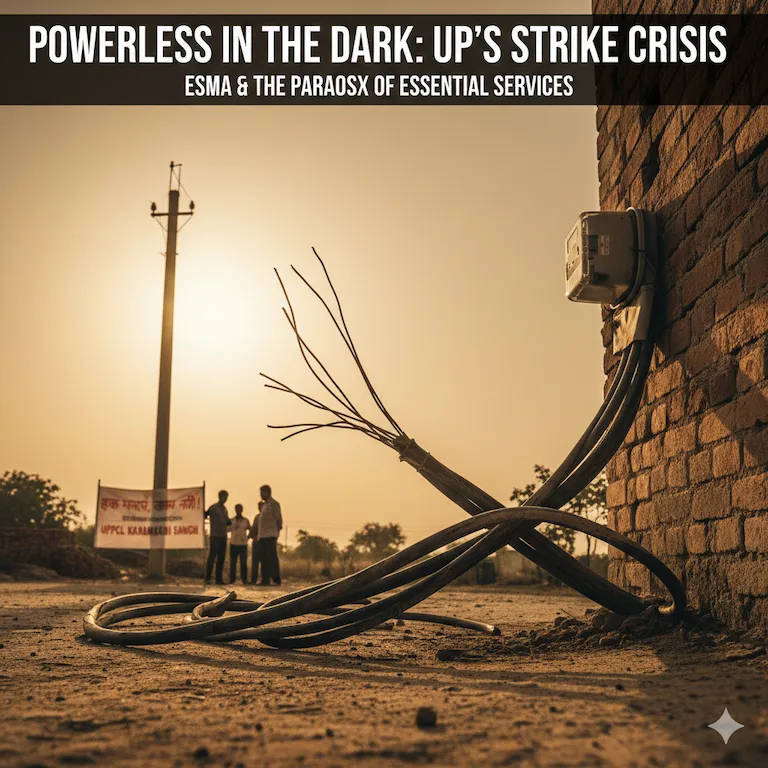
The Essential Services Maintenance Act (ESMA) serves as a crucial legislative measure that ensures the uninterrupted provision of essential services during disruptions such as strikes and protests. In Uttar Pradesh (UP), power strikes have become a contentious issue, significantly impacting daily life and economic activities. The state’s government invokes ESMA to maintain order and prevent prolonged outages, emphasizing the need for a continuous power supply to hospitals, schools, and industries. These measures often spark debates over workers’ rights versus public safety, highlighting the delicate balance that officials must strike to ensure both service continuity and fair labor conditions.
Key takeaways from blog post
Here are the key takeaways from the analysis of the grievance regarding the UPPCL strike and service delays:
1. Service Bottleneck: The “Last Mile” Failure
Despite the smart meter company providing the necessary hardware (armored cables), the final activation—the pole connection—remained stalled. This highlights a critical dependency on departmental linemen who, in this instance, prioritized union activities over service delivery.
2. Legal Defiance of ESMA
The Uttar Pradesh government had invoked the Essential Services Maintenance Act (ESMA), which legally prohibits strikes in the power sector for six months. The blog emphasizes that the ongoing strike is a direct violation of this state mandate, aimed at ensuring uninterrupted power during extreme weather.
3. Financial Accountability: “No Work, No Pay”
A major point of contention is how to apply the “No Work, No Pay” principle. The post argues that employees who participate in an illegal strike (post-ESMA invocation) should not receive salaries from the public exchequer, citing Supreme Court precedents.
4. Administrative Silence
The grievance points to a breakdown in communication. While a Junior Engineer provided empty assurances, senior officials (such as the Executive Engineer) were unreachable, leaving the consumer without recourse despite following all official channels.
5. Policy vs. Reality
There is a stark contrast between high-level government initiatives (like anti-strike laws and privatization efforts) and the ground-level “working style” of staff. The takeaway is that policies are ineffective without strict enforcement and departmental accountability.
The Paradox of ESMA (Essential Services Maintenance Act): Power Struggles and Public Suffering in Uttar Pradesh
The intersection of labor rights, essential services, and administrative accountability often creates a friction point that leaves the common citizen in the dark—quite literally. In the state of Uttar Pradesh, a recent grievance filed by Yogi M. P. Singh (Registration No: GOVUP/E/2025/0064200) highlights a systemic failure where high-level policy mandates, such as the Essential Services Maintenance Act (ESMA), appear to crumble when faced with the ground reality of departmental strikes and bureaucratic inertia.
The Core Conflict: Infrastructure Ready, Connectivity Denied
The crux of the issue lies in a frustrating gap between the delivery of equipment and the execution of service. On June 10, 2025, following an earlier grievance, the staff of the smart electricity meter company fulfilled their obligation by providing armored cables for two specific accounts in the name of Mahesh Pratap Singh and Keshav Pratap Singh.(Essential Services Maintenance Act and Power Strikes)
While the technical team connected the cables to the meters, a critical bottleneck emerged: the “pole connection.” In the hierarchy of the Uttar Pradesh Power Corporation Limited (UPPCL), this final step is the exclusive domain of departmental linemen. Despite the hardware being present and the consumer being ready, the physical link to the power grid remained unestablished.
When the complainant reached out to the Executive Engineer, the calls went unanswered. While a Junior Engineer offered verbal assurances, those promises dissolved into the evening air. The reason? The staff was preoccupied with strike activities—delivering speeches instead of delivering electricity.
The Legal Framework: ESMA (Essential Services Maintenance Act) and the “No Work, No Pay” Mandate
To prevent exactly this kind of public hardship, the Uttar Pradesh government invoked the Essential Services Maintenance Act (ESMA). This legal tool prohibits strikes in the electricity sector for a period of six months, covering major entities including:
- UPPCL (UP Power Corporation Limited)
- UPPTCL (UP Power Transmission Corporation Limited)
- Regional DISCOMS (MVVNL, PuVVNL, PVVNL, DVVNL, and KESCO)
The objective of ESMA is clear: to ensure that during periods of extreme weather or high demand, the state’s power infrastructure remains operational. Furthermore, the judicial principle of “No Work, No Pay”—upheld by the Supreme Court of India in cases such as K.K. Sugar Mills v. State of Uttar Pradesh—stipulates that employees are not entitled to wages for periods where work is not performed, even during lawful strikes.
The grievance raises a biting question: If ESMA is in force, making the strike technically illegal, why does the public exchequer still bear the burden of salaries for those who refuse to work?
The Human Impact of Administrative Apathy
For the residents of Uttar Pradesh, particularly during the intense heat of June, electricity is not a luxury; it is a survival necessity. The complainant’s detailed account describes a scenario where the citizen is caught between a government that issues notifications and a workforce that ignores them. (Essential Services Maintenance Act and Power Strikes)
The visual evidence of bundled, unconnected wires serves as a metaphor for the state’s energy department: the resources are available, but the will to connect them is missing. When a Junior Engineer promises a resolution by 7:15 PM and fails to deliver, it isn’t just a delay; it is a breach of the “Social Contract” between the utility provider and the taxpayer.
Questioning the Outcome of Government Initiatives
The Hon’ble Chief Minister has taken bold steps to prohibit strikes to protect the interests of the common man. However, as the grievance points out, the “outcome of such initiatives” is negligible if there is no change in the working style of the staff. (Essential Services Maintenance Act and Power Strikes)
The protest against the privatization of electricity distribution in 42 districts (under Agra and Varanasi zones) has become the catalyst for this defiance. While labor unions have the right to voice concerns, doing so by violating ESMA and holding the public’s access to light and cooling hostage presents a moral and legal crisis.
Moving Toward Accountability
Shri Arvind Mohan (Joint Secretary) at the Chief Minister’s Secretariat received the grievance. The resolution of this specific case (Registration No: GOVUP/E/2025/0064200) will serve as a litmus test for the effectiveness of the state’s grip on its own departments regarding the Essential Services Maintenance Act and Power Strikes.
Key areas for administrative review include:
- Enforcement of ESMA: Why did management allow staff to engage in “speech-making” and strike activities during active duty hours?
- Communication Protocols: Why did senior officials, such as the Executive Engineer, fail to respond to citizen queries during a service crisis?
- Fiscal Discipline: Will the management strictly apply the “No Work, No Pay” principle to those who participated in the strike despite the ban?
Conclusion (Essential Services Maintenance Act and Power Strikes)
The transition to smart meters and modernised infrastructure is a hollow victory if the basic “pole connection” remains an insurmountable hurdle due to labour unrest. For the citizens of Uttar Pradesh, the hope is that the government’s firm legal stance on ESMA translates into functional reality on the streets. Accountability must flow as consistently as the electricity itself.
To ensure you effectively follow up on your grievance, I have compiled the official contact details for the specific authorities mentioned in your request, along with the relevant digital portals.
1. Public Grievance Authority (Chief Minister’s Secretariat) (Essential Services Maintenance Act and Power Strikes)
The official to whom your grievance has been forwarded for oversight:
- Officer Name: Shri Arvind Mohan (Joint Secretary)
- Contact Number: 0522-2226350 / 0522-2226354
- Email Address: arvind.12574@gov.in / jansunwai-up@gov.in
- Office Address: Chief Minister Secretariat, Room No. 321 (or 303 for Lok Shikayat Section-3), 3rd Floor, Lok Bhawan, U.P. Secretariat, Lucknow.
2. UPPCL / DISCOM Concerned Authorities (Essential Services Maintenance Act and Power Strikes)
Based on your grievance, the following senior officials oversee the UPPCL and Madhyanchal (MVVNL) operations:
| Authority | Name | Mobile / Contact | |
| Chairman, UPPCL | Dr. Ashish Kumar Goel, IAS | 0522-2287801 | chairman@uppcl.org |
| Managing Director, UPPCL | Shri Pankaj Kumar, IAS | 0522-2288377 | md@uppcl.org |
| Managing Director, MVVNL | Ms. Riya Kejriwal, IAS | 9415911111 | md@mvvnl.org |
| CMO Public Grievance | Section Officer | 0522-2226459 | cmup@nic.in |
3. Web Links & Digital Access (Essential Services Maintenance Act and Power Strikes)
Use these links to track your status or escalate the matter if it remains unresolved:
- Jansunwai (Samadhan) Portal:jansunwai.up.nic.in
- Action: Use your Mobile Number and Registration No. (GOVUP/E/2025/0064200) to “Track Grievance.”
- UPPCL Consumer Portal:consumer.uppcl.org
- Action: Register or track meter-related service requests.
- UPPCL Official HQ Directory: uppcl.org/uppcl/en/page/headquarter
4. Summary of Referenced IDs (Essential Services Maintenance Act and Power Strikes)
- Primary Grievance ID: GOVUP/E/2025/0064200 (Dated 12/06/2025)
- Linked Grievance ID: GOVUP/E/2025/0062967 (Dated 10/06/2025)
- Consumer Account Nos: 2704668219 & 8667726000
- Official Helpline: 1912 (Toll-free 24×7 for electricity complaints)
Would you like me to draft a formal “Reminder/Escalation” letter using these details that you can email to the Joint Secretary?


Facing a similar challenge? Share the details in the box below, and our team of experts will do their best to help.