
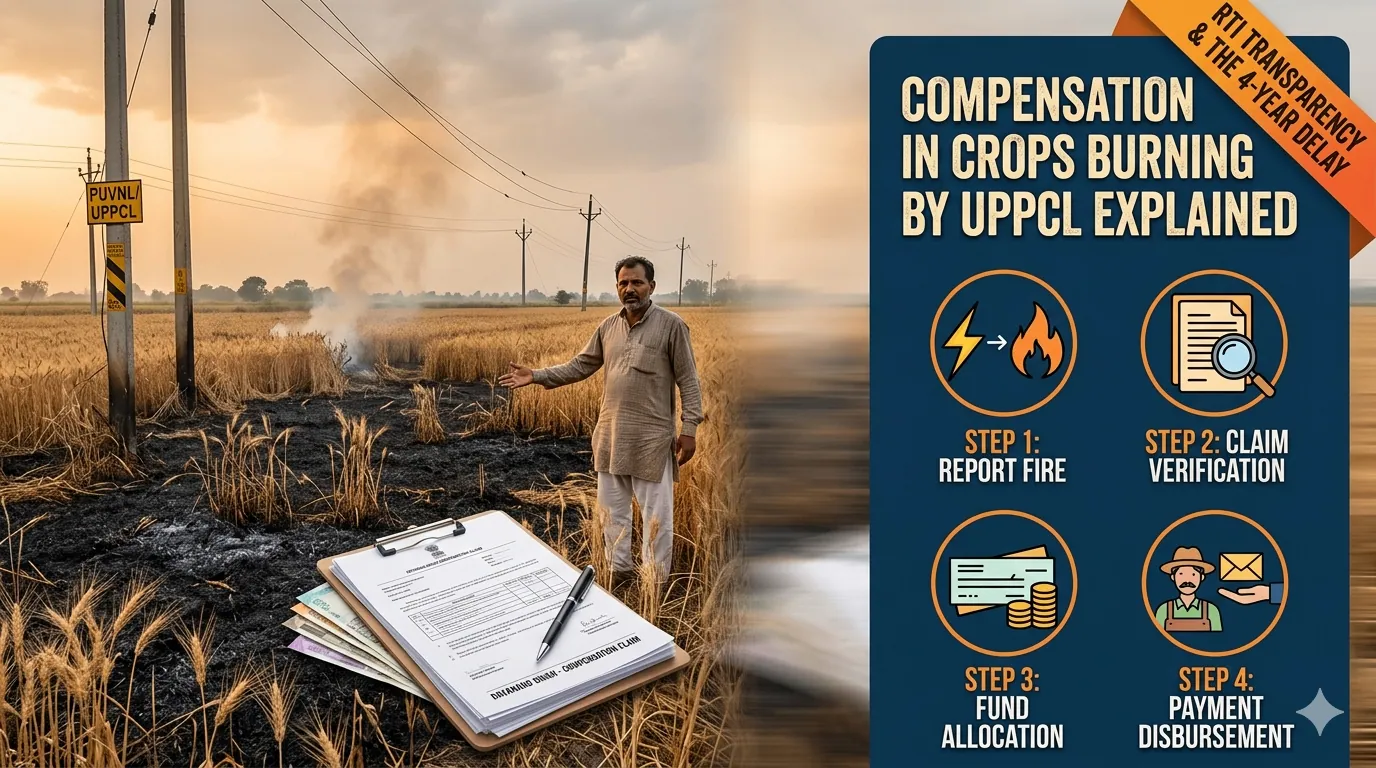
Key Takeaways (Compensation in Crops Burning by UPPCL)
- The RTI Act aims to ensure transparency. However, bureaucracy delays farmer compensation. Yogi M P Singh’s appeal highlights a claim pending since April 2021.
- The appeal reveals RTI violations by the PUVVNL. It includes the failure to transfer requests timely and respond within legal limits. This undermines accountability.
- Four years of procrastination in compensating a farmer raises concerns over the effectiveness of governmental support for farmers’ livelihoods.
- Urgent action is needed to address RTI violations and the delayed compensation, reflecting the government’s commitment to farmers.
- The case illustrates a lack of transparency in administrative processes, affecting trust and financial stability for farmers facing crop loss.
⚡️ Compensation in Crops Burning by UPPCL: Farmer Compensation and the RTI Gridlock in UPPCL/PUVVNL
The Right to Information (RTI) Act, 2005, is a cornerstone of transparency in India. Bureaucratic delays constantly test its efficacy, especially when it involves our most vulnerable—our farmers.
Yogi M P Singh recently filed an RTI appeal (Registration No. PUVNL/A/2025/60230). The appeal sheds harsh light on the alleged procrastination within the Purvanchal Vidyut Vitran Nigam Limited (PUVVNL). PUVVNL is a subsidiary of the Uttar Pradesh Power Corporation Ltd. (UPPCL). The appeal raises concerns about issues regarding Compensation in Crops Burning by UPPCL. It also highlights the failure to ensure timely payment of crop damage compensation.
The case involves a compensation claim for a farmer, Dayanand Singh S/O Shobhnath Singh. A short circuit reportedly burnt his wheat crop. This claim has been pending since April 18, 2021. This unfortunate incident caused Mr Singh significant financial loss. It also threatened the livelihood of his entire family. Farming is their primary source of income. Furthermore, the persistent inaction regarding this claim raises concerns about the effectiveness of governmental policies. These policies support farmers, but stakeholders often tout them without implementing them promptly.
📅 The Administrative Maze: RTI Act Violations
The core of the appeal focuses on two violations of the RTI Act. The Public Information Officer (PIO) and the Public Authority committed these violations. (Compensation in Crops Burning by UPPCL)
1. Failure in Timely Transfer (Section 6(3))
I filed the initial RTI application (Registration No. PUVNL/R/2025/60342) on June 6, 2025. The appropriate authority transferred it to another PIO on June 23, 2025. (Compensation in Crops Burning by UPPCL)
If someone submits an application to the wrong public authority, the authority must take action. This is according to Section 6(3) of the RTI Act, 2005. This means the authority should direct the application to the correct public authority.
…transfer the application or such part of it as may be appropriate to that other public authority. Inform the applicant immediately about such transfer. The transfer of an application pursuant to this sub-section shall be made as soon as practicable. This transfer must occur no later than five days from the date of receipt of the application.
The transfer in this case took 17 days (from June 6 to June 23). This is a clear violation of the statutory five-day limit. This delay effectively eroded the applicant’s time to receive a response.
2. Failure in Timely Response (Section 7(1)) (Compensation in Crops Burning by UPPCL)
The second violation concerns the fundamental response timeline. Section 7(1) of the RTI Act mandates that a PIO, upon receiving a request, shall:
…as expeditiously as possible, and in any case within thirty days, either: Provide the information… or Reject the request for reasons specified in Sections 8 and 9.
The original application was filed on June 6, 2025. By the time the appeal was filed on July 22, 2025, the mandatory 30-day period had passed. The appellant did not receive the requested information. This led to the appeal on the grounds of “No Response Within the Time Limit.” The appellant suggests this is a deliberate strategy of procrastination.
🌾 The Underlying Issue: The Compensation Gridlock (Compensation in Crops Burning by UPPCL)
The RTI requests aimed to uncover why compensation payment to farmer Dayanand Singh was delayed for four years. Specifically, the applicant sought information regarding:
- Internal Communications: Notings and action taken on official letters (Letter No. 2765 dated 29.04.2025 and Letter No. 2974 dated 07.05.2025) that likely address the compensation payment.
- Fund Shortfall: We did not meet the demand of ₹40 lakh. The Executive Engineer reportedly made this demand for paying compensations.
- Fund Processing Mechanism: Details on how the Director of Finance’s office processes fund demands from subordinate offices.
- Budget Status: Was the budget increased on the ERP system on March 25, 2025? If so, why hasn’t Dayanand Singh received his compensation yet?
The failure to provide this information within the stipulated RTI timeline creates an informational black hole. This suggests that the payment is being held up. The reason might be due to “unavailability of the fund,” as stated in the appeal documentation concerning an earlier memo.
Impact on Farmers (Compensation in Crops Burning by UPPCL)
A compensation case has been pending for four years. Specifically, it relates to a farmer’s burnt crop. This case underscores a profound lack of empathy and urgency in the administrative machinery. This protracted delay in securing financial relief is deeply detrimental to the economic stability of a farming family. It potentially impacts their next planting cycle and overall livelihood. The appellant accuses that this procrastination is anarchy in the public authority’s workings. This accusation highlights the serious erosion of public trust caused by such administrative lethargy.
📢 Call for Immediate Action and Transparency
The RTI Act provides individuals with a mechanism for recourse. Additionally, the Appellate Authority now takes on the responsibility of rectifying these lapses. Furthermore, requesting the Appellate Authority to direct the PIO to provide the information at the earliest is essential. Ultimately, it is a key step toward transparency. (Compensation in Crops Burning by UPPCL)
This case is not just about one farmer’s compensation. The state tests the accountability of state-owned power utilities to the law and the citizens they serve. Immediate and transparent action on both the RTI violations is paramount. The state must also urgently address the long-pending compensation payment. The Yogi Adityanath government can truly reflect its commitment to farmers only then.
The public deserves to know the mechanism behind such egregious delays. They also deserve to know the reason for these delays. This is especially important when the compensation serves as basic relief for crop loss. Transparency in internal ‘notings’ is crucial. It prevents instances of administrative procrastination from recurring. Transparency in ‘fund processing’ is equally important.
Here are the official web links:
- Purvanchal Vidyut Vitran Nigam Limited (PuVVNL): https://puvvnl.up.in/
- Uttar Pradesh Power Corporation Ltd. (UPPCL):


Facing a similar challenge? Share the details in the box below, and our team of experts will do their best to help.