
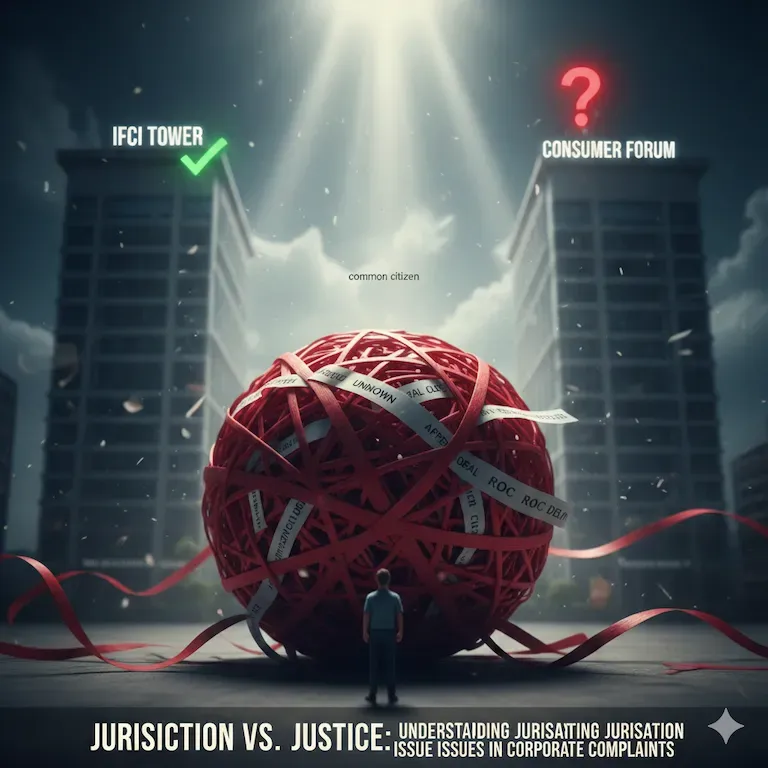
Here are the key takeaways from the jurisdictional and administrative dispute between Yogi M. P. Singh and the ROC Delhi. Understanding jurisdiction issues is crucial when examining cases like this.
1. Jurisdictional “Dead Zones” (Understanding Jurisdiction Issues)
The primary hurdle was a conflict over where the company is legally registered versus where it physically operates. Specifically, while the company has an office in Gurugram (Haryana), the ROC Delhi claimed no jurisdiction. Consequently, this highlights a common frustration for citizens: the difference between a Corporate Office and a Registered Office.
2. Nature of the Grievance vs. Regulatory Scope (Understanding Jurisdiction Issues)
The Ministry of Corporate Affairs (MCA) and the ROC primarily enforce the Companies Act, 2013; consequently, they handle:
- Statutory filings and compliance.
- Internal management fraud.
- License validity.
The authorities clarified that a non-refund for advertisements is, in fact, a “deficiency of service;” thus, it is a civil/consumer matter, not a corporate compliance violation that would lead to the cancellation of a business license.
3. The Requirement for “Speaking Orders” (Understanding Jurisdiction Issues)
A major point of contention was the brevity of official remarks. The applicant argued that public officials should provide “comprehensive details” and guidance rather than “cryptic remarks.” This highlights a demand for more transparent communication in the CPGRAMS (grievance redressal) process. Understanding jurisdiction issues is also crucial in ensuring that grievances are addressed within the appropriate legal frameworks and that citizens are aware of their rights and the avenues available for addressing complaints.
4. Recommended Legal Recourse (Understanding Jurisdiction Issues)
The final disposal of the appeal provides a clear roadmap for similar disputes:
- Consumer Forums: The appropriate venue for seeking refunds or compensation for services not rendered.
- Civil Courts: For recovery of money based on contractual agreements.
5. Corporate Identity Verification (Understanding Jurisdiction Issues)
Before you file a grievance, verify the CIN (Corporate Identity Number). Also, check the Registered Office via the MCA portal. A company might have a massive physical presence in one state. However, its legal registration, and thus the governing ROC, might be in another state such as Telangana or Karnataka.
Understanding Jurisdiction Issues: The Case of Yogi M. P. Singh vs. ROC Delhi
In the complex landscape of corporate governance in India, a citizen’s grievance often struggles to reach a regulator’s authority. Consequently, jurisdictional red tape frequently blocks this bridge. For instance, the case of Appeal Number DCOYA/E/A/24/0000569, filed by Mr. Yogi M. P. Singh, is a quintessential example. In fact, it shows the “jurisdictional carousel” that many applicants find themselves trapped in when dealing with multinational corporations.
The Heart of the Dispute
The grievance originated from a financial dispute with Facebook India Online Services Pvt. Ltd. Specifically, Mr. Singh alleged that the company failed to refund a prepaid balance following the cancellation of advertisements. In the eyes of the complainant, this wasn’t just a commercial disagreement; rather, it was a matter of corporate irregularity and “fraudulent activity” that, consequently, warranted the cancellation of the company’s license. Understanding jurisdiction issues is crucial, as it determines the legal authority under which the complaint can be filed and adjudicated.
The Jurisdictional Tug-of-War (Understanding Jurisdiction Issues)
The crux of the frustration, therefore, lies in a bureaucratic “ping-pong” match between various offices of the Registrar of Companies (ROC):
- The Applicant’s Stance: Mr. Singh argued that since the company’s address—DLF Atria, Jacaranda Marg, Gurugram—falls within the NCR region, the ROC Delhi & Haryana was the appropriate authority.
- The Official Response: Deputy ROC Gaurav (ROC Delhi) made a succinct remark when disposing of the case. He stated: “Company not registered within the jurisdiction of this office.”
- The Confusion: The matter had previously been forwarded to ROC Telangana. The applicant labeled this move a “blunder.” The physical operations mentioned were in Haryana.
Administrative Deadlock and the Appeal
Mr. Singh’s appeal highlights a common grievance against the CPGRAMS (Centralized Public Grievance Redress and Monitoring System) process: specifically, the use of “cryptic remarks.” Furthermore, the applicant contended that it is the “obligatory duty” of the ROC staff to provide comprehensive details and, thereby, guide the citizen toward the correct authority rather than simply closing the file with a one-sentence disclaimer. Understanding jurisdiction issues is crucial, as it determines the authority’s responsibility in addressing grievances effectively and ensures that citizens receive the appropriate support and resolution from the relevant departments.
However, the Regional Director (RD) Northern Region, Vinod Sharma, provided the final closure on June 25, 2025, with a clarification that shifts the nature of the dispute entirely:
“Moreover, the matter pertains to the non-refund of the amount paid for advertisement, raising understanding jurisdiction issues. Consequently, it does not fall under the purview of this office. Therefore, the complainant may approach the appropriate authority or consumer forum for resolution of their grievance.”
Key Takeaways for Consumers (Understanding Jurisdiction Issues)
This case underscores a vital distinction in Indian law:
- ROC/MCA Purview: The Registrar of Companies typically handles violations of the Companies Act, 2013 (e.g., filing failures, fraud in balance sheets, or management disputes).
- Consumer Forum Purview: Disputes regarding “deficiency of service” or “non-refund of fees”—even if the entity is a registered company—are generally considered civil/consumer disputes.
Conclusion (Understanding Jurisdiction Issues)
The applicant viewed the non-refund as a sign of a “fraud company.” Moreover, they believed it should lose its license. However, the regulators viewed it as a private commercial dispute. Consequently, the takeaway for the public is clear. The ROC ensures companies exist and operate legally; therefore, the Consumer Courts are the actual battleground for individual financial recovery.
The case serves as a reminder that “Good Governance” requires more than just the existence of portals like CPGRAMS. It needs a more empathetic guidance system. Such a system should direct citizens to the right door the first time they ask.
To ensure your grievance reaches the right hands, it is important to distinguish between the Corporate Regulator (ROC/MCA) and the Consumer Dispute Authorities (Consumer Forum); consequently, understanding the differences can facilitate more effective resolution. Understanding jurisdiction issues is also critical in determining which authority holds the power to address your specific concerns.
Based on the official records and your case history, here are the direct contact details and web links for the concerned public authorities.
1. Corporate Regulatory Authorities (MCA)
If your complaint is regarding company registration or a violation of the Companies Act 2013, these are the relevant offices.
| Authority | Name of Official | Contact Details | Office Address |
| ROC Delhi & Haryana | Sh. Pranay Chaturvedi | Email: roc.delhi@mca.gov.in Phone: 011-26235703 / 08 | 4th Floor, IFCI Tower, 61, Nehru Place, New Delhi – 110019 |
| RD Northern Region | Sh. Vinod Sharma | Email: rd.north@mca.gov.in Phone: 011-24366038 | B-2 Wing, 2nd Floor, Pt. Deendayal Antyodaya Bhawan, CGO Complex, New Delhi – 110003 |
| ROC Hyderabad | (Registered Office Jurisdiction) | Email: roc.hyderabad@mca.gov.in Phone: 040-29805427 | 2nd Floor, Corporate Bhawan, GSI Post, Bandlaguda, Nagole, Hyderabad – 500068 |
2. Consumer Grievance Authorities (Recommended)
Since the ROC has stated that “non-refund of advertisement fees” is a consumer matter, you should use these portals to seek a financial refund while also understanding jurisdiction issues.
- National Consumer Helpline (NCH):
- Portal: consumerhelpline.gov.in
- Helpline Number: 1915 or 1800-11-4000
- WhatsApp Support: +91 81300 09809
- e-Daakhil Portal (To file a formal legal case online):
- Web Link: edaakhil.nic.in
- Purpose: Allows you to file a case in the District/State Consumer Commission without physically visiting the court.
3. Contact Details of the Company (Understanding Jurisdiction Issues)
When filing your complaint in the Consumer Forum, use the Registered Office address to ensure the legal notice is valid:
- Company Name: Facebook India Online Services Pvt. Ltd.
- Registered Address: 14th Floor, Skyview 10, The Skyview, Survey No. 83/1 of Raidurg Village, Serilingampally Mandal, Hyderabad, Telangana – 500081.
- Official Email: tvk@fb.com


Facing a similar challenge? Share the details in the box below, and our team of experts will do their best to help.