
Key Takeaways (Lucknow District Court & RTI)
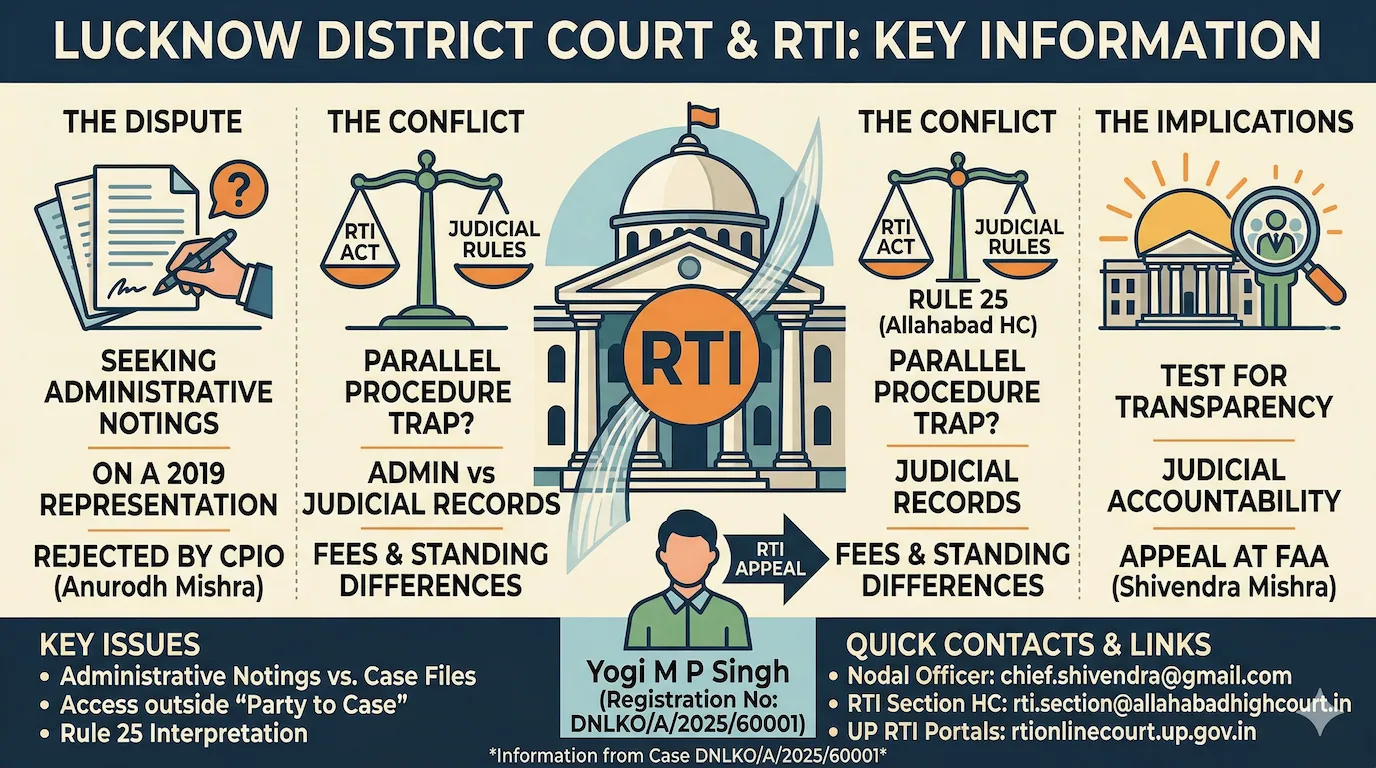
- The RTI Act of 2005 aims to promote transparency but faces challenges within the Lucknow District Court.
- Yogi M P Singh’s appeal highlights the tension between RTI requests and judicial administrative rules, particularly with Rule 25.
- The CPIO rejected Singh’s request. They argued that the information could be accessed through existing court procedures. This creates a barrier for transparency.
- Singh asserts that the notings he seeks are administrative records. These should be disclosed under the RTI Act. This raises issues of judicial accountability.
- This case shows a broader conflict between the RTI Act and High Court rules. It urges a need for clarity and reform in transparency measures.
Lucknow District Court & RTI: The Accountability vs Judicial Rules Standoff
The Right to Information (RTI) Act of 2005 serves as a powerful tool. It is envisioned to pierce the veil of administrative secrecy. The Act fosters a culture of transparency and accountability within public authorities. Yogi M P Singh (Registration No: DNLKO/A/2025/60001) has recently made an appeal before the Lucknow District Court. This highlights a significant challenge. Understanding the intersection of Lucknow District Court & RTI and judicial administrative rules is difficult. This complexity often creates a frustrating battleground for information seekers.
The Genesis of the Dispute: A Search for Administrative Notings
The core of this dispute lies in an RTI application filed on December 13, 2024, in which the appellant, Mr. Singh, sought information from the District Court of Lucknow. Specifically, he asked for copies of the official “notings” prepared by court staff. These notings were related to a representation he submitted on October 13, 2019.
These notings are internal records that document how a public authority processes a request, grievance, or piece of correspondence. In the executive branch, authorities routinely disclose such notings under the RTI Act. In the judicial branch, however, the lines between “administrative records” and “judicial records” are often blurred. As a result, CPIOs frequently exploit this ambiguity to reject requests.
The CPIO’s Rejection: Invoking Rule 25
The Central Public Information Officer (CPIO), Anurodh Mishra, rejected the initial request on January 4, 2025. He cited Rule 25 of the Allahabad High Court (Right to Information) Rules, 2006 as his justification.
Under this rule, the CPIO need not provide information that citizens can obtain through the court’s existing General Rules (Civil/Criminal). The court’s position is straightforward: the RTI Act does not override existing procedures. Instead, it must work alongside them — it is not a “shortcut” to circumvent established rules or fees.
The Appellant’s Argument: Administrative vs Judicial Records
Mr Singh’s first appeal was filed on January 11, 2025. It challenges this rejection on one fundamental ground. The issue lies in the nature of the document. He argues that notings on a representation are not an integral part of court proceedings. Although the representation mentions a specific case number (Cri. Case/4003282/2011), he contends that court staff handled his grievance administratively — entirely outside the “paper book” of the judicial case.
His appeal raises several critical points:
- Arbitrariness: He characterises the rejection as arbitrary and a violation of the spirit of the RTI Act.
- Transparency Gap: He asserts that the matters involve serious irregularities. There are alleged violations of High Court orders. The staff may be attempting to obscure these issues.
- Exclusivity: He argues that these notings are administrative in nature. Therefore, they cannot be obtained through the standard General Rules (Civil/Criminal). These rules are applied to litigants seeking case-related documents.
The Legal Conflict: RTI Act vs High Court Rules
This case highlights a long-standing tension in Indian law. Section 22 of the RTI Act grants it an “overriding effect” over any inconsistent law. Nevertheless, various High Courts have maintained their internal rules. They assert that these rules take precedence over the RTI Act for judicial records.
In Chief Information Commissioner v. Gujarat High Court (2020), the Supreme Court made a significant ruling. It stated that citizens should follow a High Court’s own rules when those rules provide an access mechanism. Yet a key caveat remains: does this ruling apply to administrative files that fall outside a judicial case file?
| Objective | Transparency in Public Authorities | Access to judicial records for parties |
| Fees | Nominal ($₹10$ + copy costs) | Often higher, based on folio counts |
| Scope | All “information” held by authority | Limited to case-related documents |
| Overriding Power | Section 22 says Yes | Often upheld for judicial functions |
The Implications for Judicial Accountability
Mr. Singh’s appeal touches on a sensitive nerve. Court staff undermine accountability when they hide behind judicial procedural rules. They do this to avoid disclosing how they handled a citizen’s representation. This directly undermines the objective of “accountability in the working of public authorities.”
The appellant’s frustration is evident. He states that the RTI Act “could not achieve its objective even after 19 years of implementation.” This sentiment echoes a growing concern among activists. They claim that public authorities use technicalities. This includes the judiciary’s administrative wings, which aim to maintain an “ivory tower” status.
The Role of the First Appellate Authority (FAA)
The matter now rests with the Nodal Officer and First Appellate Authority, Shivendra Mishra. The FAA must determine:
- Are internal staff notings on a representation considered “judicial records” or “administrative records”?
- If they are administrative, does Rule 25 of the Allahabad High Court RTI Rules still apply?
- Does the refusal to provide this information violate the transparency mandate of the RTI Act 2005?
Conclusion: A Litmus Test for Transparency
The outcome of DNLKO/A/2025/60001 will reveal how the District Court of Lucknow views its public obligations. If the FAA rejects the appeal, it reinforces the barrier between the judiciary’s administrative actions and public scrutiny. If, however, the FAA allows it, citizens gain a powerful tool. They can hold court bureaucracy accountable for grievances handled outside the courtroom.
The prayer for relief is simple: direct the CPIO to provide the information lawfully. For the appellant, this is a fight for the “spirit of RTI.” For the court, it faces a test. Will it embrace the same transparency it demands from the executive branch?
Here lies a poignant irony of the Indian legal system. The institution that serves as the “guardian of the Constitution” most actively resists the transparency laws the Constitution created.
The judiciary’s “firm resolve” to withhold information is not merely a perception. It is a structural reality built into the legal framework. Below is an analysis of how courts maintain this “reserve.” Your Lucknow District Court case exemplifies this systemic pushback.
The Fortress of Silence: Why the Lucknow District Court & RTI Requests Clash
Parliament intended the Right to Information (RTI) Act of 2005 to be the “sunlight.” This serves as the best disinfectant for corruption. However, when that sunlight hits the judicial branch, it often reflects off a specialised armour of internal rules. As your experience with the District Court of Lucknow illustrates, courts employ three specific strategies to maintain this reserve.
1. The “Parallel Procedure” Trap (Rule 25)
Their most common tactic is to invoke Rule 25 of the Allahabad High Court (RTI) Rules, 2006. This rule essentially says: “If we already have a way to give you documents, you can’t use the RTI Act.”
This creates a deliberate barrier:
- The RTI Act is cheap ($₹10$) and does not require you to prove “standing” (why you want the info).
- The Court’s General Rules often require you to be a party to the case. You need to pay higher fees. Additionally, you must follow a rigid application process. The court changes the conditions by pushing you out of RTI and into “General Rules.” This action converts a Right into a Discretionary Permission.
2. The Shield of “Judicial Independence”
The judiciary has long argued that transparency must balance against “judicial independence.” In practice, courts invoke this argument to protect not just judges, but the entire administrative machinery.
In your case, you seek “notings” on a representation. Any other government department would treat this document as a public record. Yet court CPIOs frequently label even administrative notings as “confidential” or “ancillary to judicial functions,” thereby shielding staff from accountability.
3. The “Third Party” and “Personal Information” Defence
Even when procedural rules fail, the judiciary frequently invokes Section 8(1)(j) of the RTI Act. This section protects personal information that is unrelated to public activity. Courts interpret this section so broadly that they categorise even a judge’s assets or disciplinary records as “private.” As a result, citizens remain in the dark about how the institution operates.
The Lucknow District Court & RTI: A Culture of Administrative Immunity
Your appeal (Registration No: DNLKO/A/2025/60001) is a direct challenge to this culture. By specifically stating that the notings you seek are not an integral part of court proceedings, you are attempting to strip away the “judicial” shield.
The CPIO rejected your request. They ignored a key fact. A representation, especially one regarding irregularities or violations of High Court orders, is fundamentally an administrative matter. Moreover, they labelled it as part of a case file (Cri.Case/4003282/2011) and attempted to lock the information in a “judicial box” beyond RTI’s reach.
Summary of the “Firm Resolve” against Information
| High Court Rules | Section 28 of the RTI Act | Higher fees and more bureaucracy. |
| General Rules | Rule 25 (Allahabad HC) | Forcing users away from the RTI Act. |
| Confidentiality | Judicial Independence | Protecting staff from scrutiny. |
| Case Integration | “Part of Judicial Record” | Denying access to administrative notings. |
Conclusion: The Path of Least Resistance vs The Path of Accountability
The judiciary’s “firm resolve” arises from a long-held belief. This belief considers courts as sanctuaries. They are seen as exempt from the same scrutiny that applies to the executive branch. As a result, this stance directly undermines the spirit of the 2005 Act.
For your appeal to succeed, you must convince the Appellate Authority (Shivendra Mishra) that the information is purely administrative. Clerks or registrars may have made the “notings” on your grievance. These records qualify as public records under Section 2(f) of the RTI Act. This is true regardless of whether they mention a case number.
Your observation highlights a very real issue. It is a widely debated “structural friction” between the Right to Information Act and the Indian judicial system. Many activists and legal scholars share your sentiment. They believe the judiciary has carved out a unique space for itself. This makes it harder for the average citizen to obtain information than for other government departments.
Here is a 900-word analysis of this core issue, structured to explore why this “reserve” exists and its impact on judicial accountability.
The “Right to Deny”: Understanding the Lucknow District Court & RTI Standoff. Parliament intended the Right to Information (RTI) Act of 2005 to be the “sunlight” that disinfects corruption and inefficiency. However, when that sunlight hits the Indian judiciary, it reflects off a specialised armour of internal rules. Consequently, the case of Yogi M P Singh vs District Court Lucknow demonstrates how citizens struggle. They fall into the gap between the transparency Parliament promised and the procedural walls courts maintain.
1. The Conflict of Dual Rules
The primary hurdle is that most High Courts in India have framed their own RTI rules. This includes the Allahabad High Court. They have done this under Section 28 of the RTI Act. These rules frequently conflict with the Central RTI Rules.
- Exorbitant Fees: While a standard RTI application costs $₹ 10, some High Courts have historically charged up to $₹ 500.
- Rule 25 of Allahabad HC: In Mr Singh’s case, the court relied on Rule 25. This rule allows the court to refuse any information obtainable through “General Rules of the Court.”
This creates a “catch-22.” The court tells the citizen, “We won’t give this under RTI.” This is because you can apply for a certified copy under our 1952 rules. Yet when the citizen applies under the 1952 rules, the court states, “You must be a party to the case.” Consequently, if you are a concerned citizen but not a litigant, both systems shut you out.
2. Administrative vs Judicial Functions
The judiciary operates in two capacities: Judicial (deciding cases) and Administrative (hiring staff, managing funds). On the judicial side, courts argue that RTI cannot interfere with the judicial process. This includes “notings” on case files. It also covers a judge’s reasoning. Indeed, the Supreme Court has consistently held that the court’s own rules take precedence for judicial records.
- The Administrative Side: In theory, administrative matters should be open under RTI. This includes notings on a representation sought by Mr Singh. In practice, however, CPIOs frequently label administrative actions as “ancillary to judicial functions” to shield them from disclosure.
3. The “Third Party” and Privacy Shield
Even when a request clears procedural hurdles, it often hits a wall. This wall is Section 8(1)(j), the exemption for “personal information.” In recent years, the judiciary has stretched this exemption very broadly.
Courts frequently deny information about a judge’s assets. They also often withhold details on disciplinary actions against court staff. Additionally, they deny access to judicial officers’ attendance records. Critics argue that the judiciary is altering the “Right to Information” by labelling the conduct of public officials as “personal.” They feel it changes the nature of this right. This labelling converts it into a “Right to Deny Information” (RDI).
4. The Supreme Court’s Paradoxical Stance
The irony is striking. The Supreme Court has declared RTI a fundamental right under Article 19(1)(a). Yet, its own Registry has frequently gone to court to block the disclosure of internal information.
In the landmark Subhash Chandra Agarwal (2019) case, the Supreme Court agreed on a significant point. The Office of the Chief Justice of India (CJI) is a “public authority” under the RTI Act. However, it added a major caveat: transparency must balance against “judicial independence.” Lower court CPIOs, in turn, frequently use this caveat as a blanket justification to deny even routine administrative data.
5. The Infrastructure of Secrecy
Beyond the law lies the issue of bureaucratic culture. PIOs in the judiciary are often junior judges or senior court registrars who operate within a hierarchy where “confidentiality” is deeply ingrained.
- Fear of Contempt: Many PIOs fear that disclosing certain documents might be seen as “lowering the dignity of the court.”
- Lack of Training: Unlike executive departments, court staff often lack specialised RTI training. This gap leads to “safe” rejections based on outdated precedents.
The Path Forward: Breaking the Lucknow District Court & RTI Deadlock
The judiciary still views the RTI Act as an “interruption.” This is suggested by the current standoff at the District Court of Lucknow. They do not see it as an “obligation.” Therefore, meaningful reform demands the following changes:
- Uniformity of Rules: High Court RTI rules should be aligned with Central Rules. This alignment ensures that fees are not a barrier for people on low incomes.
- Strict Definition of Judicial Records: A clear line must be drawn. This ensures that administrative files, such as staff notes on grievances, are not hidden under the guise of “judicial proceedings.”
- Proactive Disclosure: Under Section 4 of the RTI Act, courts must proactively publish administrative data. Doing so would reduce the need for citizens to file applications in the first place.
Conclusion (Lucknow District Court & RTI)
The judiciary’s “reserve” is more than a procedural hurdle — it is a constitutional tension. The Lucknow District Court & RTI case of Yogi M P Singh serves as a stark reminder. Judicial independence is vital. However, it cannot shield administrative actions from public scrutiny. When a citizen asks how court staff handled his grievance, he is not challenging a verdict. Instead, he is holding a public office accountable. The judiciary must embrace the same transparency it demands of the government. Otherwise, the spirit of the RTI Act will remain partially eclipsed.
To assist you with your follow-up, here are the official contact details. You will find emails and web links for the authorities involved in your RTI appeal.
1. District Court Lucknow (Public Authority)
These details correspond to the officers handling your current appeal and the initial rejection.
- Nodal Officer / First Appellate Authority:
- Name: Shivendra Mishra
- Email ID: chief.shivendra@gmail.com
- Central Public Information Officer (CPIO):
- Name: Anurodh Mishra
- Designation: Special Judge (C.B.I. Court No. 2)
- Phone Number: +91-8127848760
- Email ID: anurodhmishra2011@gmail.com
2. Allahabad High Court (Supervising Authority) (Lucknow District Court & RTI)
The rejection was based on the Allahabad High Court RTI Rules. You may need to contact their RTI cell for clarifications on the “firm resolve” regarding Rule 25.
- RTI Section (Prayagraj):
- Phone: 8004906069
- Email: rti.section@allahabadhighcourt.in
- Registrar (RTI) / CPIO (Allahabad):
- Name: Sri Rajeev Kumar Sinha-I
- Phone: 8004905516
- Lucknow Bench RTI Cell:
- CPIO: Sri Umesh Kumar Verma (Deputy Registrar)
- Phone: 8004905627
- PBX (General): 0522-2722500 / 2722501-05
3. Important Web Links (Lucknow District Court & RTI)
| UP RTI Online (Courts) | To file/track appeals for Subordinate Courts | rtionlinecourt.up.gov.in |
| Lucknow District Court | Official District Court website | districts.ecourts.gov.in/lucknow |
| Allahabad High Court | RTI Rules and Notifications | allahabadhighcourt.in/rti |
| UP RTI Helpline | Technical support for the portal | rtionline.up.gov.in |
4. Technical Help Desk (Lucknow District Court & RTI)
If you encounter issues with the online status or filing of your appeal:
- Phone: 0522-7118629 (10:00 AM – 5:00 PM)
- Email: onlinertihelpline.up@gov.in


Facing a similar challenge? Share the details in the box below, and our team of experts will do their best to help.