
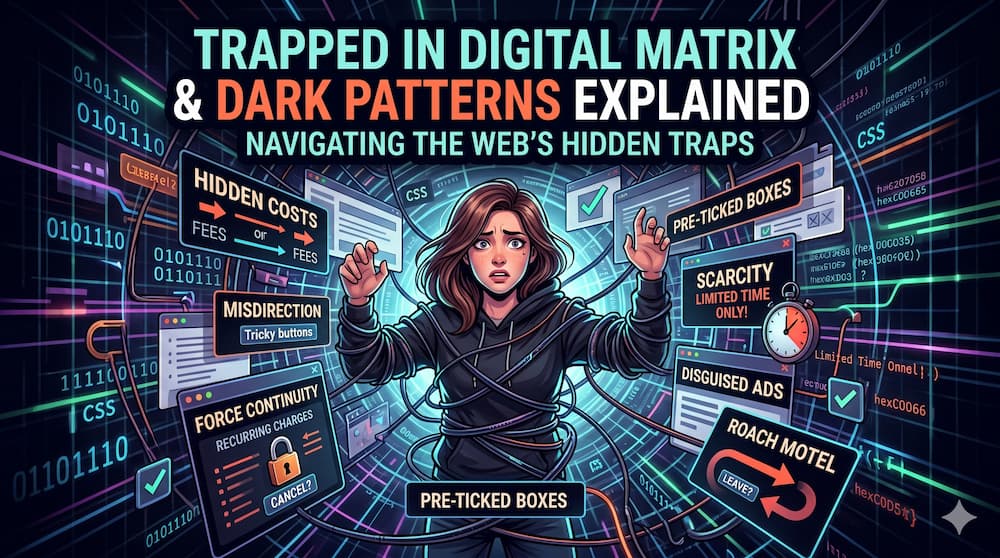
This online environment, crafted by savvy marketers and tech companies, employs dark patterns—deceptive design elements that push us towards decisions we might not consciously make. Trapped in this digital matrix, we encounter persistent notifications and hidden opt-outs; these tactics ensnare users, creating a sense of urgency and obligation. As we engage with this digital ecosystem, it’s important to cultivate awareness and critical thinking skills to help us avoid these traps and make informed decisions that align with our true intentions and values.
Key Takeaways
- Dark patterns manipulate consumer choices and behaviour, creating a deceptive online environment.
- Automated billing systems exploit consumers through interface asymmetry, making upgrades effortless but downgrades difficult.
- Forced plan manipulation adds hidden fees that disrupt informed consent, leading to unexpected financial penalties.
- Identity fragmentation complicates billing experiences, leaving users trapped due to disconnected payment management systems.
- Consumers must demand accountability and push for transparent digital interfaces to reclaim their rights in the digital age.
Trapped in the Digital Matrix & Dark Patterns: How Automated Billing Systems Victimize Everyday Consumers
In the modern digital economy, cloud computing, software-as-a-service (SaaS), and artificial intelligence create seamless experiences in our lives. We click a button, enter our payment details, and instant infrastructure appears at our fingertips.
But beneath the polished user interfaces of tech conglomerates lies a rigid, algorithmic architecture designed to protect corporate revenue at the absolute expense of consumer transparency. For individual developers, retail business owners, and independent professionals, using these platforms often feels like navigating a digital quagmire filled with dark patterns. These manipulative user interface choices mislead users, limit their options, and create hidden financial liabilities.
1. Interface Asymmetry: The Seamless Upgrade vs. The Hidden Exit
The core element of digital consumer exploitation relies heavily on interface asymmetry. Tech platforms spend billions of dollars optimising user journeys to ensure that spending money is as effortless as possible. If an independent consumer wishes to “Upgrade” their digital tier—whether adding storage to a custom domain or increasing API thresholds—the option is prominently displayed, colour-coded, and achievable with a single mouse click.
However, when consumers attempt to “Downgrade” a service to cut unnecessary costs, they find themselves trapped in the digital matrix and dark patterns.
The “Downgrade” option is routinely omitted from primary billing dashboards. It is buried deep within multi-layered settings, deliberately categorised under obscure technical terminology, or entirely hidden from sight. This intentional friction forces users into stressful, non-intuitive navigation paths simply to scale down a service tier they no longer wish to fund. It is a direct restriction on consumer choice operating in plain sight.
2. The “Trap Switch”: Forced Plan Manipulation
When a consumer finally uncovers the hidden path to a downgrade, they frequently encounter an artificial roadblock: forced plan manipulation.
Consider a user locked into a standard Annual or Fixed-Term subscription model. If they decide mid-year that their business requirements have scaled down, the platform’s software prevents a direct, immediate downgrade. Instead, the interface mandates a bizarre, intermediate technical loop: the user must first transition their entire billing structure to a “Flexible Plan” before the system will even unlock the downgrade utility.
This mandatory intermediate step is often explained without operational clarity. To an everyday user, it appears to be a harmless, standard administrative requirement. In reality, it is a calculated legal trap built directly into the software’s logic—an exact embodiment of being trapped in the digital matrix & dark patterns.
3. Concealed Cancellation Liabilities and the Loss of Informed Consent
The true compliance violation occurs the exact second a user complies with that forced plan switch. In the platform’s backend architecture, migrating from an Annual or Fixed-Term contract to a Flexible Plan is automatically registered as an “Early Cancellation” of the annual commitment.
The user interface deliberately conceals the immediate financial consequence of this action. By executing this forced transition to unlock the downgrade path, the system silently triggers a massive early termination penalty—frequently equivalent to the entire remaining cash value of the annual contract.
Because the system forces this behaviour without presenting a prominent, clear, pop-up confirmation warning or an OTP-verified penalty acknowledgement, it completely denies the consumer the right to informed consent. The user completes what they believe is a routine service adjustment, only to face predatory, arbitrary billing weeks later. This hidden liability structure is a primary reason why so many vulnerable users find themselves hopelessly trapped in the digital matrix and dark patterns.
4. The Blind Giant: Identity Fragmentation in Automated Billing
Compounding the anxiety of predatory subscription terms is the complete disconnect within the internal payment architectures of tech giants. Major cloud ecosystems do not see users as human beings; they see them as isolated strings of code across fragmented databases.
A single retail consumer might manage an ecosystem using multiple linked identities:
- A personal email account acting as the primary financial purchaser.
- A professional domain email managing workspace productivity tools.
- A developer console profile that experiments with specialised AI API tools.
To the user, this is all one pocket, paid for with a single bank account. The platform’s automated systems treat these as entirely separate corporate entities that legally block them from sharing ledger info.
When a user initiates specialised API services, the backend funnels the usage through a separate Cloud Platform Billing Account rather than the primary workspace account. To comply with localised banking guidelines—such as the Reserve Bank of India (RBI) E-Mandate Framework—the system forces the user to register an automatic background mandate capped at massive regulatory limits (e.g., up to ₹15,000) just to process micro-verification transactions of ₹2.
5. The Sync Loop Penalty
The true frustration peaks when a spike in active usage occurs. If an API key encounters an unexpected burst of data traffic, a significant charge is instantly generated. When the automated background system attempts to pull this new balance via the registered mandate, local banking security firewalls frequently block the automatic transaction as an unverified risk.
The consumer, acting in bona fide faith, immediately intervenes and clears the balance to zero via a manual payment. However, because the automated platform and the API communicate via delayed sync schedules, the system flags the account status as “Restricted” due to the initial failed automatic pull.
Independent users discover themselves trapped in the digital matrix & dark patterns: they settle their balance at zero, yet glaring red warning banners scream that their payment method actually broken, completely freezing their developer tools. This multi-layered administrative confusion keeps them in a state of constant financial anxiety regarding unexpected background sweeps.
Conclusion: The Path to Regulatory Reclamation (Trapped in Digital Matrix & Dark Patterns)
Digital subscription models cannot remain a free-for-all where corporate interfaces override fundamental consumer rights. When platforms utilise predatory UI designs, force plan-switching loops, and conceal termination liabilities, they leave everyday users trapped in the digital matrix & dark patterns, in direct violation of basic statutory protections like Section 2(47) of the Indian Consumer Protection Act, 2019.
Consumers must fight back by keeping detailed records, filing formal complaints with specialised divisions like the Consumer Protection Unit (CPU), and demanding accountability from institutions. Equally forcing tech conglomerates to build symmetrical, transparent interfaces can reclaim consumer safety in the digital age.
Here is a clean, structured index of the official contact identifiers, mobile/toll-free channels, email coordinates, and web tracking interfaces for all authorities handling your escalation ecosystem.
1. Primary Authority: Consumer Protection Unit (CPU Division) (Trapped in Digital Matrix & Dark Patterns)
This is the specialised ministerial division actively investigating the dark patterns and structural billing architecture of your case.
- Concerned Officer: Smt. SARITA (Under Secretary, CPU & CONFONET)
- Official Office Address: Room No. 466-A / 374, Department of Consumer Affairs, Krishi Bhawan, New Delhi – 110001
- Primary Division Email ID: uscpu-ca@nic.in (Secondary/Desk: socpu-ca@nic.in)
- Direct Landline Connection: 011-23097042
2. Pre-Litigation Authority: National Consumer Helpline (NCH / INGRAM) (Trapped in Digital Matrix & Dark Patterns)
This is the statutory omni-channel tracking hub handling your active pre-litigation dispute routing.
- National Toll-Free Helpline: 1915 (Alternative Backup Line: 1800-11-4000)
- Availability: 08:00 AM to 08:00 PM (All 7 days of the week, excluding national holidays).
- Official WhatsApp & SMS Interface: +91-8800001915 (Direct interactive chat assistant for updating docket files)
- Core NCH Email Coordinate: nch-ca@gov.in (Secondary escalation monitor: sonch-ca@gov.in / dirpg-ca@nic.in)
- Live Case Tracking Interface: consumerhelpline.gov.in/user/track-complaint.php
3. Associated Digital Application Coordinates (Trapped in Digital Matrix & Dark Patterns)
If you prefer managing escalation updates on your phone without using standard web links, your docket profile is accessible through the following application portals available on the Google Play Store:
- NCH Official Application: “NCH App” (Managed by the Department of Consumer Affairs)
- Unified Government Application: “UMANG App” (Navigate to the National Consumer Helpline module inside the dashboard using your registered credentials)
Summary Table for Fast Reference (Trapped in Digital Matrix & Dark Patterns)
| Department / Node | Primary Action | Email / Digital Link | Contact Node |
|---|---|---|---|
| CPU Division (Krishi Bhawan) | Regulatory Review | uscpu-ca@nic.in | 011-23097042 |
| NCH INGRAM Portal | Web Desk Tracking | consumerhelpline.gov.in | Toll-Free: 1915 |
| NCH WhatsApp Assist | Text Automated Ping | WhatsApp System | +91-8800001915 |
| NCH Central Email Node | Document Submissions | nch-ca@gov.in | Central Repository |

Facing a similar challenge? Share the details in the box below, and our team of experts will do their best to help.