
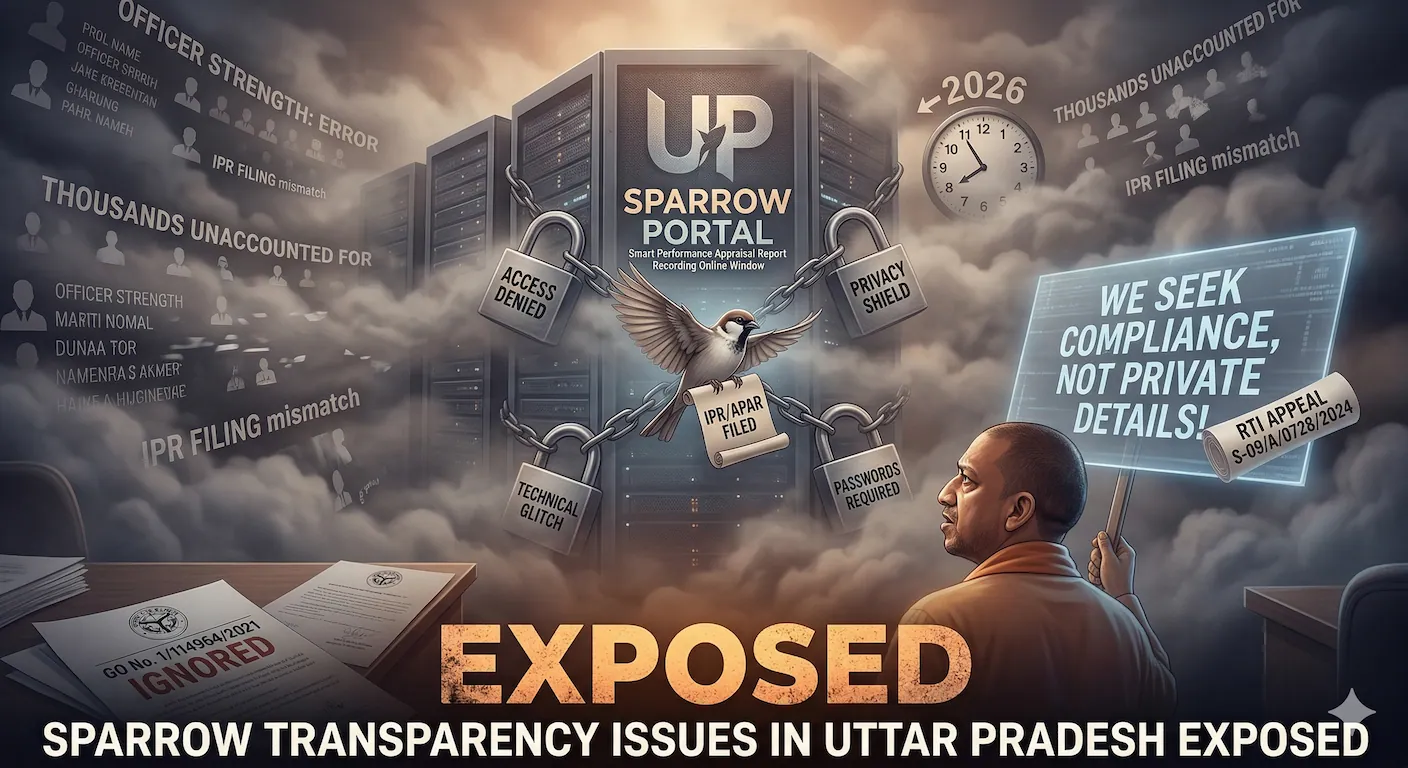
Key takeaways from this blog post are as follows
The blog post highlights a systemic failure in the digital accountability framework of Uttar Pradesh’s administration. It specifically points to SPARROW Transparency Issues in Uttar Pradesh. Here are the key takeaways:
## 1. The Transparency Gap in SPARROW
The SPARROW portal, designed for tracking officer performance and assets, is currently plagued by data discrepancies. There is a significant mismatch. The actual number of officers in service does not match those who have filed their Immovable Property Returns (IPRs). Thousands of officials remain unaccounted for in the digital system. (SPARROW Transparency Issues in Uttar Pradesh)
## 2. Weaponization of “Privacy” and “Technicalities”
Public Information Officers (PIOs) are frequently using two primary excuses to deny RTI requests:
- Privacy Shield: Misinterpreting asset filing status as “personal information” to avoid disclosure. However, the request is about compliance. It concerns whether they filed, not the private content of the filings.
- Access Excuse: Because the portal uses individual passwords, the District Magistrate’s office claims they “do not have the data.” This effectively creates a vacuum of responsibility.
## 3. Breakdown of Administrative Oversight (SPARROW Transparency Issues in Uttar Pradesh)
The post identifies a “culture of non-compliance” where:
- Government orders for voluntary disclosure are being ignored by subordinates.
- Superiors (like District Magistrates) are failing to enforce these orders.
- Administrative headers are avoiding legal accountability by skipping Information Commission hearings citing “network issues.
## 4. The Need for “Data Purification”
To fix the system, the post argues for:
- Public Dashboards: Moving away from secrecy by publishing lists of defaulters.
- Audit Trails: Implementing logs to track which officers are delaying their submissions.
- Verification: Moving beyond “self-reporting” to a system that cross-verifies declarations with actual property records to prevent corruption.
## 5. Legal Impasse (SPARROW Transparency Issues in Uttar Pradesh)
The specific case of Yogi M.P. Singh vs. DM Mirzapur shows how a simple request for compliance data can be dragged out for years. This happens through procedural evasion. It highlights the need for the State Information Commission to take a stricter stance against non-responsive PIOs.
The SPARROW Portal Crisis: A Breakdown of Transparency and Accountability in Uttar Pradesh
The digitalization of governance was intended to bring sunlight into the corridors of power. In Uttar Pradesh, the SPARROW (Smart Performance Appraisal Report Recording Online Window) portal was launched. It aimed to modernize the Performance Appraisal Reports (APAR). It also aimed at updating the Immovable Property Returns (IPR) of Provincial Civil Service (PCS) officers. However, as of 2026, the portal has become a symbol of administrative opacity rather than a tool for accountability.
The ongoing legal battle in Yogi M.P. Singh vs District Magistrate Mirzapur (Appeal No. S-09/A/0728/2024) has revealed a systemic failure. Public authorities are refusing to disclose whether government servants are complying with mandatory asset disclosure orders.
### 1. The Core Conflict: Data Discrepancy vs. Official Strength (SPARROW Transparency Issues in Uttar Pradesh))
The most glaring issue identified by various standing committees is the mismatch. The “Actual Strength” of the civil services does not align with the number of IPR filings recorded on the portal.
For years, thousands of officers have remained “unaccounted for” in the digital system. This is not merely a technical glitch; it is a fundamental breakdown in oversight. The Department of Personnel and Training (DoPT) figures often do not align with the SPARROW portal’s data. This misalignment creates a “gray zone.” In this zone, non-compliant officers can hide in plain sight. Without knowing how many officers should be filing, the portal functions more like a voluntary suggestion. It is not a mandatory requirement.
### 2. The “Privacy” Shield: A Misinterpretation of the RTI Act
In the case of the Mirzapur Collectorate, the Public Information Officer (PIO) has repeatedly taken a stance. The PIO argues that information regarding asset disclosure cannot be shared. This is due to it constituting “personal details” and being protected by individual ID-password encryption.
This defense is legally flawed for two reasons: (SPARROW Transparency Issues in Uttar Pradesh)
- Compliance vs. Content: The appellant is not necessarily seeking the private bank balance or bedroom dimensions of an officer. The request is to obtain a list of names. These names are of those who complied with the Government Order and those who did not.
- Public Interest: Under Section 8(1)(j) of the RTI Act, you can disclose personal information. This is allowed if it serves a larger public interest. This facilitates transparency and accountability. Civil servants are paid from the public exchequer. Therefore, their compliance with anti-corruption measures, like asset disclosure, is a matter of intense public concern.
### 3. The “Inaccessible Portal” Excuse (SPARROW Transparency Issues in Uttar Pradesh)
District Magistrates claim they “do not have access” to the filing status of their subordinates. This is one of the most frustrating hurdles for transparency advocates. This creates a vacuum of responsibility.
The District Magistrate leads the district administration. They need to verify whether their staff has complied with a direct Government Order. An example of such an order is G.O. No. 1/114964/2021. If they cannot do this, then the hierarchy of command is broken. The “decentralised” nature of SPARROW is being weaponised to avoid accountability. By claiming the data is only on a central server in Lucknow, local offices successfully stonewall RTI applicants.
### 4. The Culture of Non-Compliance
The State Information Commission has noted that “neither government nor accountable public staff are showing interest” in ensuring compliance. This lack of interest manifests in several ways:(SPARROW Transparency Issues in Uttar Pradesh)
- Missing Audit Trails: There is no transparent log. It fails to show when an officer was reminded to file. It also does not show when they defaulted.
- Inconsistent Reporting: Different standing committees (the 106th vs. the 112th) have reported wildly different numbers of non-filers, suggesting that data is being “sanitized” or poorly tracked.
- Avoidance of Hearings: As seen in the recent UP Information Commission proceedings, PIOs frequently skip online hearings. They cite “network problems” to justify their absence. This practice drags out cases for years. Meanwhile, the non-compliant officers remain shielded.
### 5. Proposed Solutions: The Path to “Data Purification”
To restore faith in the SPARROW portal and the RTI process in Uttar Pradesh, several structural changes are required:
#### A. Mandatory Public Compliance Lists (SPARROW Transparency Issues in Uttar Pradesh)
The government should move away from the “secret” nature of filing status. A simple dashboard should be made public on the SPARROW portal showing:
- Total Sanctioned Strength of Officers.
- Number of IPRs filed by the deadline.
- Names and Designations of Defaulters.This would create “social pressure” and eliminate the need for hundreds of individual RTI applications.
### B. Robust Verification Mechanisms (SPARROW Transparency Issues in Uttar Pradesh)
Currently, the portal is a “self-reporting” tool with no verification. There is no system to cross-check declared assets with registration databases or bank records. Implementing a “Verification Flag” system—where a random percentage of filings are audited annually—would deter collusion and corruption.
#### C. Strengthening the Information Commission’s Power
The Commission must stop accepting “technical glitches” as a valid reason for the absence of PIOs. If a PIO claims they don’t have data, that data should be in their administrative control. The Commission should use their power in such cases. They need to invoke Section 20 of the RTI Act to impose personal penalties.
### 6. Conclusion: The Stakes for Public Trust
The struggle of Yogi M.P. Singh is not just about one district or one group of officers. It concerns the integrity of the Indian Administrative Service. When tools like SPARROW, designed to ensure honesty, remain hidden, the slogan “Maximum Governance” loses its meaning. When we hide behind a veil of digital excuses, “Maximum Governance” becomes a hollow slogan.
The state does not grant transparency as a favour to the citizen; it is a statutory obligation. The authorities must “purify” the SPARROW portal of its data discrepancies. Only after that can they open it to public audit. Otherwise, the shadow of corruption will continue to loom over public administration.
The details provided highlight a significant transparency deadlock. This involves the SPARROW (Smart Performance Appraisal Report Recording Online Window) portal in Uttar Pradesh. This deadlock specifically involves your appeal before the UP Information Commission (Court S-9).
The core of your argument is that you are seeking administrative compliance data. This includes information on who filed versus who didn’t. However, the District Magistrate’s office is treating the request differently. They view it as a plea for private asset details. They claim that these details are inaccessible due to the portal’s decentralized ID/password system.
## Core Obstacles to Transparency on SPARROW (SPARROW Transparency Issues in Uttar Pradesh)
Based on the case of Yogi M.P. Singh vs. J.S. Officer, District-Mirzapur (Appeal No. S-09/A/0728/2024), the following issues are evident:
- The “Data Silo” Defense: Public Information Officers (PIOs) claim they do not have access to filing status. This is because the portal uses individual login credentials. This issue results in a verification gap. The head of an office, such as the DM, cannot confirm if their subordinates have followed state orders.
- Misclassification of Information: The PIO’s response (Letter No. 772 dated 22.01.2025) categorized your request as “personal details.” However, you have clarified that you are seeking the names and designations of those who complied. This is a matter of official record and public accountability. It is not private financial data.
- Procedural Evasion: The repeated absence of parties due to “network problems” and the transfer of responsibility between departments (e.g., from Directorate to District level) has caused the case to stall despite the Government Order (G.O. No. 1/114964/2021) mandating these disclosures.
### Summary of the Current Legal Standing (SPARROW Transparency Issues in Uttar Pradesh)
| Item | Details |
| Appeal Number | S-09/A/0728/2024 |
| Presiding Officer | Shakuntala Gautam, State Information Commissioner (Court S-9) |
| Next Hearing | February 5, 2026 (Based on recent restoration filings) |
| Key Government Order | G.O. dated 04.01.2024 (Mandating asset disclosure by 31.01.2024) |
| Restoration Status | A Recall Application (P-20260102140) was filed on January 24, 2026, to contest the previous dismissal for non-attendance. |
## Recommended Next Steps for Accountability
To break the stalemate, the following “Data Purification” and audit steps are necessary:
- Demand a Compliance Audit: Ask the Commission to instruct the Department of Appointment (Section-7) to give a district-wise summary. This should include the filing status. They are the primary custodians of the SPARROW-PCS portal.
- Separate “Status” from “Content”: Public servants must file a return in accordance with service rules. Rule 24 of the UP Government Employees Rules-1956 outlines this requirement. Authorities must publicly disclose whether they have filed a return. However, the specific values of the assets can remain confidential.
- Penalty under Section 20(1): The PIO has shown documented defiance. They failed to attend hearings. You are within your rights to seek financial penalties against the responsible officer for withholding information.
We want to assist with your ongoing appeal and administrative follow-ups. We want to help with your ongoing appeal and administrative follow-ups. Here are the official contact details for the key authorities, involved in your case as of 2026.
## 1. Uttar Pradesh State Information Commission (UPSIC)
These are the contact details for the main commission and the specific hearing room (S-9) where your case is pending. (SPARROW Transparency Issues in Uttar Pradesh)
| Contact Point | Details |
| Address | RTI Bhawan, 7/7A, Regency Rd, Vibhuti Khand, Gomti Nagar, Lucknow – 226010 |
| Hearing Room S-9 Email | hearingcourts9.upic@up.gov.in |
| Webmaster Email | webmaster-upic@up.gov.in |
| Official Website | upsic.up.gov.in |
| General Office Phone | 0522-2724930 |
| CATS Portal Link | Complaint & Appeal Tracking System |
## 2. District Administration, Mirzapur (SPARROW Transparency Issues in Uttar Pradesh)
These are the details for the Public Information Officer (PIO) and the District Magistrate’s office mentioned in your correspondence.
- District Magistrate (DM), Mirzapur:
- Email:
dmmir@nic.inordmmir@up.nic.in - Phone (CUG): 9454417567
- Office Phone: 05442-257400
- Email:
- Public Information Officer (Tehsildar Sadar):
- Name: Shri Shakti Pratap Singh
- Phone (CUG): 9454416823
- Address: Collectorate Compound, Mirzapur, UP – 231001
## 3. State-Level Personnel Authorities (SPARROW Transparency Issues in Uttar Pradesh)
The Appointment Section of the UP Government manages the SPARROW-PCS portal. You may need to escalate or copy them on your submissions.
- Appointment Section-7 (Secretariat, Lucknow):
- Key Portal: sparrow-pcs.up.gov.in
- Nodal Officer Contact: Often accessible through the UP Secretariat Directory.
- Chief Minister’s Office (RTI Cell):
- Section Officer (RTI): Shri Sanjay Chaturvedi
- Phone: 0522-2226455
- Email:
cmup@nic.in
### Summary of Your Registration Details
Make sure to quote these IDs in all your emails to the Commission for your records: (SPARROW Transparency Issues in Uttar Pradesh)
- Registration Number: A-20240401203
- Appeal File Number: S09/A/0728/2024
- Diary Number: D-260720250008
- Recall Application ID: P-20260102140 (Filed Jan 24, 2026)
Would you like me to draft a “Reminder Letter” addressed to the District Magistrate (dmmir@nic.in) demanding they provide the name of the Nodal Officer responsible for SPARROW compliance in Mirzapur?
Update (7 September 2026): For the complete case analysis — covering RTI Registration DIRLB/R/2024/60013, the Sparrow Portal implementation dispute, and the current proceedings before the Uttar Pradesh State Information Commission — see this in-depth write-up.


Facing a similar challenge? Share the details in the box below, and our team of experts will do their best to help.