
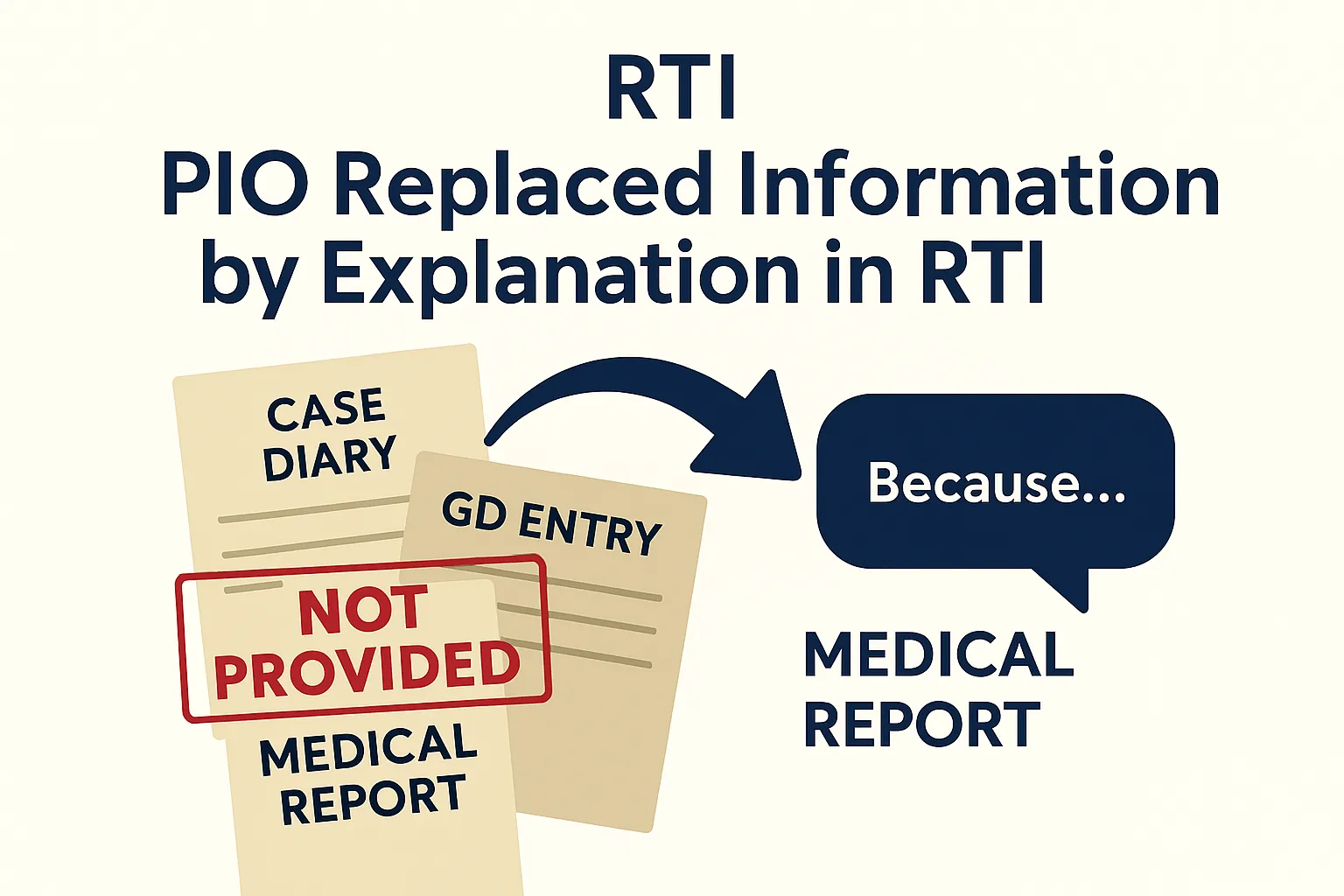
PIO Replaced Information by Explanation: Core Issues in an RTI Second Appeal
PIO has replaced traditional information dissemination methods with a more effective approach: providing detailed explanations. This shift aims to enhance understanding and clarity, ensuring that stakeholders and the public receive comprehensive insights rather than just raw data. By prioritising explanations, organisations can better engage their audience and foster informed decision-making. This method allows for a deeper exploration of the context and implications of the information being shared. As a result, individuals are better equipped to understand complex issues and contribute meaningfully to discussions. Overall, this change marks a significant improvement in communication strategies within various sectors.
Key Takeaways
- PIOs are replacing traditional information disclosure with explanations, undermining the Right to Information Act.
- This article explores systemic issues highlighting how explanations do not qualify as information under RTI.
- Examples include identity discrepancies, ignored medical evidence, and exclusion of individuals without justification, all indicating a lack of transparency.
- The First Appellate Authority often fails to scrutinise PIO responses, weakening the RTI framework’s safeguards.
- Overall, avoiding the practice where PIO replaced information by explanation is crucial for maintaining RTI integrity.
Introduction
The Right to Information Act, 2005 (RTI Act) was enacted to empower citizens with access to recorded government information, not post‑facto explanations or justifications. However, many RTI applicants encounter a recurring problem: instead of being given documents that already exist on record, they receive narratives, opinions, or selective replies. This blog post examines the core systemic issues that prompted a Second Appeal under Section 19(3) of the RTI Act before the Uttar Pradesh Information Commission, using a real case from Mirzapur as context. Across such cases, the issue of PIO replaced information by explanation is a central concern for transparency.
Information vs. Explanation: A Fundamental Disconnect
At the heart of the appeal lies a basic violation of Section 2(f) of the RTI Act. The applicant sought recorded information—General Diary entries, Case Diary notings, and investigation file justifications. These are not speculative materials; they are mandatory records created in the ordinary course of police functioning.
Instead of providing certified copies, the Public Information Officer (PIO) offered explanations such as “this was done because…” or “that was not included since…”. Under RTI law, such explanations do not qualify as information. If a decision is lawful, its rationale must exist on file. If it does not exist, the authority must state so clearly—silence or narrative substitution undermines transparency. This section perfectly illustrates instances where replaced information by PIO is given as explanation rather than original official records.
Identity Discrepancy and the Duty to Record Reasons
One of the most serious issues raised concerns an identity discrepancy in official records: one individual was physically arrested, while judicial proceedings were initiated against another. Such a discrepancy cannot exist in a vacuum. These types of situations shine a light on the practice of replacing information by explanation, an action frequently seen from PIOs.
Criminal procedure requires that every arrest, detention, or substitution of identity be backed by written justification. These reasons are typically recorded in the Case Diary or related investigation notes. The failure to disclose any such recorded justification raises a critical question: were reasons recorded and withheld, or were they never recorded at all?
Both scenarios point to systemic non‑compliance—either with the RTI Act or with criminal procedural law.
Medical Evidence Ignored Without Recorded Justification
Another core issue involves medical evidence. An X‑ray report confirming a fracture was available, yet the chargesheet proceeded under “simple hurt” sections. The explanation provided was that a “supplementary medical report was not prepared.” It is clear here that the public information officer instead replaced the medical information by explanation, in breach of RTI guidelines.
This response again misses the legal point. The RTI request did not ask why the doctor failed to act, but why the Investigating Officer chose to ignore existing medical evidence. Such decisions must be documented in the Case Diary. Ignoring material evidence without written justification is not only procedurally suspect but also erodes accountability.
Exclusion of an Accused Without File Notings
The exclusion of a named individual from the final chargesheet, despite being mentioned during investigation, represents another common transparency failure. The PIO responded that the name did not appear in the initial report. This does not answer the RTI query. In this context, the PIO replaced information by explanation, which is problematic from a legal perspective.
Investigations evolve. When an accused is dropped, the Investigating Officer must record why. The absence of disclosed reasons suggests either non‑recording or non‑disclosure—both of which defeat the purpose of RTI.
The Role of the First Appellate Authority
The First Appellate Authority (FAA) is meant to act as an internal corrective mechanism. In this case, the FAA issued a non‑speaking order, merely endorsing the PIO’s reply without examining whether the requested information existed or was lawfully denied. Such mechanical approvals weaken the appellate safeguard built into the RTI framework. Accordingly, it becomes vital for authorities to avoid replacing information by explanation, as seen throughout Second Appeals.
Conclusion
This Second Appeal highlights a recurring institutional problem: the conversion of RTI into a Q&A exercise rather than a document‑disclosure regime. When explanations replace records, transparency collapses. The case underscores why Information Commissions play a vital role—not merely to order disclosure, but to reaffirm that in a democracy, every official action must leave a paper trail, and that trail belongs to the public. In summary, avoiding the situation where a PIO replaced information by explanation remains a central requirement for upholding the integrity of RTI.
Below is a clear, structured consolidation of the Application IDs, official emails, mobile numbers, and web links of all concerned public authorities involved in your RTI matter, strictly based on the information you have already provided and used in your filed Second Appeal.
1. RTI / Appeal Application Identifiers
RTI Application (Section 6(1)) (PIO Replaced Information by Explanation)
- RTI Registration Number: SPMZR/R/2026/60079
- RTI Transaction ID: SPMZRR20260000000097
- Date of Filing: 12‑02‑2026
First Appeal (Section 19(1)) (PIO Replaced Information by Explanation)
- First Appeal Registration Number: SPMZR/A/2026/60018
- Date of Filing: 10‑03‑2026
- Date of FAA Order: 03‑04‑2026
Second Appeal (Section 19(3)) (PIO Replaced Information by Explanation)
- UPIC Registration Number: UPICR20250000353
- UPIC Appeal Number: A‑20260402504
- Date of Filing: 28‑04‑2026
2. Public Information Officer (PIO) Details
Office: Superintendent of Police, Mirzapur
Department: Home Department (District)
- Name: Rajkumar Meena
- Designation: Additional Superintendent of Police (Operation)
- Official Address:
Office of Superintendent of Police, Mirzapur, Uttar Pradesh - Pincode: 231001
- Mobile Number: 9454401105
- Email ID: asp-op.mi@up.gov.in
3. First Appellate Authority (FAA) Details (PIO Replaced Information by Explanation)
Office: Superintendent of Police, Mirzapur
- Name: Aparna Rajat Kaushik
- Designation: Superintendent of Police, Mirzapur
- Official Address:
Office of Superintendent of Police, Mirzapur, Uttar Pradesh - Pincode: 231001
- Mobile Number: 9473567333
- Email ID: spmzr-up@nic.in
4. Uttar Pradesh Information Commission (Second Appellate Authority) (PIO Replaced Information by Explanation)
Authority: Uttar Pradesh Information Commission (UPIC)
- Official Address:
RTI Bhawan, 7/7A, Regency Road
Vibhuti Khand, Gomti Nagar
Lucknow – 226010, Uttar Pradesh - Telephone: 0522‑2724930
- Official Website:
5. Online RTI / Appeal Portals (Web Links) (PIO Replaced Information by Explanation)
- UP RTI Online Portal (RTI & Appeals Filing):
https://rtionline.up.gov.in - Uttar Pradesh Information Commission Website:


Facing a similar challenge? Share the details in the box below, and our team of experts will do their best to help.