
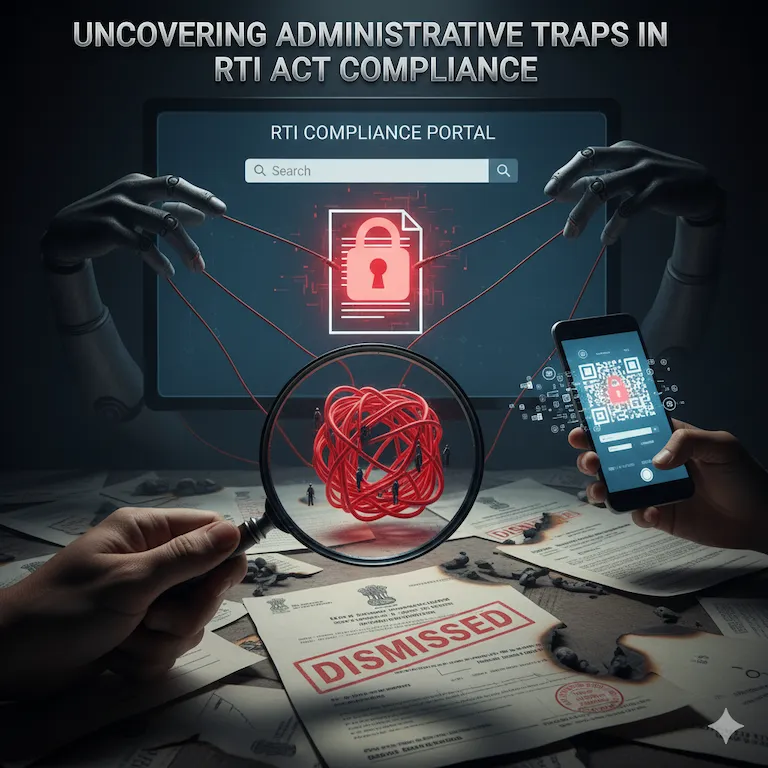
This appears to be a deliberate “administrative trap.” It is a perfect example of how administrative traps can manifest in practice. In this article, we are uncovering administrative traps. One example is when the Commission’s staff sent the notice correctly but attached an incorrect file. This has created a scenario where you cannot legally comply. Yet, the system will record that you were “notified.” If you don’t respond, they can dismiss the case for non-prosecution or “lack of interest.”
Uncovering Administrative Traps: How Clerical “Errors” are Killing the RTI Act
The Right to Information (RTI) Act of 2005, we known as the “Sunlight Law.” It aimed to illuminate the dark corners of Indian bureaucracy. However, nearly two decades later, there is a growing demand for revealing administrative traps. This need arises as a response to more sinister forms of shadow-play. One significant concern is Administrative Mismanagement. This phenomenon goes beyond simple laziness, as officials create a series of “technical glitches” and clerical “oversights.” These issues effectively strip citizens of their legal rights.
The “Correct Notice, Wrong File” Maneuver (Uncovering Administrative Traps)
A recent case involving the Uttar Pradesh State Information Commission (UPSIC) highlights a cunning tactic currently plaguing the system. The Commission sends a formal hearing notice to the appellant via email. On the surface, the Commission appears to be functioning perfectly. However, it is vital to note the dangers of administrative traps being uncovered in the attachment.
When the appellant opens the attached PDF, they find it has nothing to do with their case. It might be a file from a completely different department or a generic document. By doing this, the Commission’s registry achieves two things:
- The Record of Service: The digital system logs that they “Successfully Delivered” the notice.
- The Compliance Deadlock: The appellant cannot prepare a “Written Statement” or “Compliance Report.” The authorities have not provided the actual order or facts needed to respond.
When the hearing date arrives, the Commissioner sees a “served” notice but does not receive a reply from the appellant. Consequently, the Commissioner dismisses the case or passes an adverse order, all under the guise of the appellant’s “non-cooperation.” It is a typical outcome of failing to properly uncover these administrative traps.
The Digital Mirage of Transparency
Digital India” and portals like the Complaint and Appeal Tracking System (CATS) promise efficiency. However, they often act as a barrier. Uncovering administrative traps within these institutions highlights a recurring pattern of mismanagement:
- The “Ghost Order” Dilemma: Courts pronounce orders in open sessions, but they never upload them to the portal. Without sharing an order, no enforcement can take place.
- Email Mapping Errors: Notices often go to the wrong email addresses. Sometimes, they reach individuals who are not parties to the case.
- The Payment Barrier: Non-functional payment gateways, like Rajkosh, stop citizens from filing appeals altogether. This creates a financial wall between the citizen and justice.
The Human Cost of Institutional Apathy
This is not merely a “clerical error”—it is a violation of the Principles of Natural Justice. The “Right to Reason” is a cornerstone of our legal system. A quasi-judicial body like the Information Commission must serve the correct documents. Otherwise, it denies the citizen the right to a fair hearing. Without the proper uncovering of administrative traps, accountability slips away.
In many instances, when these technical failures occur, IT experts fail to address them, leading to administrative silence. They often redirect these grievances to local police stations or irrelevant departments. This action mocks the intelligence of the information seeker. Moreover, this perpetuates a cycle where uncovering such administrative traps becomes essential for justice.
The Path Forward: Demand for a Digital Audit
To prevent the RTI Act from becoming a “Dead Letter Law,” we must demand accountability for these “glitches.” Addressing and uncovering administrative traps through external audits will ensure greater transparency.
- Mandatory Linking: Do not mark a case “Disposed” on the system until you verify the signed PDF. You must verify the actual order and attach it after the verification.
- Technical Accountability: Registry staff must personally hold themselves liable for “mis-tagging” files. This is especially important when it leads to the dismissal of an appeal.
- Verified Service: The Commission must adopt a protocol that requires the appellant to acknowledge receipt of the correct documentation. The protocol can only consider the “Service of Notice” complete after this acknowledgment. This ensures that administrative traps that may otherwise remain uncovered are actively counteracted.
The RTI Act aimed to transform the “subject” into a “citizen.” When the gatekeepers of transparency use technical mismanagement as a shield, they fail an individual. They also dim the light of democracy itself. Therefore, uncovering the administrative traps in this system is critical for real progress.
Key Takeaways (Uncovering Administrative Traps)
- Administrative traps hinder compliance with the RTI Act, leading to systematic injustices.
- The ‘Correct Notice, Wrong File’ tactic exemplifies how mismanagement can prevent effective responses.
- Digital systems promise transparency but often trap citizens with errors and non-delivery of crucial information.
- Addressing these traps requires accountability and verification processes to ensure fair access to justice.
- Demanding a digital audit will help uncover administrative traps and restore the intended purpose of the RTI Act.
I want to help you secure your records. I have compiled the official contact details for the departments involved. This ensures that your objections reach the right desks in this administrative trap. Uncovering Administrative Traps
Using these details, send your objection via both email and Registered Post. This is the best way to prevent the Commission from dismissing the case on the 24th.
1. Uttar Pradesh State Information Commission (UPSIC)
This is the primary authority where your appeal is pending. The email was sent from Court S-5. You should target the Registrar and the Webmaster to report the “wrong attachment” error.
| Role / Section | Email Address | Phone / Contact |
| Court S-5 (Commissioner Office) | hearingcourts5.upic@up.gov.in | (Direct Bench Email) |
| Registrar (UPSIC) | registrar-upic@up.gov.in | 0522-2724930 |
| Administrative Officer | adminofficer-upic@up.gov.in | RTI Bhavan, Vibhuti Khand |
| Webmaster (Portal Issues) | webmaster-upic@up.gov.in | For technical file errors |
| Official Website | upsic.up.gov.in | — |
2. Directorate of Basic Education (The Respondent) (Uncovering Administrative Traps)
The PIO of this department is the one failing to provide information. Copying their senior officers on your objection will put pressure on the PIO. This should encourage them to comply before the hearing.
| Authority / Officer | Email Address | Mobile / Phone |
| Director General (School Education) | upefaspo@gmail.com | 0522-4024565 |
| Director, Basic Education | upefaspo@gmail.com | 1800-1800-666 (Toll Free) |
| Special Secretary (Education) | splbasicakt@gmail.com | 0522-2236173 |
| Section Officer (Basic-1) | upgov.basic1@gmail.com | 9454411614 |
| Address | Nishatganj, Lucknow, UP 226007 | — |
3. Lucknow Development Authority (LDA)
You mentioned a copy was sent to the LDA. To ensure they are aware of the file mismatch, use these verified contacts:
| Name / Designation | Role | Mobile Number |
| Mr. Prathamesh Kumar | Vice Chairman, LDA | 7232914444 |
| Mr. Vivek Srivastava | Secretary, LDA | 9918001605 |
| Mr. Rajeev Kumar | OSD / RTI Official | 9918001461 |
| General Email | vicechairmanlda@gmail.com | — |
Summary of App Details & Links (Uncovering Administrative Traps)
- UP RTI Online Portal: rtionline.up.gov.in
- Case Status Link: UPSIC Case Status (Use Appeal No: S05/A/0785/2025)
- Technical Helpline: 0522-7118629 (10 AM to 5 PM) or
onlinertihelpline.up@gov.in


Facing a similar challenge? Share the details in the box below, and our team of experts will do their best to help.