
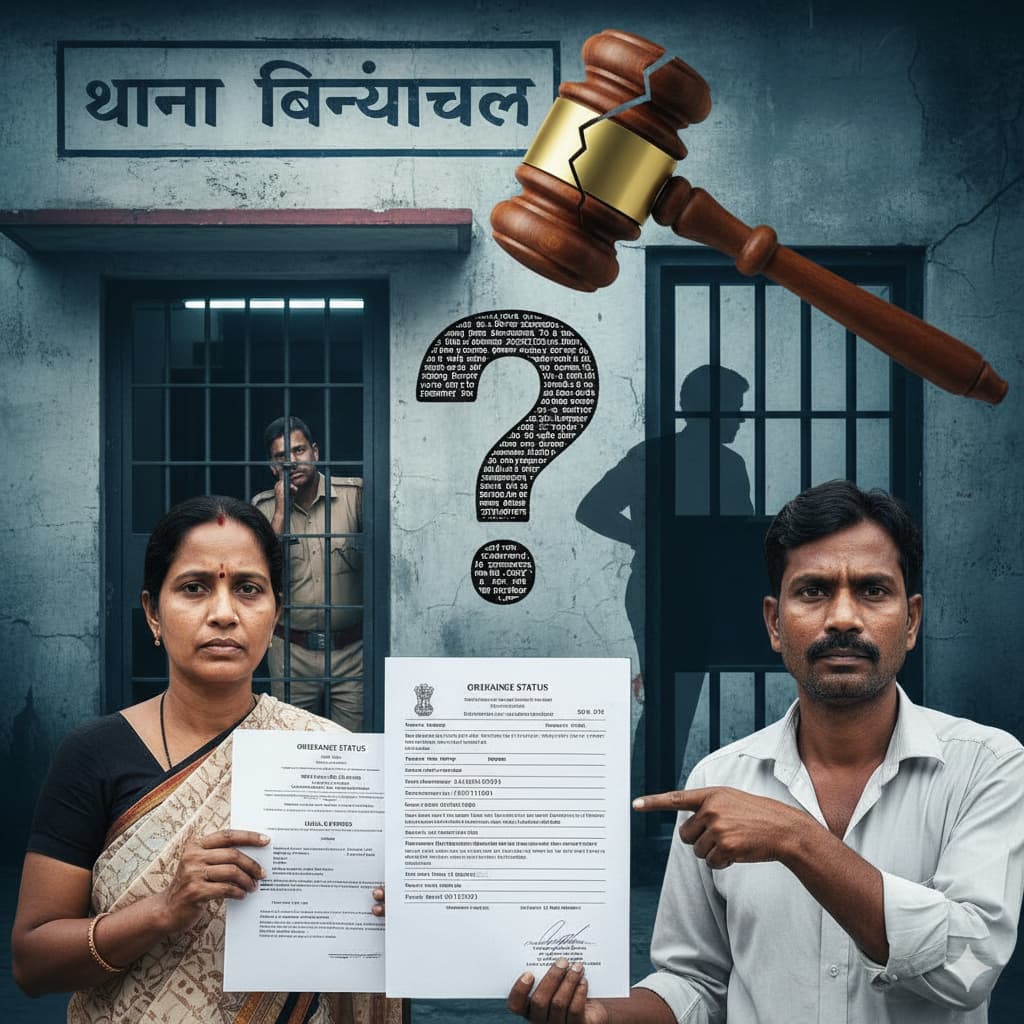
🚨 A Citizen’s Challenge to the New Law: Analyzing Allegations of Illegal Detention and Police Misconduct under the BNSS
This Grievance Against Illegal Detention in Uttar Pradesh examines how officials have applied India’s new Bharatiya Nagarik Suraksha Sanhita (BNSS), 2023. Specifically, the BNSS replaced the long-standing Code of Criminal Procedure (Cr.P.C.) to modernize the country’s criminal justice system. Nevertheless, two linked public grievances subsequently raise serious questions about that early implementation.
Key Takeaways
- Mahima Maurya challenges the application of the new BNSS law in Uttar Pradesh, citing her husband’s and brother’s illegal detentions.
- Her grievances question the misuse of police arrest section 170, alleging that preventive arrests lacked justification.
- She points out inconsistencies in police reports and accuses officials of manipulating documents related to her case.
- Mahima demands accountability for police actions and compliance with RTI provisions, highlighting the need for transparency.
- The article concludes with a call for a thorough investigation to address potential abuses under the BNSS law, ensuring citizens’ rights are upheld.
Introduction: The Core of the Grievance (Grievance Against Illegal Detention in Uttar Pradesh)
Mahima Maurya filed both grievances (Registration Nos. GOVUP/E/2025/0008765 and GOVUP/E/2025/0005549) with the Government of Uttar Pradesh. In particular, they question not only the use of preventive arrest powers but also the recording of non-cognizable reports (NCRs). Her case centers on the alleged illegal detention of her husband, Pramod Kumar Kushwaha, as well as her younger brother, Mithilesh Maurya, by police in Mirzapur. Furthermore, it raises broader concerns regarding transparency, documentation, and accountability within the state’s police machinery, especially as officials roll out the new law.
The petitioner is Mahima Maurya. She alleges that, specifically, police in Mirzapur illegally detained and harassed her husband, Pramod Kumar Kushwaha, and her younger brother, Mithilesh Maurya, on September 14, 2024. Moreover, her grievances highlight several discrepancies in police records as well as the alleged misapplication of BNSS sections. Additionally, she indicates that authorities failed to provide the requested information — a troubling pattern that points toward a possible misuse of authority.
⚖️ Grievance 1: Preventive Arrest and Bail (Grievance Against Illegal Detention in Uttar Pradesh)
Registration No: GOVUP/E/2025/0008765
Date of Receipt: 26/01/2025
Current Status: Under Process
The Claim of Illegal Arrest (Grievance Against Illegal Detention in Uttar Pradesh)
This grievance centers on the preventive arrest of the petitioner’s younger brother, Mithilesh Maurya. He is 28 years old and lives in Prayagraj. Police arrested him under Sections 170/126/135 of the BNSS.
- Section 170 of BNSS succeeds Section 151 of the old Cr.P.C. It lets a police officer arrest someone without a warrant. The officer must have “knowledge of a design to commit a cognizable offence” and must consider the arrest necessary to prevent the crime.
- Police allegedly justified the arrest this way: “If they had not been arrested, an unpleasant incident would surely have occurred.”
The petitioner immediately challenges this reasoning. She points out that police also arrested her husband, Pramod Kumar Kushwaha, on the same date. Yet the Sub Divisional Magistrate Sadar granted him bail that same day. She argues this swift bail undermines the police’s “credibility and its report.” In her view, it suggests officers made the arrest without justification, or as part of a fabricated account.
The RTI Act and Information Denial
Police also refused to give Mahima Maurya a copy of any complaint registered against her own complaint. Their response was simply “नहीं” (No), as documented on page five of her attached PDF. (Grievance Against Illegal Detention in Uttar Pradesh)
The petitioner demands an answer: “Please provide the reason for not providing the copy as required under subsection 1(d) of section 4 of RTI Act 2005.”
This raises a critical legal challenge. Section 4(1)(d) of the RTI Act, 2005, requires every public authority to “publish all relevant facts while formulating important policies.” This duty extends to decisions that affect the public. As a result, officials cannot simply withhold a document without citing a statutory reason. Their failure to explain the denial amounts to a clear administrative lapse.
Allegations of Document Manipulation
Mahima Maurya further alleges that officials manipulated the police records:
- NCR No. 104/2024, dated 14/09/2024, does not contain her name. Yet police later confirmed they had registered an NCR based on her application.
- Her medical examination report copy, which does mention her name, originally listed the sections as “nil.” Someone then allegedly manipulated the report to add sections from the NCR related to Manoj Kumar Kushwaha.
This accusation carries real weight: submitting a “forged copy” to a court is a criminal offense. That risk underscores the petitioner’s concern about the integrity of the official documentation.
🔎 Grievance 2: More Evidence in This Grievance Against Illegal Detention in Uttar Pradesh
Registration No: GOVUP/E/2025/0005549
Date of Receipt: 17/01/2025
Current Status: Case Closed (Disposed of at the subordinate officer level)
Result: Dissatisfied (“Harassment by official”)
This second complaint forms the other half of the Grievance Against Illegal Detention in Uttar Pradesh, and it surfaces further contradictions in how officials applied the new BNSS.
The Contradictory Arrest Narrative
This second grievance digs deeper into the arrest of Mithilesh Maurya. According to the police report:
- Officers presented Mithilesh Maurya and the “second party,” Manoj Kumar Kushwaha, before the court for “maintaining peace.” Manoj is the brother of the petitioner’s husband. Police cited Section 126/135 BNSS, equivalent to Section 107/116/151 Cr.P.C.
- Police state the two parties had a physical altercation stemming from a longstanding dispute.
- Officers registered an NCR (No. 104/2024) based on Mahima Maurya’s own application against the opponents, under Section 115(2) and Section 352 BNSS.
The petitioner immediately flags severe contradictions:
- Arrest Justification: In Grievance 1, police said they arrested Mithilesh Maurya under Section 170 BNSS for “designing to commit a cognizable offence.” Yet the report in Grievance 2 states officers presented him before the court under Section 126/135 BNSS for “maintaining peace.” These are two distinct, and statutorily separate, justifications.
- Jurisdictional Issue: Mithilesh Maurya lives in Prayagraj. So how could he have been “designing to commit a cognizable offence” in Mirzapur? The matter stems from a family dispute. This question undercuts the entire basis for his preventive arrest under BNSS Section 170 (Cr.P.C. Section 151).
Alleged Misapplication of BNSS Sections for the NCR
The second grievance raises an even more technical concern. It is also more alarming. Police allegedly registered the Non-Cognizable Report under BNSS sections meant solely for court proceedings, not for police registration of a complaint.
- BNSS Section 115 (assistance with orders of attachment or forfeiture of property) governs the execution of court orders, not police investigation of minor disputes.
- BNSS Section 352 (oral arguments and memorandum of arguments) governs the judicial process of submitting arguments in court. It replaces Cr.P.C. Section 314.
The petitioner asks directly: “Most respected Sir, whether the police can register the non-cognizable report under the following sections of BNSS which are applied for the court proceedings.”
If police did register an NCR using these court-specific sections, that points to a serious gap. It suggests a lack of training and understanding of the new criminal code. In the petitioner’s words, it severely “lowers the credibility of police.”
🛑 High Court Directives Behind This Grievance Against Illegal Detention in Uttar Pradesh
The petitioner includes a press note from the Information and Public Relations Department, U.P., dated September 9, 2021. This note outlines Supreme Court and High Court directives on the misuse of preventive detention sections. These sections are Cr.P.C. 107/116/151, now generally corresponding to BNSS 126/135/170.
The directive makes three key points:
- Executive Magistrates must use their powers judiciously, based on the merits of each case, to protect citizens’ fundamental rights.
- Compensation: If someone proves their detention was illegal, they are entitled to ₹25,000 in compensation.
- Action Against Officials: Authorities must take punitive action against the officer responsible for an illegal detention.
Mahima Maurya links this directly to her case: “My husband Pramod Kumar Kushwaha was put behind the bars illegally.” The police reports contradict each other, and the Magistrate granted immediate bail. Given these facts, she positions her case squarely within the High Court directives. She is seeking both compensation and disciplinary action against the officials involved.
Conclusion: This Grievance Against Illegal Detention in Uttar Pradesh Demands Accountability
This Grievance Against Illegal Detention in Uttar Pradesh, taken together with its companion complaint, illustrates a broader problem: the transition to the new BNSS may be exposing administrative and procedural weaknesses at the implementation level.
The issues she raises demand attention at the highest levels:
- Legal Accuracy: Officials need to clarify immediately why they allegedly used court-procedure sections (BNSS 115 and 352) to register a Non-Cognizable Report.
- Accountability: Police must reconcile the contradictory reasons they gave for Mithilesh Maurya’s preventive arrest. They must also explain why they arrested him in Mirzapur when he lives in Prayagraj.
- Transparency (RTI): Authorities must address their failure to provide a statutory reason for denying information under the RTI Act.
- Redressal: Given the High Court directives on illegal detention, an independent inquiry is warranted. That inquiry should determine whether the detention of Pramod Kumar Kushwaha, and of Mithilesh Maurya, was illegal. If so, it would require compensation and disciplinary action against the responsible officers.
Mahima Maurya has effectively used the grievance mechanism to highlight what she calls a “tetra-polar” conflict. It involves the Police, the Department of Medical and Health, the Quasi-Judicial Court, and the victim/accused. Because the second grievance remains “Under Process,” authorities still have an opportunity to conduct a thorough review. Doing so would help ensure the new BNSS is applied according to the letter and spirit of the law, upholding both citizens’ rights and police credibility.


Facing a similar challenge? Share the details in the box below, and our team of experts will do their best to help.