
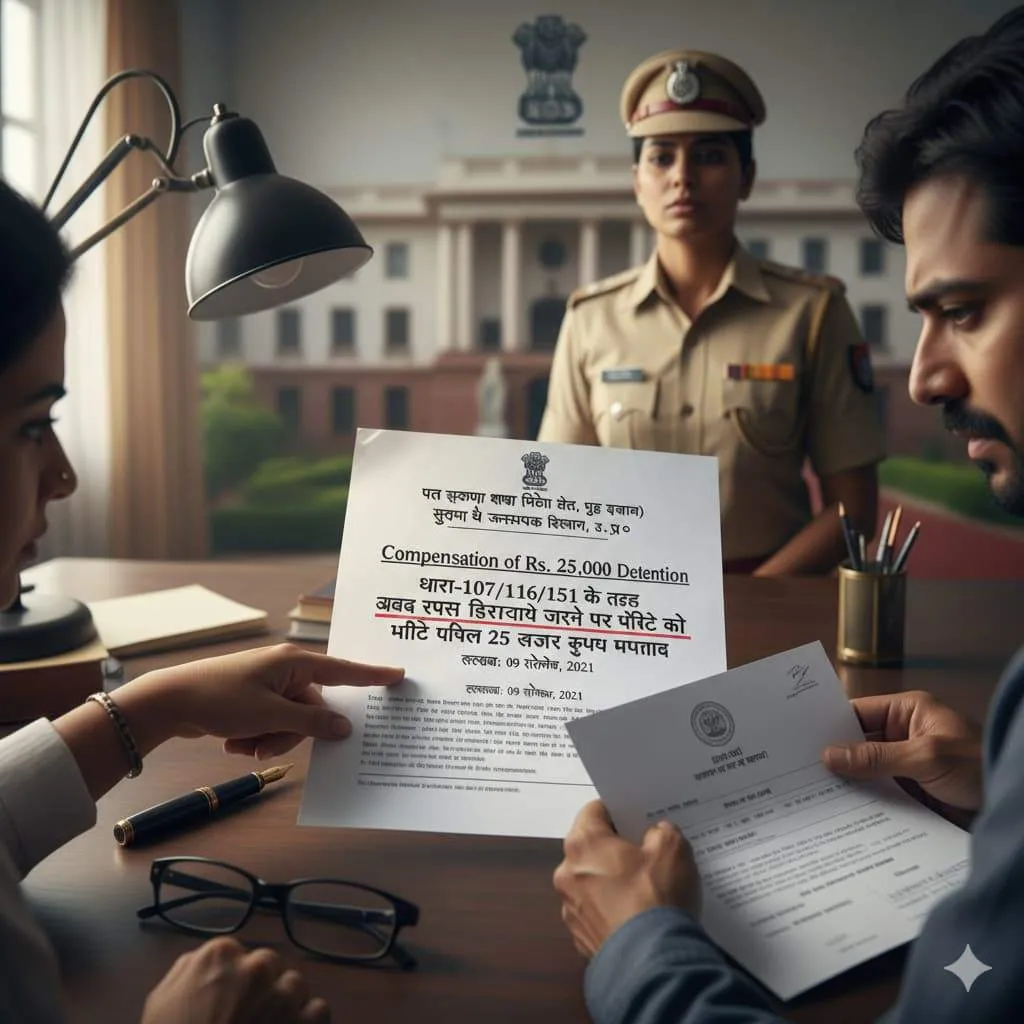
Uttar Pradesh promises real accountability when police get it wrong: the compensation of Rs.25000 for illegal detention. This rule protects any citizen wrongfully held under Section 107/116/151 CrPC. It also opens the door to disciplinary action against the officer responsible. Mahima Maurya’s case against Mirzapur Police puts that promise to the test — and raises a hard question. Will the system actually deliver on it?
Key Takeaways
- Uttar Pradesh offers a compensation of Rs.25000 for illegal detention, ensuring accountability for wrongful actions by police.
- Mahima Maurya’s case challenges this promise, alleging that Mirzapur Police illegally detained her husband and mishandled the reports.
- The conflict between police records and Mahima’s account raises doubts about adherence to the compensation of Rs.25000 for illegal detention.
- Accountability hinges on enforcing existing directives and holding officers responsible for their actions.
- The case tests the overall effectiveness of the system in delivering justice and fulfilling the promise of compensation.
Compensation of Rs.25000 for Illegal Detention: A Mirzapur Case Study
The rule of law depends on two things: clear rights, and real consequences when officials ignore them. Uttar Pradesh built exactly that consequence for one specific abuse: wrongful detention. The state created a compensation of Rs.25000 for illegal detention, payable to any victim. It also promises disciplinary action against the officer responsible.
Mahima Maurya’s grievance against Mirzapur Police puts that promise to the test. Her case carries two registration numbers: GOVUP/E/2025/0014667 and GOVUP/E/2025/0008765. It alleges that police illegally detained her husband, Pramod Kumar Kushwaha. It also alleges that the resulting police report doesn’t match what actually happened. Notably, this situation brings into sharp focus why Rs.25000 compensation for illegal detention is so significant.
The Allegations: Two Conflicting Accounts
Mahima Maurya’s complaint centres on one core claim: police illegally detained her husband, Pramod Kumar Kushwaha, on 14 September 2024. The official record tells a different story, making the question of entitlement to compensation for illegal detention of Rs.25000 all the more crucial.
- What the police documents say: The initial grievance (GOVUP/E/2025/0008765) and the closure report name a different person. They say police took preventive action against Mahima Maurya’s younger brother, Mithilesh Maurya, and others. The section cited is 170/126/135 BNSS, the equivalent of the old Sections 107/116/151 CrPC named in the government’s 2021 order. The closure report states police “took preventive action under Section 170/126/135 BNSS against both parties” on 14 September 2024.
- What Mahima Maurya says happened: She insists officers actually detained her husband at Mithilesh Maurya’s location, not Mithilesh himself. She says the Sub-Divisional Magistrate (Sadar) granted her husband bail that same day. If true, this bail order contradicts the police’s own account. It also suggests the record naming Mithilesh as the detained party is wrong or altered.
This gap between the official record and the family’s account not only raises real doubts about official compliance with rules regarding illegal detention but also underscores the need for a thorough examination of the situation. Mahima Maurya asserts that she can produce the bail order backing her version, which further complicates matters. Consequently, this gap calls into question how carefully the police investigated and documented the case. Moreover, the police report reportedly dismissed her as someone who “repeatedly files applications” — her own characterisation of how officers viewed her persistence — rather than directly addressing the bail-order question. It is crucial to remember that wrongful detention, where statutory compensation is set at Rs.25000, follows clear procedures.
Why the Compensation of Rs.25000 for Illegal Detention Matters Here
This case turns on a specific rule: the state government’s own order guaranteeing compensation of Rs.25000 for illegal detention.
A press note from the Information and Public Relations Department, U.P., dated 9 September 2021, clearly articulates the policy; consequently, it specifies that illegal detention triggers fixed compensation of Rs.25000 for victims.
“धारा-107/116/151 के तहत अवैध रूप से हिरासत पाये जाने पर पीड़ित व्यक्ति को मिलेगा 25 हजार रूपये मुआवजा” — Under Section 107/116/151, a victim of illegal detention will receive ₹25,000 in compensation.
The same note adds a second requirement:
“अवैध हिरासत किये जाने के उत्तरदायी अधिकारी के विरूद्ध भी होगी नियमानुसार दण्डात्मक कार्यवाही” — Officials will also face disciplinary action, as the rules require, if they carry out an illegal detention.
The Allahabad High Court’s directives prompted this order. State authorities — District Magistrates, the Director General of Police, and others — received clear instructions to enforce it strictly, especially in matters related to unlawful detention and the corresponding Rs.25000 compensation policy.
Mahima Maurya’s case, then, isn’t just a routine complaint. It tests whether Mirzapur Police will follow the state government’s own binding circular. By closing the case without addressing the bail record, police appear to be sidestepping that duty to provide compensation in line with the policy for illegal detention of Rs.25000.
Fixing Accountability: What Needs to Happen Next
This case raises a broader question: how does the system hold officials accountable when they ignore their own rules, particularly those on compensation of Rs.25000 for illegal detention?
- Enforce existing directives. Officers in the field need to follow office memos, circulars, and government orders consistently — otherwise the rule of law means little in practice.
- Hold responsible officers accountable. The Superintendent of Police, Mirzapur, should act against the officers involved and set a clear precedent.
- Rebuild public trust. Prompt redress — including the compensation of Rs.25000 for illegal detention — shows citizens the system doesn’t shield its own.
The grievance report closed the case. It told the complainant to pursue the matter in court, and reportedly described her as someone who files applications too often. Citizens do have the right to seek judicial remedy. But the administrative grievance system, CPGRAMS in this case, exists for a different purpose: catching exactly this kind of failure. That includes checking whether officials followed the 2021 compensation circular and properly investigated the illegal-detention and record-tampering claims — that is, whether the Rs.25000 statutory requirement was observed.
Conclusion: Will the System Deliver on Its Own Promise?
This Mirzapur case is a test. A police force that respects transparency, accountability, and citizens’ rights doesn’t happen automatically. Someone has to enforce it, consistently, from the top down; that includes ensuring the compensation for illegal detention, specifically the Rs.25000 sum, is awarded where due.
Three things need to happen next:
- The Joint Secretary and the Chief Minister’s Secretariat should reopen the grievance. They should direct Mirzapur Police to submit a new report, one that actually addresses the bail record for Pramod Kumar Kushwaha — crucial if they are to consider compensation of Rs.25000 for illegal detention as required by the state.
- Investigators need to establish the facts: who was detained, under which sections, and on whose order.
- If the investigation confirms illegal detention occurred, officials must promptly pay the ₹25,000 compensation to Pramod Kumar Kushwaha, as the September 2021 order specifically requires in such cases. They should also open disciplinary proceedings against the officers responsible for the detention and for any inconsistencies in the report.
Cases like this test whether the rule of law is a lived reality or just a phrase on paper. That question will keep coming up until administrative authorities move past quick closures and take real corrective action — especially in claim processes around compensation of Rs.25000 for illegal detention. The policy will keep being either a genuine safeguard or an empty promise. It all depends on whether anyone actually enforces it.
Public Authorities Concerned
1. Superintendent of Police (SP), Mirzapur
- Contact: SP office — Phone 05442-252578 / 05442-256655, Mobile 9454400299, Email: sp-mzr@gmail.com (spmau-up@nic.in · 93 · Mirzapur Range · DIG · 05442-256366 · 05442-257401 · 9454400215 · digrmir@nic.in · 94 · Mirzapur · SP · 05442-252578 · 05442-256655 · 9454400299 · sp-mzr@gmail.com) S3waas
- District police contact directory: https://mirzapur.nic.in/divisions/police-contact-details/
- UP Police official portal (district officials list): https://uppolice.gov.in/frmOfficials.aspx?mirzapur=&cd=MQAwADMAMwA%3D
2. Uttar Pradesh Police (state-level)
- Official site: https://uppolice.gov.in This is an Official Website of Uttar Pradesh Police (UP Police) that provides online information about CCTNS services, police units, emergency services, citizen services and all the uppolice activities. Uttar Pradesh Police
3. Information & Public Relations Department, Government of Uttar Pradesh (source of the September 2021 compensation circular)
- Official site: https://www.information.up.gov.in/en/ Information & Public Relations Department, Uttar Pradesh Up
- Address: Information and Public Relations Department (Govt of Uttar Pradesh) Lok Bhawan, Lucknow, 226001 IGoD
4. Chief Minister’s Secretariat / Jansunwai (IGRS) Portal (for escalating the grievance, as the article recommends)
- Official portal: https://jansunwai.up.nic.in — Citizens can register grievances relating to Government departments, offices, and public authorities in Uttar Pradesh through the official portal at jansunwai.up.nic.in, free of cost, without visiting a Government office. Indiacustomercare
- CM Helpline: 1076, a toll-free number operating 24 hours a day, feeding directly into the same Jansunwai grievance system as the online portal. JK Grievance Guide
5. CPGRAMS (Centralised Public Grievance Redress and Monitoring System) — where Mahima Maurya’s grievance was registered
- Official portal: https://pgportal.gov.in Centralised Public Grievance Redress and Monitoring System (CPGRAMS) is an online platform available to the citizens 24×7 to lodge their grievances to the public authorities on any subject related to service delivery.
- Complaint status tracking uses the registration number format cited in the article (GOVUP/E/… numbers).


Facing a similar challenge? Share the details in the box below, and our team of experts will do their best to help.