
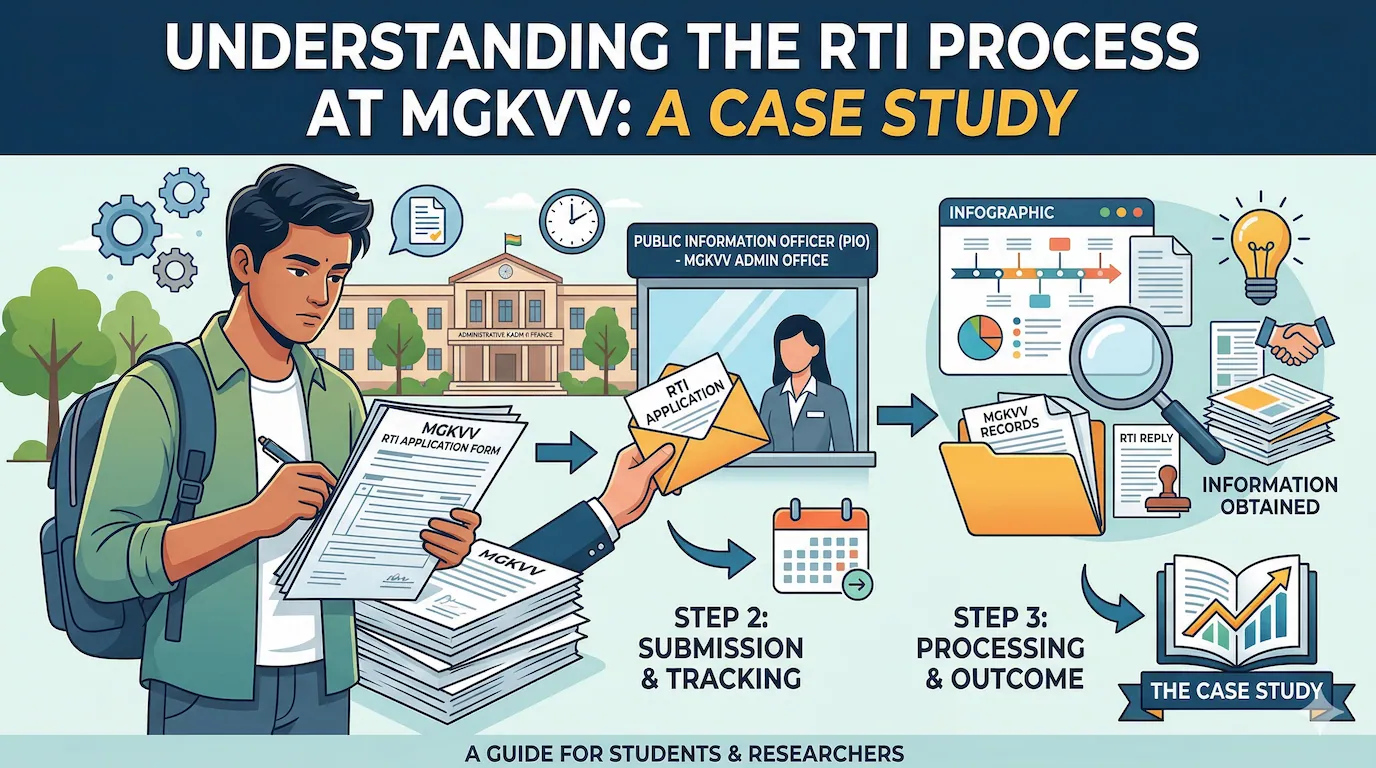
Here are the key takeaways from the analysis of your RTI case against Mahatma Gandhi Kashi Vidya Peeth (MGKVP) — a practical guide to understanding the RTI process at MGKVV:
- Systemic Evasion of Transparency: Both the Public Information Officer (PIO) and the First Appellate Authority (FAA/Vice Chancellor) have engaged in “cryptic denials” by repeatedly referring to a single response from June 10, 2025, while ignoring that it was incomplete. Understanding the RTI Process at MGKVV is crucial to recognising why such evasions persist.
- Specific Data Gaps: The university has failed to provide critical historical and procedural data, specifically:
- Year-wise lists of affiliated colleges from 2010 to 2025.
- The official mechanism/SOP used to grant these affiliations.
- Failure of the Appellate Process: The Vice Chancellor’s office disposed of the appeal without adjudicating the merit of the complaint. By simply re-sending the same incomplete document, the FAA failed to fulfil its statutory duty to ensure full disclosure.
- Technical Breakdown: There is a significant dispute regarding the delivery of information. The appellant’s claim of non-receipt of the June 10th email highlights the university’s failure to ensure “safe and verified delivery” of legal documents.
- Violation of Section 4: Under the RTI Act, much of the requested information (like lists of affiliated colleges) should be proactively disclosed on the university website. Withholding this suggests a lack of institutional integrity.
- Path Forward: Since the internal university channels (PIO and FAA) have been exhausted on grounds of “misleading or false information,” the matter is now ripe for a Second Appeal to the State Information Commission (SIC) to seek penalties against the officers involved.
Understanding the RTI Process at MGKVV: Accountability in Higher Education and the Transparency Crisis at Mahatma Gandhi Kashi Vidya Peeth
Understanding the RTI process at MGKVV begins with recognising what the Right to Information (RTI) Act of 2005 was designed to achieve. The Act dismantles the “culture of secrecy” within public institutions. It replaces that secrecy with a regime of transparency and accountability. Yet, the case of Yogi M P Singh vs Mahatma Gandhi Kashi Vidya Peeth (MGKVP), Varanasi, tells a different story. Bureaucratic stonewalling and “cryptic” responses continue to undermine a citizen’s democratic rights.
A university is an epicentre of learning and ethics. When it refuses to provide clear administrative data, it raises serious concerns about higher education governance in Uttar Pradesh.
Understanding the RTI Process at MGKVV — The Core Conflict: Seeking Information on Affiliated Institutions
The crux of this matter centres on RTI requests about affiliation records of colleges under MGKVP. Yogi M P Singh, the appellant, sought detailed data spanning financial years 2010-11 to 2024-25.
The Specific Information Sought:
- Historical Records: A list of all colleges attached to the university in 2010-11, including their recognition years.
- Chronological Growth: Comprehensive lists of institutions granted affiliation across various five-year blocks (2011–2016, 2016–2021, and 2021–2025).
- Procedural Transparency: The specific mechanism or “Standard Operating Procedure” followed by the university when processing applications for new affiliations.
Despite the structured nature of the request, the PIO and the FAA provided only a fraction of the data — specifically Point 5. As a result, the most critical administrative records remain “cryptically denied.”
Understanding the RTI Process at MGKVV — The Procedural Failure: From PIO to FAA
A critical step in understanding the RTI process at MGKVV is tracing this application’s journey. That journey reveals a systemic breakdown in the university’s grievance redressal mechanism.
1. The PIO’s Evasive Response
Dr Sunita Pandey, the Public Information Officer, handled the request filed on May 7, 2025. The appellant received a response on June 10. However, that response was incomplete. In RTI jurisprudence, providing partial information without a valid exemption under Section 8 or 9 amounts to a “deemed refusal.”
2. The First Appeal and the Vice Chancellor’s Order
Dissatisfied with the incomplete data, the appellant escalated the matter to the First Appellate Authority (FAA), Vice Chancellor Prof. Anand K. Tyagi. The FAA disposed of the appeal (Registration No: MGKVV/A/2025/60019) on June 30, 2025. The reply was repetitive: “Information has already been provided on 10-06-2025 and is attached again.”
This response is a classic example of circular logiThis response is a classic example of circular logic. The appellant’s core grievance was that the June 10th information was incomplete. Therefore, re-sending the same document does not resolve the appeal. Furthermore, it ignores the FAA’s mandate to adjudicate whether the PIO’s original denial was justified.y Affiliation
One might ask why a 15-year list of affiliated colleges is so sensitive. Private college affiliations to state universities attract significant administrative scrutiny. Consequently, transparency in this area is vital for several reasons:
- Infrastructure Compliance: Are these institutions meeting the mandatory requirements set by the UGC and the State Government?
- Revenue Management: Affiliation fees and examination fees from these colleges constitute a significant portion of a university’s internal revenue.
- Student Welfare: Students need to know if their degrees are being issued by a legitimately affiliated institution to avoid future legal or professional hurdles.
- Prevention of Corruption: Secretive affiliation processes can lead to the proliferation of “paper colleges” that lack actual facilities but are authorised to enrol students.
By failing to provide the mechanism for processing these applications, the university has not provided the mechanism for processing these applications, as requested in Point 6. Consequently, the public remains in the dark about the criteria used to grant or deny these licences.
A secondary but equally frustrating issue in this case concerns digital reliability. The appellant states that the email allegedly sent on June 10, 2025, never reached his inbox.In the digital age, “safe email delivery” is a prerequisite for legal compliance. If a public authority claims to have sent information via email, it must produce a “Sent” receipt or a delivery log. Moreover, when a citizen reports non-receipt, the authority is legally and ethically bound to act. It must provide the information through alternative means — such as registered post or a direct download link — rather than simply declaring the matter “disposed of.”
Understanding the RTI Process at MGKVV — Moving Forward: The Second Appeal to the SIC
The First Appellate Authority has failed to provide relief. Therefore, the appellant’s next logical and legal step is to file a Second Appeal with the Uttar Pradesh State Information Commission (SIC) under Section 19(3) of the RTI Act.
Strategies for a Strong Second Appeal:
- Highlight the “Deemed Refusal”: Explicitly state that the FAA failed to address the specific points (1, 2, 3, 4, and 6) that were missing from the PIO’s response.
- Invoke Section 4: Under Section 4 of the RTI Act, public authorities are required to proactively disclose their organisational structure and procedures. The university should have this list of affiliated colleges on its website by default.
- Demand Penalties: Request the Commission to impose penalties on the PIO under Section 20 for “malafidely” denying information aConclusion: Understanding the RTI Process at MGKVV and the Call for Institutional Integrityclusion: A Call for Institutional Integrity
Understanding the RTI process at MGKVV is ultimately about accountability. The institution bears the name of the Father of the Nation — a champion of truth and transparency. It must live up to those values. When it resorts to “cryptic denials” of public data, it betrays its own legacy.
Transparency is not a favour the university grants to citizens. It is a statutory obligation. Until the university provides a year-by-year breakdown of its affiliations and explains its administrative “mechanism,” suspicion over its governance will persist. Above all, the struggle of Yogi M P Singh is not merely about a list of colleges. It is about every citizen’s right to hold powerful institutions accountable to the law of the land.
Based on your case details and current records for 2026, here is the structured contact information for the public authorities and links involved in your RTI request.
1. Core Case Identifiers
| RTI Application | MGKVV/R/2025/60031 | 07/05/2025 | Disposed (10/06/2025) |
| First Appeal | MGKVV/A/2025/60019 | 23/06/2025 | Disposed (30/06/2025) |
2. Concerned Public Authority Contact Details
The following individuals are the legally designated officers for Mahatma Gandhi Kashi Vidya Peeth (MGKVP), Varanasi.
A. First Appellate Authority (FAA) (Understanding the RTI Process at MGKVV)
- Name: Prof. Anand K. Tyagi
- Designation: Vice Chancellor
- Mobile: 9839501925 / 945280XXXX
- Email: vc@mgkvp.ac.in / vcmgkvp@gmail.com / vc.office@mgkvp.ac.in
B. Public Information Officer (PIO)
- Name: Dr Sunita Pandey
- Designation: Registrar / Controller of Examinations
- Mobile: 9839501925 / 0542-2222689 (Office)
- Email: registrarmgkvp@gmail.com / registrar@mgkvp.ac.in
C. Nodal RTI Officer (Understanding the RTI Process at MGKVV)
- Name: Sri Rajesh Rai
- Designation: Nodal Officer, RTI Cell
- Mobile: 9839501925
- Email: nodalrticellmgkvp@gmail.com
3. Web Link Details (Understanding the RTI Process at MGKVV)
To track status or file further appeals, use these official portals:
- UP RTI Online Portal:https://rtionline.up.gov.in/
- Use this to file your Second Appeal to the State Information Commission.
- MGKVP Official Website: https://mgkvp.ac.in/
- UP State Information Commission (SIC):http://www.upsic.gov.in/
- Direct link for Second Appeal guidelines and cause lists.
Important Note on “Cryptic Denial” (Understanding the RTI Process at MGKVV)
The PIO’s response directed you to the university website for Points 3 and 4. However, under the RTI Act, a simple link is insufficient when it does not contain the specific historical data requested. In such cases, the PIO must offer Inspection of Records under Section 2(j)(i) rather than issuing a denial.
Would you like me to help you draft a formal notice to the Nodal Officer regarding the non-receipt of the email sent on June 10, 2025?


Facing a similar challenge? Share the details in the box below, and our team of experts will do their best to help.