
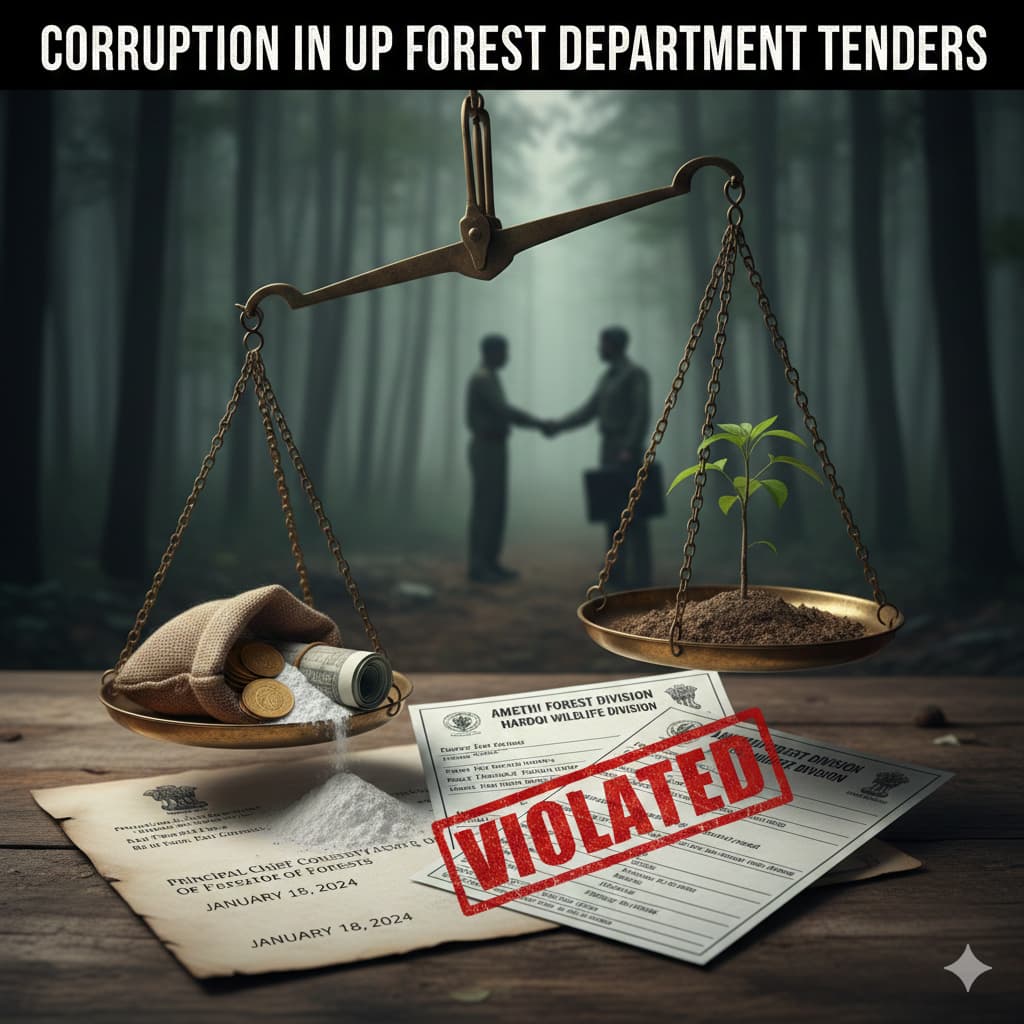
🚨 Procurement Scandal Uncovered: How UP Forest Officials Allegedly Subverted Orders for Personal Gain
Introduction: The Whisper of Corruption Turns to a Roar
The procurement process within the Uttar Pradesh Forest Department for essential agricultural materials, specifically Gypsum Powder Aggregate, has become a focal point of serious corruption allegations. What initially appeared to be isolated instances of bureaucratic red tape has revealed a systemic manipulation of tender conditions designed to create a monopoly and facilitate potential “paper-only” supplies.
Recent documents confirm a disturbing pattern: Divisional Forest Officers (DFOs) across multiple divisions—including Amethi, Firozabad, and Hardoi—appear to have deliberately violated clear directives from the state’s highest forest authority, the Principal Chief Conservator of Forests (PCCF). This act of insubordination strongly suggests an orchestrated effort to protect a system that allegedly favors a single contractor, Pass Enterprises, enabling widespread corruption in the supply chain.
The core of the issue lies in the creation of arbitrary and contradictory eligibility criteria in the tender documents, ensuring that only a select few firms can even bid. This detailed analysis breaks down the evidence, revealing the precise mechanisms used to subvert open competition and transparency.
Section 1: The Apex Order and its Willful Violation 📜
The most damning evidence comes from comparing the state-level directive with the divisional tender notices.
The PCCF Mandate (Dated: January 18, 2024)
Responding to concerns about restrictive bidding practices, the Principal Chief Conservator of Forests and Head of Department, Uttar Pradesh, Lucknow (PCCF), issued a clear order (Letter No. Camp 84/PA). A constituted committee specifically recommended eliminating the restrictive clause:
❌ There is “no basis for imposing the condition of ‘having experience of working only in the Forest Department’”.
Instead, the PCCF mandated that divisions should only require experience of “working of similar nature in any Government Department or Public Sector Undertaking.” This directive was circulated to all Divisional Forest Officers (DFOs) and Directors for strict compliance.
The DFOs’ Act of Non-Compliance
Despite this unambiguous order issued in January 2024, the subsequent tender notices issued by the DFOs in January 2025 explicitly violated this directive.
| Division | Tender Notice Date | Violating Clause | Effect |
| Amethi | Jan 25, 2025 | Requires 4 to 5 years experience specifically with the Forest Department. | Directly contradicts the PCCF order by restricting the experience pool. |
| Firozabad | Jan 24, 2025 | Mandates experience in supply of Gypsum in the Forest Department. | Maintains the illegal restriction, ignoring the inclusion of other Government Departments. |
| Hardoi | Jan 20, 2025 | Requires 5 years experience in gypsum supply in the Forest Department. | An explicit and direct disregard for the highest departmental authority’s instructions. |
The issuance of these three tenders one year after the PCCF’s order, with the same restrictive clauses, is not an oversight. It strongly indicates a willful subversion of official policy at the divisional level, allegedly to keep the tender process closed to all but one favored entity.
Section 2: Manufacturing Monopoly: The Arbitrary Barriers 🛑
Beyond the experience clause violation, the tender documents are littered with additional high and contradictory barriers, supporting the claim that the system is engineered for a single successful bidder.
I. The Financial and Experience Discrepancy
Both the Amethi and Hardoi tenders commit a classic contradiction noted in the initial complaint:
- Experience Demand: Up to 5 years of supply experience (with the Forest Department).
- Financial Proof Demand: Only 3 years of Income Tax Returns (ITR) and Audited Balance Sheets.
This disparity is illogical for genuine procurement. It suggests that the required 5-year experience mark is tailored to fit the history of the current incumbent (Pass Enterprises), while the financial proof is kept at a more manageable three years.
II. Unnecessary and Expensive Certifications
To supply basic material like Gypsum Aggregate, the DFOs mandated highly specific and expensive quality certifications:
- ISO 9001:2015 Certificate: Required by Amethi, Firozabad, and Hardoi. While a quality marker, making it mandatory for a raw aggregate supply is often used to exclude smaller, reliable regional suppliers.
- Zero Effect and Zero Defect Certificate (ZED): Required by Amethi. The ZED scheme is aimed at incentivizing manufacturing excellence, not a standard requirement for material supply. Mandating this is an extreme barrier to entry.
III. Excluding the Supply Chain
The Amethi and Firozabad tenders explicitly demand a Lease Holder Certificate and government authority letter for extraction.
- This condition prevents legitimate traders, authorized suppliers, and aggregates—who may offer better rates—from bidding. It forces the supplier to be the actual mine owner or lessee, a severe constraint that artificially restricts the market to a tiny fraction of qualified businesses.
IV. Excessive Personal Documentation
The Amethi and Hardoi tenders demand a Character Certificate and a Status Certificate issued by the District Magistrate (DM) or Superintendent of Police (SP). For a simple material supply contract, such high-level personal documentation provides DFOs with undue discretionary and subjective power to disqualify bidders for reasons unrelated to technical or financial capacity.
Section 3: The Threat of “Paper-Only” Supply 👻
The consequences of this manufactured monopoly extend beyond unfair bidding. The initial email alleged that the supply of Gypsum is often “nearly on Paper,” facilitated by Bill Trading between the contractor and department officials, including Forest Rangers and DFOs.
The incentive for this ghost supply is simple: at the quoted rate of ₹3950 per MT, actual supply may not be financially viable after factoring in all costs. By limiting the tender to a single, cooperating contractor, officials allegedly allow the contractor to show the supply on records only.
A genuine physical supply requires crucial documentation:
- E-Way Bills: For tracking the movement of material across state borders.
- Ravannah: The Royalty Payment Document proving the Gypsum has legally been extracted and dispatched from its source (likely Rajasthan).
The inability or refusal of the department to produce these two documents, as alleged, would be decisive proof that the Gypsum never reached the barren land, making this a clear case of massive financial fraud and environmental sabotage.
Conclusion: A Call for Accountability and Procurement Reform 📢
The documents confirm that the divisional forest procurement process is fundamentally compromised. The wilful violation of a PCCF order, coupled with the systemic use of highly restrictive and contradictory clauses, points toward a clear mechanism designed to ensure a monopoly and facilitate corrupt practices.
An immediate, high-level inquiry is necessary to investigate:
- Why the DFOs of Amethi, Firozabad, and Hardoi violated the January 18, 2024, PCCF order.
- The full record of E-Way Bills and Ravannahs for all Gypsum orders awarded to Pass Enterprises over the past five years.
The State Government must enforce the PCCF’s order immediately and implement Model Procurement Conditions that grade contractors based on standard metrics (like those used by PWD/Irrigation) rather than arbitrary, department-specific experience. Only through transparent rules and strict compliance can the alleged nexus between certain contractors and divisional officials be broken, restoring accountability and ensuring that public funds are used for genuine environmental work.



Facing a similar challenge? Share the details in the box below, and our team of experts will do their best to help.