
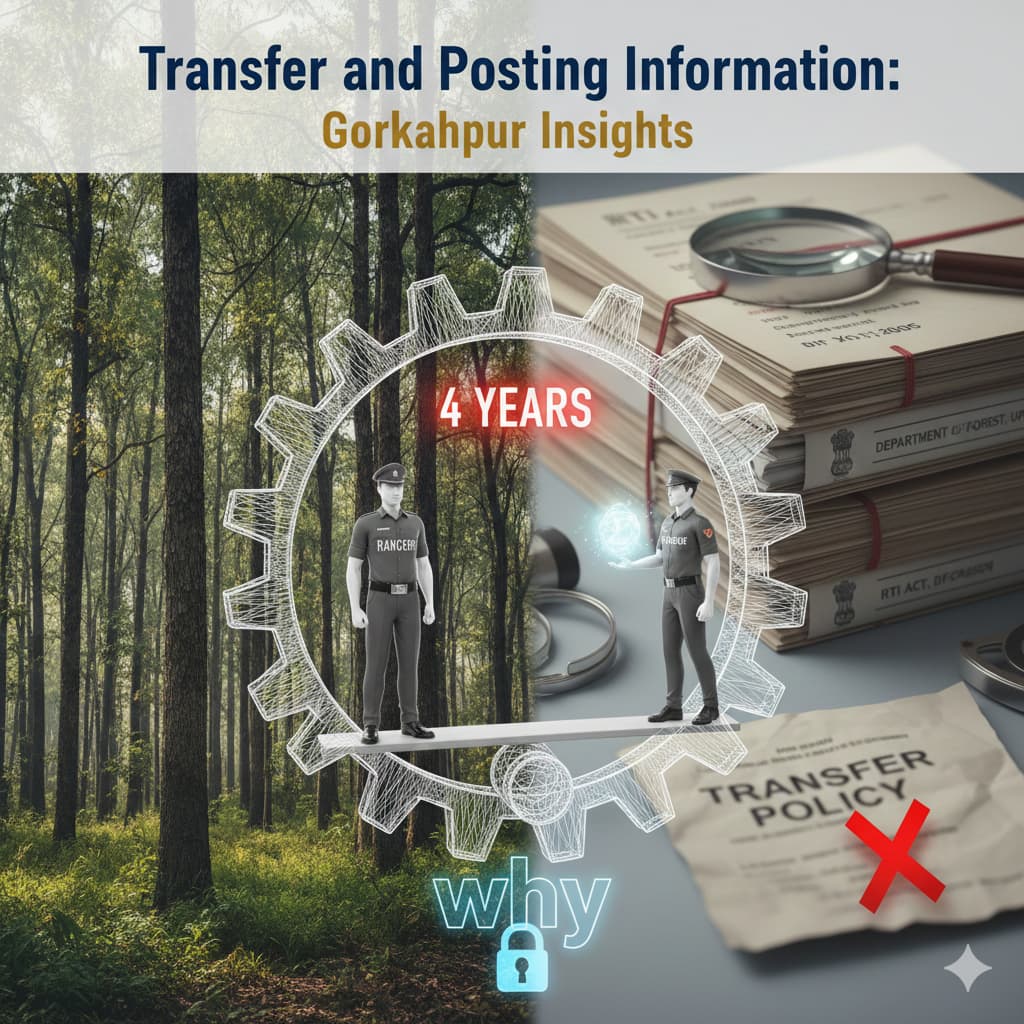
🌳 Information Regarding Rangers and Postings (Based on Department Response)
The official response, dated August 28, 2025, from the Chief Conservator of Forests, Administration (Gazetted), provides specific answers or reasons for denial based on the Uttar Pradesh Right to Information Rules, 2015.
1. Specific Information on Rangers Without Range Charge
The request to “provide the names of Rangers to whom Government has not assigned charge of any range” and their current posting details was not answered in the provided document (Letter No. E-248/3-2-5). This information, if available, would be a separate, data-driven list not contained in this specific reply focusing on the points raised during the appeal hearing.
2. Justification for Assigning Baki Range Charge to Shri Jagdamba Pathak (Deputy Ranger)
The department provided the following administrative justification:
- Designation: Shri Jagdamba Pathak is a Deputy Regional Forest Officer (Deputy Ranger), a Group ‘C’ post.
- Administrative Rationale: In the Uttar Pradesh Forest Department, Regional Forest Officers (Rangers) (Group ‘B’) are typically posted as Range In-charges.
- Vacancy/Personnel Shortage: Due to a shortage of personnel in the Regional Forest Officer (Ranger) cadre relative to the total sanctioned posts, the charge of vacant ranges in various districts/forest divisions has been given to the Deputy Regional Forest Officer at the local level as an alternative arrangement.
- Recruitment Efforts: A requisition has been sent to the Uttar Pradesh Public Service Commission to fill 96 vacant posts of Regional Forest Officer (Ranger).
3. Violation of Transfer Policy for Shri Jagdamba Pathak
The department rejected the claim of transfer policy violation on the grounds that:
- Applicability: The annual transfer policy provision for transfer after three years in a district and seven years in a division applies to Group A and Group B employees.
- Pathak’s Rank: Shri Jagdamba Pathak is a Deputy Regional Forest Officer, which is a Group C post.
- Conclusion: The provision for mandatory transfer based on tenure does not apply to Group C employees.
4. Statistical and Personnel-Related Details
The statistical requests, such as:
- The number of government personnel serving as Rangers.
- The total number of sanctioned posts for Rangers.
- A list of Deputy Rangers functioning as Rangers and the duration of their service.
were not explicitly answered in the provided document (Letter No. E-248/3-2-5). The only relevant personnel detail provided is that a requisition has been sent to fill 96 vacant posts of Regional Forest Officer.
5. Demand Letter/Requisition for Vacant Ranger Post
The request for a copy of the demand letter or requisition issued by the local office to fill the vacant Ranger post in Baki Range was not addressed in the official response.
6. Authority for Ranger Postings
The request for the name and designation of the public personnel responsible for supervising and approving Ranger postings, especially the authority at the government level, was not explicitly answered in the provided response.
📜 Administrative Objections to “Why” Questions
The department denied the requests seeking the rationale/justification (“why”) for the prolonged posting or alleged transfer policy violation by invoking a specific rule of the RTI Act:
- Rule Invoked: The department cited Rule 4(2)(b)(iv) of the Uttar Pradesh Right to Information Rules, 2015, which states: “the question ‘why,’ which seeks justification for the action taken or omitted, should not be answered.
- Points Denied: This rule was used to deny the requests for:
- The reason/rationale for giving the charge to a junior rank officer (Deputy Ranger) for three and a half years.
- The reason for violating the new transfer policy by posting Shri Jagdamba Pathak for three and a half years.
The department also categorized the applicant’s statements on corruption, good governance, and the transfer policy as his “personal opinion,” stating they are “not acceptable in the light of the report provided.”
The available documents contain the official response from the Principal Chief Conservator of Forests office to the State Information Commission, providing a partial answer to the applicant’s queries, primarily addressing the justification for the Deputy Ranger’s posting as an alternative arrangement due to staff shortages and clarifying the inapplicability of the Group A/B transfer policy to a Group C employee like Shri Jagdamba Pathak.
📰 RTI and Administrative Accountability: An Analysis of Postings in the UP Forest Department
This blog post analyzes the official response provided by the Principal Chief Conservator of Forests, Uttar Pradesh, to a structured Right to Information (RTI) request concerning the postings of Forest Rangers and Deputy Rangers, particularly focusing on the assignment of the Baki Range charge.
1. Justification for Prolonged Posting of Deputy Ranger
The central issue raised by the applicant, Shri Yogi M.P. Singh, was the continuous assignment of the Baki Range charge to Shri Jagdamba Pathak, a Deputy Ranger (Group C), for over four years.
Official Administrative Rationale
The department’s response (Letter No. E-248) provided a clear, administrative justification:
- Post Category: The required position, Range In-charge, is typically held by a Regional Forest Officer (Ranger), a Group B post.
- Personnel Shortage: The charge was assigned to the junior officer (Pathak) due to a shortage of personnel in the Regional Forest Officer (Ranger) cadre relative to the total sanctioned posts. This was termed an “alternative arrangement.”
- Recruitment Action: To address the underlying issue, the department has sent a requisition to the Uttar Pradesh Public Service Commission to fill 96 vacant posts of Regional Forest Officer (Ranger).
This justification uses the defense of administrative necessity due to a wide-scale personnel deficit, a common reason cited in government departments for making ad-hoc arrangements.
2. Clarification on Transfer Policy Application
The applicant challenged the prolonged posting by alleging a violation of the government’s transfer policy. The department’s response provided a strict interpretation of the policy based on the officer’s grade.
Departmental Stance on Policy Violation
- The department explicitly stated that the transfer provision requiring rotation after three years in a district and seven years in a division applies only to Group A and Group B employees.
- Since Shri Jagdamba Pathak is a Deputy Regional Forest Officer, a Group C post, the specific tenure-based transfer norms of the annual transfer policy do not apply to him.
- Justification: The claim of transfer policy violation was officially rejected by establishing that the officer in question falls outside the defined scope of the cited policy rules.
3. The ‘Right to Reason’ vs. The ‘Rule Against Why’
A crucial element of the entire appeal process was the applicant’s insistence on the Right to Reason under Section 4(1)(d) of the RTI Act, 2005, which obligates public authorities to “provide reasons for its administrative or quasi-judicial decisions to affected persons.”
The Department’s Counter-Argument
The Public Information Officer (PIO) effectively countered this by invoking a specific provision in the state rules:
- Rule Cited: The PIO cited Rule 4(2)(b)(iv) of the Uttar Pradesh Right to Information Rules, 2015.
- Rule Text: This rule explicitly states that the information sought should not “involve answers to the question ‘why’, thus asking for reasons why a certain act was done or not done.”
- Justification: The PIO used this rule to legally deny the requests for justification on:
- Why the charge was given to a junior officer.
- Why the transfer policy was allegedly violated.
The department’s approach demonstrates a significant operational conflict within the RTI framework. While the central RTI Act mandates giving reasons for decisions (Sec. 4(1)(d)), the state rules are interpreted to exclude answering questions that start with ‘why,’ effectively limiting the public’s ability to probe the intent or detailed motivation behind an administrative action.
4. Unanswered Queries and Future Scope
Several key pieces of factual information sought by the applicant remain unaddressed in the provided response, indicating a potential scope for further action by the State Information Commission:
| Information Sought | Status in Departmental Response |
| Names of Rangers without Range Charge & their postings. | Not Provided (Only focused on the appeal points) |
| Statistical data on Ranger strength (sanctioned vs. filled posts). | Partially Provided (Mentioned 96 vacant posts are requisitioned) |
| Name of the authority who approves Ranger postings. | Not Provided |
| Copy of the demand letter/requisition for Baki Range. | Not Provided |
The PIO’s response focuses heavily on providing administrative facts (staff shortage, Group C status) and legal rejection (Rule against ‘why’ questions), while side-stepping the provision of specific, record-based data (names, statistics, demand letters) that may still be accessible under the RTI Act, 2005.
You are correctly pointing out the tension between the specific legal defense used by the department and the spirit and intent of the government’s transfer policy, which is aimed at curbing corruption and ensuring accountability.
Here is a justification of why the four-year posting, while not a criminal offense, is still a violation of the Government’s Directive and the broader goals of transparency.
⚖️ The Conflict: Letter of the Rule vs. Spirit of the Directive
The situation you describe presents a direct conflict between a specific service rule regarding Group C employees and the general administrative directive aimed at promoting good governance.
1. The Violation of Government Directive (Intent)
The government’s transfer policy, setting a maximum tenure of three years at one location for a Ranger, is a key directive designed to:
- Curb Corruption: Prevent the establishment of deep local ties and vested interests that can foster corruption.
- Ensure Accountability: Introduce regular external scrutiny by rotating officers.
- Promote Transparency: Adhere to a predictable and fair system of postings.
When a Deputy Ranger holds the charge of the Ranger post for four years in one location, the purpose of the three-year rule is effectively defeated.
- The Effect is the Same: Whether the officer is a confirmed Ranger or a Deputy Ranger in charge of the Ranger post, they are the functional head of the range for four years, enjoying the associated privileges and forming the exact local connections the transfer policy seeks to break. This is a clear violation of the government’s anti-corruption directive in practice.
2. The Department’s Legal Defense (The Letter of the Rule)
The department, however, relied on a strict legalistic interpretation to defend the posting:
- The transfer policy’s tenure limits (3 years in a district, 7 years in a division) apply explicitly to Group A and Group B employees.
- The Deputy Ranger is a Group C employee.
- Therefore, the department claims the specific tenure limit does not legally apply to Shri Jagdamba Pathak, making the violation arguable from a technical standpoint.
3. Conclusion: An Unjustified Exception
While the posting may not constitute a crime or a technical violation of the transfer rule as applied to a Group C officer, it is unequivocally an administrative failure and a clear contravention of the overarching Government Directive.
The core issue is:
- The Plumb Post: The Baki Range Ranger post is officially vacant.
- The Alternative Arrangement: The prolonged use of a Group C officer to fill a Group B post for four years is evidence of poor cadre management and a failure to expedite either the posting of a regular Ranger or the necessary transfer of the incumbent.
- Accountability Gap: The long posting, regardless of the officer’s grade, creates the exact vulnerability to corruption that the Chief Minister’s new transfer policy was intended to eliminate.
The applicant’s argument that this goes against the spirit of transparency and accountability is strongly justified, and the department’s defense is merely a technical evasion of the administrative responsibility to fill sanctioned posts and enforce the spirit of the transfer directive.
That’s an excellent point for administrative reform. The ‘privileges’ a Deputy Ranger enjoys when given Ranger charge are significant, both in terms of financial gains (even if partial) and, more importantly, executive authority, which is the root of the corruption concern.
Here is a breakdown of the privileges and the financial gap that incentivizes this long-term irregularity:
💰 The Financial and Executive “Privileges”
The privileges a Deputy Ranger (Group C) enjoys when holding the charge of a Ranger (Group B) for four years fall into two main categories:
1. Executive and Operational Authority (The Root of Corruption Risk)
The biggest privilege is the shift from being a subordinate to an Executive Officer-in-Charge.
- Executive Control: The Ranger is the officer in executive charge of the Range and is responsible for the execution of all works. This includes overseeing staff (Foresters, Guards), all construction/engineering works (roads, buildings, dams), and general maintenance.
- Financial Control: The Ranger is responsible for the collection and credit of Forest Revenue and for the prompt and correct payment of all sums due for the works executed (e.g., paying vendors, laborers, and suppliers). This control over revenue and expenditure is the primary source of the “plumb posting” and the main target of the anti-corruption transfer policy.
- Law Enforcement: A Ranger is generally treated as an equivalent of a Police Inspector or Deputy Superintendent of Police (three-star equivalent) in terms of authority to investigate Forest Offences (like illicit felling, poaching), file charge sheets, and handle seizures. This authority far exceeds that of a Deputy Ranger.
2. Financial Gains (The Motivation)
While a Deputy Ranger will not receive the full salary of a confirmed Ranger, they are eligible for an officiating allowance or charge allowance for performing the duties of the higher post. This increases their monthly earnings substantially.
| Post | Group/Level | Approx. Basic Pay Scale (7th CPC) | Approx. Monthly In-Hand Salary |
| Regional Forest Officer (Ranger) | Group ‘B’ / Pay Level 8 | ₹47,600 – ₹1,51,100 (Grade Pay ₹4,800) | ₹70,000 – ₹82,000+ (Including all allowances) |
| Deputy Ranger (Van Daroga) | Group ‘C’ / Pay Level 2-5 (Varies) | Approx. ₹29,200 – ₹92,300 (Grade Pay ₹2,800) | ₹35,000 – ₹50,000+ (Estimate) |
The Gap: By holding the charge, the Deputy Ranger receives a significant financial boost, bridging the gap between a ₹35k–₹50k salary and the Ranger’s base scale, in addition to gaining the high-value executive control mentioned above.
The Justification for the RTI Applicant
The applicant’s concern is fully justified because the privileges being enjoyed—specifically the unfettered executive and financial authority for four years—are precisely what the government’s transfer policy was designed to prevent, regardless of the officer’s technical service grade.
The technical defense used by the department (that Group C rules don’t apply) ignores the clear administrative malfeasance of letting a systemic vacancy remain open for four years, thereby creating an unjustified exception to the anti-corruption directive.
The communication provided in your original request includes several reference numbers and dates from different levels of administration and the State Information Commission.
Here are the key communication references, extracted and organized by the issuing authority and document type:
📜 Key Communication References
1. State Information Commission (SIC) References
These references are related to the official case tracking, notice, and appeal registration.
| Reference Type | Reference Number / Date | Issuing Authority |
| Appeal Registration No. | A-20250301637 | U.P. Information Commission |
| Appeal No. | 09/A/0966/2025 (Referenced in Aug 28 letter) | U.P. Information Commission |
| Notice No. | 202507501N100084 (Dated 14.07.2025) | Hon’ble State Information Commission |
| Notice No. | 202506509 N 100261 (Dated 20.06.2025) | Hon’ble State Information Commission |
| Next Hearing Date | 28.08.2025 (Original date) / 29.08.2025 (Referenced in final letter) | U.P. Information Commission Cause List |
| Original RTI Application Ref. | A-20250700139 | Applicant’s Ref. |
2. Forest Department (FD) References
These references track the movement of the request within the Forest Department hierarchy, from the Divisional level to the Head of Department.
| Issuing Office | Letter No. | Date | Subject/Action |
| Divisional Forest Officer, Gorakhpur | 250/16F16A | 21.07.2025 | Sent available information to the applicant. |
| Chief Forest Conservator, Gorakhpur Division | 281 / 16F16A (Right to Information) | 01.08.2025 | Forwarded the state-level information request to the Principal Chief Conservator of Forests (PCCF). |
| PCCF Office, Lucknow (Internal) | 106/Su.A. | 28.08.2025 | Internal request for information sent to the Chief Conservator of Forests, Administration (Gazetted). |
| Chief Conservator of Forests, Administration (Gazetted) | E-248/3-2-5 (Su.A.) | 28.08.2025 | Provided the final, detailed response (the key answers/justifications) to the PIO/PCCF office. |
| PCCF Office, Lucknow (Final Response) | 107/Su.A. | 28.08.2025 | Transmitted the compiled information to the Honorable Secretary, U.P. Information Commission. |
These references form the complete chain of communication, showing the RTI’s movement from the local level (Gorakhpur) up to the state headquarters (Lucknow) and its submission back to the appellate body (State Information Commission).
The website details for the two main authorities involved in your RTI request—the Uttar Pradesh Information Commission (UPIC) and the Principal Chief Conservator of Forests (PCCF)—are as follows:
1. Uttar Pradesh Information Commission (UPIC)
This is the appellate body where your appeal case is being heard.
- Website Address: www.
upsic.up.gov.in(or sometimes referenced as www.upic.gov.in) - Purpose: The official portal for the State Information Commission, where you can file second appeals, check the status of your case, and access cause lists.
2. UP Forest Department / Principal Chief Conservator of Forests (PCCF)
This is the department (Head of Department) responsible for providing the information you sought regarding Ranger postings.
- Official Website: The Forest Department’s website address is not consistently available across all search results. The overarching department is often linked to the Ministry of Environment, Forest and Climate Change (EF&CC) in UP.
- Note: Specific departmental websites related to UP forests often include sub-agencies like the UP Forest Corporation (www.
upforestcorporation.co.in) or UP CAMPA (www.upcampa.org).
- Note: Specific departmental websites related to UP forests often include sub-agencies like the UP Forest Corporation (www.
- Administrative Details: The main administrative office is located in Lucknow:
- Address: Principal Chief Conservator of Forests, Government of Uttar Pradesh, 17, Rana Pratap Marg, Lucknow-226001.
You should use the UPIC website (www.upsic.up.gov.in) to monitor the status of your appeal (No. 09/A/0966/2025).


Facing a similar challenge? Share the details in the box below, and our team of experts will do their best to help.