
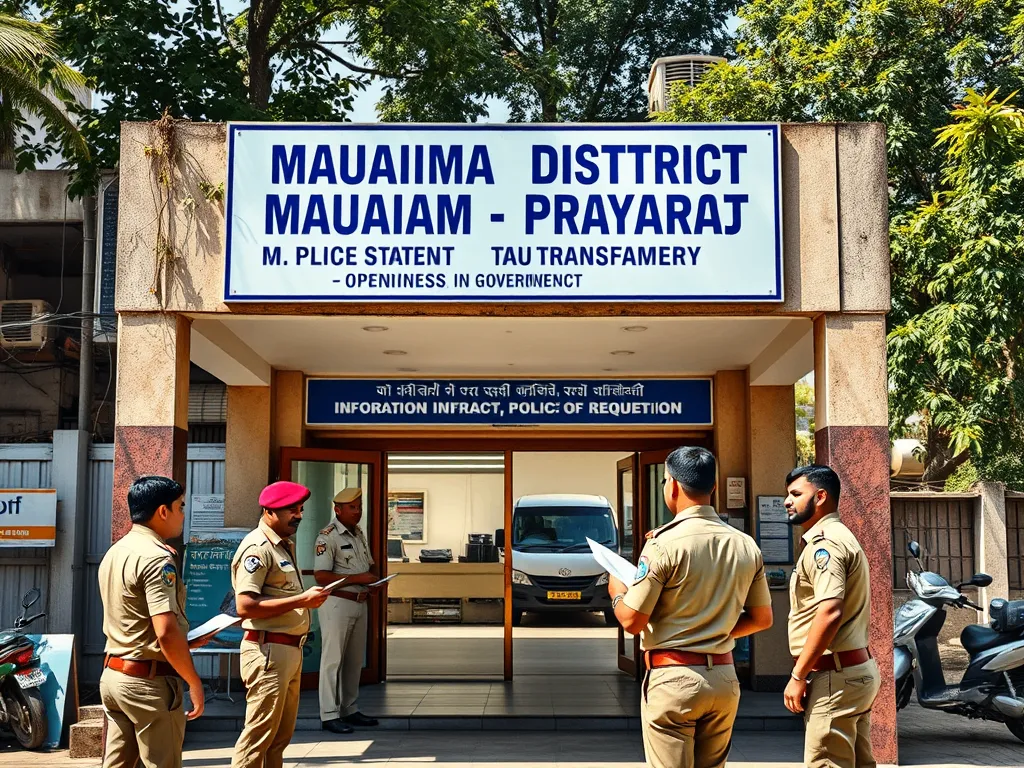
🚨 RTI Response Analysis: Mauaima Police Station, Prayagraj
Mauaima Police Station, Prayagraj, refused to provide any information to the information seeker. Consequently, the incident raises concerns about transparency and accountability at Mauaima Police Station, Prayagraj. Furthermore, the lack of responsiveness casts doubt on the department’s commitment to upholding the rights of citizens seeking access to information from Mauaima Police Station, Prayagraj. As a result, the Uttar Pradesh Information Commission is now considering this matter, and further deliberations will soon take place to ensure that justice prevails. Hopefully, the commission will facilitate a resolution that emphasises the importance of public access to information. In addition, this could encourage better practices among police stations across the state, especially at Mauaima Police Station Prayagraj.
Introduction
Shri Yogi M.P. Singh applied under the RTI Act, 2005, and requested details about operations, financial expenditure, and personnel postings specifically at Mauaima Police Station Prayagraj (Commissionerate). Subsequently, the Assistant Police Commissioner forwarded the request. However, the Police Station In-Charge’s report revealed significant gaps and administrative hurdles in providing data at Mauaima Police Station Prayagraj.
1. Partially Provided Information (Data Available)
The Police Station report provided concrete crime data for 2022-23 and addressed the first part of Query 1. Additionally, this response created an expectation of transparency.
Mauaima Police Station Prayagraj: Crime Statistics (FY 2022-23)
| Type of Case | Number Registered |
| FIRs (First Information Reports) | 681 |
| NCRs (Non-Cognizable Reports) | 131 |
| Preventive Cases (107/116/151 CrPC) | 744 |
However, the report does not include data for the current financial year.
2. Information Denied/Deferred (Citing Other Branches)
The applicant was told to approach other Police Commissionerate branches for key financial and administrative queries, since the local police station claimed it did not have the data readily available.
Queries Deferred to Other Branches
| Query No. | Subject | Police Station’s Response |
| 2 | Fuel Expenses (Diesel/Petrol) for FY 2019-20 to Current FY | “Information… is payable from the concerned branch (Transport Branch).” |
| 6 | Funds Spent on Painting/Whitewashing (Last 5 Years) | “Information… is payable from the concerned branch of the Police Commissioner. |
| 7 | Electricity Bill Funds/Expenditure (FY 2019-20 to Current FY) | “Information… is payable from the concerned branch of the Police Commissioner.” |
This response forces the applicant to chase multiple departments, against the intended spirit of a unified RTI process.
3. Information Vague (Citing Unclear Time Frame)
The police station rejected the request for personnel details, citing an unclear time frame, even though the queries were not ambiguous. Nevertheless, the applicant had specified clear information needs.
Queries Requiring Clarification on Time Frame
| Query No. | Subject | Police Station’s Response |
| 3 | Posting Details of Ongoing Station House Officer (SHO) | It is not clear from which year the applicant wants the appointment. |
| 4 | Posting Details of All Sub-Inspectors | It is not clear from which year the applicant wants information… |
| 5 | Posting Details of All Constables | It is not clear from which year the applicant wants information… |
| 8 | Action Taken Against Illegal Liquor Business/Narcotics FIRs | It is not clear from which year the applicant requires the information. |
Core Issue: The requests (3, 4, 5) ask for ongoing staff postings and their dates of joining in the district, which inherently cover their current status and a defined time frame. Requests for “action taken” (8) and crime data (1, second part) also lack a clear time frame in the response.
Conclusion: Next Steps Regarding Mauaima Police Station Prayagraj
Official documents show that much of the requested information is handled by other branches or was rejected due to an alleged unclear time frame.
To obtain the complete information, the applicant, Shri Yogi M.P. Singh, must consider the following next steps:
- File a First Appeal: Challenge the rejection of personnel details (Queries 3, 4, 5, and 8). Point out that “ongoing” staff refers to the current status. Argue that the lack of current financial year data for Query 1 is unacceptable.
- Redirect Financial Queries: File a new RTI for fuel expenses (Query 2), painting/whitewash funds (Query 6), and electricity bills (Query 7) to the Police Commissionerate’s Transport and Finance/Accounts branches.
That’s an insightful request. Focusing on the dates can often reveal delays, administrative timelines, and the context in which someone gathered and shared the information.
Here is an analysis of the key dates provided in your documents, structured to highlight the flow of the application and the response timeline:
📅 Timeline Analysis: RTI Application for Mauaima Police Station
| Date | Event/Document | Involved Parties | Notes on Significance |
| 17.12.2024 | Date of the Original RTI Application. | Shri Yogi M.P. Singh (Applicant) | This is the official start date of the 30-day window for the Public Information Officer (PIO) to respond. |
| 20.03.2025 | Reference to a letter (SSPPY/R/2023/60503). | Public Information Officer | This date, over 3 months after the application, indicates a significant initial delay in processing/forwarding the application. |
| 05.05.2025 | Reference to a subsequent letter. | Public Information Officer | Shows continued administrative action or follow-up over 4.5 months after the original application. |
| May 2025 | Date of the Covering Letter (Letter No: ST/ACPP/Public Information/2023). | Assistant Police Commissioner (ACPP), Phoolpur Commissionerate, Prayagraj | This is the date the PIO signed the letter forwarding the information to you. Note: It only specifies the month, but it references the subsequent report dates. |
| 10.05.2025 | Date of the Report to the ACPP. | Anurag Sharma, Inspector, PS Mauaima | This is the date the Mauaima Police Station prepared and signed the actual point-wise information/non-information report. |
| 12.05.2025 | Counter-signing of the Report. | Pankaj Awasthi, In-Charge Inspector, PS Mauaima | Final verification date by the in-charge inspector. This is the last date of creation for the response’s content. |
📌 Summary of Key Findings on Timeframe
- The RTI application was sent on 17.12.2024. The final report was signed on 12.05.2025—almost five months later. RTI law requires a reply in 30 days. This delay violates the law.
- The Police Station report (10.05.2025/12.05.2025) provided crime data for FY 2022-23 but omitted data for the current year. Given the May 2025 report date, missing FY 2025-26 data is a clear gap.
- Data Currency: The report, created in May 2025, contains data accurate to that date. It does not include updated information for the current financial year as of May 2025.
Actionable Point for the Appeal (Mauaima Police Station)
The delay is strong evidence for an appeal and possible penalties. In your First Appeal, highlight:
The RTI reply, dated 17.12.2024, took about 146 days, violating the 30-day limit in Section 7(1) of the RTI Act, 2005. This serious delay—alongside evasive, incomplete answers (e.g., failure to collect required information)—deserves investigation and action from the Appellate Authority.
I thoroughly reviewed the new document you provided, which records the subsequent steps taken by the authorities after your initial RTI application and the filing of a complaint/appeal before the State Information Commission (SIC).
The documents clearly show two main components:
- A letter dated December 30, 2024, from the Assistant Police Commissioner (Pankaj Lavaniya) to the State Information Commission (SIC)
- A Report from Mauaima Police Station (signed by Sub-Inspector Dheerendra Nath) to the Assistant Police Commissioner, entirely rejecting all 8 queries
- A Registered Post receipt confirming the sending of information to you on December 30, 20243333.
🛑 Critical Issue Analysis: Complete Rejection of RTI Queries
The new document completely overturns the earlier partial response and fully rejects all 8 RTI queries.
In the previous interaction, the police provided some data for Query 1 and deferred Queries 2, 6, and 7. In this new document, the Mauaima Police Station report explicitly states that all 8 queries are non-disclosable under specific clauses of the RTI Act:
1. Grounds for Total Rejection (Per Mauaima Police Report)
The Police Station report, dated around December 2024 (as referenced in the ACPP’s letter), rejects all 8 of your original queries using the following exemptions under the RTI Act, 2005:
| Query No. | Exemption Cited (RTI Act, 2005) | Nature of Rejection |
| Query 1 (FIR/NCR/Preventive Cases) (Mauaima Police Station) | Section $8(1)(H)$ 4 | Information that would impede the process of investigation or prosecution of offenders. |
| Queries 2-8 (Fuel, Postings, Funds, Illegal Liquor) | Section $8(1)(J)$ | Information that relates to personal information, the disclosure of which has no relationship to any public activity or interest, or which causes an unwarranted invasion of the individual’s privacy. |
2. Discrepancy and Legal Conflict
There is a direct and undeniable conflict between the two responses you received:
| Response Scenario | Crime Data (Query 1) | Personnel/Financial Data (Queries 2-8) |
| First Response (May 2025): | Provided detailed data for FY 2022-23 (681 FIRs, etc.). | Deferred the financial queries (2, 6, 7) and asked for clarification on the time frame for personnel queries (3, 4, 5, 8). |
| Second Response (Report dated Dec 2024): | Rejected completely using Section $8(1)(H)$ | Rejected completely using Section $8(1)(J)$ |
This total rejection is deeply questionable. Data like FIR counts and funds for painting or electricity are public records. They do not fall under the personal privacy exemption (Section 8(1)(J)).
3. The Context of the SIC Proceeding
The letter from the Assistant Police Commissioner (ACPP) Pankaj Lavaniya indicates that this information was prepared specifically for an ongoing legal proceeding:
- Complaint/Appeal: The ACPP refers to “Shikayat Sankhya S-10/A/0556/2024″8, meaning you have filed a complaint or appeal with the SIC.
- Hearing Date: The reply was prepared for filing before the SIC in Court No. S-10 on January 02, 20259.
- Designated Officer: Sub-Inspector Bhagwan Singh was nominated to attend the hearing and present the report10.
The ACPP claims that the information was prepared in accordance with the SIC’s order dated 29.12.2024 and sent to you via Registered Post on 29.12.2024 (the date on the receipt is 30.12.2024).
4. Immediate Action Required
The immediate focus should be on challenging this blanket rejection before the State Information Commission. This new document significantly strengthens your case.
You need to present the following argument to the SIC:
- Contradiction: Police gave crime data for 2022-23, then later rejected the same question using Section 8(1)(H). This inconsistency shows unreliable record-keeping.
- The claim that standard figures such as FIRs, NCRs, and expenses constitute personal information under Section 8(1)(J) is unacceptable and seeks to block the release of public data.
Present this entire document at your SIC hearing to show the Public Authority is willfully evading disclosure and blocking public information.
Use this email as a crucial submission for your Second Appeal before the SIC. It details repeated evasion and directly disputes the legal reasoning given for denial.
Below is a structured legal and administrative response for the SIC hearing on 11/09/2025, emphasising the key issues:
⚖️ Submission Analysis for Second Appeal (File No. S10/A/0556/2024)
I. Administrative and Procedural Violations (Mauaima Police Station)
The PIO’s 15 July 2025 response clearly violates procedures and administrative rules, making a strong case for non-compliance with the SIC’s earlier order.
1. Disregard of SIC’s Direction and Paperless Mandate (Mauaima Police Station)
- Non-Compliance with Order (Point 1): The Commission specifically directed the PIO to consider the objection raised by the appellant via an email representation dated 25.04.2025. Instead, the PIO issued a denial that lacked consideration and justification, directly disregarding the Honourable Commissioner’s order.
- Violation of Paperless Policy (Point 3): The PIO failed to use the official email for communicating the denial and instead dispatched it via Registered Post, which you received on 21/07/2025. This action is contrary to the spirit of the writ petition guidelines and the State Government’s directive to curb extra public burden by promoting paperless work.
2. Inconsistent and Evasive Responses (Points 2, 4)
The response is a mixture of partial disclosure and unjustified denial, creating confusion that the Commission must resolve:
| Query No. | Response Provided (15/07/2025) | Conflict/Legal Issue |
| 1 (FIR/NCR data) | Provides concrete figures for FY 2022-23 (681 FIRs, 131 NCRs, 744 preventive actions). | Conflict: This data was previously rejected in the December 2024 Police Station report (provided in your previous turn) using Section 8(1)(H), claiming it would impede the investigation. Providing the data now proves that the earlier $8(1)(H)$ claim was baseless. |
| 2 & 6 (Fuel/Painting Funds) | Defers the information: “The applicant should obtain it from the relevant branch (Transport Branch) of the Police Commissioner.” | Violation of PIO Duty: The PIO is obligated under Section 5(4) of the RTI Act to seek the assistance of any other officer (e.g., in the Transport or Finance Branch) within the same Public Authority (Commissionerate Prayagraj) to collect and furnish the information. The PIO cannot require the applicant to contact multiple branches. |
II. Invalid and Contradictory Use of Exemption Clauses (Mauaima Police Station)
Your submission correctly identifies the legal flaws in the PIO’s denial, particularly regarding the use of Section 8.
1. Misuse of Section 8(1)(J) for Financial Data (Points 7 & 8) (Mauaima Police Station)
- Queries 7 (Electricity Bills) & 8 (Illegal Liquor Action/FIRs): These are rejected under Section 8(1)(J) (Personal Information/Privacy).
- Legal Objection: Financial expenditure, such as electricity bills and funds spent on painting (Query 6), relates directly to the ‘public activity and interest’ of the Public Authority. The number of FIRs registered against illegal liquor is an operational metric and not personal information. Claiming that public expenditure figures or aggregated crime data constitute an “unwarranted invasion of privacy” is a frivolous and unsustainable use of the exemption.
2. Contradiction in Rejecting “Unclear” Queries (Point 5) (Mauaima Police Station)
- Queries 3, 4, and 5 were rejected because the PIO claims the details (e.g., posting year) are “not clear”.
- Legal Objection: Your submission correctly points out the contradiction: If the information is unclear, the PIO should seek clarification instead of automatically rejecting the request. More countries are seeking an exemption under Section 8(1) for Queries 7 and 8, while also stating that other queries (3, 4, and 5) are “unclear”. Claiming an exemption means the PIO knows what information the requester seeks and has decided it is exempt. Using both grounds—”unclear” and “exempt”—shows a clear intent to deny disclosure without proper legal justification.
3. Misuse of Section 8(1)(J) for Posting Details (Queries 3, 4, 5)
- While service details like place of posting and date of joining are generally considered public information for government employees (subject to case law), rejecting the entire request for the ongoing SHO and sub-inspectors under $8(1)(J)$ is often an attempt to hide official movements. The PIO should only withhold specific personal details (like PF/nominee information) and provide the rest.
III. Conclusion and Prayer to the Commission: Mauaima Police Station, Prayagraj
The PIO’s response demonstrates both procedural non-compliance with the SIC’s order and the malicious refusal to furnish non-exempt information by employing legally flawed justifications (Sections $8(1)(J)$ and $5(4)$).
Prayer: The appellant requests that the Honourable Commission
- Please direct the PIO to furnish the complete and correct information for all 8 points as soon as possible.
- Impose the maximum penalty under Section 20(1) of the RTI Act on the PIO/APIO/SHO for the continued failure to provide information and for providing an evasive, inconsistent, and legally flawed response, especially after the Commission’s intervention.
- Initiate Disciplinary Action under Section 20(2) against the concerned officers for deliberately misleading the Commission and obstructing the provision of public information.
Your submission has successfully documented the PIO’s lack of good faith for the SIC hearing on 11/09/2025.
Abhiraji Nishad: A Voice Against Illegal Alcohol in Naugaon
Related reading: ACP Manoj Kumar Singh: Service Details Revealed


Facing a similar challenge? Share the details in the box below, and our team of experts will do their best to help.