
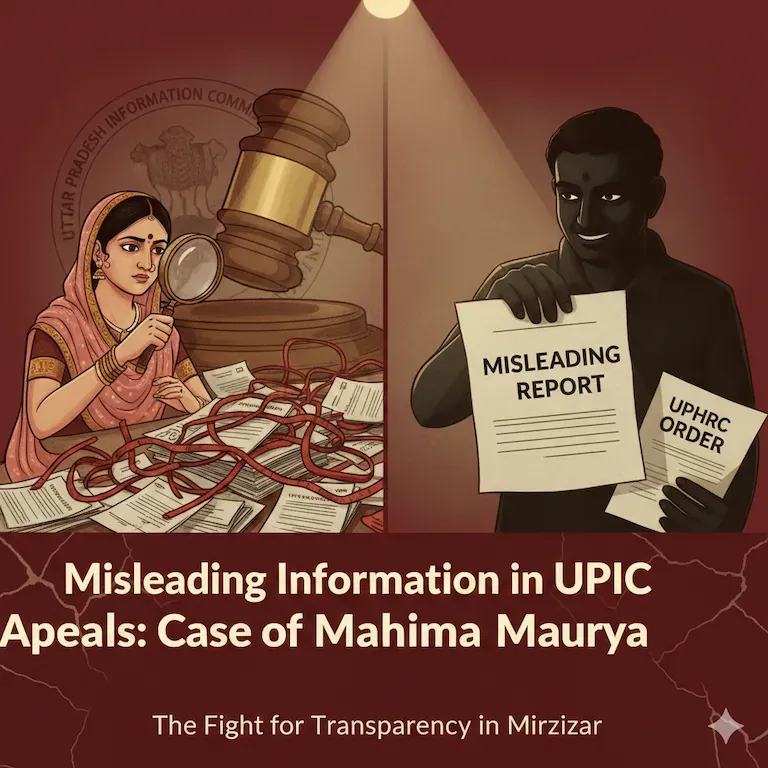
Key takeaways from this blog post are as follows
The case of Mahima Maurya vs. PIO Mirzapur highlights a critical friction point. This friction exists between citizen rights and administrative resistance. The situation is especially notable when it comes to misleading information in UPIC appeals. Here are the key takeaways from the analysis of the dispute:
1. The “Substitution” Tactic (Misleading Information in UPIC Appeals)
A primary issue in this case is the PIO’s alleged use of irrelevant documentation to answer specific queries. The PIO did not provide the action taken on the October 2024 Human Rights Commission order. Instead, the PIO provided a report related to a March 2025 Chief Minister’s office complaint. This “substitution” creates an illusion of compliance while leaving the original grievance unaddressed.
2. Digital vs. Physical Trail
The conflict highlights a disconnect in how government offices track correspondence:
- The PIO’s Claim: The order was received months later by a Head Constable in a physical “Camp Office.”
- The Appellant’s Rebuttal: UPHRC orders are transmitted digitally to a specific “Commission Cell.” It is crucial to identify the specific department or “cell” responsible for a file. This approach is more effective than simply asking for the department at large.
3. The “Right to Reason” as a Legal Shield (Misleading Information in UPIC Appeals)
The appellant successfully invoked the Right to Reason, a principle supported by the Supreme Court. It asserts that administrative bodies cannot simply say “no action taken”; they must provide the logical basis for that decision. In this case, providing a reason based on the wrong investigation constitutes a failure of this legal standard.
4. Accountability under Section 20
The blog post underscores the legal consequences for Public Information Officers who provide misleading data. Under the RTI Act, the Information Commission has the authority to:
- Impose financial penalties (up to ₹25,000).
- Recommend disciplinary action for undermining constitutional bodies like the Human Rights Commission. (Misleading Information in UPIC Appeals)
5. Systematic Obfuscation
The core takeaway is that “misleading information” is often more damaging than “delayed information.” It compels the applicant to go through a cycle of appeals and hearings. They must prove that the data provided is false. This process effectively exhausts the citizen’s resources and patience. (Misleading Information in UPIC Appeals)
This blog post explores the complexities of the Right to Information (RTI) process in India. It specifically focuses on the challenges of transparency within law enforcement agencies.
The Battle for Transparency: Analyzing the Case of Mahima Maurya vs. PIO Mirzapur
The Right to Information Act of 2005 was envisioned as the “sunlight” that would disinfect the corridors of Indian bureaucracy. However, many RTI activists and citizens find a challenge. Clear, honest information often hides behind a wall of obfuscation. The ongoing case of Mahima Maurya vs Public Information Officer (PIO), District Mirzapur, is under review. It is pending before the Uttar Pradesh Information Commission (UPIC). The text serves as a quintessential study of how people use misleading information as a shield to avoid accountability.
The Genesis: A Human Rights Mandate
The core of this dispute traces back to a directive from the Uttar Pradesh Human Rights Commission (UPHRC). In October 2024, the Commission (Diary No 4672/IN/2024) reviewed a complaint by Mahima Maurya. It directed the Superintendent of Police (SP), Mirzapur, to investigate the matter. The Commission instructed that they “do the needful in accordance with law” within six weeks.
The machinery of justice appeared to move slowly. It sometimes seemed not to move at all. In response, the complainant turned to the RTI Act to track the administrative progress of this specific order. The appellant alleges that the responses from the PIO were not only delayed. They claim the responses were also deliberately deceptive.
Misleading Information in UPIC Appeals: Information vs. Misdirection
The struggle in this case isn’t just about a lack of data. It is about the relevance and accuracy of the data provided. In RTI jurisprudence, providing “misleading” information is often considered a more serious breach. Such misinformation actively attempts to derail the quest for truth.
1. The Discrepancy in Documentation
The appellant sought details regarding the receipt of the UPHRC order dated 21/10/2024. The PIO responded that the order was received on 17/03/2025 by a Head Constable.
The appellant argues that this is a logical fallacy. In the digital age, we receive UPHRC orders online. A specific “Commission Cell” processes these orders.The PIO identified a staff member from the “Camp Office.” They also mentioned a date nearly five months after the order was issued. This has led to accusations of bypassing the actual digital trail. The PIO also allegedly overlooked the specific personnel, Ms Laxmi Devi and Mr Yogesh Kumar, who handle such files.
2. The “Wrong Report” Strategy
A common tactic is used to frustrate RTI applicants. This strategy involves the “document dump”—providing reports that look official but pertain to a different matter. (Misleading Information in UPIC Appeals)
- The Appellant’s Request: Seeking the action taken report on the UPHRC order from October 2024.
- The PIO’s Response: Provided a report from the Circle Officer City. This report was actually a response to a different communication from the Chief Minister’s office. The communication was dated March 2025.
The PIO substitutes one investigation for another. This action effectively leaves the specific UPHRC mandate unaddressed. On paper, the PIO appears to have complied with the information request.
The Administrative “Right to Reason” (Misleading Information in UPIC Appeals)
One of the most profound aspects of this case is the appellant’s invocation of the “Right to Reason.” As established by the Supreme Court of India, a sound administrative system must provide reasons for its actions—or inactions.
When the appellant asked why no action was taken on the specific UPHRC direction, the PIO had a response. The PIO claimed that an investigation found “no corroborative evidence.” The appellant questions this reasoning sharply. How can an investigation into a March 2025 CM office complaint serve as a valid reason for inaction? This is in relation to an October 2024 Human Rights Commission order.This highlights a systemic failure to treat distinct legal mandates with the individual attention they require.
Why This Matters: The Erosion of Constitutional Authority
When a Public Information Officer provides misleading data, the casualty is not just the individual applicant. The broader implications include: (Misleading Information in UPIC Appeals)
- Undermining Constitutional Bodies: The PIO fails to provide accurate tracking of a Human Rights Commission order. This action effectively undermines the authority of the UPHRC.
- Wasting Judicial Resources: The Uttar Pradesh Information Commission faces a challenge. Hon’ble Commissioner Madam Shakuntala Gautam leads this effort. They must now spend valuable court time (Court S-9) evaluating documents. The task involves separating relevant documents from decoys.
- Erosion of Public Trust: For a citizen like Mahima Maurya, the RTI is often the last resort. Administrative trickery blunts that tool and erodes trust in the rule of law.
Legal Recourse and the Role of the Information Commission (Misleading Information in UPIC Appeals)
Under Section 19(3) of the RTI Act, the Second Appeal is the final departmental stage for justice. The Information Commission has the power to:
- Impose Penalties: Under Section 20, a PIO can face fines up to ₹250 per day. The total can reach ₹25,000 for knowingly giving incorrect or misleading information.
- Recommend Disciplinary Action: Against officials who persistently defy the Act.
- Direct Compensatory Disclosure: Ordering the PIO to provide the correct specific documents requested.
The Way Forward
The case moves toward its next hearing on June 5, 2025. The focus will likely remain on the “Commission Cell” of the Mirzapur Police. The Commission must determine if the PIO’s office deliberately conflated two different complaints. These complaints are the UPHRC complaint and the CM office complaint. The intent was to hide a lack of progress on the human rights front.
For the RTI Act to remain a “vibrant” law, the Commission must ensure that “Information” has a broad meaning. It should not merely refer to “any piece of paper.” It must reflect the truthful account of government action.
Conclusion (Misleading Information in UPIC Appeals)
The case of Mahima Maurya is a stark reminder that the RTI is a marathon, not a sprint. It requires a citizen with an iron will to challenge the “misleading” narratives of powerful offices. As we await the Commission’s decision, one thing is clear. Transparency is not a favor that the state grants. It is a hard-won right that individuals must defend every time a PIO hits “send” on a misleading email.
To ensure your records are accurate for the upcoming hearing, we have organized the necessary information. Here is the contact and identification data for the three primary authorities involved in your case.
1. Uttar Pradesh Information Commission (UPIC)
This is the appellate body currently hearing your case (Appeal No. A-20250401121). (Misleading Information in UPIC Appeals)
| Detail | Information |
| Presiding Officer | Madam Shakuntala Gautam (Information Commissioner) |
| Court Room | S-9 |
| Office Address | 7/7A, RTI Bhawan, Vibhuti Khand, Gomti Nagar, Lucknow, UP |
| Official Website | upsic.up.gov.in |
| Hearing Email | hearingcourts9.upic@up.gov.in |
| Help Desk Phone | 0522-2724930 |
2. Public Information Officer (O/o Superintendent of Police, Mirzapur) (Misleading Information in UPIC Appeals)
This is the “Public Authority” you are accusing of providing misleading information.
| Detail | Information |
| PIO Name | Sri Omprakash Singh |
| Head of Office | Superintendent of Police (SP), Mirzapur |
| CUG Mobile No. | 9454400299 (Official SP Mirzapur Number) |
| Office Phone | 05442-252578 |
| Official Email | spmzr-up@nic.in (or sp-mzr@gmail.com) |
| Address | Police Office, Mirzapur, Uttar Pradesh – 231001 |
3. Uttar Pradesh Human Rights Commission (UPHRC)
This is the authority whose order (Case No. 14054/24/55/2024) was allegedly ignored or misleadingly reported.
| Detail | Information |
| Complaint Diary No. | 4672/IN/2024 |
| Office Address | 609, Krishna Fort Apartment, Faizabad Road, Lucknow – 226010 |
| Contact Number | 9454003726 |
| Official Email | admin@hrcup.org |
| Complain Status | hrcup.org/contact |
Summary of Key Application IDs (Misleading Information in UPIC Appeals)
Keep these numbers ready for every communication to avoid confusion:
- Appeal Registration No: A-20250401121
- UPIC File No: S09/A/0666/2025
- UPHRC Case No: 14054/24/55/2024
- UPIC Diary No: D-250720250014
Would you like me to draft a formal letter to the SP Mirzapur’s office? I will request the specific logs from the “Commission Cell” mentioned in your appeal.


Facing a similar challenge? Share the details in the box below, and our team of experts will do their best to help.