
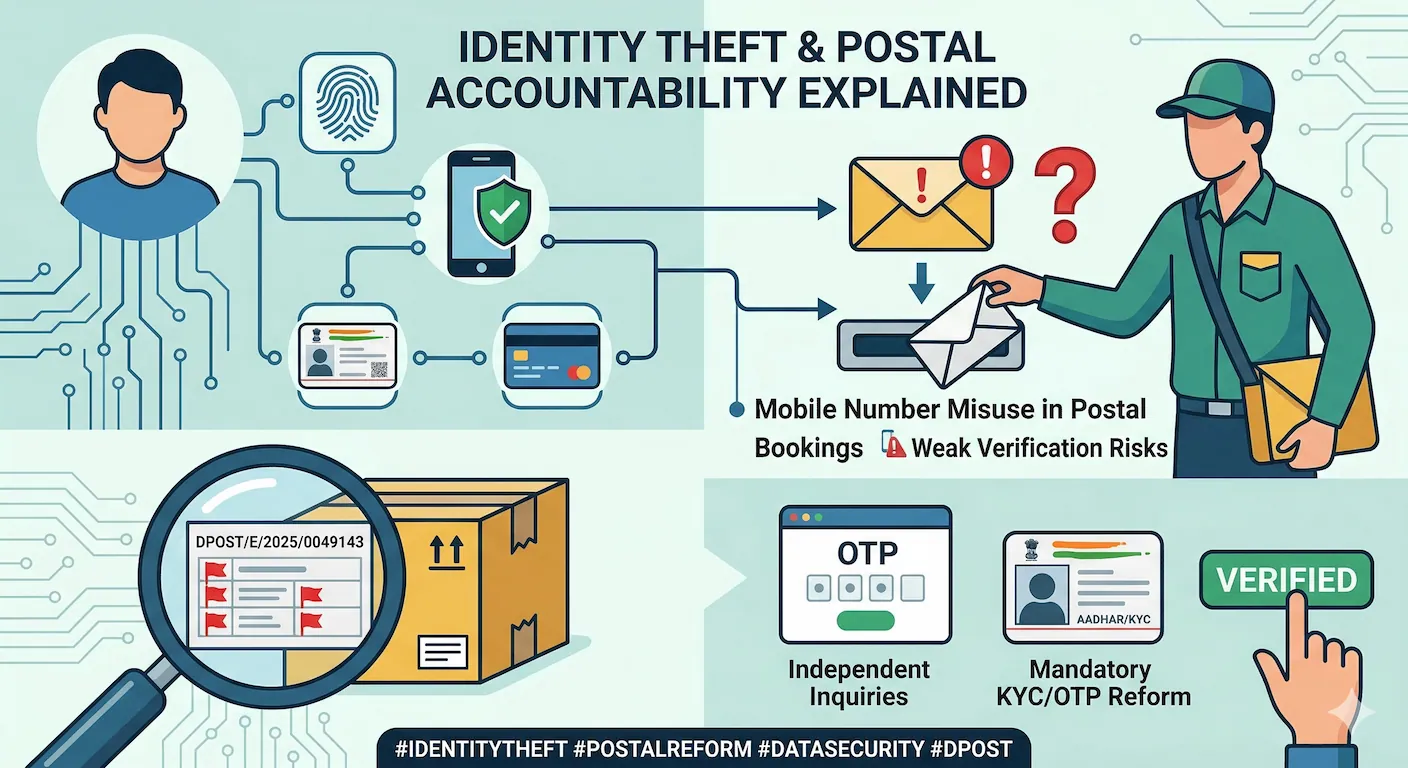
Key Takeaways (Identity Theft & Postal Accountability)
- The misuse of my mobile number in postal transactions raises serious concerns about identity theft and data security.
- Repeated grievances highlight a systemic failure in postal identity verification processes and the negligence of postal authorities.
- Officials have evaded responsibility, leading to inadequate responses that fail to address identity fraud concerns.
- Demand for immediate disclosure of sender and receiver information aims to facilitate legal action and accountability.
- Reforms are necessary to implement mobile number verification and proper KYC practices in postal services to protect personal data.
📢 Identity Theft & Postal Accountability: The Case of the Misused Mobile Number (A Deep Dive into $\text{DPOST/E/2025/0049143}$)
By Yogi M. P. Singh, Date: November 16, 2025. This article will explore important topics around Identity Theft & Postal Accountability.
I. The Core Crisis: When Your Identity Becomes a Postal Commodity
The saga unfolds across three successive grievances: $text{DPOST/E/2025/0046033}$, $text{DPOST/E/2025/0047546}$, and now $text{DPOST/E/2025/0049143}$. It is not merely a complaint about a postal error. It is a critical confrontation with the fundamental integrity of personal data security within a government service. At the heart of this issue is the unauthorised and fraudulent use of my private mobile number ($text{7379105911}$). This use could potentially be criminal. It occurs on official India Post articles booked at the Chunar Sub Post Office ($text{231304}$).
For weeks, I have received tracking and delivery SMS notifications for articles ($ ext{EU536417769IN}$, $ ext{EU536417928IN}$, $ ext{EU536417914IN}$). I have absolutely no connection with these articles. Someone falsely recorded my number as the sender’s contact. This is not a simple administrative mistake. It is an act of cheating by personation. The postal booking process systematically fails, exacerbating this issue. Bank accounts, Aadhar cards, and nearly every digital identity link to mobile numbers. Using this primary identifier fraudulently for legal or official transactions is a serious threat to my personal security. This situation opens the door to potential financial fraud. Fraudulently co-opting this primary identifier for legal or official transactions poses a serious threat to my personal security. It can also lead to potential financial fraud.
This situation holds immense gravity. If any individual, unknown to me, can walk into a post office and use my personal mobile number to book parcels,
2 security compromised (Identity Theft & Postal Accountability)
It means security is compromised. Security is compromised if any unknown individual uses my personal mobile number. The Department of Posts officially validates and logs this transaction. An unknown individual using my mobile number to book parcels exposes a security vulnerability. This transaction should be officially validated and logged by the Department of Posts. This framework underpins the postal system. The Department of Posts is an essential wing of the government. It must operate with the highest levels of transparency. Security is particularly important concerning identity management. The failure to do so, as demonstrated in this case, creates an environment where illegal practices can thrive.
II. The Escalation of Evasion: A Pattern of Non-Response (Identity Theft & Postal Accountability)
The most troubling aspect of this entire process is the consistent, deliberate evasion exhibited by the concerned postal authorities. My initial grievance was crystal clear. The issue was the misuse of the mobile number. It was not the delivery status of the parcels.
A. The First Irrelevant Closure ($\text{DPOST/E/2025/0046033}$) (Identity Theft & Postal Accountability)
The first closure report completely ignored the identity fraud. It stated only that the articles “had been delivered to the DPRO (District Public Relations Officer) on $text{28.10.2025}$.” This was profoundly unhelpful and demonstrated a failure to read, comprehend, or seriously investigate the complaint. It treated a critical identity security breach as a routine delivery query.
B. The Second Evasive Closure ($\text{DPOST/E/2025/0047546}$)
The response on 12/11/2025 from J. M. Pandey, Assistant Director of Postal Services, Postmaster General Allahabad, was even more disheartening. The final remark stated: “Sir, we inform you that the sender submitted the same number to the booking office. We did not add any additional numbers from our side.” (Identity Theft & Postal Accountability)
This is not a justification; it is an admission of failure. It confirms that they recorded my number.. The officer essentially washes his hands of the responsibility. He states that the staff merely recorded what was provided. This response not only avoids the core question but also actively justifies a dangerous and negligent operational practice:
- The booking staff at Chunar SO accepted a mobile number without any verification. This lack of verification included not using OTP validation or conducting a KYC check. Additionally, there was no simple request for proof of identity from the person presenting the parcel.
- The Department appears to protect the identity of the fraudulent sender. They closed the case with a remark that shields this information. As a result, it becomes impossible for the victim, including myself, to file a legal FIR. This hinders any pursuit of justice.
The concerned officer, J. M. Pandey, failed to address the substance of the complaint. Instead, he submitted a report that confirms a failure of internal controls. He also prematurely closed a case of alleged fraud. This situation demands a separate inquiry into his conduct.
III. Escalation to the Highest Level: The Non-Negotiable Demands
Having exhausted the channels at the local and regional levels, I have faced two inadequate closures. The third grievance, identified as $text{DPOST/E/2025/0049143}$, is an urgent appeal. The highest possible authority, ADG PG Shri Rupesh Pal in New Delhi, has escalated the situation. I hope he recognises the gravity of it.
This latest submission is not a request. It is a set of specific and non-negotiable demands. These demands are necessary to address the crime committed against me. They are also essential to restore confidence in the Department’s processes.
1. Immediate Disclosure of Sender/Receiver Details (Identity Theft & Postal Accountability)
The most immediate and critical demand is the release of the full identifying details of the parties involved:
- The Sender’s full name, complete physical address, and any other contact details recorded during the booking process.
- The details of the Receiver ($\text{DPRO}$ details) served as the destination.
This information is not for departmental curiosity. As a victim of identity theft, I must file a formal Police Complaint (FIR).This filing initiates a criminal investigation. By withholding these details, the Department is effectively obstructing justice. This action is perpetuating the identity fraud.
2. Initiate Independent and Impartial Inquiry (Identity Theft & Postal Accountability)
A departmental inquiry must move beyond the perfunctory and non-responsive level of $\text{J. M. Pandey $. A high-level, impartial probe must investigate two distinct areas:
- The Chunar SO Staff needs to determine the specific protocol violation. The negligence that facilitated the fraud permitted the system to accept and log a non-sender’s number without verification. We must assign accountability for this lapse.
- The Conduct of Supervising Officers: Take action against officers like J. M. Pandey for their apparent professional misconduct in mismanaging and unjustly closing a serious complaint about fraud and identity theft. Their actions have directly exacerbated the issue.
3. Mandate Policy Reform and Verification (Identity Theft & Postal Accountability)
The current system has significant flaws. An officer can admit that they merely record “the number provided by the sender.”This practice fundamentally breaks the law in the context of modern data protection and identity laws. The Department of Posts must implement immediate and mandatory policy reforms:
- Mobile Number: Verify all mobile numbers provided during the booking. This includes trackable articles like Speed Post and Registered Post. Use a standard mechanism to verify these numbers, such as sending a One-Time Password (OTP) to the provided number. You cannot finalise the transaction until this verification is complete.
- KYC Linkage: Explore integrating the booking process with basic $ ext{KYC}$ documents. Use documents like Aadhar for high-value or frequent consignments. This will ensure sender authenticity.
IV. Conclusion: Upholding Law in a Digital Age
The Department of Posts’ continuous and cryptic denial of accountability raises concern. They fail to uphold their duty in a law-abiding country. The simple act of delivery does not, and cannot, negate the fact of a fraudulent booking based on identity misuse. (Identity Theft & Postal Accountability)
This matter transcends a single complaint; it highlights a severe vulnerability in a vital public service. I demand that Shri Rupesh Pal and the highest echelon of the Department of Posts recognize the seriousness of $text{DPOST/E/2025/0049143}$. They must take immediate, concrete action to rectify the injustice done to me. This action will ensure the integrity and security of the postal booking system for all citizens. The failure to do so will solidify the impression that the Department itself is promoting or enabling illegal practices.
WITH REGARD, (Identity Theft & Postal Accountability)


Facing a similar challenge? Share the details in the box below, and our team of experts will do their best to help.