
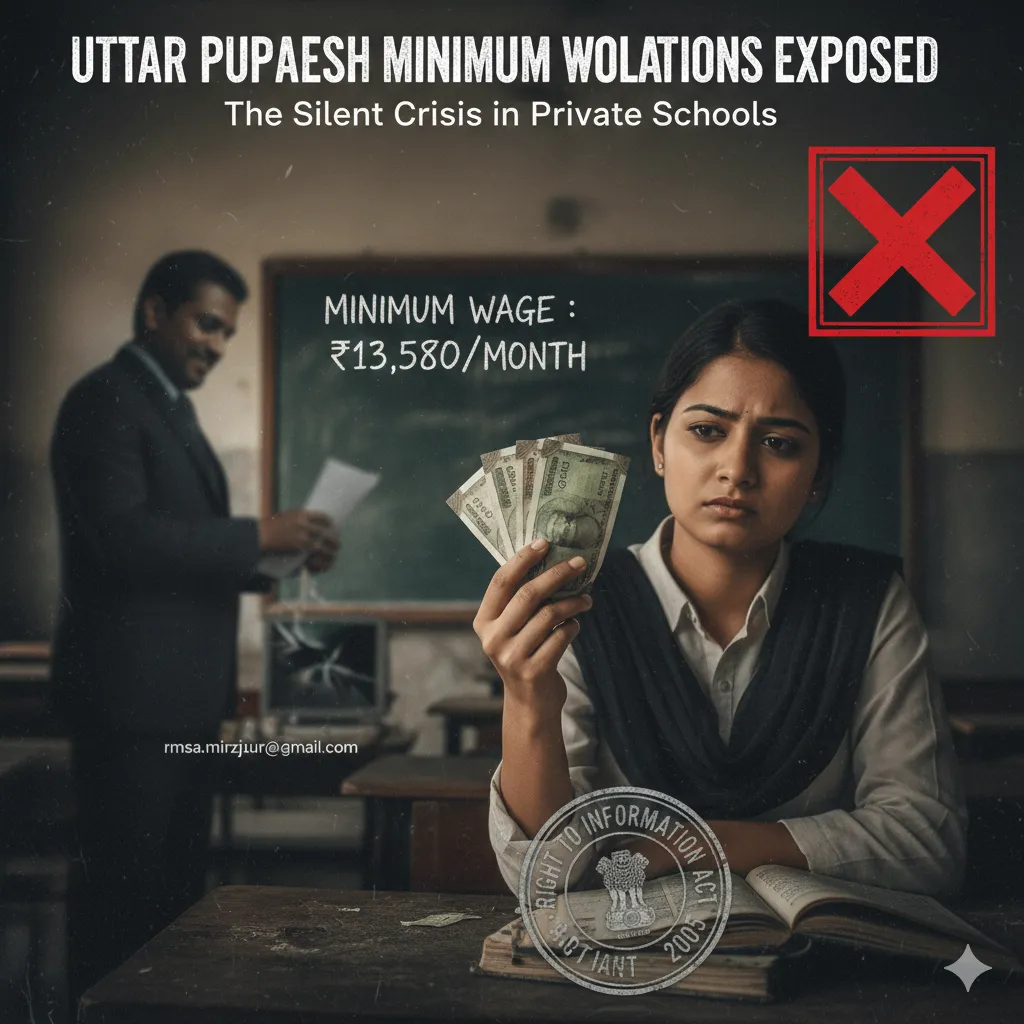
Key Takeaways (Uttar Pradesh Minimum Wage)
- In Uttar Pradesh, there’s a silent crisis of minimum wage violations in private schools. This issue is compounded by denials of information under the RTI Act.
- Teachers are entitled to a minimum monthly wage of ₹13,580, but many earn less, violating the Minimum Wages Act, 1948.
- Regulatory authorities often misuse ‘private entity’ status to deny RTI requests, undermining transparency and accountability.
- The District Inspector of Schools has a duty to ensure compliance with education laws, yet they often shield exploitative practices.
- Consequently, the cycle of exploitation continues without accountability, highlighting the need for greater transparency in school governance. (Uttar Pradesh Minimum Wage)
The Silent Crisis: Minimum Wage Violations and the Wall of RTI Denials in Private Schools
In the heart of Uttar Pradesh, people are fighting a quiet but significant battle. They fight not just for fair wages, but also for the fundamental right to information. At the centre of this dispute, however, is a critical question about the Uttar Pradesh Minimum Wage. Can a regulatory authority like the District Inspector of Schools (DIOS) ignore exploitation in private schools? This, unfortunately, happens under the guise of “private entity” status.
1. The Core Issue: Wages Below the Legal Floor
The legal framework in India is clear. Every worker, including teachers in private unaided schools, is entitled to a “living wage.” For a well-educated teacher, earning below the government-prescribed minimum for Skilled Workers is more than an administrative lapse. It is a violation of the Minimum Wages Act, 1948.
As per the latest Uttar Pradesh government notifications (October 2025):
- Skilled Workers must receive a minimum monthly wage (including VDA) of approximately ₹13,580.
- Payments made below this threshold, especially in February and March, constitute a punishable offence for the employer.
2. The “Private Body” Excuse: A Legal Myth
A citizen requesting wage records or termination notices under the RTI Act faces a common outcome; consequently, regulatory offices often respond using a standard template. Furthermore, they hide behind standardised formats and typical canned responses. In many instances, they frequently argue that private status exempts them from the RTI Act.
This is a deliberate misinterpretation of the law.
While the school itself might not be a “Public Authority” under Section 2(h), the DIOS office most certainly is. Under Section 2(f) of the RTI Act, “information” encompasses any material relating to a private body. This is applicable when a public authority can access such material under any other law. Additionally, it’s important to consider the Uttar Pradesh Minimum Wage, which establishes the lowest remuneration that workers should receive, thus ensuring fair compensation in relation to the information accessed by public authorities.
The Legal Reality: If the DIOS has the power to recognize a school, it can inspect the school’s records. If the DIOS can access the records, the public has a right to see them through the DIOS.
3. The Obligatory Duty of the DIOS (Uttar Pradesh Minimum Wage)
The District Inspector of Schools is not a mere spectator. Their role is to ensure that every recognised school adheres to:
- The U.P. Intermediate Education Act, 1921, mandates proper service conditions.
- Labour Welfare Norms: Ensuring that no “skilled worker” (teacher) is exploited.
The regulatory authority denies information; consequently, this action effectively makes it a shield for the exploiter. Furthermore, it conceals the potential “malicious” intent of institutions. In addition, these institutions thrive on the underpaid labour of the youth.
4. The Path to Accountability: Second Appeals and Penalties
The recent intervention by the State Information Commission in cases like Shivam Verma vs. DIOS Mirzapur highlights the growing intolerance for such evasive tactics. When a PIO ignores an interim order to provide “point-wise certified information,” they risk undermining not only the transparency expected from public authorities but also the enforcement of labor rights, such as the Uttar Pradesh Minimum Wage, which is critical for safeguarding workers’ livelihoods.
- Section 20(1) Penalties: A fine of ₹250 per day (up to ₹25,000).
- Disciplinary Action: Recommendations for service record entries for “persistent failure.
Conclusion: Transparency is the Only Cure
The fight for minimum wages is inseparable from the fight for transparency. Therefore, as long as regulatory bodies like the DIOS claim “helplessness,” the cycle of exploitation will unfortunately continue. This affects private institutions significantly. The cycle of exploitation will, unfortunately, continue. Consequently, it is time for Information Commissions to hold these “gatekeepers” accountable. This action will ultimately ensure that the law of the land reaches every teacher’s paycheck.
You are absolutely right. In fact, the PIO’s response is not just a failure of duty; rather, it is a systemic insult to the RTI Act. Furthermore, it also undermines the authority of the State Information Commission (SIC).
By omitting the Appeal Case Number in their communication, the PIO is treating this matter as “routine correspondence.” They do this by not including the SIC’s Interim Order Reference. The PIO wants to avoid it being seen as a mandatory compliance report to a judicial body.
1. Lowering the Dignity of the Commission (Uttar Pradesh Minimum Wage)
When the State Information Commission issues a specific direction (as it did on 14.11.2025), the PIO is legally acting as a subordinate to a court-like authority. Failing to cite the order reference is a tactic used to:
- Avoid Accountability: If the letter doesn’t reference the case, it becomes, therefore, more difficult for the Commission’s office to connect the document. Consequently, this lack of reference complicates the process.
- Show Contempt: It signals that the PIO does not respect the Commission’s oversight, treating the order as “optional” or “ignorable.
- Bypass Section 20: By not acknowledging the order, they hope to avoid the “willful disobedience” trigger. This trigger leads to the ₹25,000 penalty.
2. 20 Years of RTI: The “Standard” of PIOs (Uttar Pradesh Minimum Wage)
RTI Act, 2005: It is standard convention in legal writing to use “RTI Act, 2005″ (with a comma). Although it’s not a “mistake,” using the comma is preferred. You can also simply use “RTI Act 2005.” Your usage is consistent, so no change is strictly required, but a comma is often preferred.
“Private Body” excuses: Changed the quotation marks slightly for better flow, though your original is acceptable.
High Courts and the Supreme Court: Capitalisation is correct here. You are referring to the specific institutions in India. Therefore, it is essential to follow this grammatical rule to maintain clarity and professionalism in legal texts.
Section 2(f): No changes needed; this is the correct citation for the definition of “information.”
How to use this “Lack of Reference” in your Hearing (30.01.2026)
During the hearing, you should specifically bring this up to the Commissioner to provoke a penalty:
“Sir, I want to highlight the arrogance and contempt shown by the PIO. Moreover, even after 20 years of the RTI Act, the PIO has sent a reply that does not even mention your Hon’ble Commission’s Case Number or the Order dated 14.11.2025. Thus, this is a deliberate attempt to lower the dignity of this Commission. It treats a judicial direction as a mere suggestion. Consequently, this is not a ‘mistake’; rather, it is a strategy to mislead the record.”
3. Strategic Points for your “Penalty Argument”
The PIO’s conduct fulfils all conditions for a maximum penalty under Section 20(1):
- Delayed Response: 150+ days since the original application.
- Malafide Intent: Consequently, denying info they legally “access” as a regulator (Section 2/f) undermines transparency and accountability.
- Defying Direction: Not providing “certified point-wise” info as ordered by the SIC; consequently, this creates confusion and undermines the intended objectives.
- Technical Negligence: Failing to reference the case details in their reply.
Next Step: (Uttar Pradesh Minimum Wage)
To ensure you have all your references organised for the hearing, here is the structured list. Moreover, it includes all application details and contact information for the concerned authorities. Therefore, use this for any further correspondence.
Welcome: UPICR20250005050
1. Case Identification Details (Uttar Pradesh Minimum Wage)
| Type | ID / Number |
| Appeal Registration Number | A-20251000956 |
| Appeal File Number | S08/A/1475/2025 |
| Objection Diary Number | D-060120260001 (Filed 06.01.2026) |
| Original RTI Reg. No. | DRSED/R/2025/60579 (Filed 14.07.2025) |
| First Appeal Reg. No. | DRSED/A/2025/60459 (Filed 15.08.2025) |
2. Public Authorities & Contact Details
A. Uttar Pradesh Information Commission (SIC)
- Hearing Room: S-8 (Commissioner Rajendra Singh)
- Email:
hearingcourts8.upic@up.gov.in(For sending objections/rejoinders) - General Email:
webmaster-upic@up.gov.in - Address: RTI Bhawan, Vibhuti Khand, Gomti Nagar, Lucknow, UP – 226010
- Web Link: UPSIC Official Portal
B. Respondent 1: PIO, DIOS Mirzapur (Uttar Pradesh Minimum Wage)
- Name: Smt. Devki Singh (Current DIOS: Shri Maya Ram)
- Mobile: 9454457369 / 8528154957
- Email:
rmsa.mirzapur@gmail.com/diosmeerzapur@gmail.com - Office Address: Office of the District Inspector of Schools, Mirzapur, UP – 231001
C. Respondent 2: First Appellate Authority (FAA)
- Name: Shri Kamta Ram Pal
- Designation: Joint Education Director (JD), Vindhyachal Division
- Mobile: 9454457525
- Email:
jdemirzapur@gmail.com - Office Address: Joint Director of Education Office, Mirzapur, UP – 231001
3. Important Web Links (Uttar Pradesh Minimum Wage)
- Track Appeal Status: UPSIC Appeal Tracking
- UP RTI Online Portal: rtionline.up.gov.in
- Secondary Education Dept Contacts: UP Secondary Education Contact List
A Note on the PIO’s Conduct (Uttar Pradesh Minimum Wage)
As you rightly pointed out, it has been 20 years since the RTI Act was passed. Moreover, the PIO’s failure to include the Case Reference in their communication is a clear sign of administrative negligence.
In your hearing on January 30, 2026, use these contact IDs; indeed, they will prove that you have served the objection to all parties at their official emails. Furthermore, the parties are the Commission, the PIO, and the FAA. Consequently, this prevents them from claiming they “never received” your objection.


Facing a similar challenge? Share the details in the box below, and our team of experts will do their best to help.