
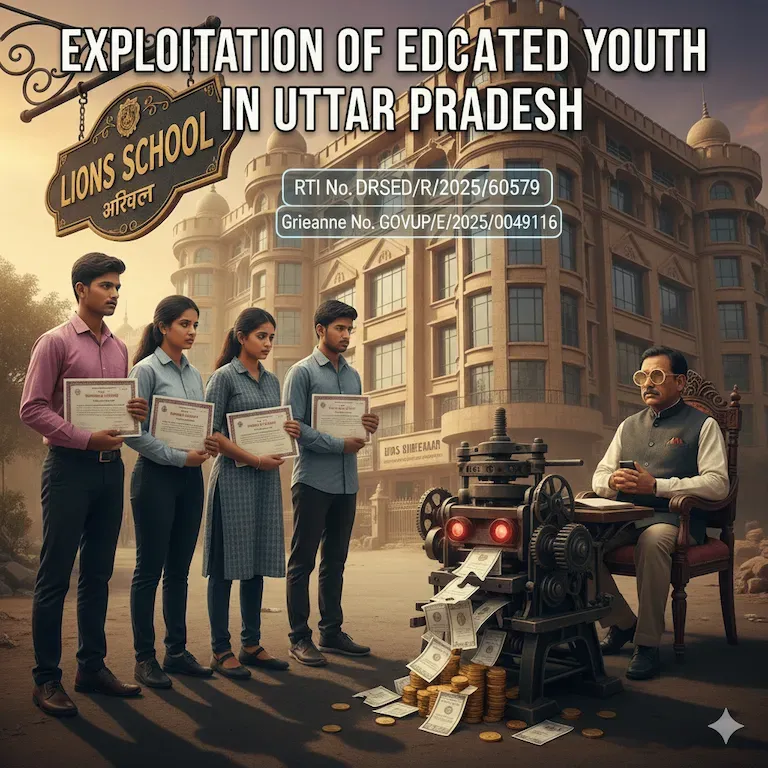
The blog post serves as a sharp critique of the educational landscape in Mirzapur. It highlights a systemic disconnect between high institutional revenue and low teacher compensation. The exploitation of educated youth is a particular concern addressed in this context.
Here are the key takeaways:
1. Systematic Wage Exploitation (Exploitation of Educated Youth)
- The Minimum Wage Gap: Despite being highly educated and teaching in English-medium settings, teachers are reportedly being paid less than the Uttar Pradesh government’s mandated minimum wage for skilled laborers (approx. ₹11,300/month).
- “Money-Minting” Nature: Private institutions are accused of collecting high tuition and admission fees from parents. They do not pass on fair wages to their staff.
2. Administrative Negligence
- The “Mute Spectator”: The District Inspector of Schools (DIOS) Mirzapur is criticized for failing to monitor these institutions. The inspector also fails to enforce labor laws. This oversight effectively allows the exploitation to continue unchecked.
- Lack of Grievance Redressal: The post highlights the administration’s failure to act on formal complaints. These include grievances such as GOVUP/E/2025/0049116. This inaction necessitates the use of RTI for transparency.
3. Violation of Labor Rights and Due Process
- Arbitrary Dismissals: Educators who demand fair pay face “vengeance.” They experience immediate termination without notice or formal inquiry. This was seen in the case of Shivam Verma.
- Defiance of State Mandates: These institutions are allegedly operating in direct defiance of Chief Minister Yogi Adityanath’s warnings. These warnings concern staff treatment and fee regulation.
4. Impact on the Community
- Dual Exploitation: The current system exploits both the educated youth (through underpayment) and parents (through excessive fees).
- Quality of Education: The post argues that the devaluation of teachers is detrimental. It inevitably leads to a decline in the quality of education provided to students.
5. Demands for Accountability in Exploitation of Educated Youth
- The RTI seeks specific evidence of:
- The identity of officials who ignored prior grievances.
- Documentary proof (or lack thereof) of minimum wage compliance.
- The legal mechanism to provide arrears to underpaid staff.
The Silent Crisis: How “Money-Minting” Schools Exploit Educated Youth in Mirzapur
The dream of a “New Uttar Pradesh” is built on the shoulders of its educated youth. Yet, in the heart of Mirzapur, a disturbing reality persists. Highly qualified teachers face treatment as cheap labour by private educational institutions. Schools collect exorbitant tuition and admission fees from parents. Meanwhile, educators—those responsible for shaping the next generation—are often paid less than the government-mandated minimum wage for skilled workers. The exploitation of educated youth is at the core of this issue.
A “Mute Spectator”: The Role of the DIOS Mirzapur in Exploitation of Educated Youth
The District Inspector of Schools (DIOS) is the primary regulatory authority. They ensure that schools operate within the framework of the law. However, the case of Shivam Verma vs. The Secondary Education Directorate (RTI Registration: DRSED/R/2025/60579) suggests a systemic lapse in oversight.
Regulatory bodies like the DIOS Mirzapur remain silent in the face of labour violations. By doing so, they become “mute spectators” to what amounts to exploitation of Mirzapur’s educated youth. The RTI filed against PIO Devki Singh and Nodal Officer Ajay Kumar Singh demands accountability. A grievance seems to have disappeared into the corridors of bureaucracy.
The Case of Lions School: A Microcosm of Exploitation
The focus of this specific struggle is Lions School, Bhujwa Ki Chowki, Lohandi Kala. The Chief Minister Yogi Adityanath has issued strict warnings regarding the fair treatment of staff. Still, the regulation of school fees remains unaddressed. The ground reality remains grim. It demonstrates further exploitation of the educated youth trying to make a living in teaching.
1. The Minimum Wage Mockery in Exploitation of Educated Youth
Government norms are not suggestions; they are mandates. According to the RTI documentation, bank statements reveal salary payments of ₹11,328 for February. They reveal payments of ₹11,308 for March. For a teacher instructing English medium students, these figures fall below the prescribed minimum wage. This minimum wage is for skilled workers in Uttar Pradesh.
When institutions “float the norms,” they aren’t just saving money; they are devaluing the very concept of education. This is a clear case of exploitation directed at the youth who are highly educated and dedicated.
2. Arbitrary Dismissal and “Vengeance”
The pursuit of dignity often comes at a high price. On April 19, 2025, Shivam Verma was allegedly dismissed without notice or a proper enquiry. Why? Because he dared to demand the minimum wages he was legally entitled to. This “arbitrary expulsion” serves as a warning to other teachers: stay silent, or stay unemployed. Such incidents contribute to the ongoing exploitation faced by educated youth in the region.
The Core Demands for Transparency
The RTI request filed on July 14, 2025, isn’t just a request for papers; it is a demand for justice. The five key points of inquiry highlight the depth of the issue. They expose how the exploitation of educated youth has wider implications for society.
- Accountability for Grievances: Who processed the initial complaint (GOVUP/E/2025/0049116), and what is their professional history?
- Proof of Compliance: Where are the documents? They should prove that an educated teacher received at least the basic minimum wage of a labourer.
- Due Process: Where is the evidence of the notice served before the expulsion?
- The Wage Gap: Why is a teacher at a high-fee institution being paid less than the state-mandated minimum for skilled labour?
- Compensation Mechanisms: What is the government’s plan to ensure arrears are paid to those cheated by these institutions?
The Economic Burden on Parents vs. Teacher Poverty
There is a cruel irony at play. Parents in Mirzapur are under a “huge burden” due to rising admission fees. They believe their hard-earned money is being used to provide top-tier education. In reality, a significant portion of that money is used for institutional profit. It appears as “money minting.” This money does not reach the salaries of the people actually doing the teaching. The exploitation suffered by educated youth is deeply tied to teacher poverty.
When a teacher is underpaid and stressed, the quality of education inevitably suffers. The exploitation of the teacher is, by extension, the exploitation of the student. It also reflects wider issues about youth who are educated yet exploited for their skills.
Conclusion: A Call for Administrative Intervention
The state government must move beyond warnings and initiate strict audits of private school payrolls. The DIOS office must enforce the law. If they cannot, or will not, the “unemployed youth” of Uttar Pradesh will remain a pool of cheap labour. Private interests continue to exploit this resource. This perpetuates the cycle of exploitation for the educated youth.
The case of Shivam Verma is not an isolated incident. It is a bellwether for the state of education in Mirzapur. The Secondary Education Directorate must prove that the law applies to everyone. This includes the powerful managements of private schools.
How You Can Help in Exploitation of Educated Youth
Transparency is the first step toward reform. If you are a teacher in Mirzapur facing similar issues, you should ask questions. If you are a parent concerned about where your fees are going, it is time to ask questions. By standing together, we can push back against the exploitation that educated youth face in this system.
Key Takeaways
- The educational landscape in Mirzapur exhibits a stark disconnect. Institutions generate high revenue, yet teachers receive low compensation. This situation illustrates the exploitation of educated youth.
- Many teachers earn less than the mandated minimum wage despite their qualifications, as private institutions prioritise profit over fair pay.
- The District Inspector of Schools is failing to enforce labour laws, allowing unchecked exploitation and a lack of grievance redressal.
- Teachers face arbitrary dismissals when demanding fair wages, perpetuating a culture of fear and compliance in the sector.
- The exploitation of teachers compromises the quality of education, ultimately impacting both students and their families financially.
To help you track your case, I have compiled the official contact information. If necessary, you can escalate the matter using these details. The compilation is based on your RTI and grievance registration.
1. Primary Case References
These are the IDs you must quote in all future correspondence:
- RTI Registration Number:
DRSED/R/2025/60579(Filed: 14/07/2025) - RTI Appeal Number:
DRSED/A/2025/60459(Filed: 15/08/2025) - Grievance Registration Number:
GOVUP/E/2025/0049116(Filed: 12/05/2025)
2. Concerned Public Authorities (Mirzapur District)
The following officials are legally responsible for processing your requests and monitoring the institution (Lions School):
| Role | Name | Mobile/CUG | Email Address |
| PIO / DIOS Mirzapur | Devki Singh | 9454457369 / 9026522034 | rmsa.mirzapur@gmail.com |
| First Appellate Authority | Kamta Ram Pal | 9454457525 | jdemirzapur@gmail.com |
| Nodal Officer (Secondary) | Ajay Kumar Singh | 9026522034 | admadhyamik@gmail.com |
| Joint Director (Education) | Kamta Ram Pal | 05442-266144 | jdemirzapur@gmail.com |
3. State-Level Oversight Authorities (Lucknow/Prayagraj)
If the district authorities remain “mute spectators,” you can escalate to these offices:
- Chief Minister’s Helpline: Dial 1076 (Available 24/7 for grievance tracking).
- Secondary Education Directorate: * Email:
desecedu@gmail.com- Phone: 0522-2239006
- UP Madhyamik Shiksha Parishad (UPMSP):
- Secretary Email:
upmspprayagraj@gmail.com - Office Phone: 0532-2622767
- Secretary Email:
4. Important Web Links
Use these portals to track status or file fresh complaints if there is no response:
- RTI Status Tracking: rtionline.up.gov.in
- Grievance (IGRS) Tracking: jansunwai.up.nic.in (Samadhan Portal)
- Official School Monitoring: School Affiliation Monitoring System
- Official Board Portal: UPMSP Contact Directory
Important Tip for Your Next Step:
The statutory 30-day limit for your RTI has likely passed since the filing date was in July. You should immediately check the status of your First Appeal (DRSED/A/2025/60459). If the First Appellate Authority (Kamta Ram Pal) fails to provide the information within 45 days, take additional steps. You should file a Second Appeal if needed. Then file a Second Appeal if needed. You need to do this with the State Information Commission in Lucknow.

Facing a similar challenge? Share the details in the box below, and our team of experts will do their best to help.