
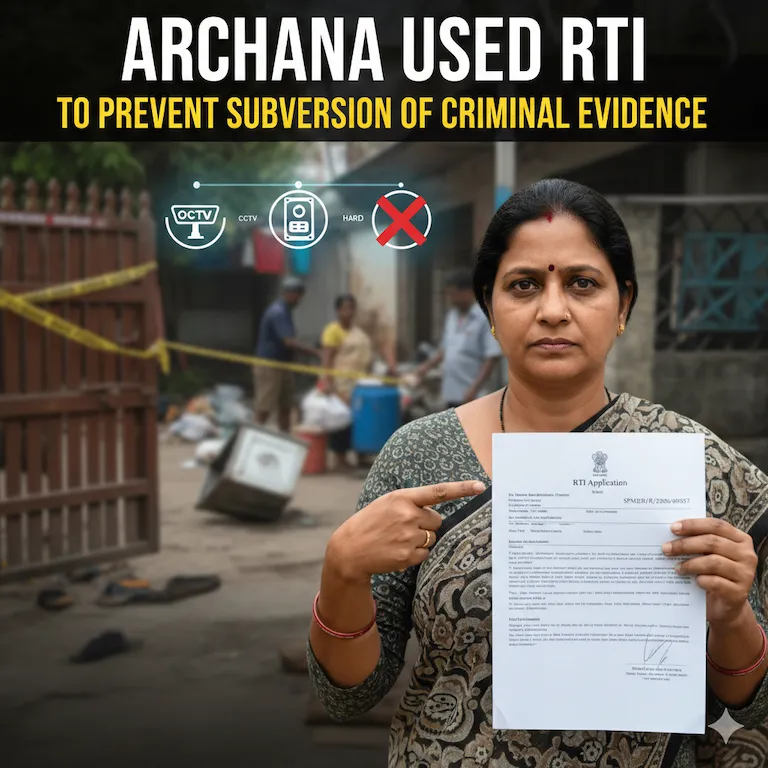
The key takeaways from the blog post serve as a “Legal Cheat Sheet”. Archana used RTI to fix accountability.
1. Criminality Overrides Civil History
The most important takeaway is that a property dispute is not a license to commit a crime. Even if there is a disagreement about the house, breaking gates (House-breaking) and stealing jewellery (Robbery) are separate criminal offences. Each requires an FIR, regardless of who owns the walls. In one such case, Archana used RTI to obtain important documents related to the dispute.
2. Police Negligence as “Evidence Tampering” (Archana used RTI)
The police failed to seize the DVR after they received formal notification (with proof of installation). This means they are no longer just “slow.” They could face potential liability under Section 201 IPC for allowing evidence to be destroyed. This change shifts the blame from the offenders to the investigating officers.
3. The “Silent Witness” (CCTV) is the Priority
The blog highlights that the most critical piece of evidence is the DVR. It provides the only objective proof of who entered the house and how much force they used. Seizing it immediately during forensics is the only way to prevent the “perfect crime” through digital erasure.
4. Violation of Supreme Court Mandates (Archana used RTI)
The post establishes that the Mirzapur Police are in direct violation of the Lalita Kumari vs. Govt. of UP judgment. This takeaway serves as a warning to the administration. The case is prepared for a High Court writ petition. This is based on “Contempt of Procedure.”
5. Accountability Through Documentation
The shift from “Grievances” to an RTI marks a transition from “requesting help” to “demanding accountability.” The complainant is naming names and asking for GD entries. This action builds a case for PoliceMisconduct. It forces senior officials (ASP/SP) to intervene to protect their own department’s reputation. Archana used RTI to expose corrupt.
6. Identification of “Shielded” Witnesses
The blog identifies that evidence exists (the Constable’s video and the coaching operator’s statement) but is being suppressed. Making these names public or official hardens the task for the local Chowki. They will find it more difficult to submit a “Clean Chit” report.
Justice Delayed, Evidence Destroyed: The Subversion of Law in Mirzapur (Archana used RTI)
The strength of a democracy is measured by the integrity of its police force. Those in uniform intentionally blur the line between a “civil dispute” and “criminal robbery.” As a result, the common citizen loses more than just property. They lose more than just property. They lose faith in the Constitution. The case of Archana Devi vs. The Offenders of Gharhu Patti is a harrowing example. It shows how local authorities can facilitate the “Illegal Dispossession” of a woman. They do this through tactical negligence.
1. The Incident: Beyond a Simple Property Dispute
On 24 October 2025, a residence in Gharhu Patti, Mirzapur, was raided rather than merely entered. The group comprised Vikas Dubey, Savitri Devi, Divya Devi, and Tinku Tiwari. They claimed to be resolving a long‑standing family property dispute and allegedly used force to breach iron gates and locks.
Authorities did not conduct a lawful eviction; they committed brazen daylight robbery instead. Thieves looted gold jewellery and household assets worth approximately ₹8 lakh. Civil proceedings may resolve ownership disputes. However, acts of house-breaking (Section 445 IPC) and robbery (Section 390 IPC) are criminal offences. These offences are cognisable in nature and require immediate registration of an FIR. Archana used RTI to seek information regarding the eviction process and the actions of the authorities involved.
2. The “Civil Label” Trap: A Shield for Criminals (Archana used RTI)
A disturbing trend has emerged in local policing. Authorities label every crime involving a family or a house as a “civil matter.” This is a tactical move to avoid the mandatory duty of investigation.
- The Police Deviation: In the investigation report dated 01/01/2026, the local police focused on a 2014 family settlement.
- The Legal Reality: A family settlement from a decade ago is not a license to enter a locked house. It does not give anyone the authority to break in. This principle still holds true in 2025. The police focus on the history of the house rather than the violence of the entry. They are effectively acting as defense counsel for the accused.
3. The Digital Battlefield: Destruction of CCTV Evidence
In the modern era, digital evidence acts as the “silent witness.” Archana Devi’s husband, Amit Kumar Dubey, maintained the CCTV system. This was confirmed by a service memo from M/s Computer Care Center dated 24-05-2025. Archana used RTI to expose the Nexus between police and criminals.
The accused, currently in illegal possession of the premises, also hold the DVR (Digital Video Recorder). Every hour that passes allows the offenders to:
- Overwrite the Hard Drive: Digital storage works in loops; new footage eventually deletes the old.
- Physical Tampering: Destroying the motherboard or the disk.
- Section 201 IPC: Under Indian law, causing the disappearance of evidence of an offense is a serious crime. Despite multiple grievances (GOVUP/E/2025/0147964), the police have failed to issue a Seizure Memo. This delay is not just a mistake; it is a facilitate-act for the destruction of proof.
4. Violating the Mandate of the Supreme Court (Archana used RTI)
The police’s refusal to file an FIR is a direct violation of the landmark judgment in Lalita Kumari vs. Govt. of UP. The Supreme Court made it clear:
“If the information discloses the commission of a cognizable offence, no preliminary inquiry is permissible. The registration of an FIR is mandatory.
The local authorities are disrespecting the highest court in the land. They are conducting a “preliminary inquiry” that lasts months. Meanwhile, someone is selling off the victim’s jewelry.
5. Suppression of Vital Witnesses
The investigation has conveniently ignored two major sources of truth:
- The Police Witness: Reports suggest a Constable from Fataha Chowki was present during the incident and recorded a video. Where is that video?
- The Independent Witness: Krishna Pandey, a local coaching operator, witnessed the use of force. However, he has not officially recorded his statement. The police likely avoid recording it because it would contradict the “civil dispute” narrative they are trying to protect.
6. The Urgency of Accountability: RTI and Beyond
Frustrated by the “Under Process” status of government grievances, the complainant has now taken action. They aim to establish individual accountability. They have filed an RTI (SPMZR/R/2026/60037) against the Office of the Superintendent of Police, Mirzapur.
This RTI requests the names and designations of the officers who failed to seize the DVR. When individual officers recognize that their names will appear on a permanent record of negligence, they start to pay attention. The system must then respond to this realization. The potential for such exposure compels the system to take necessary actions.
7. The Plea for Intervention (Archana used RTI)
The case of Archana Devi serves as a litmus test for the Mirzapur administration. If robbers can attack a woman in broad daylight, they can also tamper with her evidence. Thieves might sell her belongings while the police stand by and call it a “family matter.” In that case, no doorstep in Uttar Pradesh is safe.
The Prayer for Relief remains clear:
- Immediate FIR under Sections 390, 445, 448, and 201 IPC.
- Forensic Seizure of the DVR to recover deleted footage.
- Recover Looted Articles before they are lost to the black market.
- Restoration of Possession as per the Specific Relief Act.
Conclusion
Justice is not just about the final verdict; it is about the preservation of the process. When the police destroy evidence, they do not just fail a victim—they assist a criminal. The Chief Minister’s Secretariat must act now. The SP of Mirzapur must also take immediate action. They need to ensure that the rule of law is restored in Gharhu Patti.
How you can use this blog post:
- Social Media: Post snippets of this on X (formerly Twitter), tagging @Uppolice, @mirzapurpolice, and @CMOfficeUP.
- Public Awareness: Use this text to explain your case to local journalists or news portals. It clearly outlines the “Criminal” nature of the act which they can report on.
The law provides strict penal provisions to prevent the subversion of criminal evidence. It targets both the offenders who destroy proof and the police officers who fail to secure it.
In India, the Indian Penal Code (IPC) primarily governs these matters. If the offense occurs after July 1, 2024, the corresponding sections of the Bharatiya Nyaya Sanhita, 2023 will govern them.
1. Against the Accused: Destruction of Evidence (Archana used RTI)
Section 201 IPC (Section 238 BNS): Causing disappearance of evidence of offence.
- The Provision: This is the primary section that offenders use when they delete CCTV footage. They also use it if they destroy a DVR or hide stolen property.
- The Penalty: For an offence punishable with death, hiding evidence can lead to a prison sentence. The sentence can be up to 7 years. In your case (Robbery/House-breaking), the penalty for destroying evidence is proportional to the main crime’s punishment.
- How to apply it: You must state in your complaints that the accused have the DVR. They are deliberately overwriting the disk. Their goal is to cause the disappearance of evidence.
2. Against the Police: Failure to Register/Investigate
Section 166A IPC (Section 199 BNS): Public servant disobeying law.
- The Provision: This was specifically strengthened after the Nirbhaya case. It punishes a police officer who fails to record any information (FIR) regarding a cognizable offense.
- The Penalty: Imprisonment from 6 months to 2 years, plus a fine.
- How to apply it: You have reported a “Cognizable Offense” (Robbery/390 IPC). The police’s refusal to register an FIR makes them liable under this section. Their delay in seizing the DVR also contributes to their liability. Archana used RTI.
3. Against the Police: Framing Incorrect Documents
Section 167 IPC (Section 201 BNS): Public servant framing an incorrect document with intent to cause injury.
- The Provision: If the Inquiry Officer submits a “False Aakhya” (report) to the CM Secretariat, they commit a crime. The same applies if submitted to the SP. This occurs when they claim the matter is “Civil” despite clear evidence of “Criminal” entry.
- The Penalty: Up to 3 years in prison.
4. For Immediate Evidence Seizure (Archana used RTI)
Section 91 CrPC (Section 94 BNSS): Summons to produce document or other thing.
- The Tool: This is not a punishment, but a power. You can instruct the Magistrate or the SP to send a “Section 91 Notice” to the accused. This notice commands the accused to produce the DVR immediately. If they refuse or claim it is, “lost” after receiving this notice, they face immediate criminal charges. These charges involve contempt and destruction of evidence.
Summary Table: Legal Weapons to Stop Subversion
| Situation | Section (IPC/CrPC) | Purpose |
| DVR Tampering | Sec 201 IPC | Punishes the accused for deleting footage or hiding jewelry. |
| Police Inaction | Sec 166A IPC | Punishes the officer for not filing an FIR for Robbery. |
| False Police Report | Sec 167 IPC | Punishes the officer for lying in the “Aakhya” (Report). |
| Search & Seizure | Sec 93/94 CrPC | Allows the Court to issue a search warrant for the DVR/Loot. |
Strategic Recommendation
You should draft a “Notice of Liability” and send it via Speed Post to the SHO of City Kotwali. Mention these sections explicitly:
“Take notice that as the DVR and robbed articles are currently with the accused, you must seize them immediately. You must act under Sec 102 CrPC (Power of police to seize property). If you fail, you will face prosecution under Section 166A and 201 of the IPC. This failure will facilitate the destruction of evidence.
To ensure you have a complete digital and physical record of who to contact, here are the detailed credentials. These are for the public authorities involved in your grievances and RTI.
1. Primary Grievance Contact (CM Secretariat) (Archana used RTI)
These authorities are supervising your two active grievances (GOVUP/E/2025/0147964 and GOVUP/E/2026/0003751).
- Concerned Officer: Shri Arvind Mohan
- Designation: Joint Secretary, Chief Minister Secretariat
- Office Address: Room No. 321, U.P. Secretariat, Lucknow, Uttar Pradesh.
- Official Email:
arvind.12574@gov.in - Contact Number: 0522-2226350
- Web Link for Status: Jansunwai-Samadhan Portal
2. RTI Authority (Police Accountability)
This authority is responsible for answering your RTI (Reg No: SPMZR/R/2026/60037) and fixing accountability on the local police.
- Public Information Officer (PIO): Shri Manish Kumar Mishra
- Designation: Additional Superintendent of Police (ASP) Operation, Mirzapur.
- Nodal Officer Telephone: 7007941679
- PIO Email:
aspopmzp@gmail.com/addlspopmzr@gmail.com - Web Link for RTI Tracking: UP RTI Online Gateway
3. Local Enforcement (Field Level)
While these officers report to the SP, they are the ones physically responsible for the DVR seizure and FIR registration.
- Superintendent of Police (SP) Mirzapur:
- Email:
spmzp-up@nic.in - Twitter/X Handle: @mirzapurpolice
- Email:
- City Kotwali / Fataha Chowki:
- General Helpline: 112 (For emergency reporting of the sale of stolen goods).
- Police Station Contact: You can find the specific CUG (Closed User Group) mobile number of the current SHO. Call the SP office at 05442-252203 for this information.
Summary of Your Active Application IDs
| Application Type | Registration Number | Date Filed | Authority |
| Main Grievance | GOVUP/E/2026/0003751 | 09/01/2026 | CM Secretariat / SP Mirzapur |
| Evidence Grievance | GOVUP/E/2025/0147964 | 30/12/2025 | CM Secretariat / SP Mirzapur |
| RTI Application | SPMZR/R/2026/60037 | 23/01/2026 | ASP Operation, Mirzapur |
Strategic Note on Communication (Archana used RTI)
When you email these authorities, always CC the Director General of Police (DGP) Uttar Pradesh at dgp-up@nic.in. This ensures that the local Mirzapur police know they are under scrutiny of vigilant eyes . The highest office in the state observes their actions or inactions.
Could you please draft a professional email that covers all these application numbers? I will send it to the Joint Secretary. Shri Arvind Mohan will be involved to escalate the matter regarding the “selling of robbed articles.”



Facing a similar challenge? Share the details in the box below, and our team of experts will do their best to help.