
Key takeaways from this blog post is as follows
Here are the key takeaways from the structured blog post regarding your ongoing legal battle. This summary will touch upon important topics such as Procedural Gaps and Property Rights.
1. Systematic Misclassification of Crimes (Procedural Gaps and Property Rights)
- Family members fraudulently sold ancestral property, which the complainant argues. According to complainant the act of the father is a Criminal Breach of Trust (BNS 316) and Cheating (BNS 318).
- The local police (C.O. Sadar, Mirzapur) have categorized the matter as a “purely civil dispute” regarding land division to avoid filing an FIR.
2. Documented Procedural Failures
- Inadequate Inquiry: The investigators conducted the investigation solely via mobile phone without summoning the complainant to present physical evidence or land records.
- Lack of Natural Justice: The investigation conducted ex-parte and perfunctorily failed to formally hear the complainant’s side.
3. Administrative Misconduct and RTI Evidence (Procedural Gaps and Property Rights)
- Evidence obtained through RTI (Appeal No: A-20251202121) reveals that the police intentionally misled the complainant.
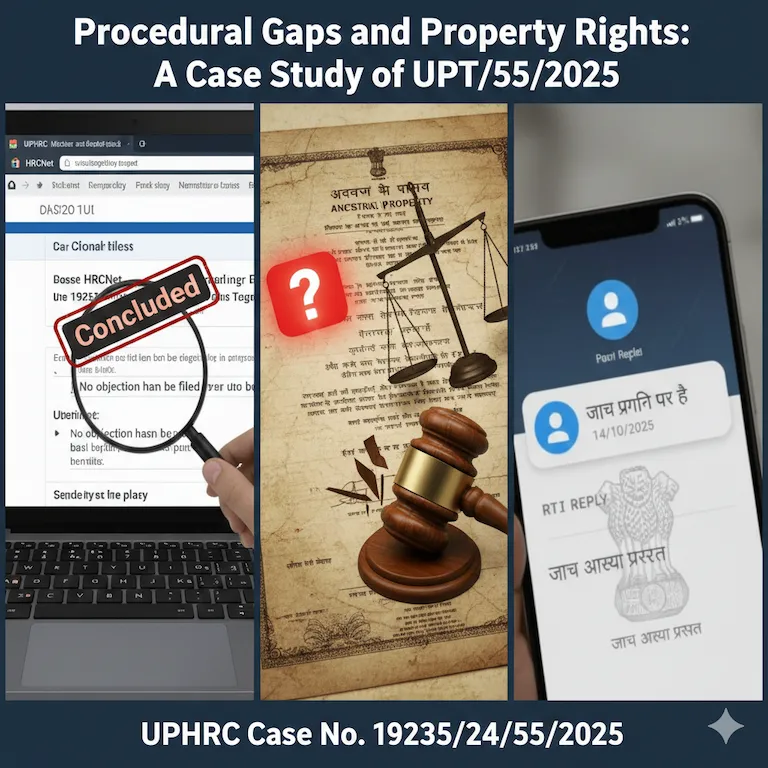
- On October 14, 2025, the PIO stated that they were “in progress” with the inquiry, even though they were finalizing the report for submission by October 19, 2025.
4. Reopening the “Concluded” Case (Procedural Gaps and Property Rights)
- Although the UPHRC initially closed the case on December 19, 2025, and stated that “no objection was filed,” the complainant demonstrated that the UPHRC made a factual error.
- A fresh representation (Diary No. 522/IN/2026) has been successfully linked to the original file to seek a restoration of the case.
5. High-Level State Oversight (Procedural Gaps and Property Rights)
- The matter has been escalated to the Chief Minister’s Secretariat via the IGRS portal (Grievance No. GOVUP/E/2026/0010866).
- The Joint Secretary in Lucknow is now monitoring the Mirzapur police’s response, creating a layer of accountability above the local district level.
6. Demand for Independent Investigation
- The final objective is to set aside the local C.O. Sadar report and have a fresh inquiry conducted by an independent senior officer (ASP/DySP) from outside the Mirzapur district to ensure impartiality.
This structured blog post focuses on the legal and procedural battle that you are currently navigating. It documents the case, highlights the misclassification of “Civil vs. Criminal,” and exposes the procedural errors in the investigation.
Procedural Gaps and Property Rights: Navigating Property Fraud and Procedural Lapses in Uttar Pradesh
In the complex landscape of Indian property law and human rights, many citizens blur the line between a “civil dispute” and a “criminal offense”—sometimes intentionally. For them, seeking justice for the fraudulent sale of ancestral property is not just a legal battle; it becomes a fight against systemic inertia and procedural negligence. This post examines a live case currently before the Uttar Pradesh Human Rights Commission (UPHRC) and highlights the critical challenges the complainant faces when the police apparatus fails to act.
1. The Core Conflict: Ancestral Birthright vs. Fraudulent Sale (Procedural Gaps and Property Rights)
Naresh Kumar Jaiswal, the complainant in Case No: 19235/24/55/2025, asserts his fundamental claim to ancestral property under Mitakshara Law and the Hindu Succession Act, 1956, and alleges that someone is systematically erasing his birthright as a coparcener through the fraudulent sale of ancestral land in Mirzapur.
The allegations are serious: the sale of property subject to pending litigation (Criminal Misc. Case No. 915/2021) without the consent of the coparceners. In legal terms, this moves beyond a simple “family partition” and enters the territory of Criminal Breach of Trust and Cheating, governed by the Bharatiya Nyaya Sanhita (BNS) Sections 316 and 318.
2. The “Civil Dispute” Trap: A Shield for Inaction
A recurring theme in police inquiries across India is the classification of property crimes as “purely civil in nature.” In this case, the Circle Officer (C.O.) Sadar, Mirzapur, concluded in a report dated 19/10/2025 that the matter was a family disagreement over land division.
However, the complainant argues this is a procedural evasion of duty. When a father or brother sells ancestral assets to third parties to deplete the estate and deprive heirs of their share, it constitutes a cognizable criminal offense. By labeling it “civil,” the local police effectively shield the accused from a formal FIR and a rigorous criminal investigation.
3. Procedural Flaws: The Denial of Natural Justice (Procedural Gaps and Property Rights)
Justice is not only about the final verdict but the process used to reach it. The UPHRC case has exposed two major procedural lapses that have hindered the complainant’s pursuit of a fair remedy:
The “Telephonic” Inquiry
The investigation report by C.O. Sadar admits that they contacted the complainant only via mobile phone. They did not issue a formal summons or provide an opportunity to present documentary evidence—such as sale deeds, bank records, or court stay orders. This ex-parte approach violates the principles of natural justice.
The RTI Deception (Procedural Gaps and Property Rights)
The most alarming development shows evidence of administrative misconduct revealed through RTI Appeal No: A-20251202121. While the complainant sought information about the investigation, the Public Information Officer (PIO) claimed that the inquiry was “in progress” on 14/10/2025. In reality, just five days later, they finalized the report and sent it to the Commission. This deliberate delay prevented the complainant from contesting the report at the district level before the Commission closed the case initially.
4. The Human Rights Dimension: Dignity and Reputation
Beyond the financial loss, the case highlights the misuse of “character assassination” as a defensive tactic. The police report propagated claims of “misconduct,” “mental illness,” and identified procedural gaps that compromised property rights against the complainant without a shred of medical evidence. Such baseless allegations, when included in official government records, constitute defamation under BNS Section 351 and violate the fundamental right to dignity and reputation.
5. The Pincer Strategy: Engaging the CM’s Secretariat
Faced with the closure of the case in December 2025 on the mistaken grounds that “no objection was filed,” the complainant has launched a two-pronged strategy.
- UPHRC Restoration: A fresh representation (Diary No: 522/IN/2026) has been linked to the original file, pointing out the “factual error” in the record regarding the filing of objections.
- IGRS Oversight: A high-level grievance (No: GOVUP/E/2026/0010866) has been registered with the Chief Minister’s Secretariat, Lucknow.
By notifying the Superintendent of Police (SP), Mirzapur, through the CM’s portal, the complainant has ensured that the local police are now accountable to the highest levels of the state government.
6. The Road Ahead: Seeking an Independent Inquiry (Procedural Gaps and Property Rights)
The ultimate prayer in this battle is simple: Impartiality. The complainant is requesting the UPHRC to set aside the biased local report and direct a fresh inquiry by an independent senior officer (ASP/DySP) from outside the Mirzapur district.
This case serves as a reminder that the “Record Room” does not mark the end of a legal journey. When a citizen possesses evidence of procedural flaws and administrative misconduct, they can—and must—reopen the doors of justice.
Summary of Key Facts for Reference:
- Case Number: 19235/24/55/2025
- New Diary Number: 522/IN/2026
- Primary Allegations: Fraudulent sale of ancestral land, Police Inaction, Defamation
- Legal Provisions Cited: BNS Sections 316 (Criminal Breach of Trust), 318 (Cheating), 351 (Defamation)
- Administrative Oversight: IGRS No. GOVUP/E/2026/0010866
Based on the documents provided, here are the structured contact details and identifiers for the public authorities and case files involved in your matter:
1. Core Case Identifiers
- UPHRC Case / File No: 19235/24/55/2025.
- Original Diary No: 5885/IN/2025.
- New Linked Diary No: 522/IN/2026.
- IGRS (Jansunwai) Registration No: GOVUP/E/2026/0010866.
- RTI Appeal No: A-20251202121.
2. Public Authority Contact Details (Procedural Gaps and Property Rights)
| Authority | Role | Contact Details |
| UP Human Rights Commission (UPHRC) | Primary Adjudicating Body | Address: TC-34 V-1, Vibhuti Khand, Gomti Nagar, Lucknow – 226010. Emails: uphrc@nic.in , uphrclko@yahoo.co.in. Fax: 0522-2728108. Website: http://uphrc.up.nic.in/. |
| National Human Rights Commission (NHRC) | Central Oversight / Law Division | Address: Manav Ad अधिकार Bhawan, Block-C, GPO Complex, INA, New Delhi – 110023. Email: cr.nhrc@nic.in. Fax: 011-24651332. Website: http://www.nhrc.nic.in. |
| Chief Minister Secretariat, UP | State-Level Oversight (IGRS) | Officer: Shri Arvind Mohan (Joint Secretary). Address: Room No. 321, U.P. Secretariat, Lucknow. Email: arvind.12574@gov.in. Phone: 0522-2226350. |
| Superintendent of Police, Mirzapur | District Enforcement Authority | Email: ssp-mzp-up@nic.in. |
| Addl. SP (City) / Nodal Officer | Inquiry Coordination | Email: spcityofficemzp@gmail.com. Alternate Email: aspopmzp@gmail.com. CUG No: 9454401104. Fax: 05442-256655. |
3. Local Investigating Officers
- Circle Officer (C.O.) Sadar, Mirzapur: Shri Amar Bahadur.
- Public Information Officer (PIO): Manish Kumar Mishra.
4. Essential Web Links (Procedural Gaps and Property Rights)
- HRCNet (Case Status Tracking): www.nhrc.nic.in.
- UPHRC Official Portal: http://uphrc.up.nic.in/.
- Jansunwai (IGRS) Portal: https://jansunwai.up.nic.in/ (Relevant for monitoring Grievance No. GOVUP/E/2026/0010866).
Would you like me to draft a specific “Urgent Reminder” for any of these individual officers using their direct email addresses?


Facing a similar challenge? Share the details in the box below, and our team of experts will do their best to help.