
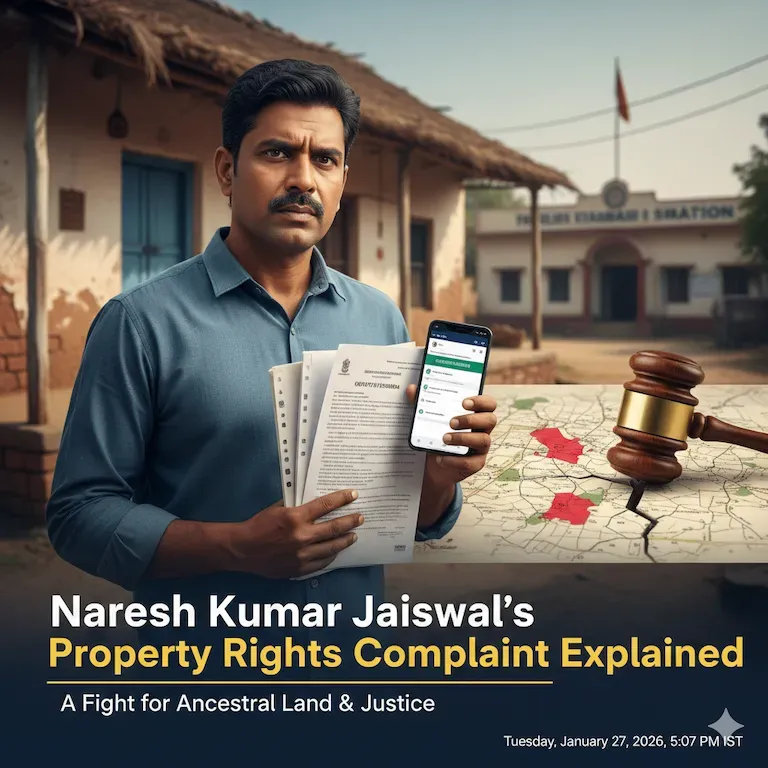
The blog post details a complex legal and administrative struggle involving ancestral property rights and allegations of official misconduct. This article will specifically discuss Naresh Kumar Jaiswal’s Property Rights as a key part of the case.
Here are the key takeaways: (Naresh Kumar Jaiswal’s Property Rights)
1. The Core Legal Dispute
At the heart of the matter is the right of a son in ancestral property. Under Indian law, this right is acquired by birth. The complainant, Naresh Kumar Jaiswal, argues that his father, Ashok Kumar Jaiswal, lacks the legal authority to sell ancestral land. He cannot sell the land without his consent. (Naresh Kumar Jaiswal’s Property Rights)
2. Allegations of Illegal Property Sales
The post documents a series of land transactions in Village Bhatevra, Mirzapur, spanning from 2019 to 2021. The complainant alleges these sales were made:
- Without a formal partition of the property.
- With the intent to cheat the rightful heir (the son).
- By misrepresenting the father’s sole ownership of the land.
3. Demand for Criminal Action (BNS) (Naresh Kumar Jaiswal’s Property Rights)
The complainant is seeking the registration of an FIR under the Bharatiya Nyaya Sanhita (BNS). Specifically:
- Section 318 (4): Pertaining to cheating and dishonestly inducing delivery of property.
- Section 19: Relating to cheating by personation or misrepresentation of identity/status.
4. Systemic Failure and Official Bias
A major theme of the post is the dissatisfaction with the Uttar Pradesh Police and Revenue officials.
- Station House Officer (SHO) Chilh: Accused of submitting “arbitrary and inconsistent” reports that merely parrot the father’s version of events.
- Lack of Verification: The complainant argues that officials failed to perform due diligence. They did not verify the ancestral status of the land before closing previous grievances.
- Mockery of Law: The administrative process is described as “vindictive.” It shields the father rather than protecting the son’s legal rights.
5. Escalation to High-Level Authority
The local authorities in Mirzapur provided “cryptic” and unsatisfactory responses. Because of this, the matter has been escalated to the Chief Minister’s Secretariat in Lucknow. The complainant is demanding accountability for his father. He also demands it for the “guilty public servants” who allegedly facilitated the fraud through negligence. (Naresh Kumar Jaiswal’s Property Rights)
Two weeks after this complaint, Mr. Jaiswal filed a further representation with the Superintendent of Police, Mirzapur. We examine that filing, and the coparcenary law behind it, in Ancestral Properties Controversy: Legal Rights Explained.
Naresh Kumar Jaiswal’s Property Rights: A Son’s Legal Battle Against Systemic Apathy
In the complex tapestry of Indian property law, the concept of ancestral property holds a sacred position. It is not merely real estate; it is a heritage intended to sustain generations. For Naresh Kumar Jaiswal, a resident of District Mirzapur, Uttar Pradesh, this heritage has led to a profound legal struggle. It has deeply affected him. His grievance has multiple registration numbers. These include GOVUP/E/2025/0083834 and GOVUP/E/2025/0055717. It highlights a disturbing intersection of familial betrayal. It also shows administrative negligence.
This case serves as a poignant example. It highlights the hurdles common citizens face when seeking justice. These hurdles include the illegal sale of joint family property and the perceived “vindictive” reports of local law enforcement.
The Core Issue: Illegal Sale of Ancestral Property
At the heart of Mr. Jaiswal’s grievance is a fundamental tenet of Hindu Law: The right of a son in ancestral property accrues by birth. The complainant states that his father, Ashok Kumar Jaiswal, has been selling the ancestral land. This land is in Village Bhatevra (Kon), Pargana Kantit, Tehsil Sadar. He has done this systematically and without the consent of the other stakeholders. (Naresh Kumar Jaiswal’s Property Rights)
The specifics of the disputed transactions are documented across several years:
- October 2019: Sale of 925 sq. ft. to Smt. Gutti.
- September 2020: Sale of 1110 sq. ft. to Smt. Kajal Bharti.
- March 2021: Sale of 1369 sq. ft. to Mulhara Devi.
Mr. Jaiswal contends that since the property is ancestral and undivided, his father acts merely as a ‘Karta’ (manager). He has no legal authority to sell the shares of his descendants to satisfy personal motives or “ulterior” designs.
Allegations of Cheating under the Bharatiya Nyaya Sanhita (BNS) (Naresh Kumar Jaiswal’s Property Rights)
The complainant has explicitly requested to register a First Information Report (FIR) under the Bharatiya Nyaya Sanhita (BNS). They specifically cited Section 318 (4) (formerly aspects of Section 420 IPC).
The Legal Argument for Cheating
Mr. Jaiswal argues that by selling property that partially belongs to his son, the father has: (Naresh Kumar Jaiswal’s Property Rights)
- Deceived the stakeholders regarding the status of the land.
- Dishonestly induced buyers to enter into sale deeds for land he did not fully own.
- Encroached upon the inherent birthrights of the son.
He also refers to Section 19 of BNS. He alleges a form of “cheating by personation”. This involves misrepresenting ownership status to facilitate these illegal transactions.
The Failure of Administrative Oversight
The alleged conduct of the Station House Officer (SHO) of Police Station Chilh and the local revenue officials is alarming. The matter is perhaps more distressing. Mr. Jaiswal’s grievances consistently point toward a “mockery of the law” perpetrated by the very individuals hired to uphold it.
1. Arbitrary and Inconsistent Reporting
The complainant alleges that the reports submitted by the police and revenue staff on the government portal are “arbitrary.” They are also “cryptic.” He claims these reports are not based on independent verification. There was no deep dive into land records. Instead, these reports reflect his father’s version of events.
2. Lack of Proper Verification (Naresh Kumar Jaiswal’s Property Rights)
Jaiswal critiques the local administration harshly. He notes that the reports show a “vindictiveness.” They fail to adhere to the set norms of the government. The officials only echoed the father’s statements. This action effectively bypassed the legal reality of the ancestral nature of the land.
3. The Closed Case Dilemma
One of the previous grievances (GOVUP/E/2024/0081433) was marked as “Case Closed” on June 11, 2025. The remarks provided were generic—simply stating that the report had been submitted for observation. This “closed” status did not resolve the underlying issue of the illegal sale. It also failed to address the registration of an FIR. This led to the complainant’s high level of dissatisfaction. Subsequently, there were appeals to the Chief Minister’s Secretariat. (Naresh Kumar Jaiswal’s Property Rights)
Understanding the Rights of a Son in Ancestral Property (Naresh Kumar Jaiswal’s Property Rights)
To understand why this grievance is so significant, one must look at the legal framework governing ancestral property in India:
- Birthright: A son (and, since 2005, a daughter) has an equal right in ancestral property from the moment of birth.
- The Karta’s Limitations: The head of the family manages the property. They can sell it only under specific conditions: “Legal Necessity” or the “Benefit of the Estate.” Selling land to deprive a legal heir of their share does not fall under these categories.
- Partition Suits: A son can file a partition suit at any time. This action allows him to legally separate his share from the joint holding.
A Call for Accountability
Mr. Jaiswal’s appeal to Shri Arvind Mohan (Joint Secretary) at the Chief Minister’s Secretariat is a plea for accountability. He is not just requesting the return of his land. He also seeks action against guilty public servants who have allegedly submitted false reports. (Naresh Kumar Jaiswal’s Property Rights)
The grievance highlights a systemic gap. Local police often view property disputes as “civil matters.” They ignore the criminal elements of fraud, cheating, and forgery that frequently accompany illegal land transfers. The police refuse to register an FIR under the BNS. People perceive this as shielding the perpetrator. It enables the continued erosion of the complainant’s rights.
Conclusion: The Path Forward (Naresh Kumar Jaiswal’s Property Rights)
The case of Naresh Kumar Jaiswal is a litmus test for the Uttar Pradesh Government’s grievance redressal mechanism. If the portal is to be more than a digital filing cabinet, there must be:
- Independent Re-investigation: A senior official from outside the Chilh Police Station should verify the ancestral nature of the properties. It is important to confirm if the properties in question are truly ancestral.
- Legal Scrutiny of Sale Deeds: The Tehsildar and Registrar must provide an explanation. They need to clarify how these sales were allowed. This should have occurred only with the “No Objection” of the co-parceners (legal heirs).
- Strict Action Against Negligent Staff: If reports were indeed filed without verification, the responsible officers must be held accountable. Departmental action is necessary to restore public trust. Departmental action is necessary to restore public trust.
Justice in land matters is not just about hectares and square feet; it is about the rule of law. As this case progresses, people will focus on the Chief Minister’s Secretariat. The public wants to see if they can turn a “closed” file into a “resolved” injustice.
To assist you in escalating your grievance, here are the official contact details. You can also follow up on the existing ones. These details are for the public authorities involved in your case.
1. Chief Minister’s Secretariat (Lucknow)
This is the office of the Joint Secretary mentioned in your grievance status. They handle high-level oversight of state grievances.(Naresh Kumar Jaiswal’s Property Rights)
| Authority / Officer | Contact Details |
| Shri Arvind Mohan (Joint Secretary) | Phone: 0522-2226350 / 0522-2226354 |
| Email Address | arvind.12574@gov.in |
| Office Address | Room No. 321 (or 318), Lok Bhawan, U.P. Secretariat, Lucknow – 226001 |
| CM Office General Email | cmup@nic.in |
2. Police Administration (District Mirzapur) (Naresh Kumar Jaiswal’s Property Rights)
Your complaint specifically names the Station House Officer (SHO) of Chilh. You may need to contact his superiors to report the “arbitrary” nature of the reports.
| Designation | Official CUG / Mobile Number | Email Address |
| DIG/SSP Mirzapur | 9454400299 | spmzr-up@nic.in |
| Addl. SP (City/Ops) | 9454401104 / 9454401105 | asp-city.mi@up.gov.in |
| CO Sadar (Supervising CO) | 9454401591 | co-sadar.mi@up.gov.in |
| SHO Police Station Chilh | 9454404004 | — |
3. Grievance Portal & Digital Links
You can use these links to track your status. Moreover, you can file a reminder (reminder/appeal). You can also view the specific documents uploaded by the officials.
- Official Grievance Portal (Jansunwai/IGRS): https://jansunwai.up.nic.in/
- Track Grievance Status: https://jansunwai.up.nic.in/checkstatus
- Land Records (Bhulekh UP): https://upbhulekh.gov.in/ (To verify current ownership and the sale deeds you mentioned).
- UP CM Helpline: Dial 1076 (Toll-free within Uttar Pradesh).(Naresh Kumar Jaiswal’s Property Rights)
Summary of Your Application IDs (Naresh Kumar Jaiswal’s Property Rights)
You should quote these specific IDs in any future correspondence:
- GOVUP/E/2025/0083834 (Received: 23/07/2025)
- GOVUP/E/2025/0055717 (Received: 26/05/2025)
- GOVUP/E/2024/0081433 (Received: 12/11/2024 – Currently marked as Closed)
Would you like me to draft a formal “Reminder/Appeal” text? You can copy and paste it into the Jansunwai portal to reopen the closed case.


Facing a similar challenge? Share the details in the box below, and our team of experts will do their best to help.