
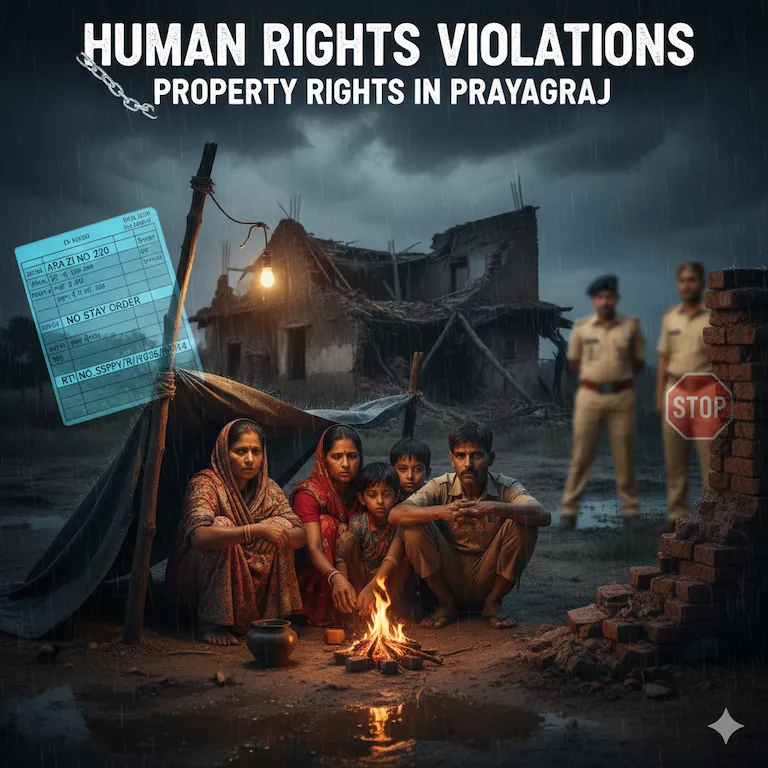
Here are the key takeaways from the blog post regarding the ongoing dispute over Arazi No. 220, the legal battle for accountability, and the concerns surrounding Human Rights Violations in this case:
- Illegal Obstruction of Property Rights: The police have blocked the family of Shri Tej Bahadur Singh. They have prevented them from repairing their ancestral home for five years. They have done this despite having no legal authority to do so.
- Absence of Judicial Stay: A Lekhpal report dated June 22, 2025, confirms that no court has issued a stay order. There is no injunction regarding the construction on the plot.
- Administrative Evasion: The Public Information Officer (PIO) stated they never received the SDM’s order dated June 23, 2025. The Mauaima Police also claimed they did not get the order. This occurred even though the document was physically attached to the original RTI application.
- Discriminatory “Selective Enforcement”: The police have allowed other neighbors on the same plot to build permanent houses. They have specifically targeted and stopped only the applicant’s construction.
- Human Rights Violations: The illegal police obstruction has forced the family to perform sacred funeral rites under the open sky. They have had to do this on four separate occasions. This violates their right to dignity (Article 21). It also infringes on their religious freedom (Article 25).
- Active Appeal for Accountability: A First Appeal (Registration No: SSPPY/A/2026/60034) has been filed with the Additional Commissioner of Police, Prayagraj. It challenges the misleading reports. It also seeks the names of the responsible officers.
Human Rights Violations: How Administrative Evasion Stalls Property Rights in Prayagraj
The Right to Information (RTI) Act of 2005 promised a new era of transparency. However, many citizens still find themselves battling a wall of administrative silence. A recent case involving Arazi No. 220 in Village Saraijeet Rai Urf Pure Bhava, Phoolpur, shows local authorities using evasive reporting. This obstructs justice. It also ignores fundamental rights, and sadly, examples of Human Rights Violations are evident in such administrative evasion.
The Core Dispute: Ancestral Rights vs. Police Inaction
Shri Tej Bahadur Singh and his family simply wanted to repair their ancestral home after it collapsed during heavy rains. However, for five years, opposing parties have used muscle power to block their construction—a situation local reports characterise as “Gundaism.” This dispute further highlights how certain Human Rights Violations can occur when police inaction hinders the family’s right to their property.
A critical turning point occurred on June 22, 2025, when a local Lekhpal inspected the site. The official report confirmed three vital facts:
- The applicant maintains possession of the dilapidated structure.
- Natural causes led to the building’s collapse.
- No court has issued a stay order or injunction to prevent the reconstruction.
A Systemic Breakdown of Accountability (Human Rights Violations)
The Lekhpal’s findings were followed by a formal order issued by the Sub-Divisional Magistrate (SDM) of Phoolpur. This order was released on June 23, 2025. It directed the Mauaima Police to investigate and take legal action. Under Section 4(1)(d) of the RTI Act, public authorities must provide administrative reasons for their decisions. Instead of complying, the police met the order with silence, opening up questions about Human Rights Violations arising from a lack of accountability.
The applicant filed an RTI seeking the Action Taken Report (ATR). The Assistant Police Commissioner (ACP) of Phoolpur forwarded a report. This report claimed the police “never received the order in the office mail.” This claim directly contradicts the facts, as the applicant physically attached the SDM’s order to the original RTI application.
Selective Enforcement and Human Rights
The most distressing aspect of this case involves selective enforcement. While the police block the applicant from repairing his roof, they have allowed other stakeholders on the same plot (Arazi No. 220) to build permanent houses during the same period. Clearly, such actions point towards violations of human rights, highlighting the problem of Human Rights Violations in local administrative practices.
This “pick and choose” policy does more than just delay a building project; it violates basic human dignity. For five years, the family has conducted sacred funeral rites. They have performed religious sacraments under the open sky on four separate occasions. This is because they lack a roof. This situation constitutes a gross violation of:
- Article 21: The Right to Life and Dignity.
- Article 25: The Right to Freedom of Religion.
The Path to Accountability: First Appeal SSPPY/A/2026/60034
Dissatisfied with the PIO’s evasive summary, the applicant filed a First Appeal on February 2, 2026, under registration number SSPPY/A/2026/60034. The appeal demands that the Additional Commissioner of Police, Prayagraj, provide a point-wise rebuttal to the local police station’s claims. As the matter concerns Human Rights Violations.
The fight now shifts to the Commissionerate level. The core question remains. If no court has issued a stay order, how can a police station act as a “parallel court? How can it strip a citizen of their property rights? In summary, unless the appeal is acted upon, ongoing Human Rights Violations are likely to continue unchecked within the system.
Key Takeaways
- The ongoing dispute over Arazi No. 220 highlights illegal obstruction of property rights by the police, preventing the family from repairing their home for five years.
- No court has issued a stay order regarding the construction. However, police have selectively enforced rules against the applicant. They have allowed others to build.
- The case demonstrates human rights violations. The family has conducted sacred rites under the open sky due to lack of shelter. This situation infringes on their dignity and religious freedom. It is an explicit case of Human Rights Violations.
- A First Appeal has been filed to challenge misleading reports and seek accountability from responsible officers in the Prayagraj police.
- This dispute remains unresolved. It raises critical questions about systemic accountability. There are ongoing human rights violations in the enforcement of property rights.
Based on the documents provided, here are the specific identification and contact details for the authorities and the applications involved in your case:
🆔 Application & Appeal Identifiers in the matter of Human Rights Violations
- Original RTI Registration Number: SSPPY/R/2026/60014.
- First Appeal Registration Number: SSPPY/A/2026/60034.
- State Information Commission Appeal Number: S-09/A/2249/2025.
- Civil Court Case Number: 3853/2022 (Valendra Singh vs. Tej Bahadur Singh).
📞 Contact Details of Public Authorities (Human Rights Violations)
| Authority / Officer | Designation | Mobile / Phone | Email Address |
| Umesh Sharma | ACP Phoolpur (PIO) | 7985007310 | co-phoolpur.ah@nic.in |
| Additional CP | First Appellate Authority (FAA) | 9454402862 | adcp-pol.ah@nic.in |
| Kuldeep Singh Gunawat | Nodal Officer | 9454401015 | adlspgangaparaldpolice@gmail.com |
| State Information Commission | Hearing Court 9 | Not provided | hearingcourts9.upic@up.gov.in |
| Other Recipient | AC First Prayagraj | Not provided | acfirstprg123@gmail.com |
| Other Recipient | Commissioner Allahabad | Not provided | commall@nic.in |
🌐 Web Links & Digital Details
- UP RTI Online Portal: https://rtionline.up.gov.in/ (Used for filing and tracking SSPPY/R/2026/60014 and SSPPY/A/2026/60034).
- Human Rights Contacts: The appellant has also engaged with the National Human Rights Commission (cr.nhrc@nic.in) and the UP Human Rights Commission (uphrc@nic.in).
Would you like me to draft a formal email to the First Appellate Authority (adcp-pol.ah@nic.in) to officially notify them of the evidence you uploaded with Appeal Number SSPPY/A/2026/60034?


Facing a similar challenge? Share the details in the box below, and our team of experts will do their best to help.