
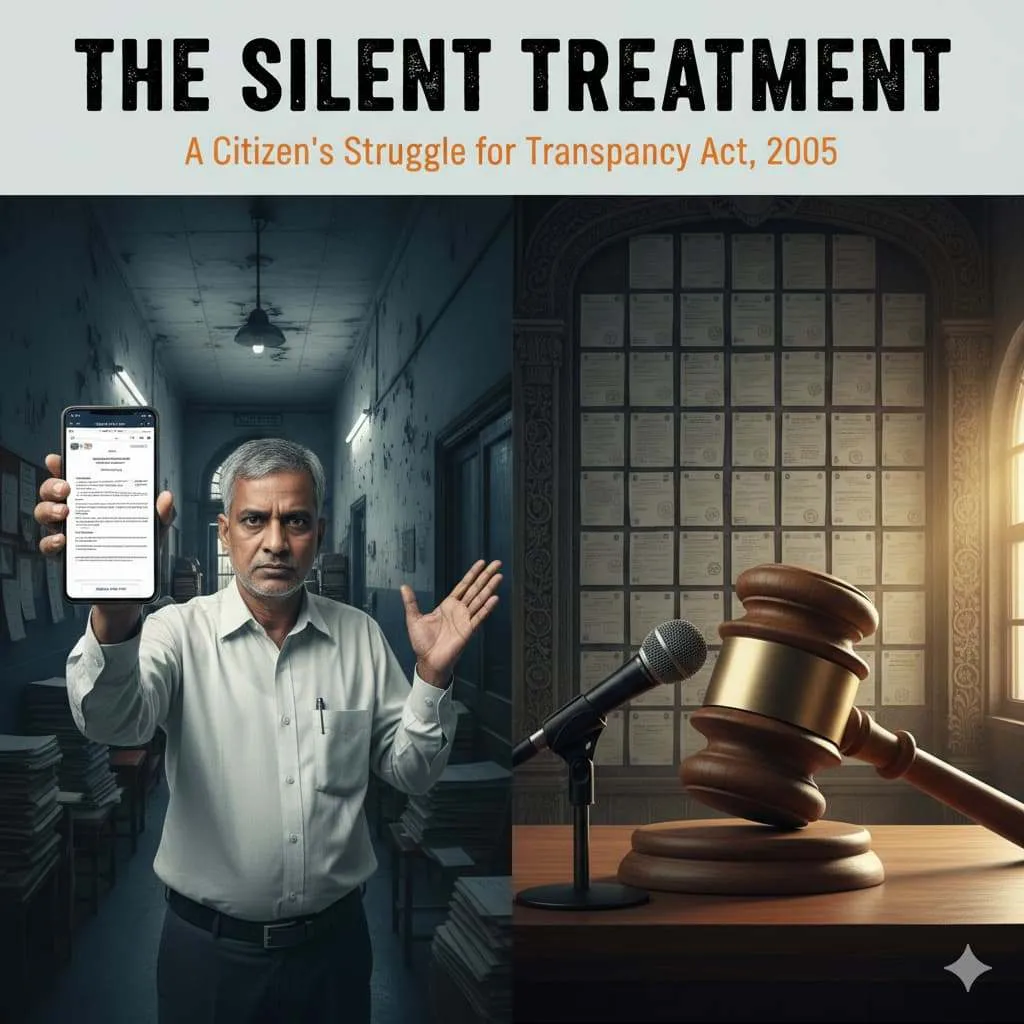
The Silent Treatment: A Citizen’s Struggle for Transparency Under RTI Act, 2005 🚫
A recent case filed before the Uttar Pradesh Information Commission shows a worrying pattern of silent treatment that has become increasingly prevalent in the interactions between citizens and government bodies.
There is alleged non-compliance and indifference by public authorities towards the Right to Information (RTI) Act, 2005, which is designed to promote transparency and accountability.
The second appeal was filed by Yogi M P Singh, a concerned citizen from Mirzapur, who felt compelled to take this step after experiencing a prolonged and frustrating lack of response from the authorities.
It chronicles his distressing experience that is indicative of receiving a silent treatment from both the Public Information Officer (PIO) and the First Appellate Authority (FAA), who seemingly disregarded their statutory obligations.
They reportedly neglected to act on his application and later appeal, which not only exacerbated his disappointment but also raised serious questions about accountability in the public sector.
This situation reflects a broader trend where citizens seeking information are often met with apathy, leading to a diminished trust in the institutions that are meant to serve them and a chilling effect on the exercise of rights granted under the RTI Act.
The Core Grievance about Silent Treatment: Silence from Public Authorities 🤐
Yogi M P Singh, the appellant, filed an RTI application on August 22, 2024, to the Chief Medical Officer (CMO), Mirzapur (Medical Health and Family Welfare Department), seeking vital information regarding the healthcare facilities and services available in the region, which he believed were crucial for the community’s well-being.
The RTI application specifically aimed to uncover details about resource allocation, availability of medical staff, and the overall state of public health initiatives. Unfortunately, the CMO did not provide any information within the stipulated time frame as mandated by the RTI Act, prompting Singh to feel a sense of urgency in following up on his request.
Consequently, after waiting patiently for over a month without a response, he decided to escalate the matter and filed a First Appeal on October 22, 2024, with the AD Mirzapur, hoping that this formal procedure would yield the necessary information and allow him to advocate effectively for improved health services in his community.
The central issue is the complete lack of response from both authorities:
- PIO’s Action: The original PIO marked the RTI application as “APPLICATION TRANSFERRED TO OTHER PIO as on 09/09/2024″. Still, they did not furnish any information. The appellant views this as a failure by the original PIO to “entertain” the inquiry.
- FAA’s Action: The First Appeal status shows “RTI APPEAL RECEIVED as on 22/10/2024,” with no later order or reply.
The appellant’s core argument is this: Both the PIO and the FAA have not acted. This inaction appears as a silent treatment and is a “mockery” of the RTI Act’s provisions. It reflects an “insolence” towards the law designed to make sure transparency. Incidentally, silent treatment to such requests under RTI undermines the Act’s purpose.
The Information Sought: Focus on Healthcare and Public Spending 🏥
The appellant sought five specific points of information, all about the Tuberculosis Isolation Centre and Hazrat Imam Yusuf Hospital in Mirzapur, shining a light on healthcare facilities and financial integrity:
these encompassed inquiries into the operational efficiencies of the facilities, the quality of medical services provided, the allocation of funding and resources, transparency in administrative processes, and the patient care protocols in place.
By addressing these aspects, the appellant aimed to underscore the importance of accountability in public health institutions, ensuring that both the quality of care delivered to patients and the ethical management of financial resources are at the forefront of discussions surrounding these critical healthcare establishments.
- Justification for Digital X-Ray Prescription: Reason for prescribing costly digital X-ray tests when facilities are allegedly unavailable at the T.B. Isolation Centre, forcing poor patients to use private providers, and its necessity before a sputum test.
- Fund Spent on Medicines (FY 2022-23): Details of expenditure on medicine purchases in the District T.B. Hospital and Divisional Hospital.
- Fund Spent on Medicines (FY 2023-24): Details of expenditure on medicine purchases in the District T.B. Hospital and Divisional Hospital.
- Basis for Private Prescription: A Government Order, circular, or memo exists. It permits doctors at hospitals to prescribe medicines from private medical stores.
- Reason for Service Gaps: Explanation for the lack of comprehensive test and medication facilities for tuberculosis patients. Tuberculosis is a contagious disease that the government aims to eradicate.
The Larger Plea: Combating Anarchy and Strengthening Democracy 📢
Beyond seeking his specific information, the second appeal serves as a powerful commentary on the state of public administration. The appellant asserts that the continuous deterioration of RTI provisions by authorities stems partly from their silent treatment of requests, which aims to keep opacity. They wish to hide “rampant corruption.”
He urges the Commission to take “harsh steps against the wrongdoer”. This is to prevent “anarchy, lawlessness, and chaos” and to reinforce democratic values. This case is not just about five points of information. It is a battle for the principle that public servants must be accountable under the law. Treating citizens’ inquiries with silence not only breaches trust but also democracy.
The Uttar Pradesh Information Commission now addresses this alleged breakdown in the RTI framework, acknowledging that such failures undermine the very essence of transparency and accountability in governance. It must uphold the fundamental right to know, which is not only a legal obligation but also a moral imperative in a democratic society.
The issue is further compounded by the fact that officials’ silent treatment of public queries is unacceptable and needs rectification, as it fosters an environment of secrecy and distrust that can have far-reaching consequences on public confidence in governmental institutions.
Moreover, it is essential for the Commission to implement stricter measures and ensure that all public servants are held accountable for their responsibilities, thereby promoting a culture of openness that empowers citizens to seek information without fear or hesitation.


Facing a similar challenge? Share the details in the box below, and our team of experts will do their best to help.