
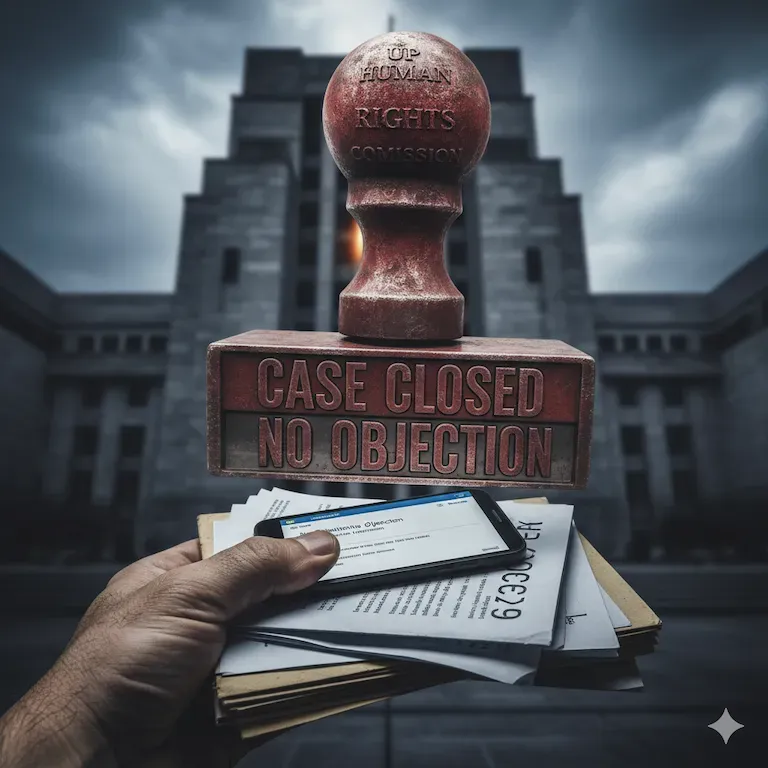
The blog post highlights that administrative negligence undermines the UPHRC’s effectiveness and that independent oversight is lacking. The role of a Human Rights Commission is crucial in addressing these shortcomings. This creates a ‘justice gap’ for victims of human rights violations.
Here are the specific pillars of that failure: (Human Rights Commission)
- Administrative Failure: The Commission frequently closes cases, falsely claiming that complainants did not respond. This occurs because the registry often fails to link complainants’ emails or letters to the physical file.
- Procedural Evasion: The Commission conducts “telephonic inquiries” using the very police departments accused of misconduct. As a result, it accepts perfunctory and biased reports as fact.
- Legal Misclassification: The system enables the police to shield criminals by labelling cognisable offences as “civil disputes.” This includes offences like fraud and breach of trust. Consequently, victims are denied the right to a criminal investigation (FIR).
- The Transparency Gap: Evidence from RTI requests shows that local police often provide false information. They mislead both the victim and the Commission about the status of investigations. They do this to prevent a fair hearing.
The Bottom Line
For a victim, winning at the UPHRC currently revolves around surviving the paperwork and administrative errors. The actual merits of their case matter less. To achieve justice, a complainant must prepare to file “fresh representations.” They must maintain a rigorous physical paper trail to counter the Human Rights Commission’s internal mismanagement.
Would you like me to summarize the specific legal sections? These might include BNS 316 or Sec 36 of the PHR Act. I can provide these summaries for your records.
Justice Delayed (Human Rights Commission): The Systematic Failure of Process at the UPHRC
The Uttar Pradesh Human Rights Commission (UPHRC) was established for a singular, noble purpose. It acts as the ultimate watchdog for the “common man” against the excesses of state power. For thousands of citizens in India’s most populous state, it is their court of last resort. This happens when police ignore the facts. It also occurs when administrative machinery grinds justice into the dust.
A closer look at recent case trajectories reveals a troubling pattern of systemic mismanagement. This issue is specifically visible in property disputes, criminal breach of trust, and the investigative process. This mismanagement is more than just a matter of slow paperwork. It represents a fundamental breakdown of the principles of natural justice. This breakdown leaves victims more vulnerable than before they filed their complaints.
1. The “Administrative Void”: When Objections Disappear
One of the most glaring issues in the UPHRC’s current operations is the disconnect between the Registry and the Bench. In many cases, a complainant strictly adheres to the Commission’s directives. They file substantive objections to police reports within the stipulated time frame.
Yet a persistent pattern emerges. Courts often dismiss cases in limine. They consign them to the records based on the mistaken belief that the complainant failed to file an objection. When the Human Rights Commission’s final order declares, “No objection has been filed… let the file be consigned,” the victim may nonetheless hold an email receipt or a postal tracking slip. Such possession indicates a collapse of the internal document-tracking system. This “administrative void” effectively silences the victim and permits biased police reports to prevail as the final word.
2. Reliance on the “Bogus” Inquiry: The Fox Guarding the Henhouse ( Human Rights Commission)
The core issue in many UPHRC complaints is police inaction or misconduct. Naturally, the Commission calls for an “Investigation Report” (Janch Akhya). However, mismanagement occurs when the Commission tasks the same department under scrutiny to conduct the inquiry.
The Problem of the “Telephonic Inquiry” (insert Human Rights Commission)
Recent cases have highlighted a disturbing trend where Circle Officers (COs) conduct “investigations” via a simple mobile phone call.
- The authorities never formally summon the complainant.
- Authorities never examine documentary evidence (such as court records or RTI findings).
- The police rely almost entirely on the statement of the “Opponent.”
When the UPHRC accepts these perfunctory, one-sided reports without questioning the methodology, it ceases to be an independent watchdog. It becomes a rubber stamp for local police departments.
3. The “Civil Dispute” Trap: Evasion of Criminal Jurisdiction (insert Human Rights Commission)
Mismanagement at the Commission is often visible. It allows police authorities to re-classify cognizable criminal offenses as “civil natured.
Under the Bharatiya Nyaya Sanhita (BNS), certain sections hold specific criminal weight. Section 316 addresses Criminal Breach of Trust, while section 318 deals with Cheating. These are especially significant in matters of ancestral property and birthrights. When a father or brother fraudulently sells ancestral property to deprive a legal heir, it is a criminal act. However, police reports frequently label these as simple “family land divisions” to avoid registering an FIR. In such cases, victims can also seek assistance from the Human Rights Commission to address these abuses.
By failing to challenge this arbitrary classification, the UPHRC allows the police to evade their mandatory duty under the law. This failure effectively denies the victim the right to a criminal remedy (UDHR Article 8).
4. RTI Suppression and the Transparency Crisis ( Human Rights Commission)
A key indicator of mismanagement is the lack of transparency in the inquiry process. Complainants often make parallel Right to Information (RTI) requests. Through these, they discover that the police have misled both the victim and the Commission.
For example, a Public Information Officer (PIO) might tell a victim that they are “still in progress” with an inquiry. This is done to prevent the victim from seeing the report. However, they have already finalized the report and sent it to the UPHRC. Victims often document this “malafide intent.” The Commission rarely meets this with the disciplinary recommendations it has the power to issue.
5. The Dismissal “In Limine” and Jurisdictional Confusion
A significant issue arises from the interplay between the National Human Rights Commission (NHRC) and the State Commission (UPHRC). Under Section 36(1) of the Protection of Human Rights Act, the NHRC is restricted. It cannot hear a case if the State Commission is already involved.
Mismanagement occurs when the State Commission closes a file due to an administrative error. This may include a “missing” objection, as mentioned above. As a result, the legal vacuum entraps the victim. The NHRC refuses to step in, while the state level considers the case “active.” However, it has mistakenly “concluded” the case. This creates a “Kafkaesque” loop. The victim remains trapped between two locked doors.
6. The Human Cost of Procedural Flaws (Human Rights Commission)
Behind every “consigned” file lies a human story. Someone loses their ancestral home. A daughter is denied her birthright. Baseless claims of “mental illness” defame a citizen. The toll weighs heavily.
When the UPHRC fails to uphold Natural Justice (Audi Alteram Partem)—the right to be heard—it doesn’t just fail a case. It erodes public trust in the state’s ability to protect its citizens.
7. The Path to Reform: Restoring the Watchdog
To fix these systemic issues, the UPHRC must move toward a more rigorous and modern administrative framework:
- Digital Integration: A system where emails and online objections are automatically tagged to case files, preventing “missing” documents.
- Independent Investigators: The Commission uses its own investigative wing. This approach avoids relying solely on the local police of the district where the crime occurred.
- Strict Adherence to Timelines: Ensuring strict evaluation of reports is essential. If a report is found to be “bogus” or “perfunctory,” immediate disciplinary action is recommended against the erring officer.
Conclusion (Human Rights Commission)
The UPHRC remains a vital institution. However, it is currently hampered by administrative friction. It also relies too much on the very authorities it is supposed to monitor. For the “common man” to truly feel protected, the Commission must make certain that its doors are open. Additionally, the voices entering those doors must actually be heard.
Justice is not merely about the final order; it is about the integrity of the process. The UPHRC needs to fix its document mismanagement. It also needs to strengthen its investigative rigor. If these changes do not occur, justice will remain a privilege for those with the patience. It will favor those who fight through the paperwork. It will not be a right for all.
Have you recently filed a “Fresh Representation” with the UPHRC? Ensure you have your new Diary Number and keep a physical paper trail. In a system prone to administrative oversight, your best defense is a meticulous record.
We are providing essential information to aid you in finalizing your follow-up. This includes structured contact and identification data for the authorities involved in your case. You will need these details for your Speed Post labels and for tracking your new application.
1. Primary Judicial Authority: UPHRC
This is where your Fresh Representation (Diary No: 522/IN/2026) is currently pending.
| Authority | Details |
| Address | Uttar Pradesh Human Rights Commission, Manav Adhikar Bhawan, TC-34, V-1, Vibhuti Khand, Gomti Nagar, Lucknow – 226010 |
uphrc@nic.in (Use this for all correspondence) | |
| Secondary Email | uphrclko@yahoo.co.in (As seen on official letterheads) |
| Phone/Fax | 0522-2728108 / Fax: 0522-2728108 |
| Tracking Link | HRCNet Portal – Case Status |
2. Local Executive Authorities: Mirzapur Police
These are the respondents you are accusing of administrative bias and “bogus” reporting.
| Authority | Details |
| SP Mirzapur | Superintendent of Police Office, Mirzapur, Uttar Pradesh – 231001 |
| ASP (Nodal Officer) | Office of the Additional Superintendent of Police (Nodal Officer HRC), Mirzapur |
| Police Emails | ssp-mzp-up@nic.in, aspopmzp@gmail.com, spcityofficemzp@gmail.com |
| Police Phone (CUG) | +91-9454401104 (Additional SP City/Nodal Officer) |
3. National Oversight: NHRC (New Delhi)
Note: They closed your case under Sec 36(1). Keep these for your records if you ever need to file a “Transfer Petition” or “Review” later.
| Authority | Details |
| Address | NHRC, Manav Adhikar Bhawan, Block-C, GPO Complex, INA, New Delhi – 110023 |
cr.nhrc@nic.in, nhrc.india@nic.in | |
| Phone | 011-24663287 (Assistant Registrar – Law) |
Key Reference Numbers for your Records
Keep this table handy for all future letters:
- New UPHRC Diary No:
522/IN/2026(Current Case) - Old UPHRC Case No:
19235/24/55/2025(Reference for Restoration) - NHRC Case No:
188/24/55/2026(Dismissed/Closed) - RTI Second Appeal No:
A-20251202121(Proof of Bias)
Would you like me to create a “Tracking Log” table? You can record the dates you send letters in it. Additionally, you can log the Speed Post numbers for each of these authorities.


Facing a similar challenge? Share the details in the box below, and our team of experts will do their best to help.