
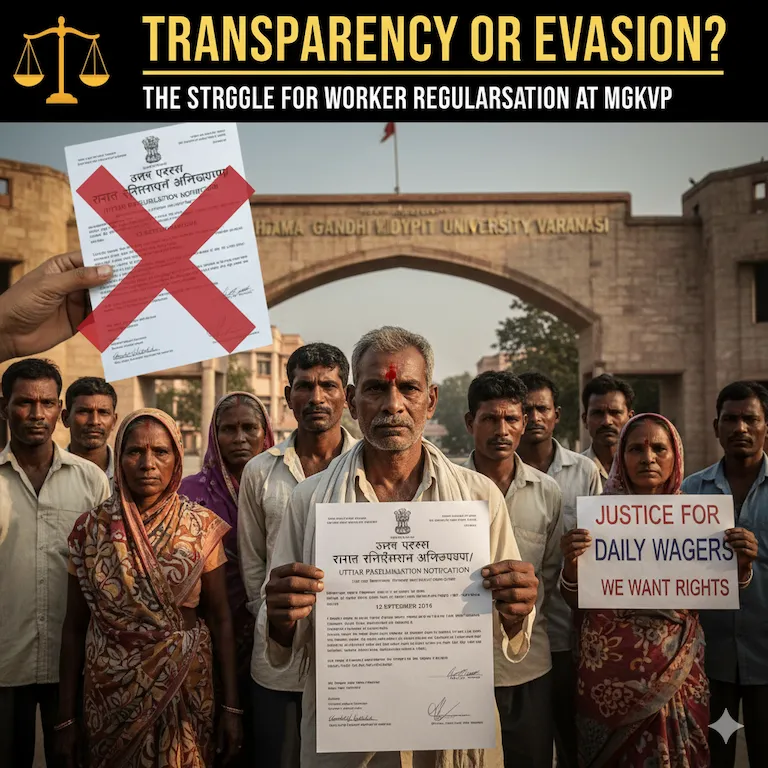
Here are the key takeaways from the analysis of the regularisation issue at Mahatma Gandhi Kashi Vidyapith (MGKVP):
1. The Legal Mandate (Regularisation 2016 Rules)
The Uttar Pradesh Government issued a notification on September 12, 2016. The notification aimed to regularize Group C and Group D workers. These workers include Daily Wage, Work Charge, and Contractual employees who were engaged on or before March 31, 2011. This rule supersedes previous orders and applies to departments outside the UP Public Service Commission’s purview.
2. Lack of Administrative Transparency
Despite the 2016 mandate, MGKVP has not provided specific data regarding its implementation. In RTI appeal MGKVV/A/2025/60025, the university used “evasive” justifications to withhold information, such as:
- Claiming the data is already on the website (without providing direct links).
- Refusing to explain the “reasons” for non-action.
- Citing “disproportionate diversion of resources” as a reason to avoid compiling lists.
3. The Rights of the Worker to be regularised
The blog highlights that “The Right to Reason” is an essential part of a sound administrative system. Workers have a right to know why the university has not regularized them despite meeting the state-mandated criteria.
4. Human and Social Impact
Unemployment and job insecurity are serious public interest issues. The delay in regularisation affects the livelihoods of hundreds of families in Varanasi. It turns a legal entitlement into a long-standing bureaucratic struggle.
5. Necessary Future Actions
To resolve the bottleneck, the post suggests:
- Proactive Disclosure: MGKVP should publish clear lists of regularized vs. eligible staff.
- State Intervention: The State Information Commission should investigate whether the university is using procedural excuses to mask administrative delays.
Transparency or Evasion? The Struggle for Worker Regularisation at MGKVP Varanasi
The quest for job security for daily wage workers in Uttar Pradesh still faces bureaucratic hurdles. A recent Right to Information (RTI) request against Mahatma Gandhi Kashi Vidyapith (MGKVP), Varanasi, highlights these difficulties. Citizens struggle to find clarity on the state’s 2016 regularisation policy.
The Core Mandate: The 2016 Regularisation Rules
On September 12, 2016, the Uttar Pradesh Government issued a landmark notification under Article 309 of the Constitution. These rules created a pathway for:
- Daily Wage workers
- Work Charge employees
- Contractual staff
The policy specifically targets Group C and Group D posts outside the UP Public Service Commission’s purview. For thousands of workers, this mandate offered hope for permanent employment and social security.
The Information Bottleneck at MGKVP
MGKVP’s response to RTI queries regarding these workers has drawn widespread criticism. Many observers label the university’s tactics as “evasive.” The university recently disposed of an appeal (Registration No: MGKVV/A/2025/60025) with a generalized reply, citing:
- Standard Redirection: The university claims its website already hosts all information.
- The “Why” Exception: The authority argues that RTI Rules 2015 exempt them from explaining the “justification” for their actions.
- Resource Diversion: The university claims that compiling this data would disproportionately divert public resources.
Critical Points of Contention
The refusal to provide point-wise data raises several concerns regarding administrative accountability:
- Lack of Specificity: The university points to its website, yet the public cannot find specific lists of regularised personnel there. Official communications also remain inaccessible.
- The Silence on “Right to Reason”: The university’s refusal to explain non-regularisation challenges the principles of a sound administrative system. Authorities must remain transparent about their decisions.
- Human Cost of Unemployment: Unemployment remains a critical issue. The status of daily wage staff represents the livelihoods of hundreds of families. These families still wait for the university to fulfill the 2016 mandate.
The Path Forward: Accountability and Action
The First Appellate Authority (Vice Chancellor Prof. Anand K. Tyagi) has procedurally closed the appeal, but the conflict remains. A public institution must practice “transparency and accountability” through:
- Proactive Disclosure: The university must publish the exact number of eligible versus regularised workers.
- Clear Communication: Officials should distinguish between regularised staff and those facing legal hurdles.
- Higher Oversight: The State Information Commission must intervene. They should determine if the “diversion of resources” excuse merely masks administrative delay.
Eligibility Criteria for Regularisation
Under the 2016 Notification, a person must meet the following specific requirements to qualify for a permanent post:
- Cut-off Date: You must have begun work on daily wages on or before March 31, 2011. This includes work charge or contract basis.
- Continuous Service: You must still be working in that position on the date the rules commenced (September 12, 2016).
- Qualifications: You must possess the required educational qualifications for the post. These qualifications must be as prescribed by the relevant service rules. This must be done at the time of your initial engagement.
- Age Limits: You must meet the age requirements for the post. This includes both minimum and maximum limits at the time of your initial engagement.
The Selection Process for Regularisation
The rules mandate a formal procedure for transitioning workers to permanent status:
- The Selection Committee: Each department or public authority must constitute a Selection Committee to verify candidate eligibility.
- Seniority Basis: The committee prepares a list of eligible persons based on their length of service (seniority).
- Character Verification: The appointing authority must verify your character and antecedents before issuing a formal appointment letter.
- Reservation Policy: The committee must follow the prevailing reservation rules (SC/ST/OBC and other categories) during the selection process.
Important Limitations for Regularisation
- Availability of Vacancies: Regularisation occurs against existing permanent vacancies. If no vacancy exists, the authority may create “supernumerary” posts (temporary permanent posts) as per government orders.
- One-Time Measure: The 2016 rules generally act as a “one-time” regularisation opportunity. This is for those who missed previous windows, like the 2001 or 1998 rules.
- Pay and Benefits: Once regularised, workers receive the pay scale associated with the post. They become eligible for standard government benefits from the date of their new appointment.
Key Takeaways
- The 2016 rules aimed to regularise Group C and Group D workers, yet MGKVP has not transparently implemented these regulations.
- MGKVP has evaded providing specific information about regularisation, claiming data is accessible online without direct links.
- Workers possess a right to know the reasons for their non-regularisation, which undermines administrative accountability.
- Unemployment remains a pressing issue due to delays, affecting the livelihoods of many families in Varanasi.
- To improve transparency, MGKVP should publish lists of regularised versus eligible staff, and the State Information Commission must ensure accountability.
We have structured contact information for the public authorities in your request. This is based on your case records and official data for 2026. Here are also the tracking links involved.
1. Case Identifiers
- Type: First Appeal
- Registration Number: MGKVV/A/2025/60025
- Applicant: Yogi M P Singh
- Filing Date: 08/07/2025
- Status: Appeal Disposed (as of 11/07/2025)
2. Contact Details of Concerned Authorities
If you plan to file a Second Appeal with the State Information Commission due to the “cryptic” or “evasive” nature of the previous disposal, you will need the following details:
| Role | Name | Designation | Contact Details |
| First Appellate Authority (FAA) | Prof. Anand K. Tyagi | Vice Chancellor | Email: vc@mgkvp.ac.in Mob: 9839501925 |
| Nodal Officer (RTI Cell) | Sri Rajesh Rai | Registrar (Officiating) | Email: registramgkvp@gmail.com Mob: 9839501925 |
| Public Information Officer (PIO) | Dr. Sunita Pandey | Registrar | Email: registrar.mgkvp@gmail.com Ph: 0542-2222689 |
3. Essential Web Links in current matter of Regularisation
Use these links to track your current status or initiate the next legal step:
- Official University Website:www.mgkvp.ac.in
- Note: Check the “RTI” or “Circulars” section for the website-based information they claimed exists.
- UP RTI Online Portal:rtionline.up.gov.in
- Use this to file a Second Appeal if the university continues to deny point-wise information.
- UP State Information Commission (SIC):upsic.gov.in
- Address: 7/7A, RTI Bhawan, Vibhuti Khand, Gomti Nagar, Lucknow, UP – 226010.
4. Direct Support Emails for Regularisation enquiry in MGKVP
For technical issues or specific department follow-ups:
- General Information: info@mgkvp.ac.in
- RTI Cell Specific: nodalrticellmgkvp@gmail.com
- State Information Commission Help: webmaster.upic@gmail.com


Facing a similar challenge? Share the details in the box below, and our team of experts will do their best to help.