
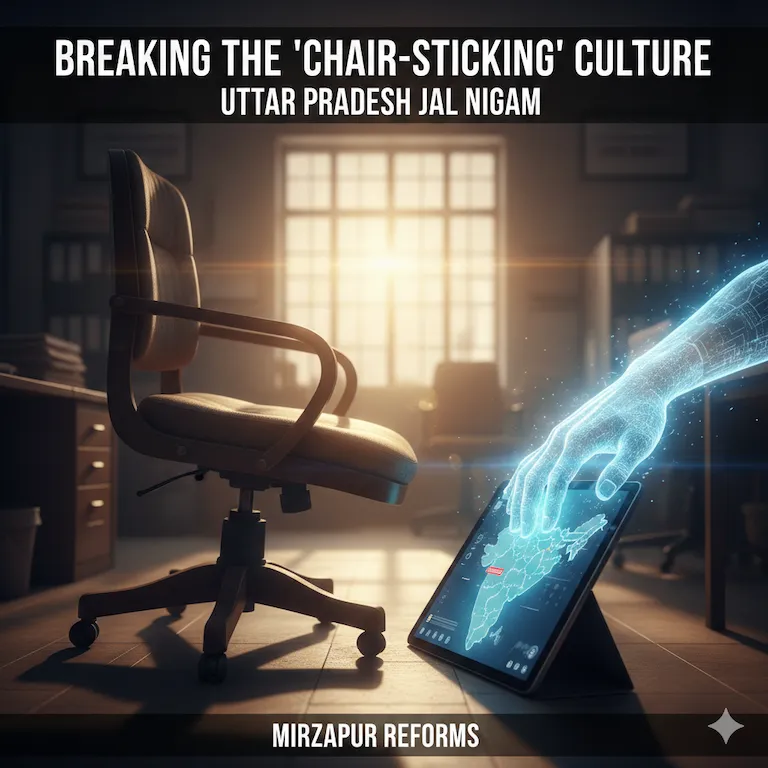
The blog post outlines a battle for transparency within the U.P. Jal Nigam, highlighting how bureaucratic delays undermine state-level policies. This discussion also addresses the urgent need for Breaking “Chair-Sticking” Culture in public institutions. Here are the key takeaways:
1. Systematic Policy Violation (Breaking “Chair-Sticking” Culture)
The Uttar Pradesh Annual Transfer Policy 2024-25 mandates that officers in Groups A and B relocate. This relocation occurs after 3 years in a district. This ensures fresh perspectives and fair oversight. However, several engineers in Mirzapur have overstayed this tenure, creating “local fiefdoms” that resist oversight.
2. Failure of RTI Compliance
The department is using “procedural sabotage” to hide information. The PIO did not transfer your RTI to the correct “Rural” wing within 5 days. This was required by Section 6(3) of the RTI Act. Instead, they waited months and then simply “disposed” of the request.
3. The “Deemed Refusal” Status
Because the PIO failed to provide a response within the 30-day statutory limit, the law considers this a “Deemed Refusal.” This permits you to bypass further delays. You can also demand disciplinary action against the PIO through the First Appellate Authority (Amit Kumar).
4. Direct Link to Corruption
The post argues that “chair-sticking” is not just a procedural error; it is a gateway to corruption. Prolonged tenures enable syndicates between contractors and engineers, leading to failed public projects like the Jal Jeevan Mission.
5. Call for Digital Accountability (Breaking “Chair-Sticking” Culture)
To fix this, the department must implement Section 4(1)(b) of the RTI Act—proactive disclosure. All joining dates should be public on the Manav Sampada portal. Tenure lengths should be public as well. This removes the need for individual citizens to fight for this basic data.
Breaking “Chair-Sticking” Culture: The Battle for Transparency in U.P. Jal Nigam Mirzapur
The administration of Uttar Pradesh, led by Chief Minister Yogi Adityanath, frequently promises “zero tolerance” toward corruption. Central to this mission is the New Transfer Policy 2024-25. This legislative tool aims to dismantle local fiefdoms where officials overstay their welcome. Such long tenures often foster deep-rooted corruption, and breaking the entrenched chair-sticking culture is crucial for real reform.
However, recent RTI inquiries in District Mirzapur reveal a troubling reality. A stark disconnect exists between Lucknow’s mandates and the actual operations of Uttar Pradesh Jal Nigam (Rural). Importantly, transparency is only possible if the system confronts the issue of chair-sticking and breaks this longstanding culture.
The “Policy vs. Practice” Paradox (Breaking “Chair-Sticking” Culture)
The core issue involves a simple, mandatory rule: rotation. According to the 2024-25 policy, Group A and B officers must transfer after 3 years in a district. Furthermore, they must move after 7 years in a division. This rule acts as a vital safeguard against “illegal gratification.” Clearly, confronting and breaking chair-sticking culture through this policy is essential for progress.
In Mirzapur, evidence suggests that several Junior Engineers (JEs) and Assistant Engineers (AEs) exceed the time limits in their posts. They remain far beyond these limits. These officials stay in one place to cultivate unauthorized influence. Consequently, this leads to substandard work in critical projects like the Jal Jeevan Mission. When officials do not fear a transfer, accountability simply vanishes, making breaking the chair-sticking culture an absolute necessity.
Administrative Sabotage: Weaponizing the RTI Process
When a citizen seeks truth through the RTI Act, the law provides a clear path. Yet, the case of Registration Number CDSJN/R/2024/60040 exposes a different story. It shows how the U.P. Jal Nigam uses procedural tactics to hide information and undermines efforts aimed at breaking chair-sticking culture.
1. The Jurisdiction Excuse
The applicant waited for over a month for a response. Eventually, the department claimed they had “no concern” with the matter. They redirected the applicant to the “Rural” wing. While this sounds like a valid distinction, the RTI Act specifically forbids such excuses to stall the process. Such redirecting is just another example of how chair-sticking culture persists and needs breaking.
2. Violation of Section 6(3)
Section 6(3) of the RTI Act creates a legal mandate. If a PIO receives an application meant for another department, they must transfer it within 5 days. Instead, the PIO simply “disposed” of the request. This act constitutes direct administrative sabotage. It deliberately exhausts the information seeker rather than helping them. Clearly, there is an urgent need for breaking chair-sticking culture to restore accountability.
The High Cost of Overstaying Officials
Why should we care if a Junior Engineer stays in Mirzapur for five years? The answer lies in the quality of public life. Only by breaking the chair-sticking culture can we safeguard public interests.
- Embezzlement Risks: Prolonged tenures allow for the creation of “contractor-engineer” syndicates. These groups often siphon funds through phantom repairs, demonstrating how not breaking chair-sticking culture can breed corruption.
- Apathetic Service: Reports from Mirzapur highlight broken hand pumps that remain unfixed for seven years. This neglect occurs because there’s no oversight on long-tenured staff. It demonstrates the consequences of failing to break chair-sticking culture.
- Policy Defiance: The department ignores the transfer policy. This action effectively challenges the authority of the state cabinet. It perpetuates the chair-sticking culture instead of breaking it.
Demanding Accountability: The Path Forward
The RTI appeal against FAA Amit Kumar (General Manager) seeks more than just dates and names. It demands the rule of law. The PIO’s “Deemed Refusal” requires strict disciplinary action under Section 20 of the RTI Act. To move forward, we must focus on breaking the chair-sticking culture that undermines transparency.
Key Demands for the Administration:
- Immediate Compliance: The U.P. Jal Nigam must proactively disclose joining dates for all Mirzapur staff. This will help break the chair-sticking culture.
- Audit of Tenures: The state must conduct a division-level audit to identify every officer exceeding the 3-year limit. Auditing is key to breaking culture of sticking to chairs.
- End the Buck-Passing: Authorities must penalise PIOs who fail to transfer applications. This will prove that breaking chair-sticking behaviours is central to the RTI Act’s spirit.
Conclusion
Transparency offers the only cure for systemic rot in public works. On paper, the “New Transfer Policy” is a powerful document. However, it remains a “paper tiger” as long as local officials can hide behind bureaucratic delays. Therefore, the Uttar Pradesh Information Commission must intervene immediately. We must ensure that public servants do not become permanent residents of their official chairs. Ultimately, breaking chair-sticking culture will determine the success of administrative transparency.
The battle in Mirzapur serves as a litmus test for the state’s commitment to reform. If the Jal Nigam hides these details successfully, accountability will not be achieved. It will remain a distant dream for the common man until chair-sticking culture is truly broken through collective effort.
To ensure your follow-up is precise, here are the official contact details for the key authorities and the digital platforms involved in your case.
🏛️ Public Authority Contact Details
| Authority | Name/Designation | Mobile/Phone | |
| U.P. Jal Nigam (Rural) HQ | MD, Dr. Raj Shekhar | 0522-4063542 | mdupjng@gmail.com |
| U.P. Jal Nigam (Rural) – Mirzapur | Executive Engineer (EE) | 9473942685 (Jaunpur/Regional) | pmunit38@gmail.com* |
| C&DS, U.P. Jal Nigam (Lucknow) | Pradeep Kr. Chaurasia (Nodal) | 9838973555 | gm5cdslko@gmail.com |
| First Appellate Authority | Amit Kumar (General Manager) | 7017574185 | gm6cdsupjn@gmail.com |
Note: The email
pmunit38@gmail.combelongs to Ramesh Chandra Maurya, who “disposed” of your request. Since he identified the Rural wing as the correct body, you should direct your fresh RTI to the Executive Engineer, U.P. Jal Nigam (Rural), Mirzapur.
🌐 Essential Web Links & Application IDs
- RTI Online Portal:rtionline.up.gov.in
- Use this to file your First Appeal and fresh RTI applications.
- Manav Sampada (eHRMS) Portal:ehrms.upsdc.gov.in
- This is where the service books and transfer details of all JEs and AEs are stored. You can request “Digital Service Book” printouts in your RTI.
- Jansunwai (IGRS) Portal:jansunwai.up.nic.in
- Use this for complaints regarding the violation of the Transfer Policy 2024-25.
🆔 Key Application IDs for Reference (Breaking “Chair-Sticking” Culture)
In all your future correspondence, always cite these specific numbers to ensure continuity:
- Original RTI ID:
CDSJN/R/2024/60040(Filed: 15/12/2024) - First Appeal ID:
CDSJN/A/2025/60002(Filed: 17/02/2025)
💡 Pro-Tip for your Next RTI (Breaking “Chair-Sticking” Culture)
When filing the new RTI to the Mirzapur Rural office, address it exactly as follows to prevent rejection:
To: The Public Information Officer, Office of the Executive Engineer, Uttar Pradesh Jal Nigam (Rural), Nakahara Road, Teliyaganj, Mirzapur, U.P. 231001.
Would you like me to draft a specific “Show Cause” letter to the Nodal Officer? It would ask why your application wasn’t transferred under Section 6(3).


Facing a similar challenge? Share the details in the box below, and our team of experts will do their best to help.